Ford Mustang Gear Ratio Chart by Year: 2026 Axle Ratios

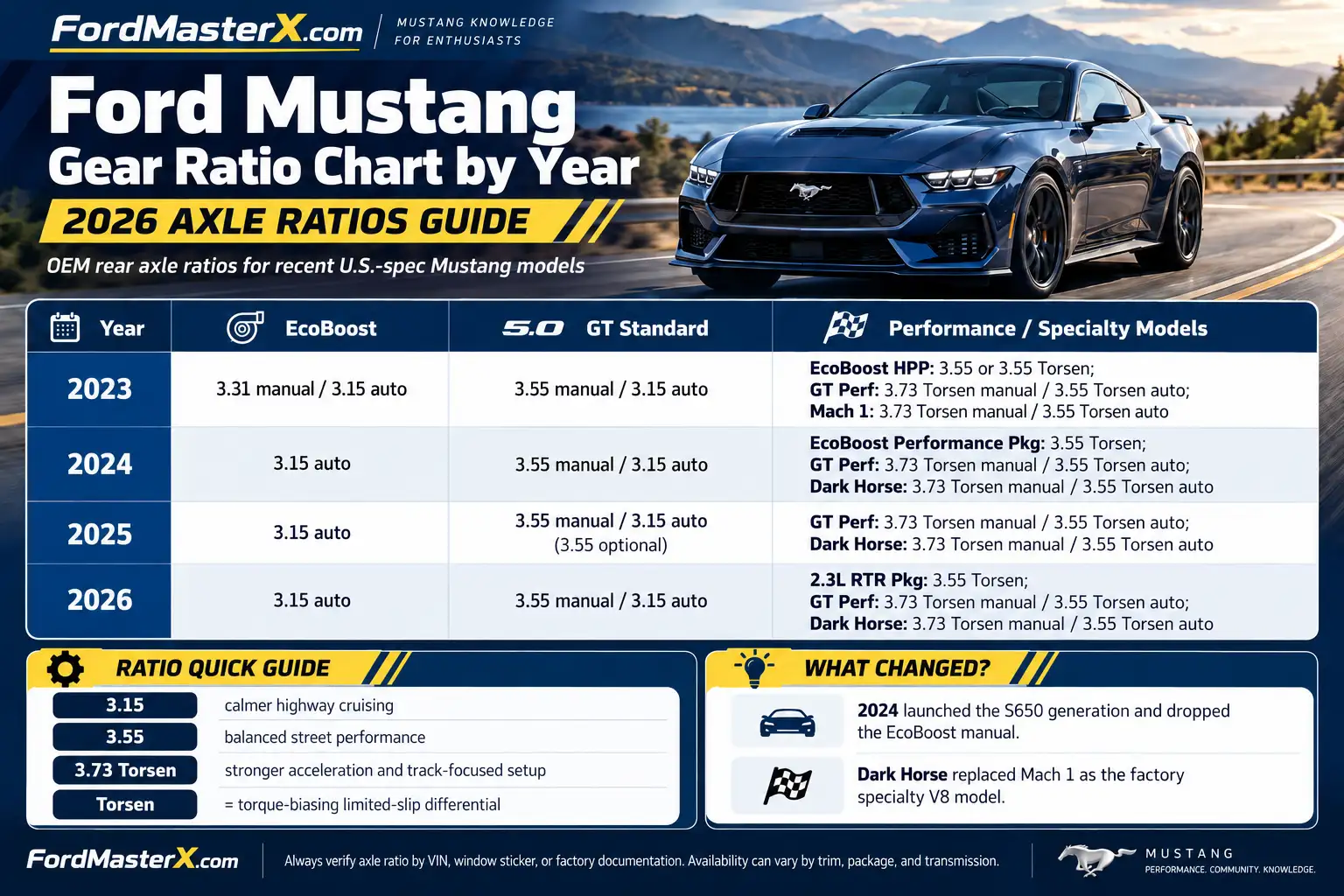
The Ford Mustang gear ratio chart depends on the model year, engine, transmission, and factory performance package. A 2026 Mustang EcoBoost normally has a 3.15:1 rear axle ratio, while a 2026 GT uses 3.55:1 with the manual transmission or 3.15:1 with the standard automatic configuration. Different factory packages can change those numbers.
The charts cover 1965 through 2026, axle codes, and modern transmission ratios. A modified Mustang may have different gearing from its original build.
FordMasterX • Factory-spec quick reference
2026 Ford Mustang Gear Ratios
Match the rear axle ratio to the engine, transmission and factory package. All ratios below are final-drive ratios, not transmission gear ratios.
- 3.15:1Standard automatic gearingEcoBoost automatic and GT automatic
- 3.55:1Manual GT or selected optionsAlso used with TORSEN in certain packages
- 3.73:1Selected manual performance modelsGT Performance Package and Dark Horse manual
Find Your 2026 Mustang Configuration
Standard, optional and package-specific ratios are shown separately.
| Model / package | Transmission | Factory status | Rear axle |
|---|---|---|---|
| EcoBoost | 10-speed auto | Standard | 3.15 |
| EcoBoost RTR | 10-speed auto | RTR package | 3.55 TORSEN |
| GT | 6-speed manual | Standard | 3.55 |
| GT | 10-speed auto | Standard | 3.15 |
| GT | 10-speed auto | Optional axle | 3.55 |
| GT Performance Package | 6-speed manual | Package | 3.73 TORSEN |
| GT Performance Package | 10-speed auto | Package | 3.55 TORSEN |
| Dark Horse | 10-speed auto | Standard trans. | 3.55 TORSEN |
| Dark Horse | 6-speed manual | Optional trans. | 3.73 TORSEN |
A 3.73 ratio provides more axle torque multiplication than 3.15 when other gearing is equal. The higher number also raises engine RPM at the same road speed when tire size and transmission gear are unchanged. TORSEN describes the differential type.
Source: Ford 2026 Mustang Order Guide, dated March 27, 2026, rear-axle ratio availability (page 36). Factory combinations only; verify vehicle-specific equipment and any subsequent modifications.
What Does a Mustang Rear Gear Ratio Mean



A 3.55:1 rear gear ratio means the differential’s pinion gear turns approximately 3.55 times for one revolution of the ring gear. Because the pinion connects to the driveshaft, the number describes the reduction between the driveshaft and the differential carrier.
A higher ratio, such as 3.73 instead of 3.15, increases axle torque multiplication and engine speed at a fixed road speed. Acceleration also depends on traction, shifting and engine output.
A rear axle ratio is different from an individual transmission ratio. Both contribute to overall gearing.
Ford Mustang Gear Ratio Chart From 1965 to 2026


These tables list documented factory options, not aftermarket upgrades. Multiple ratios in one row indicate different configurations, not one universal standard. Early models varied especially widely.
Historical entries were checked against CJ Pony Parts’ Mustang rear gear chart. Match year-specific build records to identify one car’s ratio.
Classic Mustangs From 1965 to 1973
| Model Year | Documented Factory Rear Ratios | Identification Notes |
|---|---|---|
| 1965 | 2.80, 3.00, 3.20, 3.25, 3.50, 3.80, 3.89, 4.11 | Multiple open and limited-slip versions |
| 1966 | 2.80, 2.83, 3.00, 3.20, 3.25, 3.50, 3.89 | Axle code and differential type determine the correct entry |
| 1967 | 2.80, 2.83, 3.00, 3.20, 3.25, 3.50 | Verify the engine and axle code |
| 1968 | 2.75, 2.79, 3.00, 3.10, 3.20, 3.25, 3.50, 3.83 | More than one ratio may share a broad engine category |
| 1969 | 2.33, 2.50, 2.75, 3.00, 3.25, 3.50, 3.80, 4.30 | Selected options; 2.33 was associated with Mustang E |
| 1970 | 2.33, 2.75, 3.00, 3.25, 3.50, 3.80, 4.30 | Selected options; not a complete axle-code listing |
| 1971-1972 | 2.75, 2.79, 3.00, 3.07, 3.25, 3.50, 3.80, 3.91 | Options varied; 4.11 is also documented for 1971 |
| 1973 | 2.75, 2.79, 3.00, 3.18, 3.25, 3.50, 3.55, 3.80 | Selected examples; special configurations also existed |
In 1965, axle code 1 identified 3.00 gearing; A identified 3.00 with limited slip.
For classic axle-family details, see the Ford 9-inch gear ratio specifications.
Mustang II Models From 1974 to 1978
| Model Years | Documented Factory Rear Ratios | Notes |
|---|---|---|
| 1974-1978 | 3.00, 3.40, 3.55 | Documented axle-code options across the Mustang II period |
| 1977 | 3.18 | Listed as a 1977-specific option |
Mustang II had distinct axle applications. These are period options, not standard ratios for every drivetrain.
Fox Body Mustangs From 1979 to 1993
| Model Years | Documented Factory Rear Ratios | Notes |
|---|---|---|
| 1979-1982 | 2.26, 2.47, 2.73, 3.08, 3.45 | Ratios varied by model year and powertrain; 2.26 appeared on some early Fox cars |
| 1983-1985 | 2.73, 3.08, 3.27, 3.45, 3.73 | 3.73 appears in historical axle-code listings for 1984-1985 |
| 1986-1993 | 2.73, 3.08, 3.27, 3.45, 3.55 | 3.45 appears in period references through 1990; verify exact year |
Fox Body owners should identify the axle assembly before buying parts. A previous owner may have swapped it.
Late Model Restoration’s Mustang axle reference details Fox Body options. Our Ford 8.8 gear ratio chart covers that axle family across Ford models.
SN95 Mustangs From 1994 to 2004
| Model Years | Documented Factory Rear Ratios | Notes |
|---|---|---|
| 1994-1998 | 2.73, 3.08, 3.27 | Configurations differ by model and differential type |
| 1999-2002 | 3.27 | Widely documented for regular production applications; verify special models individually |
| 2003-2004 | 3.27, 3.55 | 3.55 associated with Mach 1 and supercharged SVT Cobra applications |
Do not apply an SVT Cobra axle specification to every same-year V6 or GT.
S197 Mustangs From 2005 to 2014
| Model Years and Configuration | Factory Rear Ratio | Notes |
|---|---|---|
| 2005-2010 V6 | 3.31 | Documented common factory axle ratio |
| 2006-2009 GT manual | 3.55 | Identified in period axle-code tables |
| 2006-2010 GT automatic | 3.31 | Identified in period axle-code tables |
| 2009-2010 GT with applicable option | 3.73 | Optional ratio; not every GT received it |
| 2011-2014 GT automatic | 3.15 | Documented factory configuration |
| 2011-2014 GT manual | 3.31 | Standard ratio in axle-code references |
| 2011-2014 GT optional gearing | 3.55 or 3.73 | Confirm option and package before identifying the axle |
| 2011-2014 V6 | 2.72 or 3.31 | Listed V6 configurations; varies by option |
S197 manual and automatic GT models can have different factory axle ratios.
S550 Mustangs From 2015 to 2023
| Model Years and Configuration | Documented Rear Ratios | Notes |
|---|---|---|
| 2015-2017 V6 | 3.15 | Documented factory axle-code entry |
| 2015-2017 EcoBoost | 3.31; 3.55 with applicable equipment | Check equipment and axle code |
| 2015-2017 GT | 3.15, 3.31, 3.55 or 3.73 | Automatic, manual and Performance Package specifications vary |
| 2018-2023 EcoBoost | 3.15 or 3.31; package-dependent 3.55 on applicable cars | Do not assign one ratio to the whole generation |
| 2018-2023 GT | 3.15, 3.55 or 3.73 | Transmission and Performance Package affect selection |
| GT350 and other specialty models | Model-specific | Use that model’s original Ford specification; do not use the regular GT row |
TORSEN identifies a differential design, not a separate ratio. Two S550s can both have 3.55 gearing but different differential types.
S650 Mustangs From 2024 to 2026
| Model Year | Model and Transmission | Factory Rear Ratio | Notes |
|---|---|---|---|
| 2024-2025 | EcoBoost automatic | 3.15 | Standard configuration |
| 2024-2025 | EcoBoost with Performance Package | 3.55 TORSEN | Factory package configuration |
| 2024-2025 | GT manual | 3.55 | Standard GT manual configuration |
| 2024-2025 | GT automatic | 3.15; optional 3.55 | Check the factory order and package |
| 2024-2025 | GT Performance Package manual | 3.73 TORSEN | Package-specific |
| 2024-2025 | GT Performance Package automatic | 3.55 TORSEN | Package-specific |
| 2024-2025 | Dark Horse manual | 3.73 TORSEN | Manual configuration |
| 2024-2025 | Dark Horse automatic | 3.55 TORSEN | Automatic configuration |
| 2026 | EcoBoost automatic | 3.15 | Standard |
| 2026 | EcoBoost with RTR Package | 3.55 TORSEN | RTR package configuration |
| 2026 | GT manual | 3.55 | Standard |
| 2026 | GT automatic | 3.15 or optional 3.55 | Non-Performance Package configurations |
| 2026 | GT Performance Package manual | 3.73 TORSEN | Performance Package |
| 2026 | GT Performance Package automatic | 3.55 TORSEN | Performance Package |
| 2026 | Dark Horse manual | 3.73 TORSEN | Manual is an available option |
| 2026 | Dark Horse automatic | 3.55 TORSEN | Automatic is standard for 2026 |
These regular-production tables exclude Mach-E, Mustang GTD and specialty racing derivatives.
Which 2024 to 2026 Mustang Axle Ratios Are Factory


In 2026, a GT manual has 3.55 gearing. The GT automatic starts at 3.15 with optional 3.55. The Performance Package brings 3.73 TORSEN to the manual and 3.55 TORSEN to the automatic.
The 2026 EcoBoost starts with 3.15; the RTR Package brings 3.55 TORSEN.
The 2026 Dark Horse has 3.55 TORSEN with its standard automatic, or 3.73 TORSEN with the optional manual.
Ford’s 2026 Mustang Order Guide confirms standard, optional and package-specific gearing. Check the window sticker before ordering parts.
How to Decode Mustang Axle Codes by Year
Match a factory axle code to the exact model year. Code meanings changed between generations.
These examples show the year-specific differences:
| Mustang Year or Generation | Axle Code | Factory Ratio | Differential Note |
|---|---|---|---|
| 1965 | 1 | 3.00 | Non-limited-slip listing |
| 1965 | A | 3.00 | Limited slip |
| 1979-1993 Fox Body | Y | 3.08 | Open |
| 1979-1993 Fox Body | Z | 3.08 | Traction-Lok |
| 1983-1993 Fox Body | E | 3.27 | Traction-Lok |
| 2003-2004 Mach 1 or SVT Cobra | 2 | 3.55 | Limited slip |
| 2011-2014 GT manual | GG | 3.31 | Factory code reference |
| 2011-2014 GT automatic | YY | 3.15 | Factory code reference |
| 2015-2023 S550 | BB | 3.73 | Selected TORSEN configurations |
| 2015-2023 S550 | DD | 3.55 | Selected factory configurations |
This is not a universal decoder. For 2024-2026 Mustangs, verify the original build record instead of guessing a door-label code.
To identify your original configuration:
- Find the factory label or records. Check the driver’s door area for a certification label, or locate the original window sticker and build information. On older Mustangs, the data plate or axle tag may be more useful.
- Record the exact model year. Note the engine, transmission, trim and any Performance Package or special edition.
- Match the code to that year’s reference. Use the same year’s axle-code data, not a generic Ford truck chart.
- Check for later work. If the differential or rear axle has been changed, a factory code may no longer describe the parts in the car.
For a broader explanation of door labels and differential markings, see our Ford rear axle identification guide.
Mustang Manual vs Automatic Transmission Gear Ratios
Transmission ratios and rear axle ratios are different. Overall reduction multiplies the two, so equal axle ratios do not guarantee identical gearing between transmissions.
Ford’s published 2025 Mustang specifications provide these examples:
| 2025 Transmission | First Gear | Highest Gear | Typical Model |
|---|---|---|---|
| Getrag MT-82 six-speed manual | 3.237:1 | 0.622:1 in sixth | Mustang GT |
| Tremec TR-3160 six-speed manual | 3.25:1 | 0.63:1 in sixth | Dark Horse |
| 10-speed automatic | 4.696:1 | 0.636:1 in tenth | EcoBoost and GT |
An MT-82 in first with 3.55 rear gearing yields 11.49:1 overall reduction: 3.237 × 3.55 = 11.49.
See Ford’s 2025 Mustang technical specifications for the complete modern gear-by-gear figures. If you’re unsure which transmission your car has, use our Ford transmission identification chart to identify the unit before comparing ratios.
Mustang 3.15 vs 3.55 vs 3.73 Gear Ratios
A 3.73 axle multiplies torque more than 3.15, but raises engine RPM at a fixed road speed. Neither number predicts actual acceleration or fuel economy alone.
| Rear Axle Ratio | Relative Torque Multiplication | Typical Trade-Off |
|---|---|---|
| 3.15 | Baseline | Lower engine RPM at a fixed road speed |
| 3.55 | About 12.7% above 3.15 | Middle ground between multiplication and cruising RPM |
| 3.73 | About 18.4% above 3.15 | Greater multiplication and higher cruising RPM |
Comparisons assume the same transmission ratio and tire diameter. The 18.4% figure comes from 3.73 ÷ 3.15.
At 60 mph in a 0.636:1 overdrive with 27-inch tires, calculated RPM is roughly 1,496 with 3.15, 1,686 with 3.55, or 1,771 with 3.73. These theoretical figures exclude tire-size variation and converter slip.
How to Verify a Mustang Gear Ratio After Modifications
The original code shows how the Mustang was built, not necessarily its current gears. Owners can replace ring-and-pinion sets or swap axles.
Compare build records with repair invoices and axle markings. An axle tag may be outdated after internal changes.
If the car’s history is uncertain, have a drivetrain shop inspect the installed gears before buying parts.
How to Find Your Correct Mustang Gear Ratio
Use the Ford Mustang gear ratio chart as the first step in identifying original factory gearing. Begin with the model year and engine, then check the manual or automatic transmission and any performance-related options. A ratio that fits one GT, EcoBoost, Cobra, or Dark Horse configuration may not fit another from the same generation.
For a classic Mustang, original axle codes and period-correct documents can narrow the options. For a recent Mustang, use its factory equipment record alongside the relevant Ford specification sheet. If the car has been modified, confirm the hardware rather than relying entirely on what Ford originally installed.
The safest decision is to verify the exact drivetrain configuration before purchasing replacement gears or comparing expected engine RPM.
Ford Mustang Gear Ratio Questions by Model Year
What Rear Gear Ratio Does a 2026 Mustang GT Have
A 2026 Mustang GT has 3.55:1 with the standard six-speed manual or 3.15:1 with the standard 10-speed automatic. The automatic also offers a 3.55 option. With the GT Performance Package, the manual uses a 3.73 TORSEN and the automatic uses a 3.55 TORSEN.
Does a 2026 Mustang EcoBoost Have 3.15 or 3.55 Gears
The regular 2026 Mustang EcoBoost uses 3.15:1 limited-slip rear gearing. An EcoBoost with the 2026 RTR Package uses a 3.55:1 TORSEN. Check the window sticker to confirm whether the car has the package instead of identifying it by its exterior appearance.
Are Mustang Axle Codes the Same for Every Model Year
No. Mustang axle-code meanings vary by model year and generation. A code that represents a particular ratio on a classic Mustang cannot safely be applied to a Fox Body or S550 car without a year-specific lookup. If the rear axle has been replaced, even a correct original code may no longer reflect the installed gearing.
Do Manual and Automatic Mustangs Have Different Gear Ratios
Yes, many Mustang configurations use different final-drive ratios for manual and automatic transmissions. Their internal transmission ratios are also different. For example, the 2025 GT’s MT-82 manual starts with a 3.237 first gear, while its available 10-speed automatic starts with 4.696. Always distinguish those transmission figures from rear axle gearing.
Can a Factory Mustang Gear Ratio Chart Identify Aftermarket Gears
No. Factory charts show original gearing, not swapped axles or aftermarket sets. Verify the installed gears before ordering parts.