
Ford Fuel Gauge Ohms Chart 2026: Complete Sender Guide

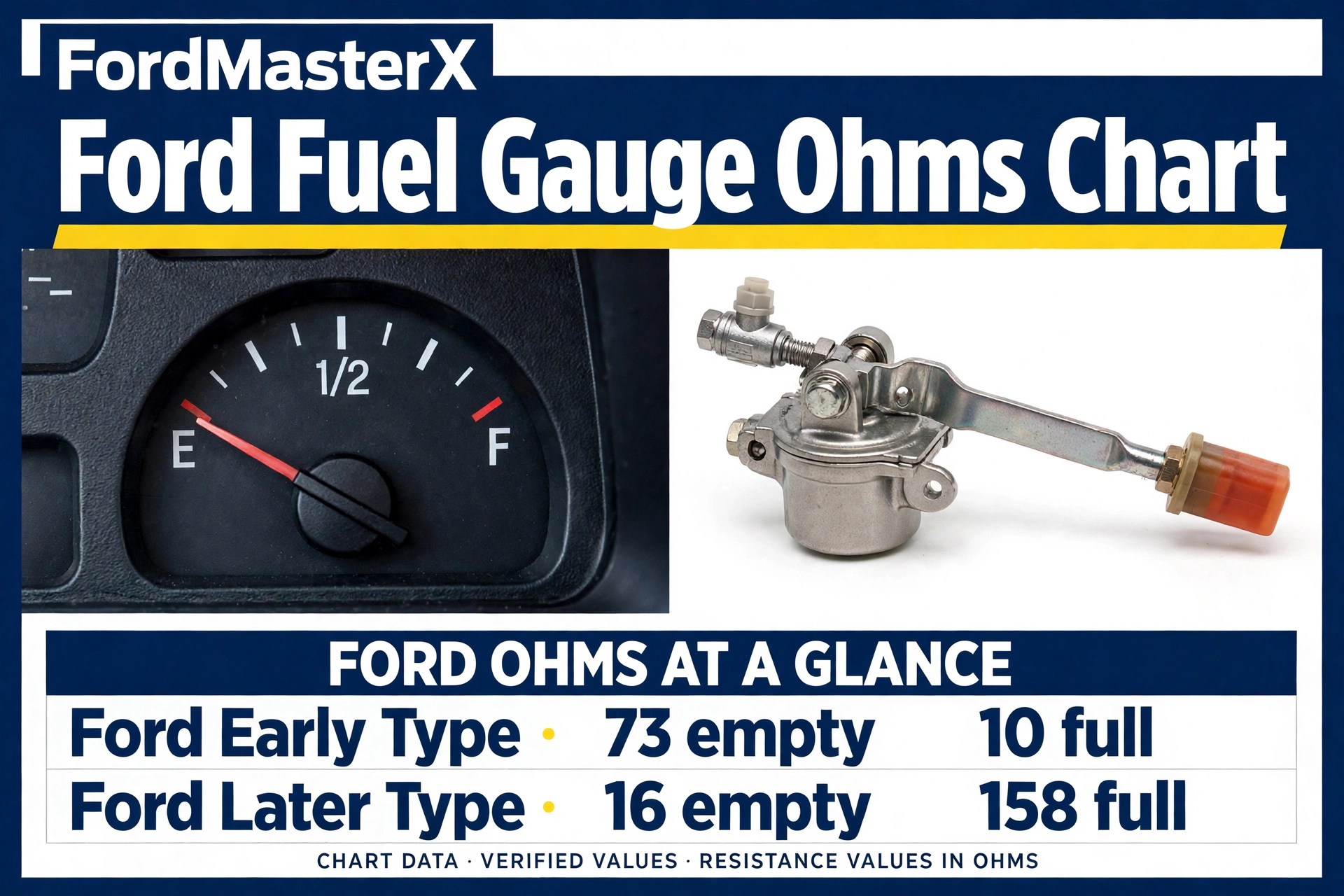
The ford fuel gauge ohms chart has two main answers. Older Fords use 73 ohms empty and 10 ohms full. Newer Fords use 16 ohms empty and 158 ohms full.
The change year is not settled. Some sources date the change to 1987. Other sources date it to 1989.
The fix is simple. Measure your own sender and trust the meter over the year.
FordMasterX built this guide for owners who test a sender with a multimeter. It gives the full chart by model year. It also shows how to test, what readings mean, and how to match an aftermarket gauge.


The Short Answer in 5 Facts



Five facts answer most questions about this chart. The table holds them. The infographic below gives the same facts to save or share.
| Fact | What it means for you |
|---|---|
| Two Ford ranges | 73-10 for older Fords, 16-158 for newer Fords |
| First number is empty | In every range, the first number is the empty reading |
| Cutover year is disputed | Sources name 1987 or 1989, so measure your sender |
| Mustang is different | 1987 to 1993 Mustangs use 22 empty and 145 full |
| Test with power off | Resistance tests need the ignition off and the plug unplugged |
Ford Fuel Gauge Ohms at a Glance
Sender resistance ranges by model group, from verified sources.
| Ford group | Empty ohms | Full ohms |
|---|---|---|
| Ford to about 1986 | 73 | 10 |
| Ford about 1987 and up | 16 | 158 |
| 1987 to 1993 Mustang | 22 | 145 |
| 1986 and older Mustang | 73 | 8 to 12 |
Direct answer: Older Fords read 73 ohms empty and 10 ohms full. Newer Fords read 16 ohms empty and 158 ohms full. Measure your sender when the year falls in 1987 to 1989.
Sources: Tanks Inc universal sender guide; Hemmings fuel sending units; The Ranger Station sender ohms thread; StangNet Mustang troubleshooting thread. Cutover year is disputed, so measure 1987 to 1989 trucks. Mid-level values are approximate, not factory specs. Mustang values come from StangNet owner reports.
The chart above is the short version. The rest of this guide gives the full chart by model year. It also gives the test steps and the gauge matching rules.
Ford Fuel Gauge Ohms Chart by Model Year
Ford used two sender ranges across the years. The older range runs in the opposite direction from the newer range. That flip is why a wrong sender reads backwards.
In the 73-10 range, resistance falls as fuel rises. A full tank reads about 10 ohms. An empty tank reads 73 ohms.
In the 16-158 range, resistance rises as fuel rises. A full tank reads 158 ohms. An empty tank reads 16 ohms.
The Tanks Inc universal sender guide lists both Ford ranges side by side. It dates the older range to Ford up to 1986. It dates the newer range to Ford 1987 and up.
| Ford group | Empty ohms | Full ohms | What to know |
|---|---|---|---|
| Ford to about 1986 | 73 | 10 | Tanks Inc lists this range for Ford up to 1986 |
| Ford about 1987 and up | 16 | 158 | Tanks Inc lists this range for Ford 1987 and up |
| 1987 to 1989 transition years | Measure | Measure | Sources disagree on the change year for these years |
| 1987 to 1993 Mustang | 22 | 145 | Mustang exception, not the same as other Fords |
| 1986 and older Mustang | 73 | 8 to 12 | Older Mustang senders read 8 to 12 ohms full |
| 2009 and later F-150 | Not stated | About 180 | Reset guide gives full values only |
Three rows in that chart need care. The transition years need a meter test, not a guess.
The Mustang rows need their own gauge. The 2009 F-150 row is a report from our own reset guide, not a factory spec. The guide gives no empty value for these trucks.
Mid-level readings are approximate, not factory specs. The gauge is damped and nonlinear. The needle will not track resistance exactly.
| Fuel level | 73-10 range | 16-158 range |
|---|---|---|
| Full | About 10 ohms | 158 ohms |
| Half | About 40 ohms | About 87 ohms |
| Empty | About 70 to 73 ohms | 16 ohms |
The 73-10 half value is a computed midpoint. The midpoint of 73 and 10 is 41.5, so about 40 is a rounded estimate. MotorTrend lists the same value in its fuel gauge guide, with full at about 10 ohms and empty at about 70.
The 16-158 half value is simple math. The midpoint of 16 and 158 is 87.
Treat both half values as estimates. No factory source lists a half-tank resistance for either range.
Other makes use different ranges, and the contrast shows why matching matters. A GM sender from 1965 to 1997 reads 0 to 90 ohms. A Mopar sender up to 1986 reads 73 to 10 ohms, the same as early Ford.
Use the chart to pick the range first. Then test the sender you have. The meter reading settles any doubt about the year.


How a Ford Fuel Sender Works
The sender is a variable resistor. A float arm moves a contact across a rheostat. Fuel level changes the resistance to ground.
The gauge is effectively an ohmmeter. It reads resistance to ground and moves the needle to match. No fuel level sensor sends a digital number in these older systems.
The Float Arm and Rheostat


The float rides on top of the fuel. It lifts the arm as the tank fills. The arm pivots a wiper contact across the rheostat board.
Each position on the board gives a different resistance. The gauge reads that resistance and shows a level. A worn board breaks the smooth change into jumps.
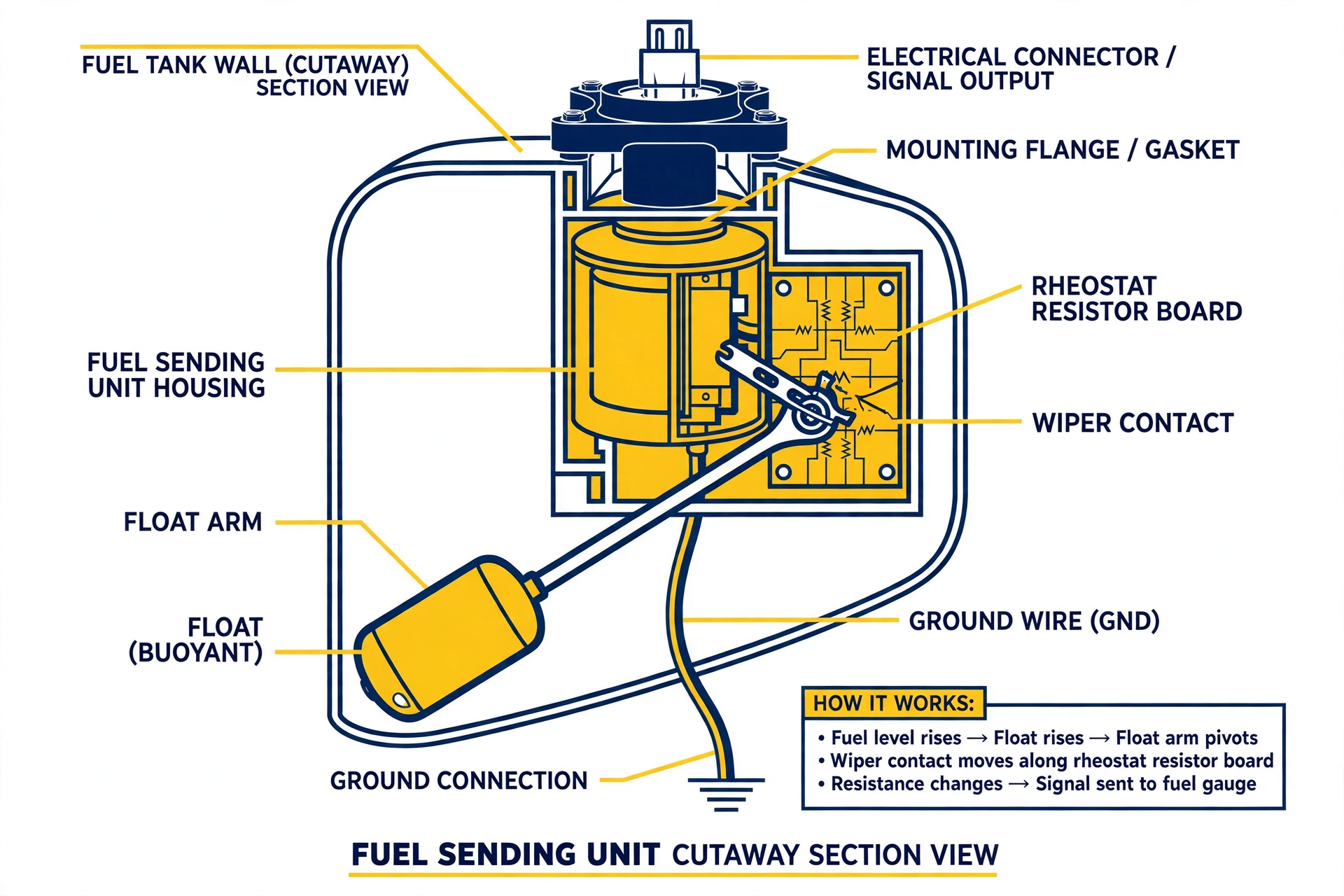
AI-generated illustration: a labelled cutaway diagram of a Ford fuel sending unit for a ford fuel gauge ohms chart guide. It shows the float arm, float, rheostat resistor board, wiper contact, and ground wire.
The diagram shows each part in place. The float and arm sit in the tank. The rheostat board and wiper sit above the fuel line on most units.
The Resistance Change With Level
Resistance changes because the wiper moves. A longer path through the resistor means more ohms. A shorter path means fewer ohms.
On a 73-10 sender, the path is longest at empty. On a 16-158 sender, the path is longest at full. The two systems run in opposite directions.
Hemmings guide to fuel sending units explains the same design in plain terms. The sender is a float, a rod, a variable resistor, and a mounting stem. The resistor is grounded on one side and wired to the gauge on the other.
The Gauge and the Sender
The gauge and the sender are one circuit. The sender sets the resistance. The gauge turns that resistance into a needle position.
A bad ground breaks the circuit. A broken wire does the same. Both faults show up as wrong readings, not as a dead gauge alone.
Modern F-150s add a computer between the sender and the gauge. The PCM reads the resistance and sends a filtered signal to the cluster. The sender still works the same way at the tank.
Once you see how the circuit works, the test steps make sense. The next section walks through the meter test.
How to Test a Fuel Sender
Test the sender before you buy parts. A meter reading takes minutes. A tank drop takes hours.
Our F-150 fuel gauge reset guide covers the cluster tests that come after the sender test. Start with the sender. The sender is the most common failure point.
Gather Your Tools First
You need a digital multimeter with an ohms setting. You need basic hand tools to reach the connector. You need access to the sender ground post for the black probe.
An analog meter also works. MotorTrend notes that digital meters change scale on their own. That auto-ranging can confuse a first-time tester.
Bench Test the Sender
- Park on level ground and turn the ignition off.
- Disconnect the negative battery cable.
- Find the sender connector at the tank or frame rail.
- Unplug the sender connector.
- Set the multimeter to the ohms setting.
- Touch the red probe to the sender signal pin.
- Touch the black probe to the sender ground post or the sender body.
- Note the reading and compare it with the chart.
- Move the float arm by hand if the sender is out of the tank.
- Watch the reading change smoothly as the arm moves.
Our Ford fuel pump wire color codes guide shows which wire carries the sender signal on F-150 and Super Duty trucks. The signal wire is Yellow with a White stripe on most single-tank trucks.
Tanks Inc gives this probe method for a bench test. It puts the red probe on the gauge lead post and the black probe on the ground post or the sender body.
Do not use a chassis ground for this test. A chassis ground reading tests the sender plus its ground path, and that is a different test.
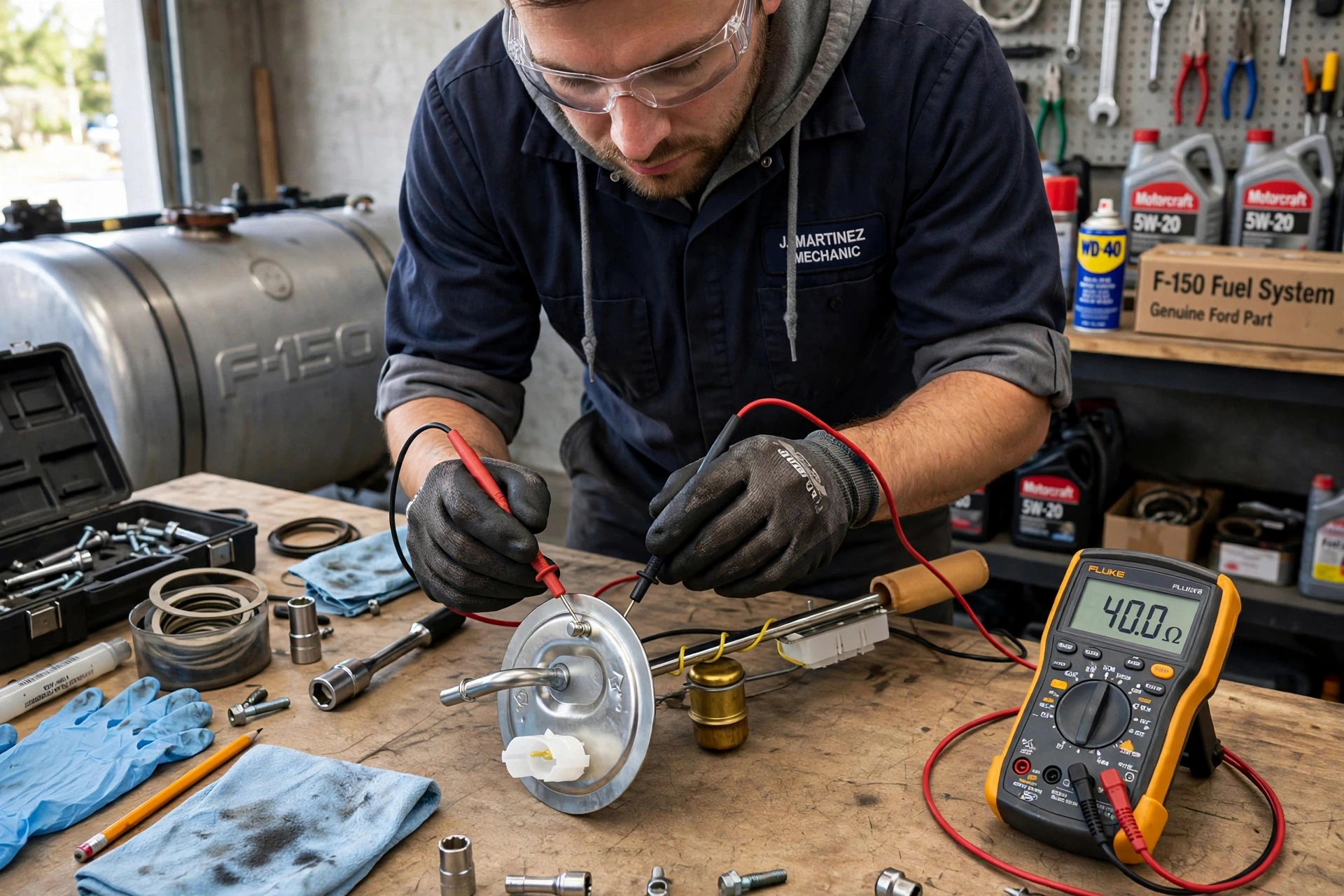
AI-generated illustration: a mechanic testing a Ford fuel sending unit with a digital multimeter on a workbench during a ford fuel gauge ohms chart test. Both probes touch the sender unit, as the Tanks Inc method directs. The meter reads about 40 ohms with the float arm at mid-travel.
The photo shows a sender on a bench with a meter attached. The meter reads about 40 ohms. That sits near the half-tank value for a 73-10 sender.
Watch the Reading Move
Fuel moves in the tank when you drive, brake, or turn. Watch the meter reading during a short drive.
A reading that moves with the fuel shows the float is free and the wiper still contacts the board. A reading that stays fixed points to a stuck arm or a worn rheostat.
Test at the Connector
The Ranger Station guide for fuel sender ohms gives the same advice for Ranger and Bronco II trucks. It lists the pre-1989 and 1989-on ranges. Test at the connector when you can reach it without dropping the tank.
Measure the sender side of the plug, not the harness side. The harness side tells you about wiring. The sender side tells you about the sender.
If the reading is steady at one value, move to the readings section next. The table there turns each reading into a likely cause.
What Your Multimeter Readings Mean
Each reading points to a different fault. The table below covers the common ones. Compare your reading with the range your truck should use.
| Reading | Likely meaning | Next step |
|---|---|---|
| OL or infinite | Open circuit | Check the wire and the sender card for a break |
| Well above 160 or OL on a 16-158 sender | Broken wire or bad sender | Test the wire, then test the sender out of the tank |
| Stuck near 16 with fuel in the tank | Likely sunk float, stuck arm, or worn rheostat | Remove the sender and check the float, arm, and card |
| 0 ohms or near 0 on a 73-10 sender | Short to ground | Check the sender lead for a ground fault |
| Reading moves as fuel moves | Sender and float move freely | The sender is likely fine, so check the gauge and wiring |
| Reading stays fixed as fuel moves | Worn rheostat or stuck arm | Remove the sender and test it on the bench |
| Gauge reads backwards | Wrong range sender or reversed arm | Confirm the range, then check the arm direction |
An open circuit reads as OL on most digital meters. That means infinite resistance. The circuit is broken somewhere between the sender and the gauge.
A reading well above 160, or OL, on a 16-158 system means the same thing. The wire may be broken.
The sender card may be dead. Test the wire first, since wire is cheaper than a sender.
Some sources list the later range as 16 to 160 ohms, not 16 to 158. The Ranger Station thread gives 1989-on Fords as 16 to 160 ohms. A reading of 160 at full is healthy, not a fault.
A likely cause is a sunk float. The float fills with fuel and sinks. The arm stays at the empty stop, so the meter stays near 16 ohms.
A stuck arm or a worn rheostat can give the same reading, so test the sender out of the tank before you order parts.
A reading of 0 ohms, or near 0, on a 73-10 system points to a short. The sender lead may touch ground.
The center terminal may ground against the sender body. Tanks Inc lists both causes for a gauge that reads full all the time. A full-tank reading of 8 to 12 ohms is normal tolerance, not a fault.
A backwards gauge is a matching fault, not a broken part. A 73-10 sender on a 0-90 gauge reads backwards.
A reversed float arm does the same. Check the range first, then the arm.
Fuel pressure is a separate system from fuel level. A level fault will not change rail pressure. Our F-150 fuel pressure sensor location guide covers that sensor when pressure is the problem.
When the reading is clear, the fix is clear too. The next section covers the one case where the chart itself is unclear.
The 1987 and 1989 Cutover Problem
Two change years appear in the sources, and they disagree. Tanks Inc dates the change to 1987, while Hemmings dates it to 1989.
| Source | Change year listed | Range listed |
|---|---|---|
| Tanks Inc | 1987 | 73-10 up to 1986, 16-158 from 1987 |
| Hemmings | 1989 | 73-10 pre-1989, 16-158 after 1989 |
| JEGS | 1989 | 73-10 for Ford models prior to 1989 |
| Ranger Station threads | 1989 | 73-10 pre-1989, 16-158 to 16-160 for 1989-on |
| Reset guide | 1987 | 16-158 for most F-150s since 1987 |
The disagreement has a likely cause. Ford changed gauge types across models over more than one year. A 1988 F-150 may already use the newer range, while a 1988 Ranger may still use the older range.
The safe rule is simple. Measure the sender before you order parts. A 73-10 sender and a 16-158 sender are easy to tell apart on a meter.
If your truck falls in 1987 to 1989, test twice. Test the sender out of the tank at empty and full. Write both numbers down, and match the gauge to the numbers, not to the model year.
Never trust a parts listing that gives only a year. Ask for the ohm range. A listing that cannot give the range is a listing to skip.
The Mustang adds one more twist. Its exception breaks the main chart entirely, and it gets its own section next.
2 Mustang Sender Ranges That Break Rules
Mustangs do not follow the main Ford chart. The 1987 to 1993 Mustang uses its own range. The 1986 and older Mustang uses another.
| Mustang group | Empty ohms | Full ohms | What to know |
|---|---|---|---|
| 1987 to 1993 Mustang | 22 | 145 | StangNet owner data, not interchangeable with other Fords |
| 1986 and older Mustang | 73 | 8 to 12 | Older Mustang senders read 8 to 12 ohms full |
The StangNet Mustang troubleshooting thread lists 22 empty and 145 full for 1987 to 1993 Mustangs. The same thread lists 73 empty and 8 to 12 full for 1986 and older cars.
The two groups are not interchangeable. A 22-145 sender on a 73-10 gauge reads wrong at every level. A 73-10 sender on a 22-145 gauge does the same.
Check the gauge before you buy a sender. A Mustang gauge is built for its own range. An aftermarket gauge with a 22-145 preset is the safe match.
Classic car parts listings often lump all early Mustangs together. That lump is wrong. Confirm the year split before you order.
Aftermarket gauges add more ranges to the mix. The next section sorts them out.
How to Match Aftermarket Gauges to Senders
An aftermarket gauge only works when its range matches the sender. A mismatch reads wrong or reads nothing at all. A gauge with the wrong range is not a broken gauge.
MotorTrend describes the same mismatch with an early Bronco in its fuel gauge guide. The owner fitted new gauges, and the fuel gauge read half on a full tank. The sender was fine, and the gauge range was wrong.
The fix is to match the numbers first. The first number in a range is the empty reading.
The second number is the full reading. Tanks Inc states this rule on its sender page.
AutoMeter lists its Ford presets in its sender select chart. The chart gives 73-10 for Ford Pre-89 and 16-158 for Ford 89 and up.
| Gauge or sender type | Empty ohms | Full ohms | What to know |
|---|---|---|---|
| AutoMeter Ford preset | 73 | 10 | Matches Ford Pre-1989 |
| AutoMeter Ford preset | 16 | 158 | Matches Ford 1989 and up |
| AutoMeter common | 240 | 33 | Most common AutoMeter range, not a Ford range |
| Dakota Digital Ford 10 | 73 | 10 | Preset for the early Ford range |
| Dakota Digital Ford 150 | 20 | 150 | Preset label, not a Ford factory spec |
| VDO | 10 | 180 | VDO standard range |
| Stewart Warner | 240 | 33 | Same range as common AutoMeter |
| GM 1965 to 1997 | 0 | 90 | Shown for contrast, not a Ford range |
Tanks Inc lists the VDO range at 10 to 180 ohms. Programmable gauges remove the guesswork.
Dakota Digital states that its gauges accept most ohm ranges through a setup menu. Set the range to match your sender, then test the gauge at empty and full.
Fixed-range gauges need the right preset. Check the gauge box or manual for its range. If the box lists 240-33, it will not read a Ford sender correctly.
Buy the sender and the gauge as a matched pair when you can. A matched pair removes the range question entirely. The maker has already done the matching for you.
When you swap a gauge, keep the old sender if it still tests well. A good sender with a matched gauge beats a new sender with the wrong range.
One Ford truck line needs a separate note. The 2009 and later F-150 changed the curve again, and it gets its own section next.
2009 F-150 Gauge Notes and TSB
Our reset guide reports a change around 2009. Pre-2009 trucks read about 160 ohms full.
Post-2009 trucks read about 180 ohms full. Treat these numbers as a report, not as factory specs. The 158 and 160 ohm full values differ by about 2 ohms, a source and method variance.
The same guide covers TSB 13-02-08. The bulletin covers 2009 to 2010 F-150, Expedition, and Navigator models.
The symptom is a gauge that reads about three quarters full after the nozzle shuts off. The distance to empty display also fluctuates.
Ford fixed it with two parts. The repair replaces the fuel pump module and its O-ring. It also replaces the canister purge valve in the engine bay.
TSB 13-02-08 applies only when the vehicle has no stored DTCs P0461, P0462, P0463, B1202, or B1204. If any of these codes are stored, the bulletin does not apply and normal diagnostics govern.
A reset will not fix this fault. The fault is in the module and the purge valve, not in the cluster memory. If your 2009 or 2010 F-150 shows these exact symptoms, check the bulletin before you replace the sender.
Our F-150 fuel pump driver module guide covers a related failure on 2004 to 2014 trucks. A failed module can stop the pump entirely. Check it when the truck cranks but will not start.
Codes P0461, P0462, and P0463 point to the fuel level sensor circuit. They confirm a circuit fault. A scan tool reads them in seconds.
With the 2009 note covered, one section is left. It covers the safety rules for every test in this guide.
3 Safety Rules Before You Test
Fuel work needs care. A small mistake near fuel vapor is a big risk. Follow these rules on every test.
Power Off for Resistance Tests
Measure resistance with the power off. The ignition must be off. The sender plug must be unplugged.
A live circuit gives a false reading. It can also damage the meter. Unplug first, then measure.
Never Use 12 Volts Here
Never connect the sender or the gauge to a 12 volt battery. The Ranger Station thread states this rule in bold. The gauge circuit runs on a 5 volt pulse from the cluster regulator.
Twelve volts will burn the sender card. It can also damage the gauge. Use the meter only, and use it with the power off.
Work Away From Vapor
Work outside or in a well ventilated space. Keep sparks and open flame away from the tank. Disconnect the negative battery cable before you open the sender connector.
If you smell strong fuel vapor, stop and ventilate the area. Do not test until the vapor clears. Fuel vapor ignites faster than liquid fuel.
Wear gloves and eye protection when you handle the sender. Fuel irritates skin and eyes. Wash your hands after the job.
These rules take minutes to follow. They protect the truck, the meter, and you.
Questions Owners Ask About Fuel Gauge Ohms
What Ohms Should Ford Senders Read
Ford senders read 73 ohms empty and 10 ohms full on older trucks. Later Ford senders read 16 ohms empty and 158 ohms full. Sources dispute the change year, so measure your sender to confirm the range before you order parts.
How to Test a Ford Fuel Sender
Unplug the sender connector with the ignition off, then set the multimeter to ohms and measure from the signal pin to the ground post. Move the float arm and watch the reading change smoothly through the range. Then compare both readings with the chart in this guide.
Why Does My Ford Gauge Read Backwards
A backwards gauge means the sender range does not match the gauge. A 73-10 sender on a 16-158 gauge reads in the wrong direction. Confirm the sender range with a meter, then fit a gauge with the matching range or fit a matching sender.
What Ohms Is a 1989 Ford Sender
Most sources list 1989 Fords at 16 ohms empty and 158 ohms full. Hemmings and the Ranger Station both date the change to 1989. Measure your sender to confirm, since 1987 to 1989 trucks vary by model and by gauge type.
Can a 73-10 Sender Match 16-158
No, a 73-10 sender cannot match a 16-158 gauge. The two ranges run in opposite directions, so the needle reads wrong at every level. Use a sender and gauge with the same range, or fit a programmable gauge set to your sender range.
What Is the Mustang Fuel Sender Range
The 1987 to 1993 Mustang uses 22 ohms empty and 145 ohms full. The 1986 and older Mustang uses 73 ohms empty and 8 to 12 ohms full. The two groups are not interchangeable, so confirm the year split first.
What to Do Next With a Bad Reading
You now have the ford fuel gauge ohms chart, the test steps, and the gauge matching rules in one place. Start with the meter reading on your own sender. Let that number pick the range, not the model year.
Test with the power off and compare the reading with the chart. A reading outside the range points to the fault. A reading inside the range points to the gauge or the wiring.
Measure twice when the year falls near the 1987 to 1989 change. Order parts only after the meter confirms the range. That one test saves a wrong sender and a second tank drop.