Ford F150 Wheel Offset Chart by Year: 1997-2026 OEM Exceptions

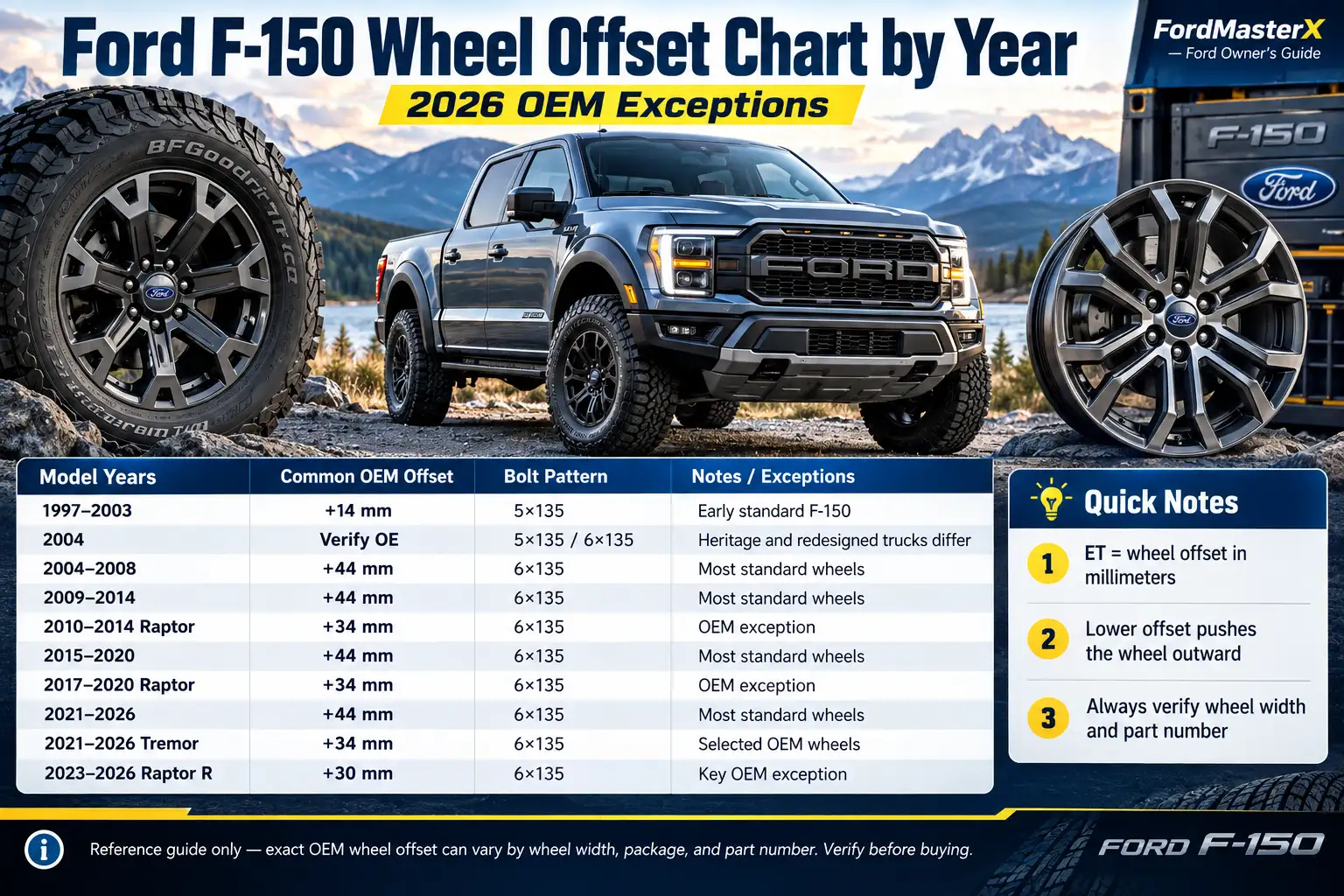
The Ford F150 wheel offset chart has two useful starting points: about +14 mm for selected 1997–2003 stock wheels and +44 mm for many later standard F-150 wheels. Neither number applies to every factory rim. A Heritage truck, a heavy-payload model, a Raptor, or a Tremor may need a different specification.
Wheel offset is the distance between the wheel’s centerline and its hub-mounting face. It affects how far the rim sits toward the suspension or fender. Start with the year-by-year chart, then check the exact wheel size, equipment package, and part number before ordering a replacement.
FordMasterX • Fitment Reference
F-150 Wheel Offset Quick Reference
Selected historical offset baselines and Ford-confirmed wheel examples. ET is measured in millimeters. A listed value is not a universal fitment guarantee for every trim or wheel width.
| Year / Application | Wheel / Configuration | ET Offset | Evidence status |
|---|---|---|---|
| 1997–2003 | Selected standard factory wheels | +14 mm | Historical reference |
| 2004 Heritage | Carryover old-body wheelDifferent from redesigned 2004 truck | Check wheel | Verify by part number |
| 2004–2014 | Selected standard configurationsExceptions and variant wheels exist | +44 mm | Common reference |
| 2015–2026 | Ford Performance 20 × 8.5M-1007-P2085AA | +44 mm | Specific accessory |
| 2021 Tremor | Matte-gray 18 × 7.5M-1007K-1875G | +34 mm | Ford factory equipment |
| Raptor R-style | 17 × 8.5 wheel kitM-1007K-FRR · Featured on 2023 Raptor R | +30 mm | Ford wheel kit |
Model years in accessory rows indicate listed applications, not proof the wheel came installed on every truck. Ford lists the Raptor R-style kit for 2024–2026 Raptor fitment.
What happens when offset drops?
For equal-width rims only. If rim width or tire size changes, recalculate inner and outer clearance. Check brake, fender, and suspension clearance before installation.
Ford F150 Wheel Offset Chart From 1997 to 2026


This Ford F150 wheel offset chart lists representative stock-wheel references and documented exceptions, not every wheel option Ford produced. ET means offset in millimeters. A positive number places the mounting face toward the outside of the wheel.
| Model Years | Wheel or Configuration | Offset | Bolt Pattern | Confidence and Notes |
|---|---|---|---|---|
| 1997–2003 | Standard 16 × 7 and selected 17 × 7.5 wheels | +14 mm | 5 × 135 mm | Historical factory-fitment reference |
| 2004 | F-150 Heritage, old-body style | Verify original wheel | 5 × 135 mm on standard five-lug models | Do not use the redesigned 2004 chart |
| 2004–2008 | Redesigned F-150, common 17 × 7.5 wheels | +44 mm reference | 6 × 135 mm | Some fitment guides also list +40 mm for specific 17-inch wheels; confirm the wheel |
| 2004–2014, selected years | Heavy Duty Payload, seven-lug models | Verify original wheel | 7 × 150 mm | Special hub; not interchangeable with six-lug wheels |
| 2009–2014 | Standard F-150, common 17 × 7.5 and 18 × 7.5 wheels | +44 mm | 6 × 135 mm | Common factory-wheel reference |
| 2010–2014 | SVT Raptor, selected 17 × 8.5 wheels | +34 mm | 6 × 135 mm | Documented Raptor wheel configuration |
| 2015–2020 | Many standard 17-, 18-, and 20-inch configurations | +44 mm reference | 6 × 135 mm | Other configurations exist; verify the OEM wheel |
| 2017–2020 | Raptor, selected 17 × 8.5 wheels | +34 mm | 6 × 135 mm | Documented Raptor wheel configuration |
| 2021–2026 | Standard F-150 wheel packages | Often +44 mm; verify by package | 6 × 135 mm | +44 mm is not a universal original-equipment specification |
| 2021–2025 | Selected Tremor 18 × 7.5 OEM wheel, ML3Z-1007-T | +34 mm | 6 × 135 mm | Wheel-specific OE replacement reference |
| 2023–2026 | Raptor R-style 17 × 8.5 Ford wheel, M-1007K-FRR | +30 mm | 6 × 135 mm | Featured on 2023 Raptor R; Ford lists kit fitment for 2024–2026 Raptors |
The older +14 mm and widely used +44 mm references are recorded in the AmericanTrucks F-150 wheel fitment guide. This is a historical fitment guide, not a VIN-specific Ford build record. In particular, the 2004–2008 17-inch references are not perfectly consistent across independent fitment sources.
For a manufacturer-confirmed modern example, Ford lists a 20 × 8.5-inch wheel with +44 mm offset and a 6 × 135 mm pattern, part M-1007-P2085AA, for 2015–2026 F-150 applications. Check the Ford Performance wheel specification. It describes that specific Ford accessory wheel, not every factory-installed wheel in those years. Ford does not validate that listing for the F-150 Lightning.
If your truck has a different wheel diameter or width, consult the Ford F150 wheel size chart rather than assuming every wheel offered within a model-year range has the same ET value.
Which 2004 F150 Wheels Need Separate Offset Checks


The 2004 F-150 name covers two different truck designs. The 2004 Heritage carried over the older body and generally used a five-lug setup. The redesigned 2004 F-150 introduced a six-lug setup on standard configurations. A wheel that fits one should not be assumed to fit the other.
A further exception is the Heavy Duty Payload setup. Certain F-150 model years were offered with seven-lug, 7 × 150 mm hubs. Their wheels do not bolt onto ordinary six-lug F-150 hubs, even if the reported offsets appear similar.
| Configuration | Important Distinction | Required Check |
|---|---|---|
| 2004 Heritage | Earlier five-lug architecture | Confirm the actual original wheel |
| 2004 redesigned F-150 | Standard six-lug architecture | Confirm size and ET by wheel number |
| Seven-lug Heavy Duty Payload | Different hub and wheel design | Confirm seven lugs and the correct load rating |
Offset describes wheel position; bolt pattern describes the lug-hole circle. The two measurements are independent. For the year-specific lug information, use the Ford F150 bolt pattern chart.
How Raptor and Tremor Wheel Offsets Differ by Package


Raptor and Tremor owners should check the actual wheel rather than relying on the standard F-150 offset. A 17 × 8.5-inch +34 mm setup is documented for selected 2010–2014 SVT Raptors and 2017–2020 Raptors. That does not establish the offset of every later Raptor wheel or optional beadlock design.
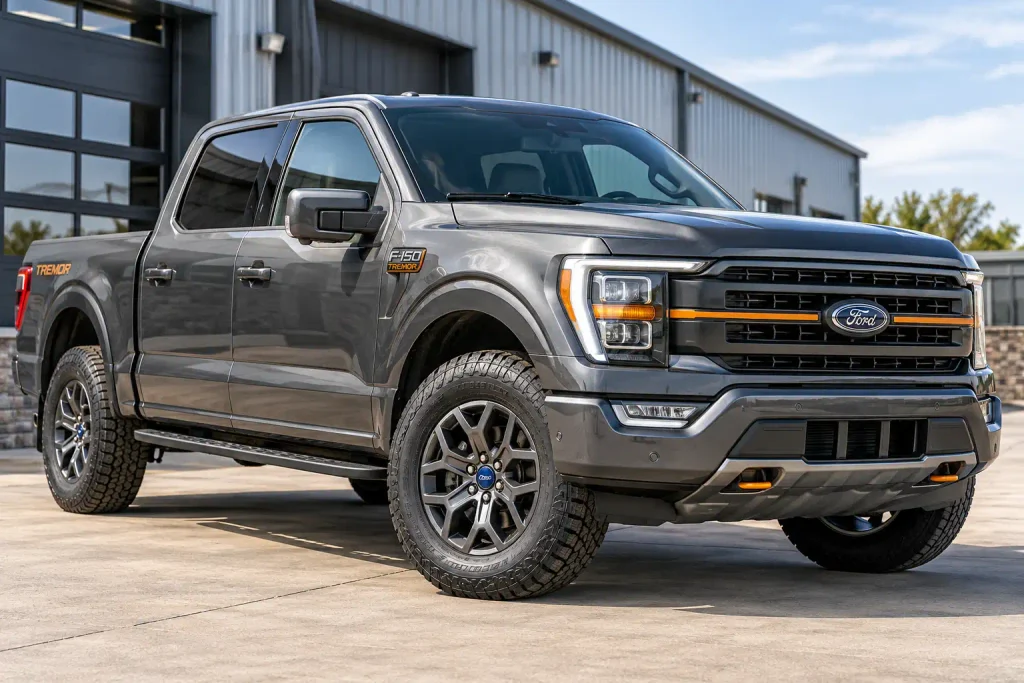
The 2021 F-150 Tremor also has a manufacturer-documented exception. Ford states that its matte-gray 18 × 7.5-inch, +34 mm wheel kit, part M-1007K-1875G, was factory equipment on the 2021 Tremor. The Ford Tremor wheel listing identifies the wheel and its offset. Replacement listings also associate the +34 mm 18-inch Tremor wheel with OEM number ML3Z-1007-T across selected 2021–2025 applications; check the part number on the actual rim.
Ford’s Raptor R-style wheel kit, part M-1007K-FRR, is another clear exception: 17 × 8.5 inches with +30 mm offset. Ford says this style was featured on the 2023 Raptor R and lists the kit for 2024–2026 Raptors. The exact fitment and specification appear in the Ford Performance Raptor R wheel kit listing.
These are specific documented configurations, not a claim that every Raptor or Tremor uses +34 mm or +30 mm. An aftermarket wheel certified for a Raptor also should not be presented as its original factory wheel.
What Positive and Negative Wheel Offset Means for F150
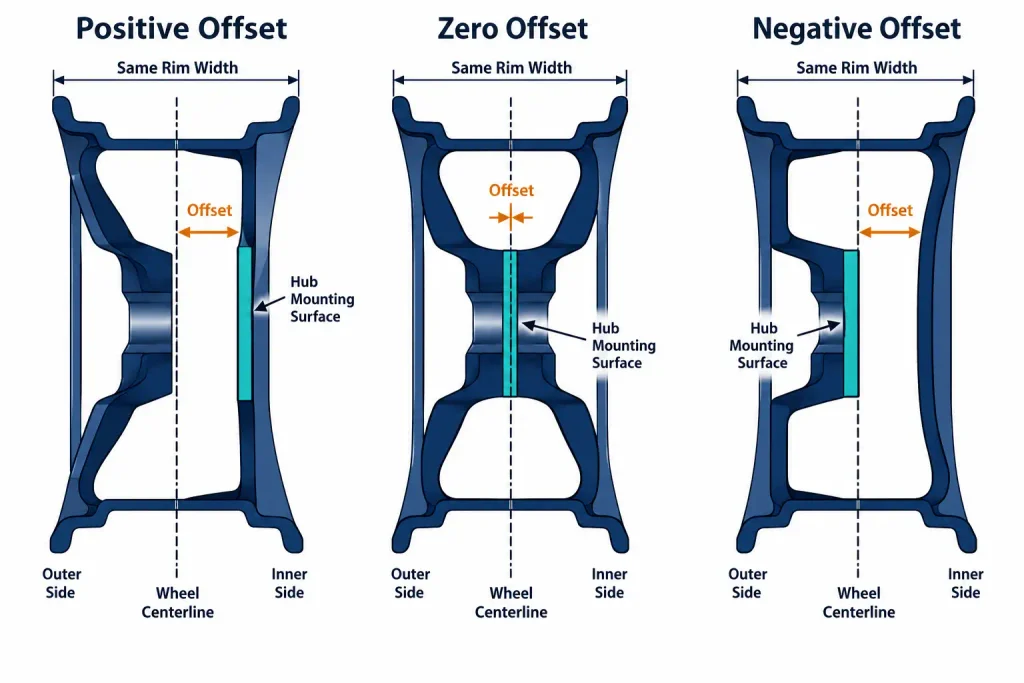
Positive wheel offset means the hub-mounting surface lies outward of the rim’s centerline. Zero offset means the surface is on the centerline. Negative offset means it lies inward of that line.
On wheels of equal width, decreasing positive offset moves the rim outward relative to the hub. For example, changing from ET+44 to ET+20 moves the whole rim 24 mm outward. Moving from ET+44 to ET+34 shifts an equal-width rim 10 mm outward.
The offset number does not tell you the full tire position by itself. A 9-inch-wide wheel at ET+20 will sit differently from an 8.5-inch-wide wheel at the same offset because half the width increase appears on each side of the centerline.
In a wheel-offset illustration, the three essential features are the rim centerline, the hub-mounting face, and the direction of positive offset. These explain why two wheels with identical bolt patterns may create different suspension and fender clearance.
How to Convert F150 Wheel Offset Into Backspacing
Backspacing measures the distance from the wheel’s hub-mounting face to its inner rim lip. Offset instead measures the mounting face’s position relative to the rim centerline. Both describe fitment, but they use different reference points.
For an approximate backspacing calculation using nominal wheel width, use:
Backspacing in inches ≈ (wheel width in inches + 1) ÷ 2 + (offset in mm ÷ 25.4)
The extra inch approximates the two rim flanges. Because flange designs differ, the wheel manufacturer’s stated backspacing or a direct measurement takes priority.
For a 20 × 8.5-inch wheel at ET+44:
- Approximate overall rim width: 8.5 + 1 = 9.5 inches
- Half the overall width: 9.5 ÷ 2 = 4.75 inches
- Offset conversion: 44 ÷ 25.4 = 1.73 inches
- Approximate backspacing: 4.75 + 1.73 = 6.48 inches
A 17 × 8.5-inch wheel at ET+34, calculated with the same assumption, has approximately 6.09 inches of backspacing. Do not use a backspacing value calculated from nominal width as a substitute for measured clearance around your brakes, suspension, or steering components.
How Wheel Width and Offset Change F150 Clearance
If you replace a factory-style 8.5-inch ET+44 wheel with an 8.5-inch ET+20 wheel, the new rim moves outward by 24 mm. Its inner lip also moves 24 mm farther away from the vehicle-side components, assuming the same wheel profile.
Now compare that original 8.5-inch ET+44 wheel with a 9-inch ET+20 wheel. The new rim is 0.5 inch wider, or 12.7 mm. Half that width difference is 6.35 mm.
| Measurement | Calculated Change |
|---|---|
| Offset reduction | 24 mm |
| Added width on each side of centerline | 6.35 mm |
| Outer rim position | 30.35 mm farther outward |
| Inner rim clearance | 17.65 mm more clearance |
These are rim-edge geometry calculations, not tire-clearance guarantees. Actual tire sidewall width, tread shoulders, alignment, wheel shape, brake-caliper clearance, fender liners, and suspension travel can change the outcome.
A tire that clears when parked can still rub while turning or compressing the suspension. If you are also changing tire dimensions, compare the original and proposed tire specifications in the Ford F150 tire size chart before selecting a more aggressive offset.
How to Verify Your F150 Factory Wheel Offset
When your exact OEM wheel is missing from a chart, use the wheel itself as the starting point. A trim name and model year may identify several wheel options.
- Identify your truck and current wheel. Record the model year, trim, factory equipment package, wheel diameter, and nominal rim width. The door-jamb tire placard helps identify original tire sizing, but it normally does not give a complete wheel-offset specification.
- Inspect the wheel markings. Look on the back of the rim for an ET marking, a stamped or cast part number, or another wheel identification code. Remove or inspect the wheel safely; do not work beneath a truck supported only by a jack.
- Match the part number. Compare the code with a Ford parts listing for your particular model and package. For used wheels, confirm that the listing describes the actual rim rather than only a compatible aftermarket replacement.
- Check the full fitment set. Confirm bolt pattern, center bore, wheel width, offset, lug-nut seat and thread, wheel load rating, and appropriate tire size. Do not assume matching PCD alone proves interchangeability.
- Confirm physical clearance. Have the installer check brake clearance, hub seating, lug-nut engagement, and steering and suspension clearance through the relevant range of movement before driving.
Cross-year swaps require additional attention because the same bolt circle can appear on trucks with different hardware. The F150 wheel interchangeability guide explains the broader compatibility checks for used factory wheels.
What F150 Wheel Fitment Mistakes Should You Avoid
A correct offset is necessary, but it is not enough to confirm safe fitment. These five mistakes are particularly easy to make when buying online.
- Treating +44 mm as universal. The year-based reference does not cover every wheel package, and Raptor or Tremor wheels have documented exceptions.
- Ignoring wheel width. A lower ET value is not the only reason a rim can extend farther outward. Added width changes both rim edges.
- Matching the bolt pattern only. Hub bore, lug hardware, caliper clearance, and wheel load rating also matter.
- Overlooking spacers. A 15 mm spacer reduces the effective offset of an ET+44 wheel to approximately ET+29, assuming the spacer and attachment system are correctly engineered for the application.
- Assuming static clearance is enough. Tires need room when the steering turns and the suspension compresses, not just when the truck is stationary.
Do not buy a wheel solely because an online configurator labels it compatible. Check the manufacturer’s application notes and have the final setup inspected if you change the factory geometry significantly.
Which F150 Wheel Offset Should You Use
The right Ford F150 wheel offset is the value specified for your actual wheel configuration, not simply the most common number for your model year. The chart gives useful historical references of +14 mm for selected 1997–2003 wheels and +44 mm for many later standard configurations, alongside documented +34 mm Tremor and Raptor examples and a +30 mm Raptor R-style wheel.
Use these figures to narrow your search. Then match the original wheel’s identification and dimensions to the replacement. If you are moving to a wider rim or lower offset, calculate the change at both rim edges and confirm tire, brake, and suspension clearance. That final check is more valuable than choosing an ET number based on appearance alone.
Frequently Asked Questions About F150 Wheel Offset
What Is the Factory Wheel Offset on a Ford F150?
There is no single offset for every F-150. Approximately +14 mm is a documented reference for selected 1997–2003 wheels, while +44 mm is common on many later standard configurations. Factory packages, rim width, and special trims can change the answer, so check your original wheel number before buying.
Do All Ford F150 Wheels Have a +44mm Offset?
No. Ford has documented +34 mm wheels for selected Tremor applications, and its Raptor R-style wheel kit uses +30 mm. Even standard-model wheel sizes may differ by package. A +44 mm reference is useful for narrowing a search, not confirming an individual wheel.
What Is the Stock Wheel Offset on an F150 Raptor?
Selected 2010–2014 and 2017–2020 Raptor 17 × 8.5-inch wheels are documented at +34 mm. Ford also lists a +30 mm Raptor R-style wheel kit. Later Raptor wheel packages can vary, so match the specific original wheel rather than assuming every Raptor has the same ET.
Will +20mm Offset Wheels Fit a Ford F150?
They might, but +20 mm alone does not prove fitment. Compared with an equal-width ET+44 rim, ET+20 moves the rim 24 mm outward. You still need the correct bolt pattern, wheel size and rating, plus adequate brake, steering, suspension, and tire clearance throughout travel.
Is Wheel Offset the Same as Backspacing?
No. Offset is measured from the wheel centerline to its mounting face, normally in millimeters. Backspacing measures from the mounting face to the inner rim lip, normally in inches. You can estimate one from the other if you know wheel width, but measured rim dimensions are more reliable.