Ford F150 Tire Size Specification Chart By Year (2004–2026)

Quick Answer
Ford F-150 factory tire sizes generally range from 17-inch wheels with 235/75R17 tires on base XL models to 22-inch wheels with 275/50R22 tires on premium trims like the Limited. Tire specifications depend heavily on the trim level, axle ratio, and towing package. Always verify your specific tire requirement by checking the Tire and Loading Information placard located on the driver-side door jamb.
Is your Ford F-150 ready for new rubber, but you’re unsure if those 35s will actually fit? Selecting the wrong tire size leads to unwanted rubbing, inaccurate speedometer readings, and potential safety risks regarding load ratings. This guide provides the official Ford F-150 tire size specification chart, covering the most common factory configurations from 2004 through 2026, along with the critical clearance checks needed for a successful, safe upgrade.

Prime for Young Adults — 6 Months Free
Students and 18–24s get six months of Prime free, then half price.
Start 6 Months Free As an Amazon Associate I earn from qualifying purchases.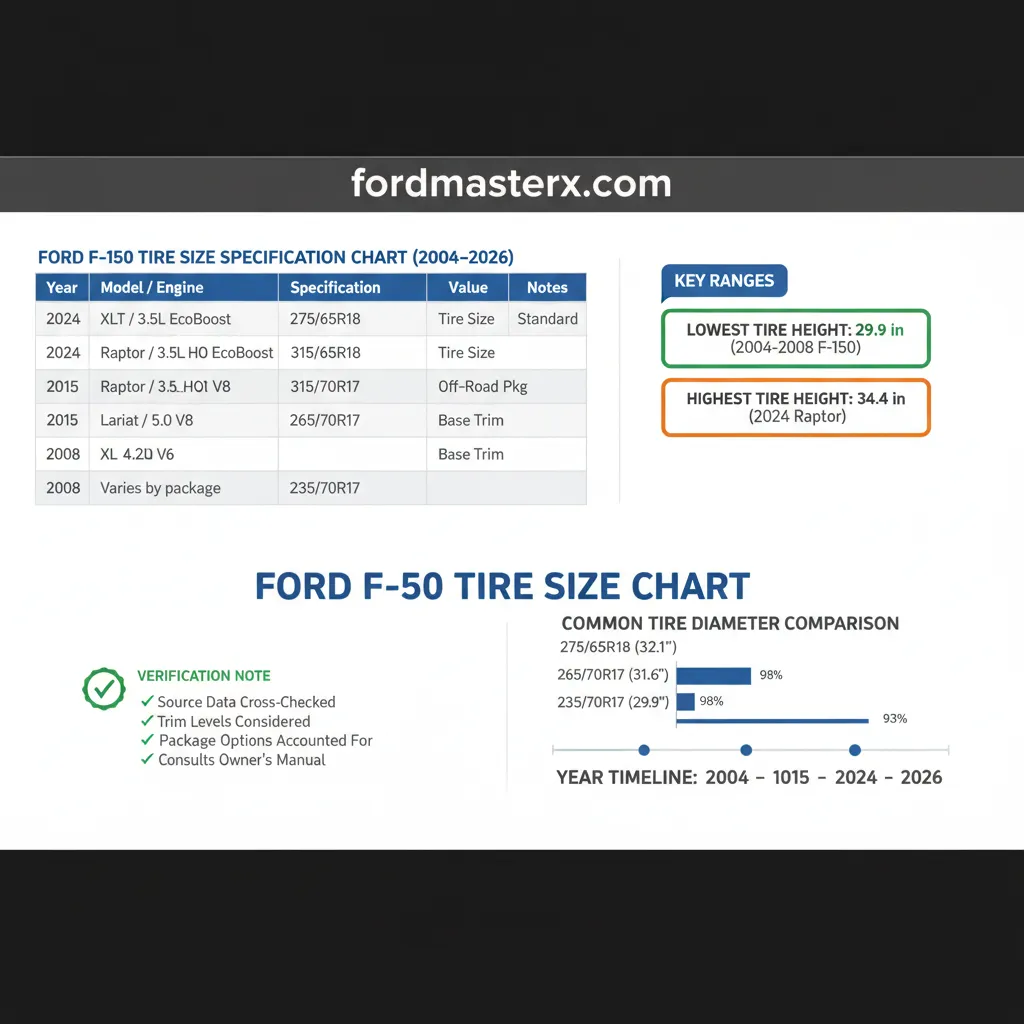
General Ford F150 Wheel and Tire Specifications
Recommended Best Deal Products


F-150 tire sizing has evolved significantly over the last two decades. While base models historically utilized 17-inch wheels, modern luxury trims and high-performance variants like the Raptor or Tremor push the envelope toward larger diameters. The following table provides a snapshot of the standard ranges observed across the 2004–2026 production era.

📤 Share Image
| Category | Standard Range | Notes |
|---|---|---|
| Wheel Diameter | 17″ to 22″ | Trim-dependent. |
| Factory Tire Width | 235mm to 315mm | Raptor/Tremor widths are outliers. |
| Bolt Pattern | 6 x 135mm | Standard for 2004+ F-150s. |
| Center Bore | 87.1mm | Crucial for aftermarket wheel fitment. |

Ford F150 Tire Size Specification Chart By Year (2004–2026)
This chart covers primary production configurations. Note that “Max Tow” or “Off-Road” packages often change factory-issued tire sizing within the same model year. Always verify with your specific door jamb sticker. Last reviewed: August 2026.
| Year | Model/Trim Context | Typical Spec | Notes |
|---|---|---|---|
| 2004–2008 | Base/XLT | 235/75R17 | Typical base fitment. |
| 2009–2014 | Lariat/Platinum | 275/55R20 | Introduction of larger 20″ wheels. |
| 2015–2020 | Standard/Off-Road | 275/65R18 | Common FX4/Off-Road sizing. |
| 2021–2026 | Raptor/Tremor | 315/70R17 | Aggressive off-road diameter. |
- Locate the B-pillar sticker (driver’s side door jamb).
- Identify your specific tire size, aspect ratio, and load index (e.g., 116T).
- Check the cold tire inflation pressure (PSI) listed on the sticker.
- Always cross-reference this data before purchasing replacement or upsized tires.
Evolution of F150 Tire Sizes and Suspension Geometry
Recommended Best Deal Products


The transition from the 2004 model year to the 2026 lineup shows a clear shift toward larger factory-equipped tire diameters. Initially, the 17-inch wheel was the workhorse standard. Over time, as consumer demand moved toward “luxury utility,” Ford integrated 20-inch and even 22-inch options. This isn’t purely aesthetic; it allows for larger brake rotors and different suspension damping profiles.
It is vital to note that suspension clearance is the primary limiting factor for tire up-sizing. For example, the 2021–2026 models feature specific “crash bars” in the front wheel wells to meet safety standards. When installing aftermarket tires that exceed factory diameter, these bars often become the point of contact, necessitating a leveling kit or specialized offset wheels to clear the obstructions.
Understanding Configuration-Specific F150 Tire Fitment
Configuration dictates everything. An F-150 equipped with a Max Tow package, a PowerBoost hybrid drivetrain, or a heavy-duty frame will have different weight distribution and suspension stiffness compared to a base model. Ignoring these variables is a common pitfall when choosing replacement tires.
- P-Metric vs. LT Tires: P-metric tires are designed for a comfortable ride and lighter duty. LT (Light Truck) tires feature stiffer sidewalls and higher ply ratings, essential if you frequently tow at the upper limits of your truck’s capacity.
- Load Index Importance: Always ensure the load index of your new tires meets or exceeds the factory specifications found on your door sticker. Installing a lower-rated tire on a heavy-duty truck configuration is a significant safety hazard.
- Speed Rating: While often overlooked, the speed rating (e.g., T, H, S) reflects the heat dissipation capabilities of the tire. Don’t downgrade if you frequently drive at highway speeds while loaded.
If you decide to switch from P-metric to LT tires, you will likely need to adjust your tire pressure. LT tires often require higher PSI to maintain the same load-carrying capacity as their P-metric counterparts.
How to Calculate Maximum Tire Size Without Rubbing
Recommended Best Deal Products


📋
Step-by-Step Fitment Methodology
Measure the distance from the center of the hub to the edge of the fender well. This is your baseline for static clearance.
Account for suspension compression. Even if the tire clears at rest, it may rub when cornering or hitting bumps.

Audible — Listen Free for 30 Days
One free credit a month and thousands of titles included.
Listen Free for 30 Days As an Amazon Associate I earn from qualifying purchases.Turn the wheels to full lock both ways. Check for interference with the sway bar, control arms, and frame rails.
Factors Affecting Performance and Economy
Changing to a larger, heavier tire impacts more than just aesthetics. Increasing tire diameter typically results in decreased fuel economy because the engine must work harder to rotate the increased mass, often shifting the effective final drive ratio.
Furthermore, your truck’s electronic brain—including the speedometer and TPMS—is calibrated to a specific tire diameter. After any significant change, you must recalibrate the speedometer using a tuner or Ford diagnostic software. Failure to do so will result in inaccurate speed readings and may confuse the transmission shift points, leading to inefficient power delivery.
Always verify your bolt pattern remains consistent when changing wheels. While the 6x135mm pattern has been the F-150 standard for years, using incorrect offset or backspacing can cause the tire to protrude beyond the fender, leading to accelerated paint wear and potential legal issues in some jurisdictions.
Frequently Asked Questions
Can I fit 35-inch tires on a stock F-150?
Generally, no. Most stock configurations require at least a 2-inch leveling kit and potentially specific wheel offsets to avoid rubbing at full steering lock. Always check your fender liner clearance first.
Will larger tires void my warranty?
While simply changing tire size rarely voids an entire warranty, it can be grounds for denying coverage on related components, such as wheel bearings, suspension bushings, or steering racks, if the dealership determines the tire weight/size caused the premature failure.
How do I fix my speedometer after up-sizing?
You can recalibrate your truck’s PCM using an aftermarket OBDII tuning device or at a dealership using the Ford IDS/FDRS system. This ensures your speedometer, odometer, and safety systems function within factory parameters.
Always verify your specific truck’s door jamb sticker before purchasing replacement tires. Suspension clearance determines your actual tire size limit more than fender width alone. Upsizing requires checking your speedometer calibration and ensuring your load capacity remains sufficient for your intended use. Check your door sticker today, compare it against the charts above, and ensure your next set of tires is built for your truck’s specific engine and trim configuration.
Audible Premium Plus — Annual Membership
12 audiobook credits up front, plus the full Audible catalogue.
See Annual Plans As an Amazon Associate I earn from qualifying purchases.