
6.7 Power Stroke EGR Delete: Complete Installation Guide

You must flash a delete-capable tune to the ECM before beginning any mechanical work to prevent the vehicle from entering limp mode. The process requires draining the secondary cooling system and carefully removing the heavy EGR cooler assembly to improve long-term engine reliability.
🎯 Key Takeaways
- Install a delete-capable tune before mechanical disassembly starts.
- Drain the secondary cooling system to avoid engine bay messes.
- Use high-quality block-off plates with heavy-duty silicone plugs.
- Retain all factory hardware for potential future stock restoration.
- Perform a pressure test on rerouted coolant lines immediately.
Performing an EGR delete on your 6.7 Power Stroke involves removing the exhaust gas recirculation cooler, blocking the exhaust manifold and intake ports, and rerouting the engine’s coolant flow. To complete this task successfully, you must follow a specific sequence of disassembly to access the tightly packed components located at the top-rear of the engine bay. This guide focuses on the mechanical steps required to clear the engine of carbon-clogged hardware and install a clean, reliable block-off kit.
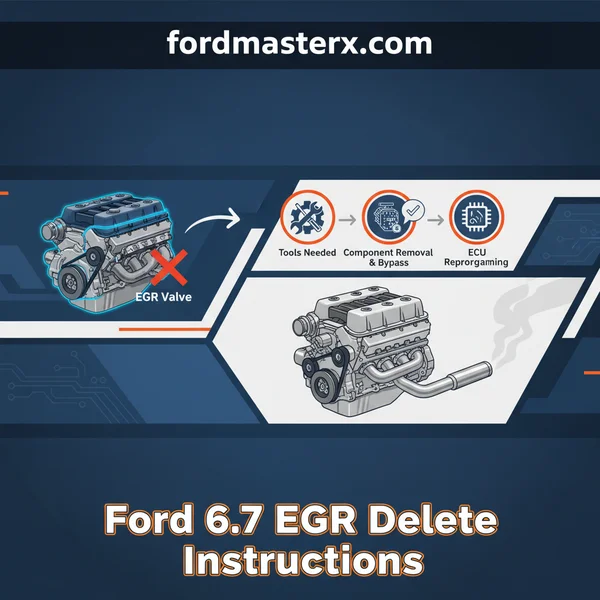
Practically, this procedure changes how your engine manages heat and exhaust flow. Because the 6.7 Power Stroke utilizes a complex dual-cooling system, precision during the coolant rerouting phase is essential to prevent air pockets or leaks. By following these instructions, you will eliminate the risk of EGR cooler failure and prevent soot from contaminating your intake air, ultimately simplifying the engine’s architecture for easier maintenance.
Essential Tools and Equipment for a 6.7 Power Stroke Delete
Necessary Hand Tools and Specialty Sockets
The 6.7 Power Stroke engine bay is notoriously cramped, so having the right reach is more important than raw power. You will need a comprehensive 1/4-inch and 3/8-inch drive socket set. Specific sizes required include 8mm, 10mm, 11mm deep (for intercooler clamps), and 13mm sockets. A variety of extensions, ranging from 3 to 10 inches, along with universal swivels, are mandatory for reaching the bolts located behind the EGR cooler near the firewall. A torque wrench capable of measuring in inch-pounds is also necessary for the intake manifold bolts to ensure a proper seal without stripping the aluminum threads.
Recommended Consumables and Prep Materials
Before you loosen a single bolt, apply a high-quality penetrating oil to the exhaust manifold hardware. These bolts endure extreme heat cycles and are prone to snapping if removed dry. You should also have at least four gallons of Motorcraft-approved coolant (Orange or Yellow, depending on your truck’s year) ready for the refill process. Use a large drain pan to catch the initial flush, and keep a container of high-temp anti-seize on hand for the new block-off plate hardware to prevent future galling.
- Universal Swivel Joints: Essential for the rear EGR cooler mounting bolts.
- 11mm Deep Socket: Specifically for the constant-tension clamps on the intercooler pipes.
- Coolant Vacuum Refill Tool: Highly recommended to prevent airlocks in the secondary cooling loop.
- Magnetic Pick-up Tool: To retrieve dropped bolts from the engine valley.
From Start to Finish: Ford 6.7 EGR Delete Explained
This comprehensive guide covers the technical process of removing the Exhaust Gas Recirculation (EGR) system from a Ford 6.7L Powerstroke diesel engine. Following these steps correctly is vital to ensure engine longevity, prevent coolant leaks, and maintain the structural integrity of your intake and exhaust manifolds. While this modification is popular for off-road performance and preventing carbon buildup in the intake, precision is required to avoid damaging sensitive electronic sensors or snapping rusted bolts in the exhaust manifold.
Step 1: Preparation and Cooling System Drainage
What you need: 13mm wrench, 10mm socket, a large drain pan, and roughly 4-5 gallons of fresh Motorcraft-approved coolant (Orange or Yellow depending on your year model).
Instructions: Before touching any bolts, ensure the engine is completely cold to avoid thermal shock or burns. The Ford 6.7 has two separate cooling systems: the primary and the secondary. Locate the drain petcock on the bottom of the radiator (driver’s side). Open the petcock and drain the primary system into your pan. You will also need to drain the secondary system to prevent a massive mess when you disconnect the EGR cooler lines. Removing the degas bottle cap will speed up this process by breaking the vacuum. Ensure all fluid is captured and disposed of according to local environmental regulations. While the fluid drains, disconnect both the driver and passenger side negative battery terminals to prevent any electrical shorts during the sensor removal process.
Pro Tip: Use a small section of 3/8-inch clear tubing on the radiator petcock to direct the coolant straight into your bucket; this prevents the wind from blowing coolant all over your workspace and undercarriage.
Step 2: Intake Plumbing and CAC Pipe Removal
What you need: Flathead screwdriver, 8mm nut driver, and a rag to cover open ports.
Instructions: You need to clear the way to access the EGR assembly sitting atop the engine. Start by removing the plastic intake assembly. Loosen the worm gear clamps on the airbox and the turbo inlet. Carefully disconnect the Mass Air Flow (MAF) sensor plug. Next, remove the Cold Side Charge Air Cooler (CAC) pipe. These are often held on by spring clips or T-bolt clamps. If your truck still has the factory plastic CAC pipe, be extremely gentle as they are prone to cracking. Once the pipes are removed, immediately stuff clean, lint-free rags into the turbo inlet and the intake manifold opening. This prevents hardware, dirt, or debris from falling into the engine, which would cause catastrophic failure upon startup.
Pro Tip: If the CAC pipe is stuck, use a small amount of soapy water around the boot to help it slide off the throttle body housing.
Step 3: Disconnecting Electrical Connectors and Vacuum Lines
What you need: A small pick tool or needle-nose pliers.
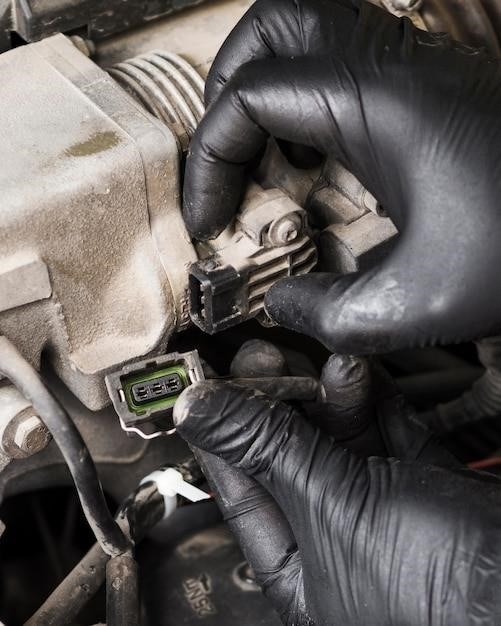
Instructions: The EGR system is integrated with the truck’s ECU via several sensors. You must locate and disconnect the EGR temperature sensor, the EGR valve motor plug, and the vacuum solenoid lines. On the 6.7 Powerstroke, these are primarily located on the passenger side near the firewall and on the top of the EGR cooler itself. Use a pick tool to gently slide the red or gray locking tabs back before pressing the release lever. If you force these, the heat-cycled plastic will snap, making reconnection difficult if you ever need to return to stock. Neatly tuck the wiring harness back toward the firewall and secure it with a zip tie to keep it out of the way for the heavy lifting in the next steps.
Pro Tip: Spray the electrical connectors with a quick blast of compressed air before disconnecting them to ensure no grit gets inside the pins.
Step 4: Exhaust Manifold Hardware Removal
What you need: 13mm deep socket, 13mm ratcheting wrench, and a high-quality penetrating oil (like PB Blaster or Liquid Wrench).
Instructions: This is the most critical and difficult part of the delete. The EGR cooler is fed by the exhaust manifold via a “crossover” or “EGR feed” pipe. The bolts holding this pipe to the manifold are subjected to extreme heat and are often rusted. Spray these bolts liberally with penetrating oil and let them soak for at least 30 minutes. Using a 13mm socket, carefully apply steady pressure to the two bolts on the exhaust manifold. If they feel like they are going to snap, stop, apply more oil, and apply a small amount of heat with a torch if necessary. Once the bolts are out, remove the gasket. You will now have an open port on the passenger side exhaust manifold which will later be covered by a block-off plate.
Pro Tip: Use a long extension and a swivel joint to reach the manifold bolts from the wheel well for a straighter, more secure grip on the bolt heads.
Step 5: Extracting the EGR Cooler Assembly
What you need: 10mm and 13mm sockets, and a second set of hands if available.
Instructions: There are several mounting bolts (usually four to six depending on the specific kit and year) that secure the heavy EGR cooler to the engine block. Most are 10mm or 13mm. Once these bolts are removed, the cooler will still be attached via two coolant hoses. Carefully pull the quick-disconnect clips on the coolant lines. Be prepared for a small amount of residual coolant to spill. With the lines free and the bolts removed, grasp the EGR cooler assembly and lift it up and out of the engine bay. It is surprisingly heavy and awkward, so be careful not to damage the plastic fuel lines or the wiring harness as you navigate the assembly out of the tight engine compartment.
Pro Tip: Lay a thick moving blanket over the passenger side fender to prevent the heavy metal cooler from scratching your paint as you lift it out.
Step 6: Installing Block-Off Plates and Coolant Bypass
What you need: The EGR delete kit (plates, gaskets, and bypass hose) and a torque wrench.
Instructions: Now that the cooler is gone, you must seal the system. Take the exhaust manifold block-off plate and install it using the factory hardware or the hardware provided in your kit. Ensure the gasket is seated perfectly; an exhaust leak here will cause a loud ticking noise and soot buildup in the engine bay. Torque these to approximately 25 ft-lbs. Next, install the intake manifold block-off plate. Finally, you must address the coolant lines. Most kits provide a silicone bypass hose. Connect this hose to the two open coolant ports where the EGR cooler was previously connected. This allows the coolant to continue circulating through the secondary system correctly. Tighten the hose clamps securely, ensuring they are positioned past the bead roll on the metal tubes.
Pro Tip: Apply a tiny dab of high-temp RTV silicone to the exhaust block-off gasket to hold it in place while you start the bolts.
Step 7: Tuning the ECU and Reassembly
What you need: A diesel programmer/tuner (e.g., EZ LYNK, SCT, or Mini Maxx) with “delete” tunes loaded.
Instructions: Crucial: Do NOT attempt to start the truck without installing a custom tune first. If you start the engine with the EGR removed but the factory software active, the truck will immediately go into “limp mode” and throw multiple Check Engine Light (CEL) codes. Connect your tuner to the OBDII port under the dashboard. Follow the on-screen prompts to “flash” the ECU with the delete-compatible tuning. This software tells the truck’s computer to ignore the missing EGR sensors and closes the logic loop for the exhaust system. Once the tune is successfully flashed, reinstall your CAC pipe and air intake assembly. Double-check all clamps for tightness to prevent boost leaks.
Pro Tip: Keep your battery on a charger during the tuning process. If the battery voltage drops while the ECU is being flashed, it can “brick” the computer, requiring a costly replacement.
Step 8: Refilling Coolant and Final Leak Test
What you need: New coolant and a vacuum coolant filler (optional but recommended).
Instructions: Refill the primary and secondary cooling systems with the fresh Motorcraft coolant you purchased earlier. Since the 6.7 Powerstroke cooling system is complex, air pockets are common. If you have a vacuum filler, use it to ensure no air is trapped. If not, fill the degas bottles to the “cold” line, start the engine, and turn the heater on high. Monitor the coolant levels as the engine reaches operating temperature. Check the exhaust manifold plate for any signs of soot or “puffing” sounds. Check the coolant bypass hose for any drips. Once the engine is up to temp and no leaks are found, take a short test drive, then re-check the coolant levels once the engine cools back down.
Pro Tip: Re-torque the exhaust manifold block-off plate bolts after one week of driving, as the heat cycles can cause the hardware to settle.
✅ Final Checklist
- Verify all electrical connectors are secured and zip-tied away from heat sources.
- Ensure the exhaust manifold block-off plate is tight and shows no signs of soot leakage.
- Confirm the coolant bypass hose clamps are tight and there are no visible green/orange/yellow fluid drips.
- Check that the ECU tune has been successfully applied and no “EGR Flow” codes are present on the dashboard.
- Verify that the CAC pipe (Cold side) is properly seated and the spring clips are locked to prevent a “boots blowing off” scenario under load.
Important Notes:
- Safety Warning: Exhaust components can stay hot for hours. Always wear eye protection and gloves when working with cooling systems and rusted exhaust hardware.
- When to Seek Professional Help: If you snap a bolt in the exhaust manifold, it may require drilling and tapping. If you are not comfortable with extractors, contact a professional mechanic.
- Estimated Time: 4 to 7 hours depending on mechanical experience and the amount of rust on the vehicle.
- Estimated Cost: $150–$300 for the hardware kit; $500–$1,200 for a compatible tuner and custom software.
The Role of ECU Tuning in the EGR Delete Process
Why Software Must Precede Hardware
You cannot physically remove the EGR components before installing a “delete-capable” tune on your truck’s Engine Control Module (ECM). The 6.7 Power Stroke relies on a network of sensors—including EGR pressure and temperature sensors—to manage fuel mapping and turbocharger vanes. If you remove the hardware without a tune, the truck will immediately enter “Limp Mode,” severely limiting power and potentially preventing the engine from starting. The tune tells the ECM to ignore the missing EGR data and shuts off the commands to the EGR valve, allowing the engine to run smoothly without the physical components present.
Selecting and Installing the Tuning Platform
Common platforms like EZ LYNK or SCT are standard for this process. You should download and install the “off-road” or “delete” tune while the truck is still fully assembled. Once the tune is successfully flashed, start the truck briefly to ensure no new error codes appear. This confirms the software is communicating correctly with the ECM. Only after verifying the software should you begin the teardown process. This sequence ensures that if a software glitch occurs, you haven’t already rendered the truck immobile by pulling the engine apart.
- EGR Valve Command: The tune sets this to “closed” permanently.
- Sensor Suppression: Disables Diagnostic Trouble Codes (DTCs) related to exhaust recirculation.
- VGT Calibration: Adjusts turbo vane logic to account for the change in backpressure.
Phase 1: Cooling System Drainage and Intake Removal
Draining the Primary and Secondary Cooling Loops
The EGR cooler on the 6.7 Power Stroke is integrated into the engine’s cooling system, meaning you must drain the coolant to avoid a massive mess in the engine valley. Locate the petcock on the bottom of the radiator. You need to drain both the primary (engine) and secondary (intercooler/EGR) loops. Expect to pull roughly 3 to 5 gallons of fluid. If the coolant is clean and relatively new, you can reuse it, but most technicians prefer starting with fresh Motorcraft Yellow coolant to ensure the system remains free of contaminants.
Clearing the Path: Intake and Intercooler Piping
To reach the EGR cooler, you must remove the upper intake assembly. Start by disconnecting the Mass Air Flow (MAF) sensor and removing the air filter housing. Use your 11mm socket to loosen the clamps on the cold-side intercooler pipe (the large plastic or aftermarket pipe on the driver’s side) and set it aside. Next, remove the “butterfly” valve or throttle body assembly located at the front of the intake. Be careful with the electrical connectors; Ford uses “push-pull” locking tabs that become brittle with age. Once the piping is clear, you will have a direct line of sight to the EGR cooler assembly sitting atop the passenger side valve cover.
- Disconnect Batteries: Always start by disconnecting both negative terminals to prevent electrical shorts.
- Remove the Crankcase Vent: Pull the CCV tube that crosses over the top of the engine.
- Unbolt the Heat Shield: Remove the small 8mm bolts holding the thermal shielding over the EGR manifold.
Understanding Secondary Cooling System Management
The Dual Cooling Loop Challenge
One of the most unique aspects of the 6.7 Power Stroke is its dual-loop cooling system. Unlike older diesel engines, this truck uses a primary cooling circuit for the engine block and a secondary cooling circuit for the EGR cooler, charge air cooler (CAC), and fuel system. When you remove the EGR cooler, you are essentially modifying the secondary loop. It is vital to understand that this system operates at lower temperatures and pressures than the main engine loop, meaning air pockets can be harder to flush out.
Practical tips for managing this system include:
- Monitor the Degas Bottle: Keep a close eye on the secondary coolant reservoir level for the first 500 miles. It is common for the level to drop slightly as trapped air finally works its way out of the CAC.
- Vacuum Filling: While many enthusiasts rely on gravity, using a vacuum-refill tool is the gold standard. It ensures that no air pockets remain in the secondary radiator, which could otherwise lead to localized hot spots.
- Identify the Radiators: Remember that the secondary radiator is the smaller one located in front of the main radiator. Ensure there are no obstructions to airflow after reassembling your front-end components.
Preventing Air Locks and Overheating
An air lock in the secondary system is more than just an annoyance; it can lead to erratic temperature readings or even damage to the transmission cooler, which is also linked to this circuit. After the delete, the coolant flow path is simplified, but the risk of a “burp” remains. Always perform at least three full heat cycles (letting the truck reach operating temperature and then cooling completely) before considering the job finished.
Post-Installation Inspection and Performance Optimization
Verifying Seal Integrity and Soot Leaks
Once the hardware is installed, the real work begins with a thorough inspection. The 6.7 engine bay is cramped, and even a tiny misalignment on a block-off plate can lead to a messy soot leak or a persistent coolant drip. Since the exhaust manifold plates are subject to extreme heat cycles, they can expand and contract, potentially loosening hardware that wasn’t torqued to spec.
Consider these inspection focal points:
- The “Soot Trace”: After a week of driving, look for fine black dust around the exhaust manifold block-off plates. This is a tell-tale sign of an exhaust leak.
- Coolant Hose Friction: Ensure that any bypassed coolant lines are secured with zip ties and are not rubbing against the steering shaft or sharp engine components.
- Re-Torque Schedule: It is highly recommended to re-check the tightness of all mounting bolts after the first 1,000 miles to account for thermal expansion.
Digital Monitoring and Software Synchronization
The hardware delete is only half the battle; the engine’s ECU must be informed of the change. Without a proper “delete tune,” the truck will immediately enter limp mode and throw various P-codes related to EGR flow. Beyond just clearing codes, you should use a digital monitor to track your Exhaust Gas Temperatures (EGTs). Without the EGR system recirculating hot air, you should notice a significant drop in intake air temperatures, which leads to cleaner combustion and better throttle response. Use your tuner to verify that the EGR valve position is reading zero and that the mass airflow (MAF) sensors are compensating correctly for the increased fresh air volume.
Conclusion
Completing an EGR delete on a 6.7 Power Stroke is a major step toward long-term reliability and reduced maintenance costs. By removing the risk of coolant contamination and soot buildup in the intake, you are allowing your engine to breathe cleaner and run cooler. However, the success of the project relies on more than just the physical removal; it requires careful management of the secondary cooling system and diligent post-installation monitoring.
As your next steps, ensure your tuning software is up to date and perform a thorough leak check after your first long-distance drive. If you found this guide helpful, stay tuned for more Power Stroke maintenance tips to keep your truck on the road for years to come!
❓ Frequently Asked Questions
Why is the secondary cooling system important during an EGR delete?
The 6.7 Power Stroke utilizes a dual-cooling system; the secondary loop manages the EGR cooler temperature. Properly draining and rerouting this loop is critical to prevent air pockets and ensure the remaining components, like the intercooler, function correctly.
What specific tools are required for the hard-to-reach bolts?
You will need a variety of 8mm, 10mm, and 13mm sockets, along with several long extensions and universal swivels. A magnetic pick-up tool is also essential for retrieving bolts dropped near the firewall.
Is it necessary to remove the intake manifold?
No, you do not need to remove the entire intake manifold, but you must remove the upper plastic intake piping and the air filter assembly to gain enough clearance for the cooler removal.
How do I handle the EGT sensors during the delete?
Most kits require you to disconnect the sensors, though some performance tunes allow you to reinstall one sensor into the new block-off plate to continue monitoring exhaust gas temperatures safely.
What are the risks of performing an EGR delete without a tune?
If you remove the hardware without flashing the ECM, the truck’s computer will detect a failure in the exhaust gas recirculation system, immediately putting the engine into a severely derated ‘limp mode.’
Should I keep the removed EGR components?
Yes, it is expert advice to clean and store the factory EGR cooler and piping in a dry place in case you ever need to return the vehicle to its stock configuration.