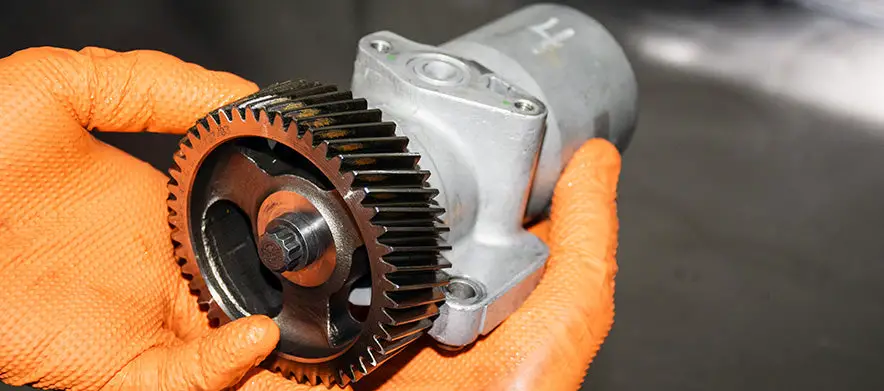
6.0 Powerstroke HPOP Failure: Top Symptoms & Diagnostics
The most definitive sign of Ford 6.0 HPOP failure is a hot no-start condition, occurring because thinned oil escapes through worn internal components or seals. To confirm a failure, you must verify that the engine is reaching the minimum 500 PSI of Injection Control Pressure (ICP) required for the injectors to fire.
🎯 Key Takeaways
- Identify ‘hot no-start’ as the primary indicator of high-pressure oil issues.
- Monitor ICP sensor data to ensure at least 500 PSI during cranking.
- Check IPR duty cycle; values over 85% indicate a major pressure leak.
- Distinguish between 2003-04 cast iron pump failure and 2005-07 fitting leaks.
- Perform an air test to isolate pump failure from standpipe or dummy plug leaks.
If your 6.0 Powerstroke runs perfectly when cold but refuses to restart after a quick trip to the gas station, your High Pressure Oil Pump (HPOP) is likely failing. This specific failure is one of the most frustrating 6.0 issues because it leaves you stranded only when the engine is at operating temperature. Understanding the mechanics of this failure is essential to avoid throwing expensive parts at a problem that requires a surgical diagnostic approach.

Identifying a failing HPOP involves more than just reading trouble codes. You need to look at how the oil pressure behaves under stress. Because the 6.0 uses high-pressure oil to fire the fuel injectors, even a small internal leak in the pump or its discharge fitting will prevent the engine from building the necessary pressure to start. Let’s break down the tell-tale behaviors and the data points you need to confirm the pump is truly the culprit.
Core Behavioral Symptoms of Ford 6.0 HPOP Failure
The Infamous Hot No-Start Condition
The hallmark of a dying HPOP is the Hot No-Start. To understand why this happens, you have to think about oil viscosity. When your engine is cold, the oil is thick and syrupy. Even if your pump has worn internal gears or a small leak, the thick oil creates enough resistance to build the 500 PSI required to fire the injectors. Your truck will likely fire right up in the morning without any hesitation, masking the underlying issue.

However, as the engine reaches operating temperature, the oil thins out significantly. In a healthy system, this isn’t an issue. But in a failing HPOP system, that thin oil escapes through internal wear points or blown seals much faster than the pump can pressurize it. When you turn the truck off and try to restart it, the pump cannot move the thin oil fast enough to hit that 500 PSI threshold. You are left cranking the engine until the starter gets tired, but the injectors never fire because the oil pressure is bleeding away internally. If you wait three or four hours for the engine to cool and the oil to thicken, the truck will magically start again.
- Cold starts are immediate: The truck fires up perfectly after sitting overnight because the oil is thick.
- Long crank times: You notice the engine takes 5-10 seconds longer to start after it’s been running for an hour or more.
- Unexpected stalling at idle: The truck may die at a stoplight once it reaches operating temperature because the pump can no longer maintain the minimum pressure needed to keep injectors firing at low RPMs.
- Gradual power loss: As the pump fails, you may notice a “lazy” throttle response or a slight miss when the engine is hot, as the pump struggles to keep up with high-demand acceleration.
Critical Diagnostic Data: Interpreting ICP and IPR Values
Key Pressure Thresholds and Duty Cycles
To stop guessing and start diagnosing, you must use a monitor (like an Edge Insight, Scangauge, or Forscan) to look at your Injection Control Pressure (ICP) and your Injection Pressure Regulator (IPR) duty cycle. These two numbers tell the story of your pump’s health. The ICP tells you how much pressure the pump is actually producing, while the IPR duty cycle tells you how hard the computer is working the pump to get that pressure.
During a healthy start, you should see the ICP climb rapidly past 500 PSI. If you are cranking a hot engine and the ICP is hovering at 200 or 300 PSI, the injectors will stay closed. This is where the IPR percentage becomes the “smoking gun.” The IPR duty cycle is measured from 15% to 85%. At a hot idle, a healthy system usually sits between 22% and 24%. If you see your IPR duty cycle climbing toward 85% while the truck is just idling or during a no-start crank, it means the computer is commanding the valve to close completely to build pressure, but the pressure isn’t staying in the system. This indicates the pump is either worn out or dumping its volume through a major leak.
- ICP Pressure: Minimum 500 PSI is required for the Fuel Injection Control Module (FICM) to trigger the injectors. Anything less results in a no-start.
- IPR Duty Cycle (Idle): 15% to 30% is the normal range at operating temperature. If you are seeing 40% or higher at idle, your pump is struggling.
- IPR Duty Cycle (Cranking): If it hits 85% and the engine won’t start, you have a massive high-pressure oil breach or a dead pump.
- ICP Voltage: Look for 0.18V to 0.24V with the key on and engine off (KOEO). If it’s higher, your sensor may be biased and giving false readings, which can mimic HPOP failure.
Another quick diagnostic trick involves the ICP sensor itself. If your truck won’t start hot, try unplugging the ICP sensor. This forces the engine computer to use a default “limp mode” value for oil pressure. If the truck starts with the sensor unplugged, the sensor was likely sending a bad signal. If it still won’t start, the mechanical side of the high-pressure system—most likely the pump or the STC fitting—is the culprit. In the next section, we will look at how the failure points differ between the early and late model 6.0 engines.
Model Year Variations: 2003-2004 vs. 2005-2007 HPOP Issues
The 6.0 Powerstroke evolved significantly during its production run, and the high-pressure oil system is where those changes are most apparent. Depending on your truck’s model year, a “failed pump” could mean two very different mechanical realities. Knowing which version you have is the first step in accurate troubleshooting.

The Early Swash-Plate Pump (2003 – Early 2004)
Owners of early 6.0 models deal with an HPOP design featuring an aluminum housing and a swash-plate internal mechanism. These units are notorious for internal mechanical failure. When these pumps go, they typically fail completely, leaving the truck in a “no-start” condition. Because the housing is aluminum, internal wear can eventually lead to a total loss of ability to generate pressure.
- Common Failure: Internal mechanical breakdown of the pump itself.
- Symptom Profile: Often results in a sudden, permanent “no-start” regardless of engine temperature.
- Pro Tip: If you have an early 2004, check your ICP sensor location. If it is behind the turbo on the HPOP cover, you have the early-style pump.
The Late Gear-Driven Pump (2005-2007)
In 2005, Ford switched to a cast-iron, gear-driven pump. These pumps are remarkably robust; in fact, the pump itself rarely “breaks” mechanically. Instead, the failure points are almost always the seals and fittings surrounding it. The most famous culprit is the Snap-to-Connect (STC) fitting, which can pop loose or leak, causing a massive drop in oil pressure that mimics a dead pump.
- Common Failure: STC fitting leaks or O-ring degradation in the high-pressure standpipes.
- Symptom Profile: Frequently manifests as a “hot no-start”—the truck runs fine until it reaches operating temperature, then refuses to restart after being turned off.
Differentiating Pump Failure from High-Pressure Oil System Leaks
One of the most expensive mistakes a 6.0 owner can make is replacing a perfectly good high-pressure oil pump when the real issue is a simple O-ring leak. Since the symptoms are nearly identical, you have to look closely at how the system is behaving under load.
Analyzing IPR Duty Cycle
The Injection Pressure Regulator (IPR) is the “brain” that controls how much oil pressure the pump builds. By monitoring the IPR Duty Cycle with a scan tool, you can see how hard the pump is working to maintain pressure. At a warm idle, a healthy system should show an IPR duty cycle around 22% to 24%. If your scan tool shows 30%, 50%, or even 85% at idle, the system is screaming that it has a leak. The pump is spinning, but the oil is escaping before it reaches the injectors.
Common Leak Points vs. Mechanical Death
Before condemning the pump, professional technicians look for “path of least resistance” failures. In 2005-2007 trucks, the standpipes and dummy plugs are the most frequent offenders. These components use rubber O-rings that eventually flatten and brittle over time. When the oil is hot and thin, it slips past these seals, preventing the ICP (Injection Control Pressure) from reaching the 500 PSI required to fire the injectors.
- The Heat Test: If the truck starts perfectly when the engine is cold (oil is thick) but struggles when hot (oil is thin), you almost certainly have a leak at a seal or fitting rather than a failed pump.
- IPR Screen Inspection: Always pull the IPR valve and check the mesh screen. If the screen is torn or pushed in, it’s a sign that debris from a failing HPOP or oil cooler has entered the system.
Conclusion
Diagnosing a 6.0 Powerstroke HPOP failure requires a mix of data monitoring and an understanding of your specific model year’s quirks. Whether you are dealing with a catastrophic mechanical failure in an early ’03 or a pesky STC fitting leak in an ’06, the symptoms—long cranks, stalling, and power loss—all point to a struggle for oil pressure. By identifying these signs early, you can avoid being stranded and ensure your engine remains reliable for years to come.
Next Steps: Connect a dedicated monitor to your OBD-II port to track your ICP and IPR values in real-time. If you see your IPR duty cycle creeping up, it’s time to inspect your high-pressure system before a “hot no-start” catches you off guard. Stay proactive and keep that 6.0 humming!
❓ Frequently Asked Questions
Why does my Ford 6.0 start when cold but not when hot?
When engine oil is cold, it is thicker and the HPOP can maintain enough pressure to start. As the oil heats up and thins out, it easily leaks past worn pump internals or degraded seals, preventing the system from reaching the 500 PSI threshold required for ignition.
How do I know if the problem is the HPOP or the ICP sensor?
Unplug the ICP sensor; if the truck starts, the sensor was likely sending biased data to the PCM. If it still won’t start, the issue is likely mechanical, such as a failing HPOP or a high-pressure oil leak.
What are the failure differences between early and late 6.0 HPOPs?
The 2003-2004 cast iron pumps are prone to internal mechanical failure. In contrast, the 2005-2007 aluminum pumps are very durable, but the ‘Snap to Connect’ (STC) fitting on the back of them is a notorious failure point that mimics pump failure.
What IPR values should I see on a healthy 6.0 Powerstroke?
At a warm idle, a healthy 6.0 should show an IPR duty cycle between 21% and 24%. If you see idle values climbing toward 30% or higher, it indicates the pump is compensating for a developing leak or internal wear.
Can a leak in the standpipes or dummy plugs look like HPOP failure?
Absolutely. Leaks at the standpipes, dummy plugs, or injector top seals are far more common than actual pump failure on 2005-2007 models and will produce the exact same symptoms, such as stalling and hot no-starts.
Is it possible for the HPOP to cause engine surging?
Yes, if the HPOP is struggling to maintain a steady pressure or if the IPR valve is sticking, the engine may surge at idle or under load as the PCM tries to stabilize the injection pressure.