
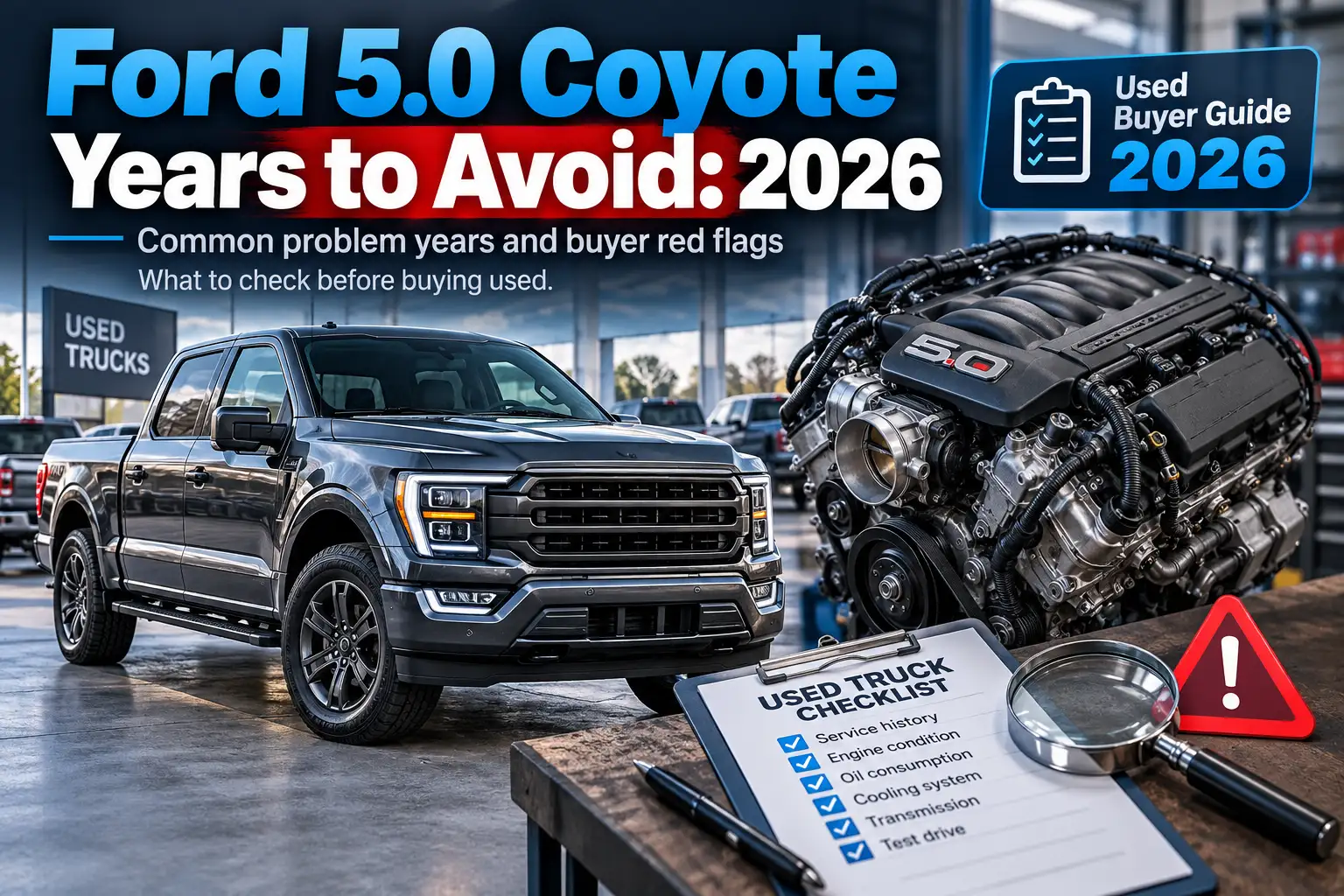
Ford 5.0 Coyote Years to Avoid: 2026 Before Buying Used

The Ford 5.0 Coyote years to avoid are not a simple list of bad engines. For used F-150 buyers, 2018 to 2020 deserve the closest scrutiny because Ford documented an excessive oil-consumption condition in some 5.0L trucks. That does not mean every truck from those years burns oil or needs an engine replacement.
If you want a practical starting point, 2015 to 2017 F-150 5.0L models are appealing used choices, especially when paired with the six-speed automatic and supported by maintenance records. Older trucks and newer Coyotes can also be worthwhile, but their condition matters more than a blanket year ranking.
This guide focuses on the F-150, separates Mustang-specific concerns, and shows what evidence should change your buying decision.
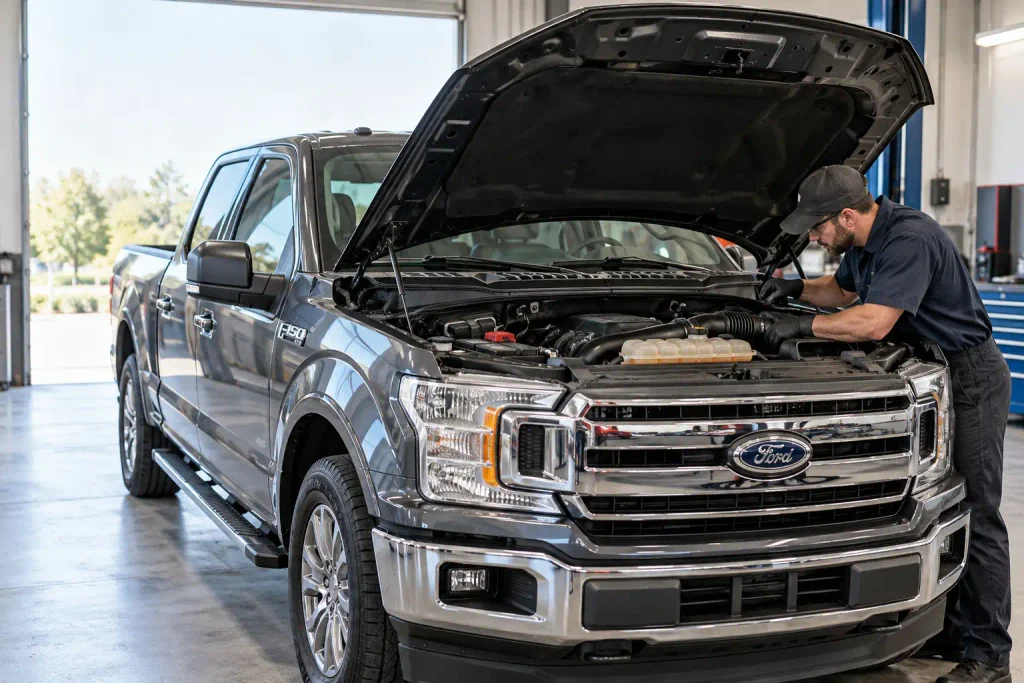
FordMasterX / Used-Engine Buying Guide
Which 5.0 Coyote Years Need a Closer Look?
For Ford F-150 buyers. These are inspection priorities, not measured engine failure rates or automatic year-wide verdicts.
Older, budget-friendly option
Check age-related wear, cooling-system condition, rust and service history. Do not reject solely by year.
Strong place to start
Consider a well-maintained 5.0L with the 6R80 six-speed. Verify engine, transmission and maintenance condition.
Verify oil-use history
Some F-150 5.0L trucks fall within Ford’s oil-consumption bulletin. Confirm repairs and current condition.
Newer does not mean risk-free
Review oil consumption, maintenance, diagnostic findings and 10-speed transmission behavior.
Ford TSB 19-2365 documents possible oil consumption of more than 1 quart in 3,000 miles without visible leaks on some 2018–2020 F-150 5.0L trucks. This is not a failure-rate estimate.
The 3 checks before you buy
- 1 Confirm VIN, model year and engine
- 2 Review oil-use and repair records
- 3 Get an independent inspection
Editorial buying guidance for F-150 5.0L models. Do not apply F-150 service-bulletin conclusions directly to Mustang GT vehicles. Source for the oil-use condition: Ford TSB 19-2365.
Which 4 Factors Change a Coyote Buying Decision
Recommended Best Deal Products


Four factors determine whether to shortlist, inspect, or reject a used Coyote.
Model and Engine Year
First, confirm whether you are buying an F-150 or Mustang GT, along with its actual engine and build information. The vehicles share an engine family, but not every service bulletin.
Actual Oil Consumption
Ask how much oil was added between changes, over what distance, and whether leaks were ruled out. A single dipstick reading cannot establish a consumption rate.
Maintenance and Repair Evidence
Ask for oil-change records and dealer repair invoices, not just verbal claims of completed updates.
Transmission and Overall Condition
Rough shifts, overheating, or tuning history can outweigh a preferred engine year.
Why 2018 to 2020 F-150s Need Extra Scrutiny
Excessive oil consumption is the strongest manufacturer-documented reason to approach some 2018 to 2020 F-150 5.0L trucks cautiously. Ford’s Technical Service Bulletin 19-2365, dated December 2019, describes some vehicles consuming more than 1 quart of oil in 3,000 miles without visible leaks.
Ford identified high intake-manifold vacuum during certain deceleration fuel shut-off events as a possible reason oil could enter the combustion chamber. The bulletin instructs technicians to inspect for leaks, change the engine oil and filter, and reprogram the powertrain control module. Vehicles built on or before October 4, 2019 also receive a revised oil-level indicator under that procedure.
The revised indicator uses a wider 2-quart normal operating range. A revised dipstick does not prove oil consumption stopped. The bulletin also directs visibly leaking engines to a different diagnostic path.
Before buying one of these trucks, request the service invoice and ask for oil-level records after the work was completed. A software update alone cannot prove the problem is resolved. Have a dealer check current VIN-specific service guidance.
For year-specific fill quantities and oil specifications, use the separate Ford 5.0 Coyote oil capacity chart and confirm the final specification in the correct owner’s manual. Do not confuse a wrong fill amount with confirmed internal oil consumption.
Buying decision: Consider a 2018 to 2020 5.0 only if the inspection is satisfactory and any past oil-use complaint has a credible documented outcome. If consumption remains unexplained or the seller refuses further checks, choose another truck.
When a 2015 to 2017 Coyote Is Better
Recommended Best Deal Products

The 2015 to 2017 F-150 with the 5.0L V8 and 6R80 six-speed automatic is a sensible first shortlist for buyers who prioritize a relatively straightforward used V8 powertrain. It predates the 2018 F-150 5.0L redesign and the later 10R80 pairing.
Some owners favor this familiar drivetrain, but no controlled failure-rate comparison proves it outlasts every newer Coyote.
Inspect for leaks, rough running, transmission problems, rust, and accident damage. Match the mileage against service records; heavy towing without documented maintenance changes the risk.
Buying decision: Shortlist well-maintained 2015 to 2017 trucks, but still require a pre-purchase inspection.
Should You Avoid 2011 to 2014 Coyote Engines
No. The 2011 to 2014 F-150 5.0L engines are not automatic rejects. These earlier trucks can still fit a tighter budget, although age, accumulated mileage, corrosion, and deferred repairs increasingly influence their value.
Early Coyote engines use port fuel injection. A claim that these model years developed direct-injection carbon buildup because of their factory injection design is incorrect. Evaluate the engine actually installed rather than importing problems from later versions or other Ford engine families.
Inspect cooling hoses, oil leaks, overheating history, idle quality, and noises. Check the chassis for rust and worn safety-critical components.
Ask for records of cooling-system repairs; a clean engine bay does not prove a healthy system.
Buying decision: Consider one when price and condition align. Reject severe corrosion, overheating, or unexplained mechanical symptoms.
Are 2021 and Newer F-150 Coyotes Safer
A newer Coyote is not automatically a safer purchase. The updated 2021-onward F-150 5.0L is outside the stated 2018 to 2020 application of Ford TSB 19-2365, but that fact alone does not prove newer engines never consume oil.
Newer hardware and lower age are advantages, but newer model years also have less long-term ownership evidence.
For a 2021 or newer F-150, review oil-change records, note any unexplained oil top-offs, and check for current service complaints. FordMasterX has a separate discussion of 2021 F-150 5.0 oil consumption if that issue is central to a listing you’re considering.
Buying decision: Consider a well-maintained 2021-plus truck based on inspection, not claims that all issues disappeared.
How Mustang GT Coyote Risks Differ From F-150
A Mustang GT and F-150 may share the Coyote engine family without sharing every reliability concern. The engines have model-specific calibrations, performance targets, and component variations, so a truck-only bulletin cannot establish which Mustang years to avoid.
The Ford Performance Coyote technical reference groups the Mustang GT versions as Gen 1 for 2011 to 2014, Gen 2 for 2015 to 2017, and Gen 3 beginning in 2018. It describes changes in cylinder heads, camshafts, and fuel injection. Those Mustang specifications should not be copied unchanged into an F-150 spec sheet.
For a Mustang, examine its year, tune, modifications, and track-use history. Undocumented changes increase uncertainty.
FordMasterX also covers Gen 3 Coyote engine specifications separately. Those performance details help explain the redesign, but they do not provide a Mustang-specific failure-rate ranking.
Do not apply the F-150 bulletin to a Mustang without Mustang-specific evidence.
Which 3 Engine Noises Change the Buying Decision
Not every Coyote tick indicates failure. Match the sound to its operating conditions.
Hot Idle Typewriter Tick
Ford’s SSM 52334 describes a typewriter-like tick on some 2011 to 2024 Mustang and F-150 5.0L engines. It may be heard after an oil change once engine temperature reaches approximately 150°F (65°C), at idle or up to about 1,700 rpm. Ford identifies that particular sound as an operating characteristic without a durability effect.
The description is specific. It does not mean all ticks, knocks, or rattles can be ignored.
Rattle During Acceleration or Deceleration
Ford’s TSB 18-2354 addresses a particular rattle on some 2018 F-150 5.0L trucks during deceleration from about 1,500 to 800 rpm or tip-in acceleration around 2,000 rpm. The bulletin calls for PCM reprogramming when the symptom and vehicle match.
Ask whether that service was performed. A different rattle needs its own diagnosis rather than automatic treatment under this bulletin.
Knocking With Other Warning Signs
Persistent heavy knocking, low oil pressure, misfires, abnormal exhaust smoke, or power loss should trigger an independent diagnosis before purchase. These symptoms do not identify a failed component by themselves, but they make an ordinary test drive an inadequate basis for buying.
Buying decision: Insist on diagnosis for serious unexplained noise.
How to Check a Used Coyote in 6 Steps
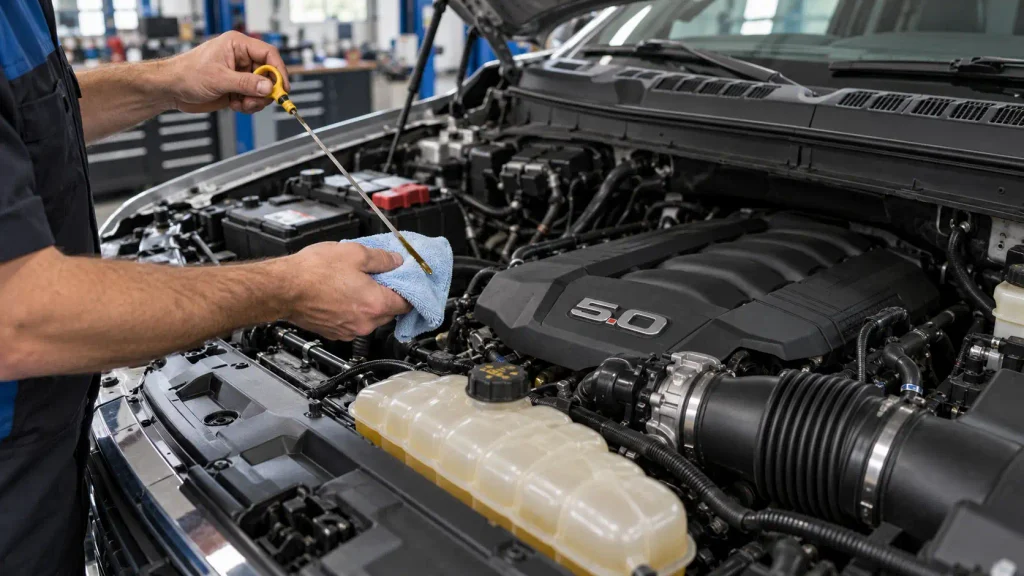
Use the same inspection sequence for every listing. Adjust the questions to the model year and stop if the seller refuses a reasonable mechanical check.
- Confirm the VIN, engine, and model year. Compare the listing with the VIN, vehicle identification label, and engine configuration. Look up open safety recalls by VIN through NHTSA or Ford. Recall results do not show every TSB repair, so ask a dealer separately about relevant service information.
- Review maintenance and repair records. Look for dated oil services, cooling-system repairs, relevant software updates, and detailed invoices. For a 2018 to 2020 truck, ask specifically about past oil-consumption complaints and whether Ford’s service procedure was completed. Missing records are uncertainty, not proof of a defect.
- Evaluate the oil-level history. Check the dipstick using the model’s correct procedure and inspect for visible leaks. Ask the owner how much oil was added between changes and over what distance. For example, repeated documented additions totaling more than a quart over 3,000 miles warrant investigation on a truck within the applicable TSB range. A quick test drive cannot establish long-term consumption.
- Listen when cold and fully warm. Arrange to hear the engine before it has been started that day, then again at operating temperature. Note start-up behavior, idle quality, smoke, and noises under controlled acceleration. Do not assume that a normal typewriter tick explains a separate knock or rattle.
- Scan and test the full powertrain. Have a qualified technician check stored, pending, and relevant history codes. During an approved road test, note delayed engagement, slipping, harsh shifts, overheating, and warning lights. For repeatable shifting concerns, use the separate Ford 10R80 transmission problems guide to understand why proper diagnosis matters more than a guess about the engine.
- Get an independent pre-purchase inspection. Ask a shop familiar with Ford trucks to evaluate the engine, cooling system, leaks, transmission, underbody, and any suspicious symptoms. Request a written report. If the truck has an unresolved major concern, obtain a firm diagnosis before negotiating or move to a different listing.
Refusal of inspection is a reason to move on.
Which Coyote Year Should You Buy or Reject
Start with 2015 to 2017 F-150 5.0L trucks, then compare the condition and repair records of individual alternatives. This matrix is an editorial buying guide, not a manufacturer reliability score or a statistical ranking of engine failures.
| F-150 Model Years | Main Buying Condition | Practical Decision |
|---|---|---|
| 2011 to 2014 | Good maintenance, healthy cooling system, acceptable age-related wear | Consider for a lower budget |
| 2015 to 2017 | Sound engine, six-speed operation checked, credible records | Preferred initial shortlist |
| 2018 to 2020 | Oil use evaluated, relevant work documented, satisfactory inspection | Buy only after added scrutiny |
| 2018 to 2020 | Active unexplained oil use or refusal of inspection | Pass until properly diagnosed |
| 2021 and newer | Current condition, records, drivetrain inspection | Consider individually |
The truck’s inspection matters more than its online year ranking.
When to Walk Away From a Used Coyote
Walk away when the evidence points to an unresolved mechanical risk that the seller will not investigate. A desirable model year, trim, or price cannot compensate for uncertainty about a serious engine problem.
Be especially cautious if the truck needs repeated unexplained oil top-offs, shows low oil-pressure warnings, produces heavy knocking, overheats, or has recurring engine faults. Also investigate transmission slipping or repeated loss of gear engagement. A clean diagnostic scan does not rule out every mechanical fault.
A documented successful repair may be acceptable. Get the invoice and verify the truck works correctly now.
If the seller conceals records or refuses inspection, move on.
Which Coyote Should a Careful Buyer Choose
For most used F-150 shoppers, 2015 to 2017 5.0L models are the strongest starting shortlist, provided their maintenance records and inspection results support the purchase. The 2018 to 2020 trucks require extra attention because Ford documented a specific excessive oil-consumption concern in some examples. Earlier 2011 to 2014 trucks and 2021-plus models can also make sense when their condition, history, and price align.
The useful answer to Ford 5.0 Coyote years to avoid is therefore conditional. Avoid an individual truck with unexplained serious symptoms or unverified repairs, not every engine built during a particular year. Before paying a deposit, confirm the VIN, investigate the known year-specific concerns, and get an independent mechanical inspection.
5 Common Questions About Coyote Years to Avoid
What Are the Worst Years for the Ford 5.0 Coyote?
For used F-150 buyers, 2018 to 2020 deserve the most attention because Ford documented an excessive oil-consumption condition affecting some 5.0L trucks. These are caution years, not proof that every engine is defective. An actual purchase decision requires service records and inspection results.
Is the 2018 Ford F-150 5.0 a Bad Engine?
Not necessarily. Some 2018 F-150 5.0L engines fall within Ford’s oil-consumption bulletin, and Ford also documented a particular acceleration/deceleration rattle for that model year. A 2018 truck with a clear repair history and good independent inspection can still be considered.
Is the 2015 to 2017 Coyote More Reliable?
The 2015 to 2017 F-150 5.0L with the 6R80 is a useful initial shortlist and is frequently favored in owner discussions. However, that preference is not proof of a lower measured engine failure rate. Inspect mileage, maintenance, leaks, and transmission behavior before choosing a truck.
Did Ford Fix the 5.0 Oil Consumption Problem?
Ford published a service procedure for certain 2018 to 2020 F-150 5.0L oil-consumption complaints involving PCM reprogramming, oil service, and a revised oil-level indicator when applicable. That bulletin does not establish a guaranteed outcome for every engine. Verify completed work and the truck’s present oil usage.
Are Mustang Coyote Years to Avoid the Same as F-150?
No. The Mustang GT and F-150 share the Coyote engine family, but their specifications and service applications differ. Do not label a Mustang model year unreliable solely because an F-150-specific bulletin covers that year. Research the Mustang’s own records, modifications, and mechanical condition.