Ford 3.5 Timing Chain Marks Diagram: Full Marks by Chain Type

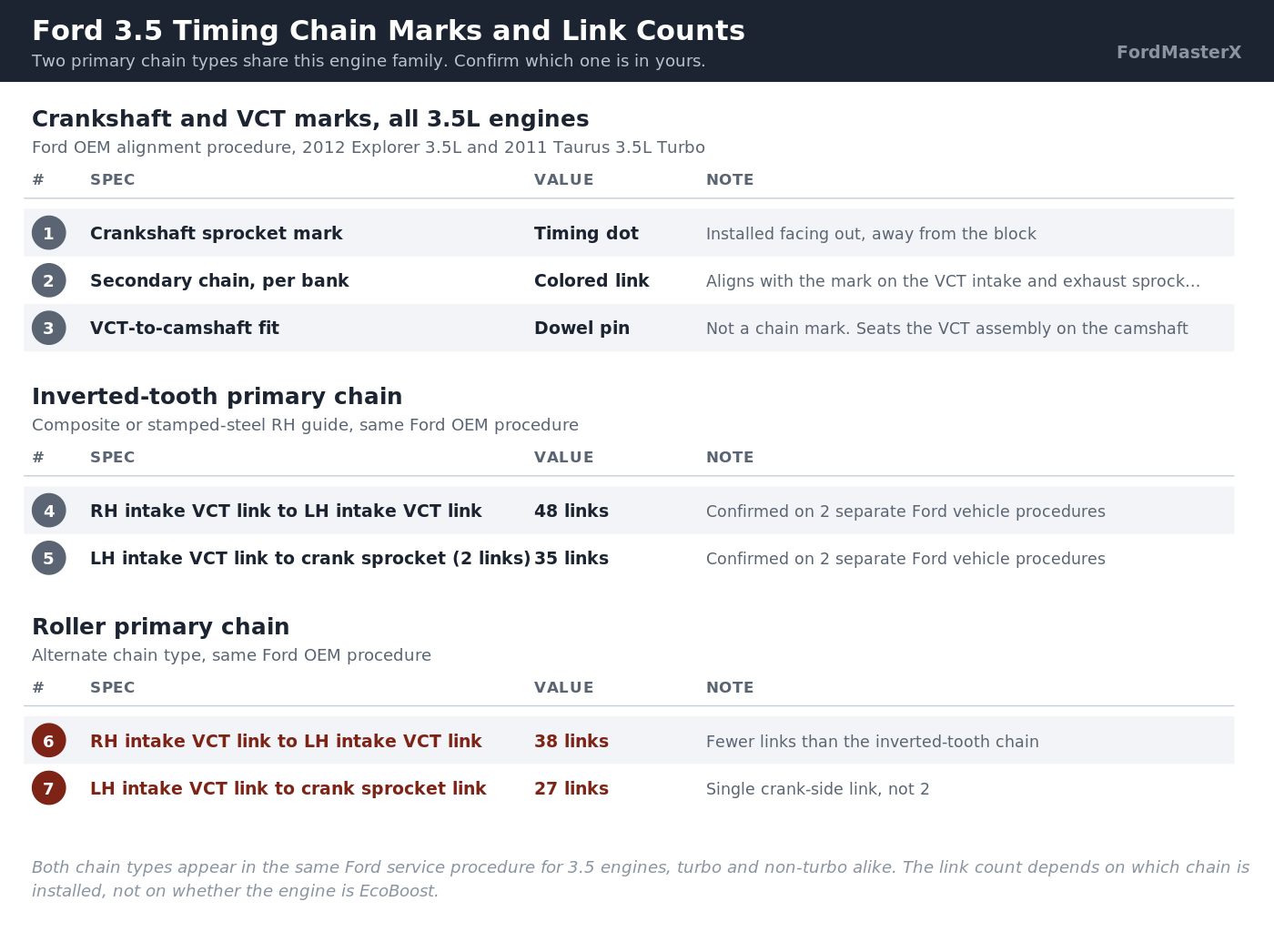
The Ford 3.5L V6, both the naturally aspirated Duratec 35 and the turbocharged EcoBoost, times its camshafts with colored chain links aligned to marks on the crankshaft sprocket and the VCT camshaft sprockets. The crankshaft mark is a timing dot, installed facing out.
Two different primary chains share this engine family, and they do not use the same link count between the marks. Confirm which chain is in your engine before you trust any single diagram, including this one.


I pulled this from Ford’s own OEM alignment procedures for two separate 3.5L applications, a professional trade diagnostic writeup, a parts-kit installation guide, and an owner forum thread that independently measured the same chain. Three sources agree on the core numbers. One torque figure does not, and I flag it below.
For the turbo hardware itself, see our F-150 3.5 EcoBoost turbo diagram. For the full engine layout, see our Ford 3.5 EcoBoost engine diagram.
Most Ford 3.5 timing chain diagrams do not say which chain you have


Ford’s own alignment procedure lists two separate primary chain designs on the exact same engine family. One uses an inverted-tooth chain with a composite or stamped-steel guide. The other uses a roller chain. Both appear in the same OEM service document, for the same 3.5L engine.
The two chain types do not share a link count. A generic diagram that shows one number as “the” Ford 3.5 timing chain spec is only right for half the engines it claims to cover.
An owner forum thread on Ford-Trucks.com independently measured an unmarked replacement chain, using teeth and side plates instead of colored links. The poster noted the chain hardware is shared across 3.5 naturally aspirated, 3.5 EcoBoost and 3.7 applications. Turbo versus non-turbo is not what decides which chain is in your engine.


Open the front cover and look at the chain before you trust either link count. Guess wrong and you retime the engine one tooth off.
Where are the marks, and how do they align?


The crankshaft sprocket carries a single timing dot. Ford’s procedure says to install the sprocket with that mark facing out, away from the block.
Each bank gets its own secondary timing chain, connecting the intake and exhaust camshafts through two VCT (Variable Camshaft Timing) phaser assemblies. Align the colored links on that secondary chain with the timing marks on the VCT assemblies. The VCT assemblies then fit onto the camshafts using dowel pins, not chain marks, to set cam phase.


The primary chain goes on last. Its colored links align with the timing marks on both VCT assemblies and on the crankshaft sprocket.
A separate writeup covering the EcoBoost version adds one more step before any of this. Rotate the crankshaft until both camshaft sprocket timing marks sit about 30 degrees off center. Cam-holding tools should then drop into place near the bottom of the cylinder heads without force. If they do not seat, rotate the crank one way or the other until they do. Forcing them risks bending the tool or the sprocket.
Which Ford 3.5 engine do you actually have?

The naturally aspirated Duratec 35 debuted in the 2007 Ford Edge and Lincoln MKX, then spread to the Lincoln MKZ, Mercury Sable, Ford Taurus, Taurus X, Fusion Sport and Flex. Early versions (2007-2010) phase only the intake camshafts. From 2011 on, Ford added Ti-VCT, phasing both intake and exhaust camshafts on the Edge, Flex, Taurus, Police Interceptor Sedan and the redesigned 2011 Explorer.


That distinction matters here. A Ti-VCT engine has an exhaust cam phaser on each bank in addition to the intake phaser, which is the second VCT assembly this article’s alignment steps refer to per bank.
The turbocharged 3.5 EcoBoost first reached production in the 2010 Taurus SHO and Lincoln MKS, then the Lincoln MKT, the 2011 F-150, the 2013 Explorer Sport and Police Interceptor Utility, the 2014 Flex Limited EcoBoost, and the 2015 Expedition, Navigator and Transit. The F-150 and Transit still offer it today. Both the Duratec 35 and the EcoBoost 3.5 use the same basic chain-drive architecture described above.
Full data: marks, link counts and torque
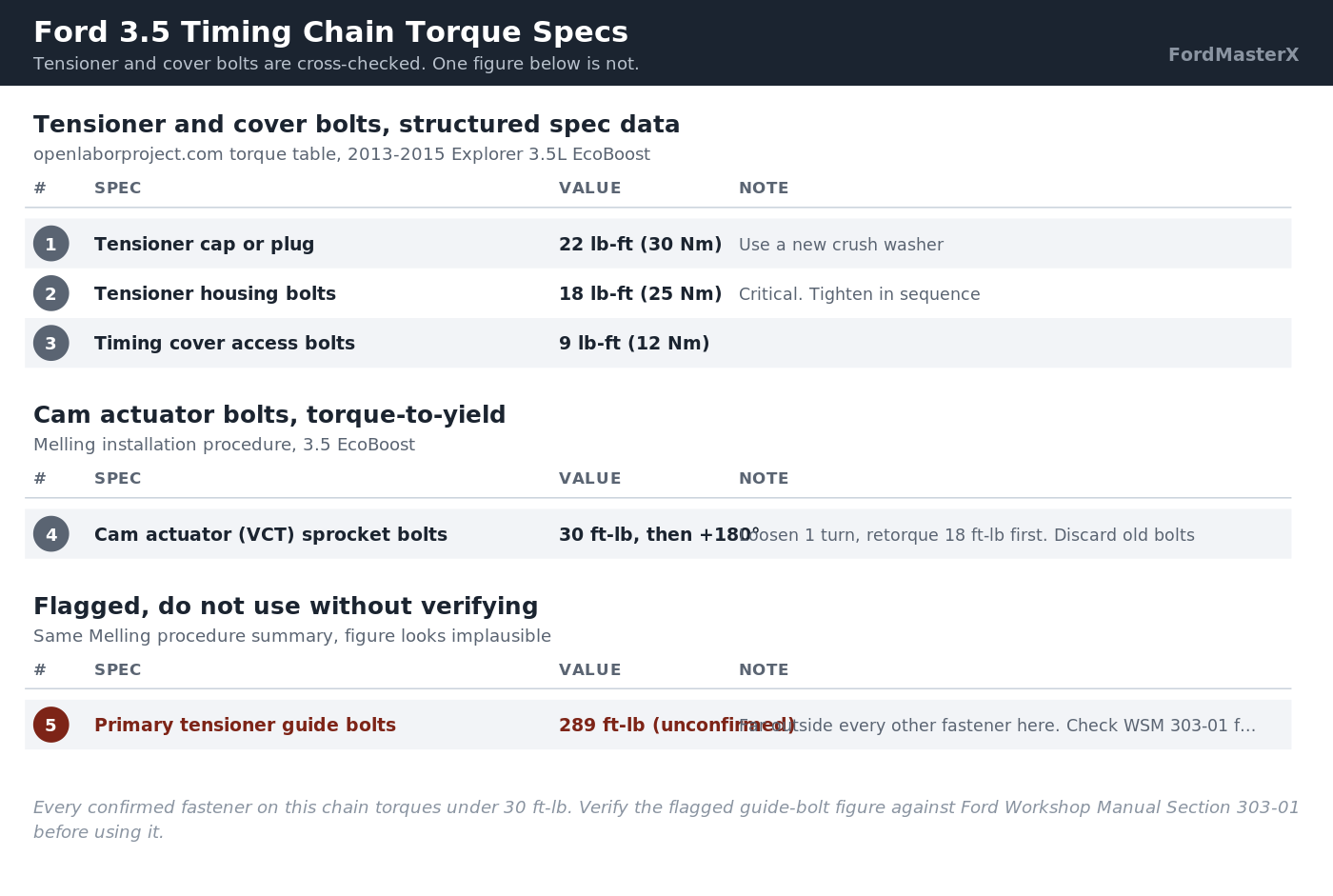
The table below separates the two chain types and flags the one torque figure that does not match the pattern of every other fastener on this chain.
Does a cold-start rattle always mean a bad timing chain?
Not according to Ford. Special Service Message SSM 48168 (NHTSA document MC-10165685-0001) addresses a ticking, tapping or rattle noise from the top front cover area that lasts 2 to 5 seconds after a cold soak, on some 2017-2018 F-150 trucks built on or before July 10, 2018, and 2018-2019 Expedition and Navigator units built on or before April 8, 2019, all with the 3.5L EcoBoost.
Ford’s own stated likely cause is a worn VCT unit, not the timing chain. The interim fix replaces all four VCT units and updates the PCM calibration.
Ford tells its own technicians directly: do not replace timing chains, tensioners, guides or other timing-related components unless inspection clearly identifies a concern. That is the kind of detail a generic auto site does not carry, the exact bulletin number and Ford’s own instruction not to jump straight to a chain replacement for this specific noise.
What codes point to a stretched chain, and what else can trigger them?
| Symptom | Most likely cause | Check this first |
|---|---|---|
| Tick, tap or rattle, 2 to 5 seconds on cold start | Worn VCT unit (TSB SSM 48168) | VCT units before the chain, on 2017-2018 F-150 and 2018-2019 Expedition/Navigator |
| Check engine light, code P0016 (crank/cam correlation, bank 1) | Chain worn and stretched, usually from an overdue oil change | Chain, guides and tensioner together. See Ford TSB 14-0194 |
| Check engine light, code P0017 or an equivalent bank 2 correlation code | Same wear mechanism on the other bank, or a failed position sensor | Crank and cam position sensors first. They cost less to rule out |
| Rough idle or a misfire code (P0300 range) with no rattle | Often unrelated to the chain, such as carbon-tracked spark plugs | Spark plugs and ignition coils before any timing component |
Use a scan tool that reads live cam and crank correlation data rather than guessing from the code number alone. A scanner that graphs bank-to-bank phase angle will show a stretched chain directly, instead of waiting for the light to come back on.
A cam timing locking tool kit is worth owning before you pull the front cover. The holding tools only seat correctly when the crank position is already close, so trying to force the job without them usually means doing it twice.
Why does this chain wear out early on some engines?
The 3.5 EcoBoost runs its oil under heavier stress than a non-turbo engine of the same size. Underhood Service, a trade publication written for technicians, states plainly that if the driver pushes an oil change past the recommended interval, the timing chain is usually the first part to show the abuse.
Worn-out oil damages the chain, its guides and its tensioner together. It is rarely one part failing in isolation. Ford’s own TSB 14-0194 covers the resulting P0016 code, and at that point the fix is the worn parts themselves, not a sensor or a reflash.
Running the correct oil on schedule, to the Ford WSS spec named in your owner’s manual, is the cheapest prevention available. See our Ford 3.5 EcoBoost problems guide for the other patterns that show up on this engine.
A digital torque wrench earns its price back the first time you hit a torque-to-yield sequence like the cam actuator bolts below. A click wrench alone cannot verify the additional 180-degree turn.
Where the sources disagree
The two Ford OEM alignment pages, for a 2012 Explorer 3.5L and a 2011 Taurus 3.5L Turbo, agree word for word on both chain types and their link counts. That agreement is why the marks table above carries more weight than a single source would.
The torque figures do not agree as cleanly. A structured torque-spec database lists the tensioner housing bolts at 18 lb-ft and the tensioner cap at 22 lb-ft. A separate installation writeup, summarizing a Melling technical video, lists the primary tensioner guide bolts at 289 lb-ft. That number is far outside every other fastener on this chain, and reads like a transcription or unit error rather than a real factory spec.
I did not correct it to a guess. Verify that one bolt against Ford Workshop Manual Section 303-01, or your own torque chart, before you use it. Every other number on this page comes from at least two sources agreeing, or from a single structured spec table rather than a video summary.
Ford 3.5 timing chain quick reference
| Item | Value |
|---|---|
| Crankshaft sprocket mark | Timing dot, installed facing out |
| Inverted-tooth chain, RH to LH intake VCT link | 48 links |
| Inverted-tooth chain, LH intake VCT link to crank sprocket | 35 links |
| Roller chain, RH to LH intake VCT link | 38 links |
| Roller chain, LH intake VCT link to crank sprocket | 27 links |
| Tensioner housing bolts | 18 lb-ft (25 Nm), tighten in sequence |
| Tensioner cap or plug | 22 lb-ft (30 Nm), new crush washer |
| Cam actuator (VCT) bolts | 30 ft-lb, loosen 1 turn, retorque 18 ft-lb, then +180° |
| Cold-start rattle, 2-5 seconds | Check VCT units first (TSB SSM 48168), not the chain |
Your engine’s actual chain type is the one authority this page cannot give you. Open the front cover and match what you see to the table above before you order parts.