
Engine Malfunction Service Now Ford Fiesta: 2026 Complete Fix Guide

Your Ford Fiesta just put “Engine Malfunction Service Now” on the dashboard, and it means the engine computer found a serious fault. This message is more urgent than a plain check-engine light, so do not ignore it and hope it goes away.
The good news is that the fix is often simple. A loose fuel cap, a tired sensor, or worn spark plugs can set this warning, and each one has a clear test.


The bad news is that driving on with a flashing warning can destroy the catalytic converter, which turns a small repair into a large one.
This guide gives the direct answer first, then the exact steps in order. You will learn what the message means, how urgent it is, the seven most likely causes, how to read the fault code yourself, and what each repair usually costs.
The Short Answer in 7 Facts


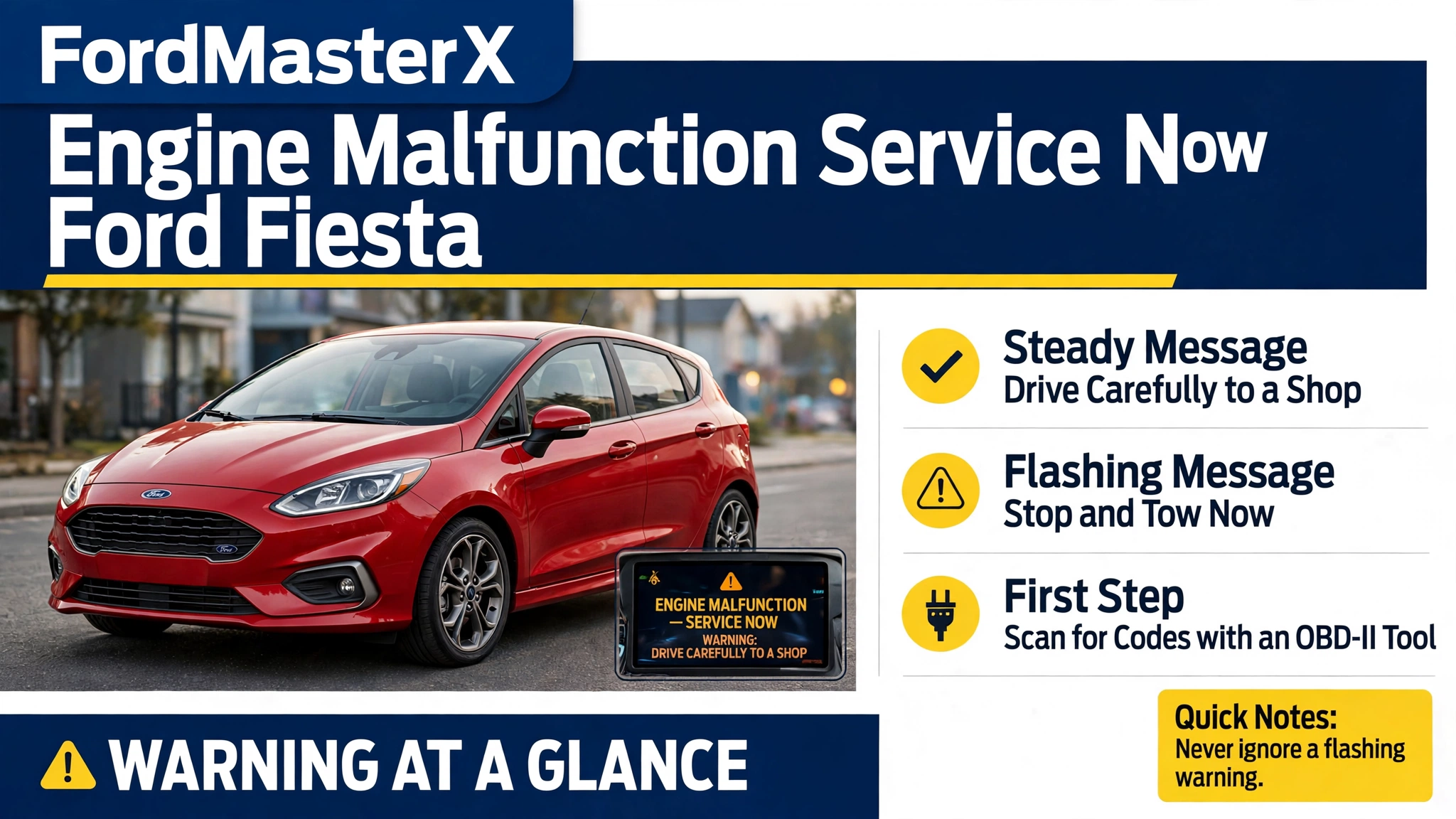
Seven facts answer most questions about this warning. The table holds them. The infographic below gives the same facts to save or share.
| Fact | What it means for you |
|---|---|
| Meaning | The ECU detected a significant engine fault, worse than a plain check-engine light |
| Steady message | Drive carefully to a repair shop, avoid hard acceleration |
| Flashing message | Stop and tow now, the catalytic converter is at risk |
| Both engine lamps together | Stop as soon as safe, switch off, try one restart |
| Most common simple cause | Loose or damaged fuel cap, often right after refueling |
| First diagnostic step | Scan for codes with an OBD-II scanner at the port under the driver dashboard |
| Reset warning | The brake-plus-accelerator reset only clears it until the ECU detects the fault again |
Ford Fiesta Engine Malfunction Service Now Triage
What the message means, how urgent it is, and the first step. Based on the Fiesta owner’s manual and CarTipsDaily’s Fiesta guide.
| What you see | What it means | What to do |
|---|---|---|
| Steady message, car drives normally | The ECU found a significant fault. Power may be limited. | Drive carefully to a repair shop. Avoid hard acceleration. |
| Flashing message or flashing check-engine light | Active misfire or severe fault. The catalytic converter is at risk. | Stop and tow now. Do not keep driving. |
| Both engine lamps on together | Malfunction in the engine management system. Power may drop and the engine may stop. | Stop as soon as safe. Switch off, try one restart. No restart means dealer before continuing. |
| Message right after refueling | Often a loose or damaged fuel cap letting the fuel system lose pressure. | Tighten the cap until it clicks. Check for cracks in the cap or seal. |
| Message with rough idle or shaking | Likely a misfire: spark plugs, ignition coils, or a sensor fault. | Stop driving. A misfire can destroy the catalytic converter fast. |
| Common cause | Typical sign | Usual fix |
|---|---|---|
| Loose or damaged fuel cap | Warning appears after refueling | Tighten or replace the cap |
| Faulty oxygen sensor | Poor fuel economy, rough idle | Replace the sensor |
| Dirty or failing MAF sensor | Stalling, hesitation, surging idle | Clean or replace the sensor |
| Ignition coils or spark plugs | Misfires, shaking, poor acceleration | Replace plugs or the bad coil |
| Throttle-body carbon buildup | Uneven idle, hesitation, stalling | Clean the throttle body |
| Weak battery or charging fault | Dim lights, hard starting, other warnings | Test battery and alternator |
| Catalytic converter failure | Rotten-egg smell, lost power, excess heat | Diagnose first, then replace if failed |
First step: Scan for codes with an OBD-II scanner at the port under the driver-side dashboard. The code names the system at fault, so the repair starts with evidence instead of guessing.
Sources: Ford Fiesta owner’s manual, instrument cluster section (ManualsLib, pages 79 to 82); CarTipsDaily Fiesta engine malfunction guide. Cost figures in the article are reported estimates from CarTipsDaily, not Ford prices.
The table above is the short version. The rest of this guide explains what the message means, what to do in the next ten minutes, and how to find the cause without guessing.
What Engine Malfunction Service Now Means on a Fiesta
When your Fiesta shows “Engine Malfunction Service Now”, the engine control unit, or ECU, has detected a significant problem that needs attention. The message appears on the information display between the gauges, and it is more serious than a plain check-engine light.
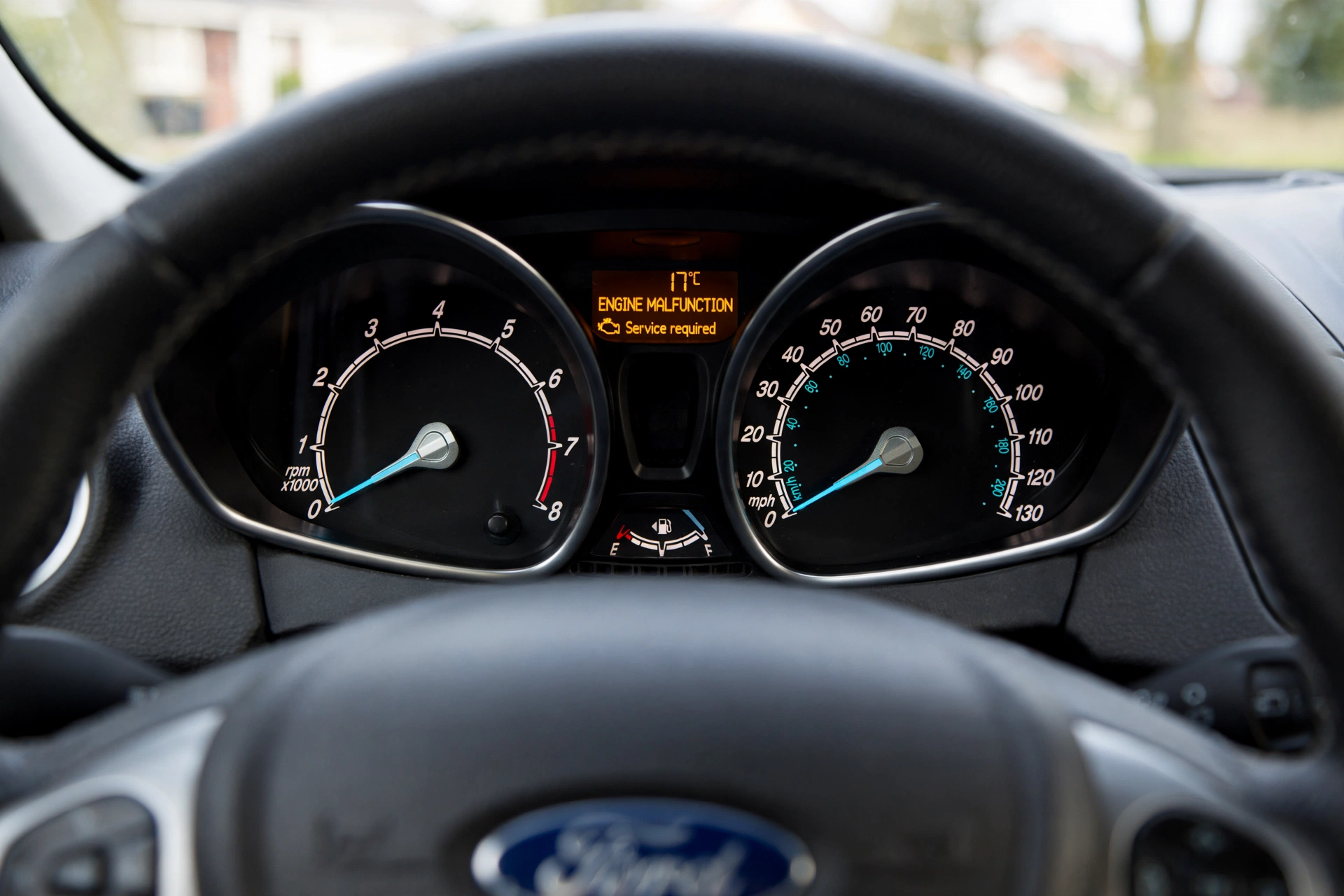
The ECU watches sensors across the engine all the time. It checks the air and fuel mixture, the ignition, the exhaust, and the charging system. When a reading falls outside its expected range, it stores a fault code and puts the warning on the display.
The warning can also cut engine power.
The Fiesta may enter a protective mode with reduced performance, often called limp mode, to limit damage while you drive to a shop. Our guide to what it means when a car goes into limp mode explains how that protection works and what it feels like from the driver seat.
Do not confuse this message with the oil-change reminder. The oil reminder is a maintenance message tied to mileage and time. “Engine Malfunction Service Now” is a fault message tied to a sensor reading the ECU does not trust.


The Fiesta owner’s manual gives the same warning in plainer terms. The Fiesta owner’s manual on ManualsLib says that if either engine warning lamp illuminates while the engine is running, it indicates a malfunction.
The engine will keep running, but it may have limited power.
That limited power is the key difference from a plain check-engine light. A plain light can mean a small emissions fault you can drive with for a few days. This message means the ECU already decided the fault is significant, so the clock on a safe drive is shorter.
Steady or Flashing: How Urgent Is It
The urgency depends on how the warning appears. A steady message and a flashing message are two different situations, and they need two different responses. Learn the difference before you decide whether to keep driving.
| What you see | Urgency | What to do |
|---|---|---|
| Steady message, car drives normally | Urgent, not an emergency | Drive carefully to a repair shop as soon as you can |
| Steady message with reduced power | Urgent | Drive gently to the nearest shop, avoid highways if possible |
| Flashing message or flashing check-engine light | Emergency | Stop driving and arrange a tow |
| Both engine lamps on together | Emergency | Stop as soon as safe, switch off, try one restart |
| Message plus shaking, stalling, or smoke | Emergency | Stop driving, do not restart and drive on |
Steady Message: Drive Carefully to a Shop


If the message is steady and the car still drives normally, you can usually drive carefully to a repair facility. Keep your speed down, avoid hard acceleration, and do not tow anything. Watch the temperature gauge the whole way, and pull over if anything changes.
Get the car checked as soon as you reasonably can. A steady message can still hide a fault that gets worse, and a sensor fault left alone can damage the catalytic converter over time.
The CarTipsDaily Fiesta engine malfunction guide makes the same point: a steady message means drive carefully to a shop, while a flashing message means stop.
Flashing Message: Stop and Tow
If the message flashes, or the check-engine light flashes with it, stop driving immediately and arrange a tow. A flashing light usually means an active misfire, where unburned fuel reaches the exhaust and overheats the catalytic converter. That damage can happen fast, and it is expensive.
Do not try to drive a flashing car to the shop to save the tow fee. A tow costs far less than a new catalytic converter. If the car also shakes, stalls, or loses power, the same rule applies: stop and tow.
Both Engine Lamps Together: The Manual’s Own Rule
The Fiesta has two engine warning lamps: the malfunction indicator lamp and the powertrain warning lamp. If both lamps illuminate together, the owner’s manual gives a strict sequence. Stop your vehicle as soon as it is safe to do so, because continued use may cause reduced power and the engine may stop.
Switch the ignition off and attempt to restart the engine. If the engine restarts, have your vehicle checked by an authorized dealer immediately.
If the engine does not restart, have your vehicle checked before continuing your journey. That wording comes from the Fiesta owner’s manual, instrument cluster section, pages 79 to 82.
If a single lamp flashes while you are driving, the manual says to reduce speed immediately. If it keeps flashing, avoid heavy acceleration or deceleration and have the car checked by a dealer immediately. Do not wait for the next service.
What to Do Right Now: 6 Steps in Order
Follow these steps in order the moment the message appears. They take ten minutes, they cost nothing, and they keep a small problem from becoming a large one.
- Note how the message behaves. Steady or flashing, any shaking, any loss of power, any smell. That detail decides whether you drive on or call a tow.
- Slow down and pull over safely if anything feels wrong. Rough running, stalling, smoke, or a flashing warning all mean stop. A safe shoulder beats a damaged engine.
- Check the fuel cap. Open the fuel door, remove the cap, and refit it until it clicks. Look for cracks in the cap or a torn seal. A loose cap is the cheapest cause on this list.
- Look under the hood, briefly. Check for an obviously disconnected hose or electrical connector, fluid leaking under the car, and corrosion on the battery terminals. Do not touch hot parts.
- Check the gauges. A rising temperature gauge or a falling oil pressure reading means stop, whatever the message says. A normal temperature gauge with a steady message means a careful drive to a shop.
- Scan for codes before you pay for parts. An OBD-II scanner reads the fault code the ECU stored. That code names the system at fault, so the repair starts with evidence.
Do not start replacing parts before the scan. Guessing at sensors wastes money, because a single code can point to one of several parts. The scan is the step that turns a warning into a diagnosis.
The 7 Most Likely Causes on a Fiesta
Seven causes explain most “Engine Malfunction Service Now” warnings on a Fiesta. They run from a ten-minute fix to a major repair, and the symptoms separate them. Match your symptoms to the list before you order anything.
1. Loose or Damaged Fuel Cap
A loose, damaged, or poorly sealed fuel cap is one of the most common reasons for this warning. When the fuel system cannot hold pressure, the ECU detects an evaporative emissions leak and sets the message. The warning often appears shortly after refueling, which is the clue.
Check the cap first because it costs nothing. Tighten it until it clicks, and inspect it for cracks or a worn seal.
A cracked cap needs a new one, and an original-equipment cap is the safe replacement. The reported cost is $15 to $30 for the part if you fit it yourself, or $50 to $75 at a shop.
2. Faulty Oxygen Sensor
The oxygen sensor, or O2 sensor, measures the oxygen in the exhaust and helps the ECU set the air-fuel mixture. When it fails, the engine can run too rich or too lean. The signs are poor fuel economy, rough idling, and hesitation when you accelerate.
A bad O2 sensor can cut fuel efficiency by up to 40 percent, according to CarTipsDaily, and it can damage the catalytic converter if it is left alone.
The reported cost is $50 to $150 per sensor for the part, or $150 to $300 per sensor installed. Replace a failed sensor rather than cleaning it, because a worn sensor rarely recovers.
3. Mass Air Flow Sensor Problems
The mass air flow sensor, or MAF sensor, measures the air entering the engine. The ECU uses that reading to calculate how much fuel to deliver.
When the sensor is dirty or failing, the calculation goes wrong, and the engine stalls, hesitates, surges at idle, or struggles to start.
Fiestas commonly show MAF faults, and the scanner usually stores a specific code for them. A dirty sensor can sometimes be cleaned with electronics-safe MAF cleaner, but a failed sensor needs replacement. The reported cost is $75 to $300 for the part, or $200 to $400 installed.
4. Ignition System Problems
Worn spark plugs and faulty ignition coils are another common trigger. The signs are engine misfires, rough running, poor acceleration, and higher fuel use. A misfire is the one symptom that should never be driven on, because it can damage the catalytic converter quickly.
Replace spark plugs on Ford’s recommended interval, and inspect the coils when a misfire code appears. Use original-equipment-grade parts for the ignition system, because cheap coils fail early and bring the warning back.
The reported cost is $30 to $60 for a set of spark plugs if you fit them yourself, or $150 to $250 at a shop. Ignition coils run $30 to $80 each for the part, or $150 to $300 installed.
5. Throttle Body Carbon Buildup
Carbon deposits on the throttle body restrict airflow and make the engine respond unevenly. The signs are an uneven idle, hesitation when you press the accelerator, and stalling. This fault is especially common on direct-injection engines, which includes many Fiesta engines.
Cleaning the carbon off the throttle body often fixes the fault. A can of throttle-body cleaner costs $10 to $20, and a shop charges a reported $100 to $200 for the cleaning.
If cleaning does not fix a sticking throttle body, replacement may be needed, at a reported $150 to $400 for the part or $300 to $600 installed. A throttle-body relearn procedure should follow a cleaning or replacement.
6. Electrical and Charging System Faults
Battery and alternator problems can trigger engine warnings when the voltage drops too low for proper engine management. The signs are warning lights, difficulty starting, and dimming headlights. A weak battery can also push the ECU into its protective limp-home mode with reduced performance.
Test the battery voltage before replacing anything. A healthy battery reads about 12.6 volts with the engine off, and 13.7 to 14.7 volts with the engine running, according to CarTipsDaily’s reported test values.
If the voltage is low while the engine runs, have the alternator tested. Our guide to charging system service now on the Ford Explorer shows the same voltage tests and the same failure pattern on a different Ford, because the charging system works the same way across the range.
7. Catalytic Converter Problems
A failing catalytic converter can trigger the warning, although it is often the victim of another problem rather than the cause. The signs are reduced acceleration, excess heat under the car, and a rotten-egg smell. A converter usually fails because a misfire or a bad sensor sent unburned fuel into it for too long.
Fix the misfire or sensor fault first, then test the converter. Replacing the converter without fixing the cause will kill the new one too.
The reported cost is $300 to $1,000 for the part, or $500 to $1,500 installed, but check the warranty first. Our guide to whether catalytic converters are covered under warranty explains the emissions warranty terms that can cover this repair.
How to Diagnose It with an OBD-II Scanner
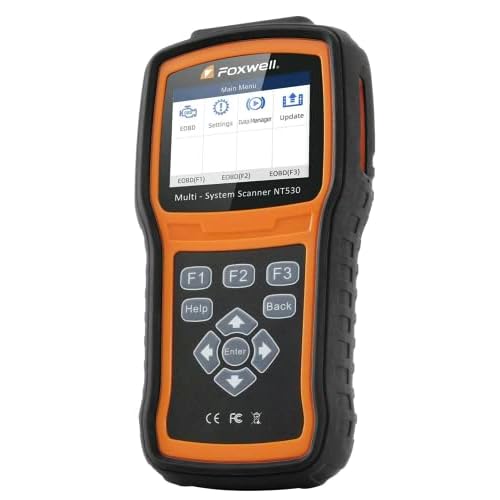
An OBD-II scanner is the fastest way to find the cause. It reads the trouble code the ECU stored, and that code points to the system at fault. Many auto parts stores will scan your car for free, or you can buy an inexpensive Bluetooth scanner that works with a phone app.
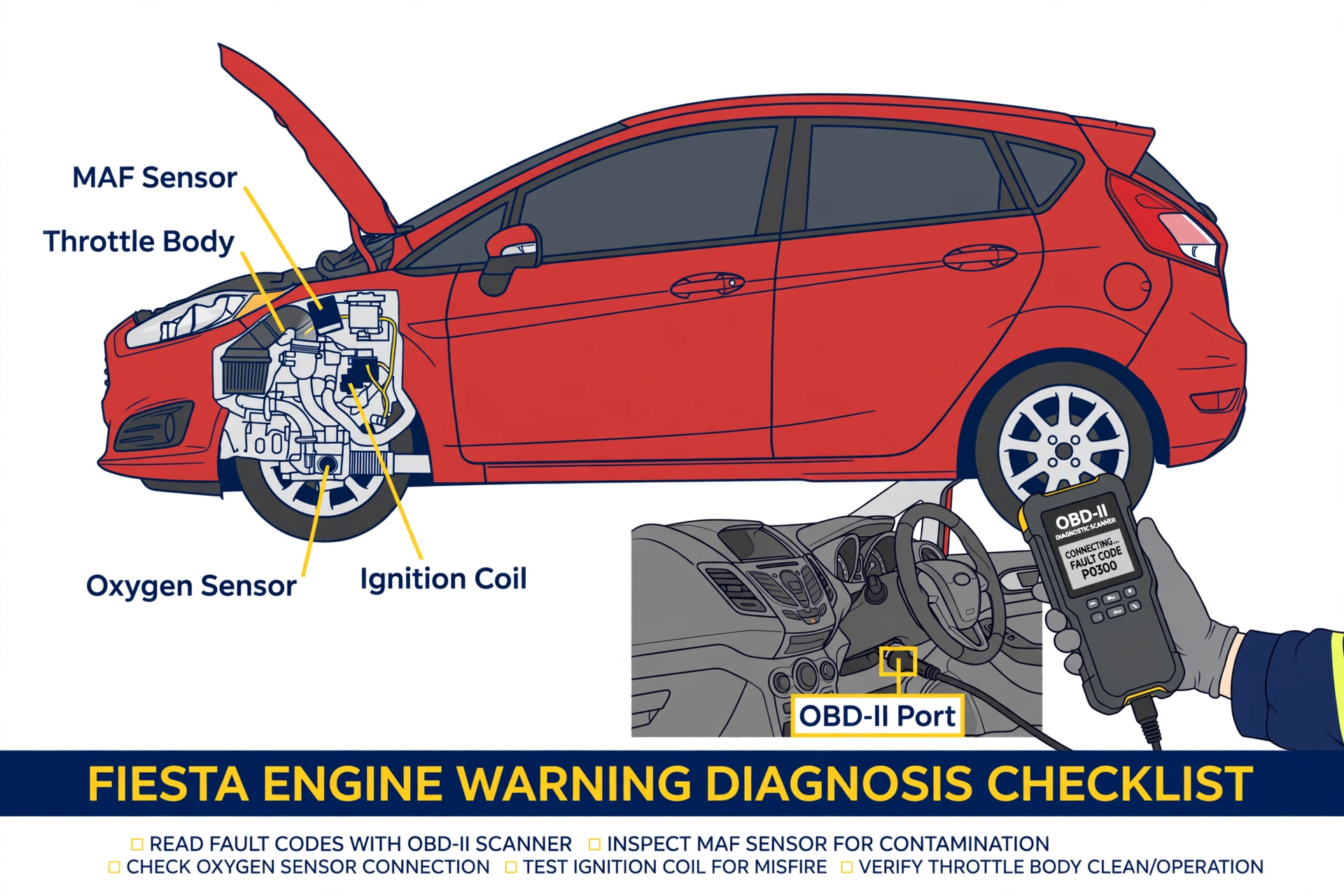
The OBD-II port sits under the dashboard on the driver side. Plug the scanner in, switch the ignition on, and read the stored codes. Write every code down before you clear anything, because clearing the codes erases the evidence the mechanic needs.
Our guide to the best scan tool for Ford ranks the scanners that read Ford-specific codes well, not just generic ones. A Ford-specific scanner can read codes a basic reader misses, which matters when the warning has no obvious cause.
| Code | Meaning | Likely cause |
|---|---|---|
| P0171 | System too lean | Vacuum leak or MAF sensor fault |
| P0172 | System too rich | Oxygen sensor or fuel pressure fault |
| P0300 to P0304 | Cylinder misfire | Spark plugs, ignition coils, or injectors |
| P0101 | MAF sensor range fault | Dirty or failing MAF sensor |
| P0420 | Catalyst efficiency below threshold | Catalytic converter or oxygen sensor |
| P0455 / P0456 | Evaporative emissions leak | Loose or damaged fuel cap, EVAP hose |
| P2111 | Throttle actuator stuck open | Carbon buildup or throttle-body fault |
One code rarely tells the whole story. A P0420 catalyst code can mean a dead converter, but it can also mean a bad oxygen sensor reporting wrong values.
A P0171 lean code can mean a vacuum leak, a dirty MAF sensor, or low fuel pressure. Read the code, then test the part before you replace it.
Freeze-frame data helps too. A good scanner shows the engine conditions when the code was set: speed, load, temperature, and fuel trim. That snapshot often separates a fault that happens at idle from one that happens at speed, which points to different parts.
What Each Repair Usually Costs
Knowing the likely cost before you call the shop keeps the estimate honest. The table below gives reported cost estimates from CarTipsDaily, not Ford prices, cross-checked against an independent YourMechanic estimate for a Fiesta oxygen sensor replacement.
YourMechanic puts that sensor job at $196 on average ($56 for parts, $140 for labor), inside the range below. Your shop’s labor rate will move the installed price, so use the ranges to judge whether a quote is fair, not as a fixed price.
| Repair | Do-it-yourself cost | Professional cost | Difficulty |
|---|---|---|---|
| Fuel cap replacement | $15 to $30 | $50 to $75 | Easy |
| Oxygen sensor replacement | $50 to $150 per sensor | $150 to $300 per sensor | Moderate |
| MAF sensor replacement | $75 to $300 | $200 to $400 | Moderate |
| Spark plugs | $30 to $60 for a set | $150 to $250 | Moderate |
| Ignition coils | $30 to $80 each | $150 to $300 | Moderate |
| Throttle body cleaning | $10 to $20 for cleaner | $100 to $200 | Moderate |
| Throttle body replacement | $150 to $400 | $300 to $600 | Difficult |
| Catalytic converter | $300 to $1,000 | $500 to $1,500 | Very difficult |
The cheapest fix on the list is also the most common first check. A fuel cap costs less than a tank of fuel, yet it sets the same warning as a failed sensor. Always check the cap and scan the codes before you approve a larger repair.
The most expensive fix is usually the consequence of ignoring a cheaper one. A misfire left alone can kill a catalytic converter, and a bad oxygen sensor left alone can do the same. Paying for a spark plug or a sensor on time is cheaper than paying for a converter later.
Ask the shop for the fault code and the test result before you approve work. A good shop will show you the code, the live sensor reading, and the part that failed the test. That evidence is what separates a diagnosis from a guess.
Can You Reset the Warning Yourself
You can clear the warning with a simple pedal procedure, but it is only a temporary fix. If the fault is still there, the ECU will detect it again and the message will return. Use the reset to confirm a fix, not to hide a fault.
- Switch the engine off. Turn the key to the accessory position, marked ACC.
- Press both pedals. Press and hold the brake pedal and the accelerator pedal together for about 30 seconds.
- Release and switch off. Release both pedals, turn the key off, and wait 10 seconds.
- Start the engine. Start the car and check whether the message is gone.
If the message stays away after a fuel-cap fix, the reset worked and the fault is gone. If it comes back within a few drives, the fault is still there, and the car needs a scan. Do not keep resetting the warning to pass an inspection or to put off a repair.
A scanner reset does the same job more cleanly, because it also clears the stored code after you have written it down. Clear the code only after you have recorded it. Clearing first destroys the one piece of evidence that names the fault.
Which Fiestas See This Warning Most
The warning can appear on any Fiesta, but it shows up most on older cars and on the small turbo engines. Age wears sensors, coils, and seals, and direct injection builds carbon on the throttle body faster than port injection. An older, higher-mileage Fiesta with original spark plugs and sensors is a likely candidate.
The 1.0 liter EcoBoost engine deserves a closer look. It is a strong little engine, but it has known weak points, and its wet timing belt needs attention on schedule.
Our guide to Ford EcoBoost wet belt problems explains the belt issue and the service interval that prevents it. A wet-belt fault will not set this warning by itself, but a tired 1.0 EcoBoost with several worn parts can set it for more than one reason at once.
Check the service history when you buy a used Fiesta. A car with fresh spark plugs, a clean throttle body, and a recent battery is less likely to put this message on the display in your first month.
A car with no history and a cleared warning is a car to scan before you pay, because a cleared code can hide a fault for a few drives.
Warranty cover can still help on a newer Fiesta. The powertrain term covers the engine and transmission, and the emissions term can cover the catalytic converter and some sensors.
Our guide to what the Ford powertrain warranty covers lists the parts each term pays for, so check it before you pay for a repair yourself.
Preventing the Warning from Coming Back
Most repeat warnings come from maintenance that was skipped, not from bad luck. Five habits keep the message away, and none of them costs much. Follow the maintenance schedule for your Fiesta model year, and the ECU will have fewer reasons to complain.
Use quality fuel from a reputable station, because bad fuel fouls sensors and injectors. Address small issues promptly, before a worn plug becomes a misfire and a misfire becomes a dead converter. Replace wear items on schedule: spark plugs, air filters, and fuel filters all protect the sensors downstream.
Check for technical service bulletins for your model year. A bulletin can name a known fault and its fix, which saves a diagnostic fee.
Keep the battery healthy too, because low voltage confuses the ECU and can set warnings that have nothing to do with the engine itself.
Finally, do not clear the warning and forget it. A warning that returns is a fault that is still there. Each return is the car telling you the repair did not work, and each ignored return moves the repair bill upward.
6 Questions Fiesta Owners Ask
Can I Drive with Engine Malfunction Service Now On
Yes, if the message is steady and the car drives normally, you can drive carefully to a repair shop. Avoid high speeds, hard acceleration, and towing, and watch the temperature gauge. If the message flashes, or the car shakes or loses power, stop and tow instead.
Is Engine Malfunction Service Now the Same as the Check Engine Light
No. A plain check-engine light can mean a small emissions fault.
“Engine Malfunction Service Now” means the ECU found a significant fault that needs attention, and the car may have limited power. Treat this message as more urgent than a steady check-engine light.
How Much Does It Cost to Fix
It depends on the cause. A fuel cap costs a reported $15 to $30 for the part.
A sensor costs a reported $50 to $300 for the part, or $150 to $400 installed, depending on which sensor. A catalytic converter costs a reported $500 to $1,500 installed. Scan the car first, because the code decides which end of that range applies to you.
Will the Warning Go Away by Itself
Sometimes. If the cause was a loose fuel cap that you tightened, the ECU may clear the message after several clean drives.
If the fault is a failed sensor, a misfire, or a vacuum leak, the message will return, and a warning that keeps coming back needs a scan, not another reset.
What Is the Most Common Cause on a Fiesta
The most common simple cause is a loose or damaged fuel cap, especially when the warning appears right after refueling. The most common part failures are the oxygen sensor, the MAF sensor, and worn spark plugs or ignition coils. The scanner code separates them in minutes.
Can a Low Battery Cause This Warning
Yes. A weak battery or a failing alternator can drop the voltage too low for proper engine management, and the ECU can set the warning.
Test the battery first if the car also struggles to start or the headlights dim, because a healthy battery reads about 12.6 volts with the engine off.
Our Final Verdict on the Fiesta Warning
Engine Malfunction Service Now on your Ford Fiesta means the ECU found a significant fault, and it deserves attention the same day. A steady message means a careful drive to a shop, and a flashing message means stop and tow.
Start with the cheap checks: the fuel cap, a look under the hood, and a scan for codes. The code names the fault, the symptoms name the part, and the repair follows from there instead of from a guess.
Fix the cause, not the message. A reset clears the display for a few drives, but only a repair clears the fault. Do that, and the warning stays away for good.