6.7 Powerstroke AC Recharge Port Location: Quick Guide

The low-pressure A/C recharge port on a 6.7 Powerstroke is located on the passenger side of the engine bay, near the firewall and cowl area. It is positioned on the thicker aluminum tubing and is usually capped with a black or blue plastic cover.
🎯 Key Takeaways
Recommended Best Deal Products
- Find the port on the passenger side near the rear firewall.
- The low-side port sits on the larger diameter aluminum pipe.
- Recharge kits only fit the smaller low-side service fitting.
- Look for a black or blue protective dust cap.
- Ensure the engine is running while checking pressure levels.
On your Ford 6.7L Powerstroke Super Duty, the low-pressure A/C service port is located on the passenger side of the engine bay, tucked toward the rear near the firewall. You will find it mounted directly on the thickest aluminum refrigerant line that emerges from the passenger side of the cabin. Identifying this specific port is the most critical step before you attempt to check your system’s standing pressure or add any refrigerant to the loop.

Prime for Young Adults — 6 Months Free
Students and 18–24s get six months of Prime free, then half price.
Start 6 Months Free As an Amazon Associate I earn from qualifying purchases.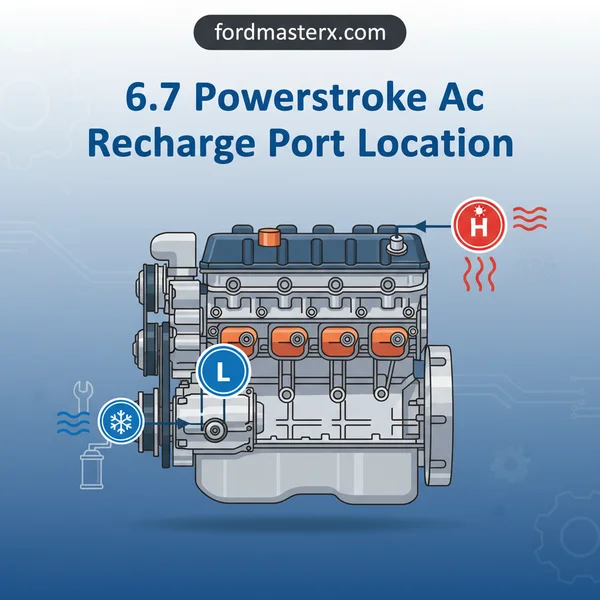
Locating this port correctly is vital for maintaining your truck’s climate control system. Because the 6.7L engine compartment is densely packed with heavy-duty cooling components, dual batteries, and turbocharging plumbing, the A/C lines can easily be overlooked. Knowing exactly where to reach ensures you do not waste time removing unnecessary plastic shrouds or mistaking a cooling system bleeder for an air conditioning service point.
Physical Location of the Low-Pressure Service Port
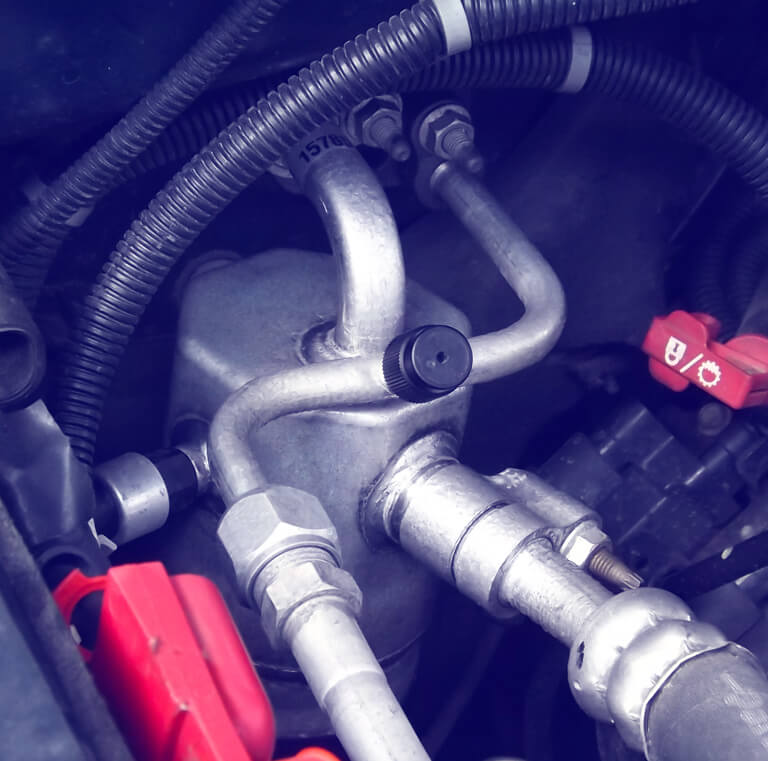
The low-pressure service port is situated in a high-and-tight position on the passenger side. To find it, stand by the passenger side front tire and look toward the back corner of the engine compartment where the hood meets the windshield (the cowl area). The port is integrated into the aluminum suction line that carries refrigerant from the evaporator core back to the compressor.
Navigating the Passenger Side Cowl Area
To access the port, you will generally need to lean over the passenger side fender. Look past the battery tray and the coolant reservoir. You are looking for a silver aluminum pipe that is roughly the diameter of a thumb. This pipe runs along the inner fender and disappears through the firewall. The service port itself points upward, usually protected by a plastic dust cap. Unlike some older gas engines where the port might be buried near the bottom of the engine, the 6.7L Powerstroke keeps this port relatively high for easier servicing.
Specific Landmarks for the 6.7L Layout
Depending on whether you are driving a first-generation (2011–2016) or a newer 6.7L model, the surrounding components might shift slightly, but the port remains in the same general zone. Use these visual cues to confirm you are in the right spot:
- The Firewall Entry: Follow the two aluminum lines that exit the cab on the passenger side; the port is on the larger of the two.
- Behind the Battery: It is positioned behind the passenger-side battery, often partially obscured by large wire looms or heat shielding.
- The Suction Line: This is the “cold” line. If the truck has been running with the A/C on, this pipe will feel cold to the touch and may have condensation on it.
Master 6.7 Powerstroke AC Maintenance in 7 Simple Steps
The 6.7L Powerstroke diesel engine is a workhorse, but like any heavy-duty machine, its comfort systems require periodic maintenance to perform at peak efficiency. This guide covers the precise location of the air conditioning recharge ports on the Ford Super Duty platform and provides a comprehensive walkthrough for recharging your system. Following these steps correctly ensures you don’t damage the compressor or overcharge the system, which can lead to costly repairs. Whether you are dealing with a slow leak or just routine maintenance, knowing exactly where to look and what to monitor will keep your cabin ice-cold even under the heaviest towing loads.
Step 1: Gather Your Tools and Ensure Safety
What you need: Safety glasses, heavy-duty mechanics gloves, a flashlight, and a high-quality AC recharge kit (R-134a for pre-2020 models; check your hood sticker for R-1234yf on newer trucks).
Instructions: Before touching any components under the hood of your 6.7 Powerstroke, ensure the engine is completely cool. The engine bay of a diesel truck retains an immense amount of heat, and the AC lines can become dangerously hot. Park the vehicle on a level surface, set the parking brake, and put on your safety gear. Refrigerant can cause instant frostbite if it contacts your skin or eyes. Inspect your recharge kit to ensure the hose is long enough to reach from the passenger side of the engine bay to the cab, as you will need to monitor the dashboard during the process. Ensure the pressure gauge on your kit is calibrated and the seal on the refrigerant can is intact.
Pro Tip: Always check the under-hood emissions and maintenance sticker. It will specify the exact type of refrigerant and the total capacity (usually in pounds and ounces). Never mix different types of refrigerant.
Step 2: Locate the Low-Side Service Port
What you need: A flashlight and a clean rag.

Audible — Listen Free for 30 Days
One free credit a month and thousands of titles included.
Listen Free for 30 Days As an Amazon Associate I earn from qualifying purchases.Instructions: On the 6.7 Powerstroke, the AC system has two ports: the High Side and the Low Side. You must ONLY use the Low-Side port for recharging. To find it, stand on the passenger side of the engine bay. Look toward the rear of the engine, near the firewall (the metal wall separating the engine from the cabin). You will see a large-diameter aluminum pipe—this is the low-pressure suction line. The service port is located on this line, typically covered by a blue or black plastic dust cap. It is positioned near the AC accumulator/drier. The high-side port is located closer to the front of the truck on a much thinner line; the recharge hose coupler will not physically fit the high-side port, which is a built-in safety feature.
Pro Tip: If the port is covered in heavy grime or oil, wipe it clean before removing the cap. Any dirt that enters the system can destroy the internal seals of the AC compressor.
Step 3: Perform an Initial Pressure Check
What you need: The AC recharge kit gauge (without the can attached yet).
Instructions: Remove the plastic dust cap from the low-side port. Take the quick-connect coupler from your recharge hose and pull back the outer sleeve. Press it firmly onto the low-side port until it clicks into place. At this stage, do not attach the refrigerant can. With the engine still OFF, look at the gauge. This gives you a “static pressure” reading. If the gauge reads zero, your system has a major leak and is completely empty; in this case, recharging will not help, and you should seek a professional. If there is some pressure, proceed to the next step. This initial check ensures that the schrader valve in the port is functioning correctly and that there is at least some refrigerant remaining in the loop.
Pro Tip: If the static pressure is exceptionally high (over 100 PSI) and the engine is cool, you may have a blockage rather than a low charge.
Step 4: Prepare the System for Charging
What you need: The vehicle’s ignition key and climate control settings.
Instructions: Disconnect the gauge for a moment. Start the truck and let the engine idle. Set the AC to the “MAX AC” setting, turn the temperature to the lowest possible “Lo” setting, and set the fan speed to the highest position. Ensure the “Recirculation” mode is active. Let the truck run for about 3 minutes. This allows the refrigerant to circulate and the pressures to stabilize. Walk back to the engine bay and observe the AC compressor clutch (located at the bottom front of the engine, driven by the serpentine belt). If the clutch is “cycling” (turning on and off rapidly), it is a classic sign of low refrigerant. If it stays off entirely, the system may be too low for the pressure switch to allow the compressor to engage.
Pro Tip: Open all the windows or the doors of the truck while doing this. This prevents the cabin from cooling down too quickly, which would cause the AC to cycle off prematurely before you get an accurate reading.
Step 5: Connect and Begin the Recharge
What you need: Refrigerant can and the recharge hose.
Instructions: Shake the refrigerant can thoroughly for about 30 seconds to mix the contents. Screw the can onto the recharge hose assembly according to the manufacturer’s instructions (some require piercing the can). With the engine running and the AC on Max, re-attach the quick-connect coupler to the low-side port. Squeeze the trigger to begin the flow of refrigerant. While charging, hold the can upright and shake it gently between the 12 o’clock and 3 o’clock positions. You will feel the can getting very cold; this is normal as the liquid expands into gas. Monitor the gauge closely. On a 6.7 Powerstroke, you generally want the low-side pressure to be between 25 and 45 PSI, depending on the ambient outside temperature.
Audible Premium Plus — Annual Membership
12 audiobook credits up front, plus the full Audible catalogue.
See Annual Plans As an Amazon Associate I earn from qualifying purchases.Pro Tip: Never turn the can upside down while charging. This can send liquid refrigerant into the compressor, which can cause “slugging” and permanent mechanical failure.
Step 6: Monitor Compressor Behavior and Temperature
What you need: An assistant (optional) or a meat thermometer for the interior vents.
Instructions: As the refrigerant enters the system, watch the compressor clutch. It should stop rapid cycling and stay engaged for longer periods. If you have a thermometer, insert it into the center dash vent. You are looking for a temperature drop. On a healthy 6.7 Powerstroke system, the vent temperature should eventually reach 40–50 degrees Fahrenheit if the outside temperature is around 80 degrees. Periodically stop squeezing the trigger to check the gauge’s “resting” pressure. The gauge only provides an accurate reading when the trigger is released and the compressor is actively running. Do not exceed the “Green” zone on your gauge, as overcharging is just as harmful as undercharging.
Pro Tip: If the pressure rises into the “Red” or “Warning” zone but the air isn’t getting cold, stop immediately. This indicates a failed expansion valve or a clogged condenser rather than a low charge.
Step 7: Finalize and Leak Test
What you need: Soapy water in a spray bottle (optional) and the port cap.
Instructions: Once the desired pressure is reached and the air is blowing cold, pull back the sleeve on the quick-connect coupler and remove it from the service port. Immediately replace the plastic dust cap—this cap actually acts as a secondary seal for the system. Use a spray bottle with a bit of soapy water to spray the area around the port. If you see bubbles forming, the schrader valve inside the port is leaking and will need to be replaced. Shut down the engine and let the pressures equalize. Wipe away any spilled oil or residue from the engine bay to prevent it from attracting dirt or damaging rubber hoses over time.
Pro Tip: Note the date and the amount of refrigerant added in your maintenance log. If you find yourself needing to do this every few months, you have a leak that requires a professional vacuum test and repair.
✅ Final Checklist
- Low-side port cap is securely tightened and not cracked.
- AC compressor clutch stays engaged without rapid clicking/cycling.
- Interior vent temperature has dropped at least 20-30 degrees from ambient air.
- The gauge reading (with compressor running) is within the manufacturer’s recommended PSI range for the current outdoor temperature.
- No audible hissing sounds are coming from the service port or line connections.
Important Notes:
- Safety Warning: The High-Side AC line can reach pressures of over 300 PSI. Never attempt to connect a DIY recharge kit to the high-side port.
- When to Seek Help: If the compressor makes a loud grinding noise, or if the system loses charge again within 24–48 hours, a component has failed and requires professional extraction and repair.
- Estimated Time: 20–30 minutes.
- Estimated Cost: $30–$60 for a DIY kit, versus $150–$300 for a professional evacuation and recharge.
Visual Differences Between Low-Side and High-Side Ports
It is easy to get confused when looking at the various silver pipes in a Powerstroke engine bay. However, Ford utilizes industry-standard sizing to ensure you cannot accidentally connect a recharge hose to the wrong side of the system. The low-side and high-side ports are physically different in both their fitting diameter and the size of the pipes they are attached to.
📤 Share
💾 Download
Fitting Sizes and Safety Designs
The most important visual cue is the size of the service fitting itself. The low-pressure port features a smaller diameter fitting. This is the port you must use for recharging. The high-pressure port, which is located further forward on the thinner line near the radiator or compressor, has a much larger diameter fitting. Most DIY recharge kits use a “quick-connect” coupler that is specifically machined to only snap onto the smaller low-side fitting, acting as a physical safeguard against high-pressure blowbacks.
The Inverse Relationship of Pipe to Port
A common mistake for beginners is assuming that the “high” side has the “bigger” everything. In reality, it is the opposite when it comes to the piping. Understanding this inverse relationship will help you identify the ports even if the plastic caps are missing:
- Low-Side Port: Small fitting diameter / LARGE aluminum pipe diameter. (This is the suction side).
- High-Side Port: Large fitting diameter / SMALL aluminum pipe diameter. (This is the discharge side).
- Cap Indicators: While not always reliable if they have been replaced, the low-side cap is typically black or blue, while the high-side cap is usually red.
Checking for the Schrader Valve
Once you unscrew the plastic dust cap from the passenger side port, you will see a valve that looks similar to the air valve on a tire. This is a Schrader valve. On the 6.7L Powerstroke, this valve is recessed inside the aluminum housing. Ensure the area around this valve is clean of grease or road grime before attaching a manifold gauge or a recharge hose, as debris can prevent a proper seal or contaminate the internal seals of the A/C system.
Clearance and Access Challenges in the 6.7L Engine Bay
The 6.7L Powerstroke is an absolute beast of an engine, providing the torque and towing capacity Super Duty owners crave. However, that massive footprint means the engine bay is incredibly crowded. When you are searching for the AC recharge port, you aren’t just looking for a cap; you are navigating a maze of heavy-duty components designed to keep this workhorse running.
Navigating the Crowded Passenger Side
The low-side service port is typically tucked away on the passenger side, often near the firewall or mounted on the accumulator/dryer. Because the 6.7L features a dual-alternator setup in many configurations and a complex cooling system, reaching this port can be a bit of a stretch. You may find that the intake piping or large wiring harnesses partially obscure your line of sight. Using a bright LED flashlight is almost mandatory here, as the deep recesses of the engine bay are prone to heavy shadowing, even in broad daylight.
Safety and Physical Obstructions
Beyond just seeing the port, you have to worry about the heat. After a long haul, the metal surfaces around the 6.7L engine retain heat for a significant amount of time. The proximity of the AC lines to the exhaust manifold and turbocharger components means you need to be cautious about where you place your hands. Here are a few practical tips for managing the space:
- Wait for the Cool-Down: Always let the engine sit for at least 30 minutes to avoid burns from nearby metal components.
- Mind the Shrouding: Some model years have plastic shrouding or weather stripping near the cowl that can make it difficult to get a straight angle with a recharge hose.
- Watch the Moving Parts: Ensure your gauges and hoses are routed away from the large cooling fan and serpentine belt area before you start the engine to engage the compressor.
- Use Long-Reach Couplers: If your standard DIY recharge kit hose feels too short, look for an extension or a professional gauge set with longer leads to keep your hands clear of the hot zone.
Refrigerant Specifications and Year-Specific Variations
Identifying the location of the port is only half the battle; knowing what to put into it is where many owners get tripped up. Ford has produced the 6.7L Powerstroke for over a decade, and during that time, the automotive industry shifted its standards for refrigerant types to meet environmental regulations.
Understanding the R-134a vs. R-1234yf Divide
For most 6.7L Powerstroke trucks built between 2011 and 2016, the standard refrigerant is R-134a. This is the common “old-school” refrigerant found in most auto parts stores. However, starting around the 2017–2020 model year transition, Ford began phasing in R-1234yf. This newer refrigerant is more environmentally friendly but requires different gauges and different port sizes. You cannot mix these two refrigerants, and the ports are specifically designed with different diameters to prevent accidental cross-contamination. If your coupler doesn’t click into place easily, stop immediately and check your truck’s requirements.
Consulting the Under-Hood Decal
Never guess when it comes to the capacity or type of refrigerant for your Super Duty. Every 6.7L comes with a Vehicle Emission Control Information (VECI) label, usually located on the underside of the hood or on the radiator support. This sticker is your “source of truth.” It will list:
- The Refrigerant Type: Clearly labeled as either R-134a or R-1234yf.
- System Capacity: Usually measured in pounds and ounces (e.g., 1.5 lbs or 24 oz).
- Oil Type: Typically PAG 46 or PAG 100, which is vital for compressor lubrication.
- Verification: This label ensures you are treating your specific trim level correctly, as dual-zone climate control systems may have slightly different capacities than base models.
Conclusion
Locating the AC recharge port on your 6.7L Powerstroke is a straightforward task once you know where to look, but the cramped engine bay and changing refrigerant standards require a bit of preparation. By focusing on the passenger side near the firewall and verifying your specific refrigerant type on the under-hood decal, you can avoid the most common pitfalls of DIY AC maintenance. Remember that a properly pressurized system not only keeps you comfortable but also ensures your compressor stays lubricated and healthy for the long haul.
Your next move should be a quick visual inspection of your AC lines for any signs of oily residue, which often indicates a leak. Once you’ve confirmed your port type and location, you’re ready to tackle the heat with confidence. Keep that Powerstroke cool and stay on the road!
❓ Frequently Asked Questions
How do I distinguish the low-side port from the high-side port?
The low-side port is mounted on the thicker aluminum suction line and features a smaller quick-connect fitting. The high-side port is located on a much thinner line and has a larger fitting diameter to prevent accidental cross-connection.
Is the location the same for all 6.7 Powerstroke model years?
Yes, Ford has maintained a consistent layout for the A/C service ports on the 6.7L engine from 2011 through current models, always placing the low-side port on the passenger side near the accumulator.
What happens if I try to connect to the wrong port?
Recharge kits are physically engineered to only latch onto the low-side port. Attempting to connect to the high-side port is extremely dangerous as the high pressure could cause the refrigerant can to burst.
Do I need to remove the air intake or battery to reach it?
No components usually need to be removed, though you may find it easier to reach by standing on a tire step or small ladder due to the height of the F-250/F-350 engine bay.
Which refrigerant does my 6.7 Powerstroke use?
Check the yellow VECI sticker under the hood; 2011-2016 models typically use R-134a, while many 2017 and newer models have transitioned to the R-1234yf refrigerant.
Why is my AC port located so close to the firewall?
This placement keeps the service port near the A/C evaporator core and accumulator, which are housed against the firewall for efficient cabin cooling and plumbing layout.