6.0 Powerstroke EBP Sensor Guide: Symptoms, Codes & Locations

The Exhaust Back Pressure (EBP) sensor is a critical component for VGT turbo operation on the 6.0 Powerstroke, and its failure often stems from a soot-clogged EBP tube rather than the sensor itself. Identifying diagnostic codes like P0470 or P0472 early can prevent engine surging and poor fuel economy.
🎯 Key Takeaways
Recommended Best Deal Products


- The EBP sensor directly controls Variable Geometry Turbo (VGT) vane positioning.
- Diagnostic codes P0470 through P0475 indicate potential sensor circuit failures.
- Clogged sensor tubes are more common than actual electronic sensor failure.
- 2003-2004 models locate the sensor near the thermostat housing area.
- 2005-2007 models moved the sensor to the driver-side valve cover.
The Exhaust Back Pressure (EBP) sensor is the primary feedback loop your 6.0 Powerstroke’s Powertrain Control Module (PCM) uses to manage the Variable Geometry Turbo (VGT). By measuring the pressure within the exhaust manifold, the PCM determines how to adjust the turbo vanes to optimize boost levels and engine braking. When this sensor fails or the tube leading to it becomes choked with carbon soot, your truck will experience erratic power delivery, significant turbo lag, and a noticeable drop in fuel economy.

Prime for Young Adults — 6 Months Free
Students and 18–24s get six months of Prime free, then half price.
Start 6 Months Free As an Amazon Associate I earn from qualifying purchases.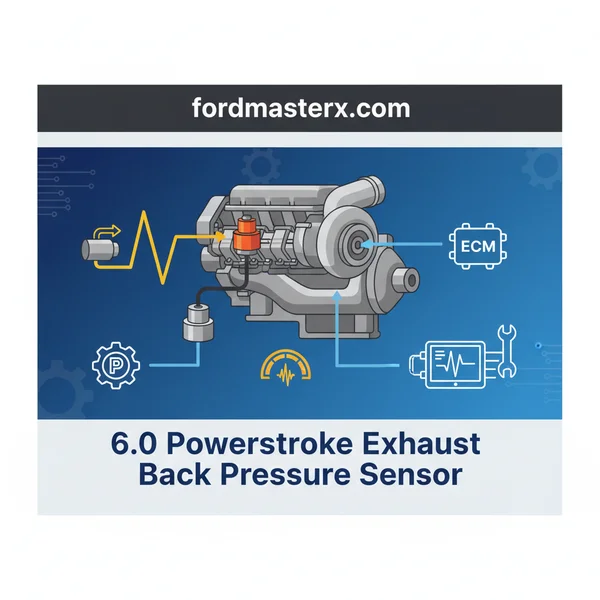
Fixing an EBP issue is one of the most cost-effective ways to restore your 6.0L’s driveability. Because the sensor lives in a harsh environment filled with heat and soot, it is a high-failure item that frequently sends “skewed” data to the computer before it fails completely. Understanding the relationship between back pressure and boost is critical to diagnosing whether your performance issues stem from a mechanical turbo failure or a simple electronic sensor error.
How EBP Data Directly Impacts VGT Turbo Performance
Your 6.0 Powerstroke uses a VGT that relies on moving vanes to change the effective size of the exhaust housing. To know where to position these vanes, the PCM compares manifold absolute pressure (MAP), intake air temperature (IAT2), and exhaust back pressure (EBP). If the EBP sensor reports incorrect data, the PCM cannot accurately command the VGT solenoid. This often results in the vanes being “parked” in a position that causes either excessive lag or dangerously high back pressure.
📤 Share
💾 Download
Decoding EBP Diagnostic Fault Codes
When your Check Engine Light (CEL) illuminates, your first step is checking for these three specific EBP-related codes. Each points to a different failure mode within the system:
- P0471 – Exhaust Pressure Sensor Range/Performance: This is the most common code for a 6.0L. It usually indicates that the sensor reading doesn’t “match” what the MAP or Barometric (BARO) sensors are seeing at key-on. This is often caused by heavy soot buildup in the sensor tube, effectively “blocking” the sensor from feeling the actual pressure changes in the manifold.
- P0472 – Exhaust Pressure Sensor Low Input: This code triggers when the PCM detects a voltage signal below 0.2V. This typically points to a broken wire in the pigtail harness or an internal short within the sensor itself.
- P0470 – Exhaust Pressure Sensor Malfunction: This is a general circuit failure. It means the PCM has lost communication with the sensor or the sensor is providing a signal that is physically impossible given the current engine load.
Symptoms of Poor Turbo Response
If your EBP sensor is failing but hasn’t yet thrown a hard code, your truck will exhibit specific behaviors. You may notice a constant hissing sound from the exhaust as the VGT vanes cycle rapidly while you are sitting at a red light. On the highway, you might experience “surging,” where the boost gauge bounces up and down while you hold a steady throttle. This happens because the PCM is receiving “noisy” data from the EBP and is constantly over-correcting the turbo vane position to compensate.
Master the 6.0 Powerstroke Exhaust Back Pressure Sensor in 8 Simple Steps
Recommended Best Deal Products


The Exhaust Back Pressure (EBP) sensor is a critical component of your 6.0L Powerstroke’s engine management system. It provides the PCM with data used to control the Variable Geometry Turbo (VGT) vanes and the Exhaust Gas Recirculation (EGR) valve. When this sensor or its mounting tube becomes clogged with soot, your truck may suffer from poor fuel economy, “turbo lag,” jerky acceleration, or a complete lack of power. This guide will walk you through the process of locating, cleaning, or replacing both the sensor and the tube to ensure your diesel engine breathes and performs exactly as it should.
Step 1: Preparation and Tool Gathering
What you need: A 1-inch deep-well socket, a 9/16-inch open-end wrench, a 5/8-inch open-end wrench, penetrating oil (like PB Blaster), a can of brake cleaner, a piece of heavy-duty weed whacker line or a flexible wire coat hanger, and safety glasses.
Instructions: Before touching any hardware, ensure the engine is completely cool. The EBP sensor is located near the front of the driver-side exhaust manifold, and these components retain heat for a long time. Begin by spraying the threads of the sensor and the nut connecting the EBP tube to the exhaust manifold with penetrating oil. Let this sit for at least 15 to 20 minutes. While waiting, clear the area around the driver-side battery and the FICM (Fuel Injection Control Module) to give yourself better visibility and more room to maneuver your wrenches.
Pro Tip: These sensors are notorious for seizing due to heat cycles and carbon buildup. Applying penetrating oil the night before you plan to do the work can save you from accidentally snapping the mounting tube, which is a much more difficult repair.
Step 2: Locating the Sensor Based on Model Year
What you need: A high-powered flashlight and a basic understanding of your engine’s manufacturing date.

Audible — Listen Free for 30 Days
One free credit a month and thousands of titles included.
Listen Free for 30 Days As an Amazon Associate I earn from qualifying purchases.Instructions: The location of the EBP sensor varies significantly depending on the year of your 6.0 Powerstroke. On 2003 and early 2004 models, the sensor is typically mounted on a bracket attached to the thermostat housing or the front of the driver-side cylinder head. On late 2004 through 2007 models, the sensor is often tucked further back, mounted on a bracket near the FICM on the driver’s side valve cover. Follow the stainless steel tube that rises up from the driver-side exhaust manifold; this tube leads directly to the sensor. Use your flashlight to inspect the wiring harness for any signs of chafing or heat damage.
Pro Tip: If your truck has been “re-flashed” by a dealership, it might use an “inferred” EBP strategy where the sensor is bypassed by the computer. However, keeping a functional, clean sensor is always better for optimal performance tuning.
Step 3: Disconnecting the Electrical Harness
What you need: A small flat-head screwdriver (optional) and shop towels.
Instructions: Once you have identified the sensor, you need to remove the electrical connector. There is a plastic locking tab on the harness. Press down firmly on the tab and pull the connector away from the sensor. If the connector is stuck due to grit and road grime, do not force it, as the plastic becomes brittle over time. Gently wiggle it while applying pressure to the tab. Once disconnected, inspect the inside of the harness plug for oil or green corrosion. If you see oil inside the connector, it means the internal diaphragm of the sensor has failed and “wicked” oil into the wires, necessitating a sensor replacement and a harness cleaning.
Pro Tip: Use a small dab of dielectric grease on the connector during reassembly to prevent moisture intrusion and corrosion, especially if you live in the “salt belt.”
Step 4: Removing the EBP Sensor
What you need: A 1-inch deep-well socket or a 1-inch wrench and a 5/8-inch wrench to hold the tube steady.
Instructions: Use the 5/8-inch wrench to hold the nut on the EBP tube steady (the “flared” fitting). While holding that nut to prevent the tube from twisting, use your 1-inch socket or wrench to unscrew the sensor itself. Turn the sensor counter-clockwise. Be careful not to apply too much side-load pressure, as you don’t want to kink the stainless steel tube. Once the sensor is loose, finish unscrewing it by hand. Examine the bottom orifice of the sensor; if it is completely packed with hard, black carbon, this is likely the cause of your performance issues.
Pro Tip: Always use a “back-up wrench” on the tube fitting. If the tube twists and kinks, it will restrict the pressure signal to the sensor, rendering even a brand-new sensor useless.
Step 5: Removing and Inspecting the EBP Tube
What you need: A 9/16-inch wrench and a 5/8-inch wrench.
Instructions: In many cases, replacing the sensor isn’t enough because the tube leading to the exhaust manifold is also clogged. Use your 9/16-inch wrench to loosen the fitting where the tube meets the exhaust manifold (down low on the driver’s side). This area is extremely tight and usually quite rusty. Once both ends are free, carefully wiggle the tube out of the engine bay. Hold the tube up to the light; if you cannot see through it, it is packed with soot. This soot acts as a buffer, preventing the sensor from reading real-time pressure changes, which confuses the PCM and causes erratic turbo behavior.
Audible Premium Plus — Annual Membership
12 audiobook credits up front, plus the full Audible catalogue.
See Annual Plans As an Amazon Associate I earn from qualifying purchases.Pro Tip: If the tube is extremely rusty or pitted, don’t bother cleaning it. New tubes are relatively inexpensive and provide peace of mind against future leaks or cracks.
Step 6: Deep Cleaning the Tube and Manifold Orifice
What you need: Brake cleaner, compressed air, and a length of weed whacker line.
Instructions: If the tube is structurally sound, spray a generous amount of brake cleaner into it. Let it soak for a few minutes to soften the carbon. Feed the weed whacker line through the tube, moving it back and forth to break up the “concrete-like” soot. Repeat this process until the brake cleaner runs clear through the tube. Next, take your wire or line and poke it into the hole in the exhaust manifold where the tube was connected. Sometimes a “plug” of soot forms right at the manifold entrance. Blow out the tube with compressed air one last time to ensure no liquid or debris remains inside.
Pro Tip: Avoid using a metal coat hanger if possible, as it can get stuck in the bends of the tube. Heavy-duty .080 or .095 gauge weed whacker line is flexible enough to navigate the curves but stiff enough to scrub the walls.
Step 7: Reinstalling the Tube and Sensor
What you need: Anti-seize lubricant, the new/cleaned sensor, and your wrenches.
Instructions: Apply a small amount of high-temp anti-seize to the threads of the tube fittings and the sensor threads. Thread the lower end of the EBP tube into the exhaust manifold by hand first to avoid cross-threading. Tighten it down with your 9/16-inch wrench. Next, secure the top of the tube to its mounting bracket. Thread the EBP sensor into the top of the tube fitting. Again, use the 5/8-inch wrench to hold the tube steady while you tighten the sensor with the 1-inch socket. Do not over-tighten; a snug fit with an extra quarter-turn is usually sufficient to create a seal.
Pro Tip: Ensure the tube is not rubbing against any wires or the FICM housing. The vibrations of a diesel engine can cause the metal tube to saw through wire insulation over time.
Step 8: Final Reconnection and System Reset
What you need: An OBD-II scanner (like ForScan or a high-end diagnostic tool).
Instructions: Snap the electrical connector back onto the sensor until you hear a distinct click. Clear any stored trouble codes (such as P0471, P0472, or P0478) using your OBD-II scanner. Start the engine and let it reach operating temperature. Using your scanner’s live data function, monitor the “EBP_AMP” (Exhaust Back Pressure Absolute) PID. At idle, the EBP should closely match the Barometric Pressure (BARO) and Manifold Absolute Pressure (MAP) readings—usually around 14.7 psi at sea level. If the readings are within 0.5 psi of each other at key-on-engine-off, the system is calibrated and functioning correctly.
Pro Tip: If your EBP reading stays static while revving the engine, you still have a clog in the manifold or a fault in the wiring harness. The pressure should rise immediately as RPMs increase.
✅ Final Checklist
- Verify that the electrical connector is clicked in and the locking tab is engaged.
- Ensure the EBP tube fittings at both the manifold and the sensor bracket are leak-free.
- Check that all tools have been removed from the engine bay, especially near the cooling fan.
- Confirm that EBP, MAP, and BARO readings are “in sync” on your diagnostic tool with the engine off.
- Take a test drive and listen for the distinct “whistle” of the VGT vanes cycling, which indicates the sensor is talking to the PCM.
Important Notes:
- Safety: Always wear eye protection when using brake cleaner and compressed air. Exhaust soot is a known irritant.
- Professional Help: If the tube nut at the exhaust manifold is rounded off or the tube snaps off inside the manifold, you may need a professional to heat the area with a torch or extract the broken piece.
- Estimated Time: 45 to 90 minutes depending on the level of carbon buildup and rust.
- Estimated Cost: $50 – $120 for a Motorcraft OEM sensor; cleaning the tube is essentially free (cost of brake cleaner). Avoid cheap “no-name” sensors, as they often fail within weeks.
Comparing EBP Sensor Locations Across 6.0L Model Years
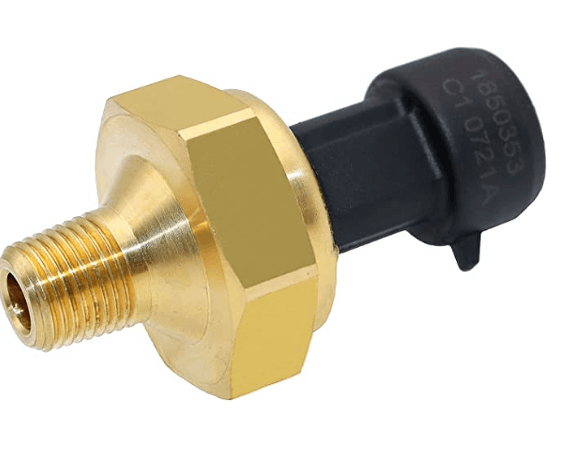
Depending on whether you own an “Early” or “Late” 6.0 Powerstroke, the EBP sensor will be in a completely different location. Ford moved the sensor midway through production to help alleviate heat-related failures and to make the sensor more accessible for cleaning. Finding the sensor is the first step in determining if you need to pull the tube for a thorough soot clean-out.
2003 to Early 2004 Model Locations
On the early 6.0L engines, the EBP sensor is located on a bracket attached to the thermostat housing at the front of the engine. A long stainless steel tube runs from the driver’s side exhaust manifold, snakes up past the power steering pump, and connects to the sensor. Because of the length and multiple bends in this early-style tube, it is highly prone to clogging. If you have an early model, you should check the sensor pigtail frequently, as it is positioned in a high-vibration area near the belt drive.
Late 2004 to 2007 Model Locations
For the later models, Ford moved the sensor to a bracket located on the driver’s side valve cover, typically near the standpipe and rail area. This location uses a shorter, more direct tube that connects to the same spot on the driver’s side exhaust manifold. While this location is much easier to reach, it is still susceptible to carbon blockage. Key identifying features for this location include:
- Mounting: The sensor is held by a simple metal clip or bracket bolted to the valve cover.
- Accessibility: You can usually swap this sensor in under 10 minutes with a deep-well socket.
- The Tube: Even with the relocated sensor, the tube still connects to the exhaust manifold near the steering shaft; this is where the majority of “soot plugs” occur.
Note for 2003-2004 owners: Some early trucks received a PCM flash from the dealership that “deleted” the EBP sensor’s input, instead using an “inferred” strategy based on MAP and BARO. However, most tuners and modern technicians prefer the sensor to be active, as it provides much tighter control over the VGT vanes and better engine braking performance.
Understanding Common EBP Fault Codes (P0470, P0471, P0472)
Recommended Best Deal Products


When your Check Engine Light illuminates on a 6.0 Powerstroke, the exhaust back pressure circuit is often the primary suspect. The PCM (Powertrain Control Module) uses this sensor to calculate the load on the engine and manage the VGT (Variable Geometry Turbocharger) vane position. If the data is missing or nonsensical, the truck will likely feel sluggish, “flat” during acceleration, or exhibit strange shifting patterns.
Deciphering the P0470 and P0471 Logic
The P0470 code is a general circuit malfunction. This usually means the PCM isn’t seeing any signal from the sensor at all. It could be a dead sensor, a broken wire, or even a loose connector. On the other hand, P0471 is a “Range/Performance” code. This is trickier because it means the sensor is sending data, but the data doesn’t make sense relative to the MAP (Manifold Absolute Pressure) or Barometric pressure sensors when the key is on and the engine is off.
- P0470: Check for harness chafing or a completely failed sensor element that has “flatlined.”
- P0471: Often caused by soot accumulation or a partially blocked tube providing delayed or skewed pressure readings.
- Practical Tip: Use a scan tool to compare EBP, MAP, and BARO readings with the engine off; they should all be within 0.5 psi of each other.
Dealing with P0472 (Low Input)
A P0472 code specifically indicates that the voltage returned to the PCM is lower than the established threshold. This often points toward a short to ground in the wiring harness or a failing sensor that has internally shorted. Since the 6.0 Powerstroke engine bay is notoriously hot, the plastic connectors and wire insulation can become brittle over time, leading to these electrical “gremlins.”
- Inspect the “v-reference” circuit; a short in the EBP sensor can sometimes “drag down” the 5-volt reference for other critical sensors like the ICP.
- Look for oil or coolant contamination inside the electrical connector, which can cause signal interference.
Critical Role of the EBP Tube in Pressure Accuracy
The EBP sensor doesn’t sit directly in the exhaust manifold. Instead, it relies on a long, narrow stainless steel tube to carry the pressure from the manifold up to the sensor. This design protects the sensitive electronics from extreme heat, but it creates a common point of failure that many owners overlook. A perfectly good sensor cannot do its job if the “straw” it’s drinking through is clogged.
The Problem with Carbon Buildup
Because the 6.0 Powerstroke is a diesel, it naturally produces soot—especially if the truck spends a lot of time idling or has a sticking EGR valve. Over time, this soot travels into the EBP tube and hardens into solid carbon. Once the tube is restricted, the sensor can no longer “see” the actual pressure changes in the manifold. This leads to surging, poor fuel economy, and erratic turbo behavior because the VGT vanes aren’t moving to the correct positions in real-time.
- A “lazy” sensor that reacts slowly to throttle input is almost always a sign of a partially clogged tube rather than a bad sensor.
- In cold climates, moisture can mix with soot and freeze inside the tube, causing temporary sensor “blindness” until the engine heat thaws the blockage.
Why Corrosion and Leaks Matter
Since the tube is made of metal and is constantly exposed to extreme heating and cooling cycles, it can eventually develop pinhole leaks or cracks due to corrosion. If pressure escapes through a hole before reaching the sensor, the PCM will receive a lower-than-actual reading. This causes the computer to over-adjust the turbo vanes to compensate for pressure it thinks it’s missing, which can lead to over-boosting or excessive back pressure that strains the head gaskets.
- Inspect the length of the tube for black “soot staining,” which is a dead giveaway of a pressure leak.
- Ensure the flare nut at the manifold is tight; engine vibration can occasionally back it off over several thousand miles.
Conclusion
The EBP sensor might be small, but it plays a massive role in how your 6.0 Powerstroke breathes and performs. From managing the VGT turbo vanes to ensuring your fuel economy stays within a reasonable range, this sensor is a critical piece of the engine management puzzle. Understanding the codes and keeping the pressure tube clear are the best ways to ensure your truck stays out of “limp mode” and on the road.
If you suspect an issue, start by checking your live data for any discrepancies between the EBP, MAP, and BARO sensors. Addressing a clogged tube or a faulty sensor early can save you from the headache of a “turbo lag” that feels like driving through molasses. Keep your sensors clean, your connections tight, and your Powerstroke will thank you with reliable power and smoother hauls!
❓ Frequently Asked Questions
How does the EBP sensor affect fuel economy?
When the sensor sends false data, the PCM incorrectly adjusts the VGT vanes, leading to inefficient combustion and significantly lower MPG.
What is the difference between EBP sensor locations on early vs. late 6.0 models?
Early 2003-2004 models have the sensor near the thermostat on the driver’s side front, while 2005-2007 models moved it to the driver’s side valve cover.
Is it possible to clean the sensor instead of replacing it?
You can occasionally clean the sensor tip with electrical cleaner, but the metal tube connecting it to the manifold is what usually requires heavy cleaning.
What happens if I ignore a P0470 code?
Ignoring the code can lead to erratic turbo behavior, surging, ‘turbo farting’ sounds, and eventual damage to the VGT actuator.
Can I delete the EBP sensor?
While some custom tunes allow for an EBP delete, it is generally recommended to keep it functional for optimal street drivability and turbo response.
Why is my 6.0 Powerstroke surging at idle?
A common culprit is a biased EBP sensor or a clogged tube, which causes the PCM to hunt for the correct turbo vane position.