
2018 Ford F-250 Towing Capacity: Diesel & Gas Specs Guide

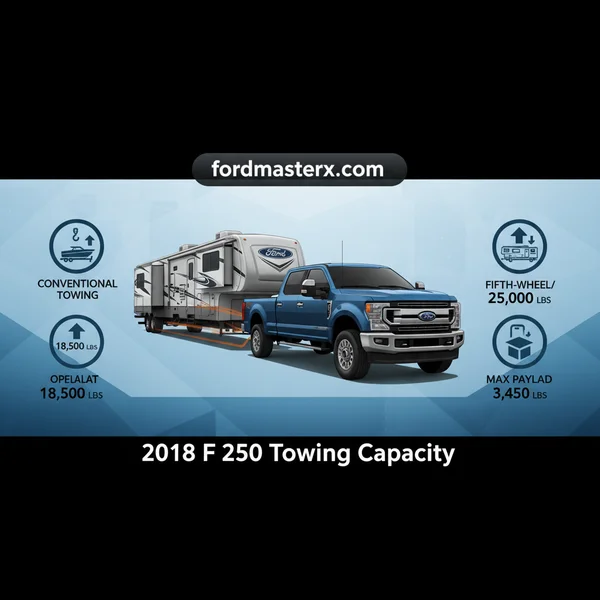
The 2018 Ford F-250 features a maximum conventional towing capacity of 18,000 pounds and a gooseneck rating of 18,500 pounds when equipped with the 6.7L Power Stroke Diesel engine. Models with the 6.2L V8 gas engine are also highly capable, providing up to 15,000 pounds of conventional towing strength depending on the axle ratio and configuration.
🎯 Key Takeaways
- Diesel engines provide the maximum towing limit of 18,500 lbs.
- The 6.2L gas engine tops out at 15,000 lbs conventional towing.
- Axle ratios like the 4.30 significantly increase gas engine GCWR.
- 4×2 models generally offer higher payload than 4×4 equivalents.
- Gooseneck towing adds roughly 500 lbs over conventional limits for diesels.
The 2018 Ford F-250 offers a maximum conventional towing capacity of 18,000 lbs and a gooseneck/5th-wheel capacity of 18,500 lbs when equipped with the 6.7L Power Stroke Diesel engine. If your truck features the 6.2L Boss V8 gas engine, your towing limits will range between 12,000 and 15,000 lbs depending on your axle ratio and cab configuration. These figures represent the upper limits of the Super Duty’s capability, but your specific truck’s rating depends heavily on how it was built at the factory.
Knowing these exact numbers is critical for more than just bragging rights. It is a matter of safety and mechanical longevity. Overloading your F-250 can lead to premature transmission wear, warped brake rotors, and dangerous handling characteristics on steep grades. By matching your trailer’s fully loaded weight to your truck’s specific engine and hitch configuration, you ensure that your 2018 Super Duty remains a reliable workhorse for years to come.
2018 F-250 Towing Capacity by Engine: Gas vs. Diesel
The engine under your hood is the primary factor in determining how much you can pull. In 2018, Ford offered two distinct powerplants for the F-250, each catering to different towing needs. The diesel engine provides the high-end torque required for massive fifth wheels, while the gas engine offers a lighter curb weight, which often results in a higher payload capacity for tongue weight.

The 6.7L Power Stroke V8 Turbo Diesel
The 6.7L Power Stroke is the undisputed king of the 2018 lineup. It produces 450 horsepower and a massive 935 lb-ft of torque. This torque is available low in the RPM range, making it ideal for moving heavy loads from a dead stop. Because the diesel engine is heavier than the gas version, it provides a planted, stable feel when hauling large trailers through crosswinds.
- Maximum Conventional Towing: 18,000 lbs
- Maximum 5th-Wheel/Gooseneck Towing: 18,500 lbs
- Best for: Full-time RVing, hauling heavy equipment, and frequent mountain driving.
The 6.2L SOHC 2-Valve Gas V8
The 6.2L gas engine is a robust, reliable option for those who don’t tow heavy loads every single day. It produces 385 horsepower and 430 lb-ft of torque. While its towing ceiling is lower than the diesel, it remains highly capable for most horse trailers and campers. One major advantage of the gas engine is the lower maintenance cost and the absence of Diesel Exhaust Fluid (DEF) requirements.
- Maximum Conventional Towing: 15,000 lbs (with 4.30 axle ratio)
- Standard Conventional Towing: 12,000 lbs to 13,000 lbs (with 3.73 axle ratio)
- Best for: Weekend towing, construction site work, and owners who prefer simpler maintenance.
2018 F-250 Towing Capacity Made Easy: Your Essential Action Plan
Understanding the towing capacity of your 2018 Ford F-250 is not just about reading a single number on a website; it is a critical safety process that ensures you do not overwhelm your suspension, brakes, or transmission. This guide covers how to accurately calculate your specific truck’s limits, taking into account engine types, axle ratios, and payload restrictions. Following these steps will prevent costly mechanical failures, ensure your insurance remains valid in the event of an accident, and provide a much smoother driving experience when hauling heavy loads behind your Super Duty.
Step 1: Identify Your Engine and Drivetrain Configuration
What you need: Your vehicle’s owner’s manual or the VIN (Vehicle Identification Number) found on the driver-side dashboard or door jamb.
Instructions: The 2018 F-250 comes with two primary engine options that drastically change towing performance: the 6.2L V8 Gas engine and the 6.7L Power Stroke Turbo Diesel V8. First, confirm which engine you have. Next, identify your drivetrain (4×2 or 4×4) and your cab style (Regular Cab, SuperCab, or Crew Cab). A 4×4 Crew Cab Diesel will have a significantly different towing profile than a 4×2 Regular Cab Gas model. For example, the 6.7L Diesel provides 925 lb-ft of torque, which is essential for hitting the maximum conventional towing limit of 18,000 lbs, whereas the gas engine usually tops out around 15,000 lbs depending on the configuration.
Pro Tip: Look at the badges on the side of your truck. If it says “Power Stroke” on the door or fender, you have the diesel engine, which generally offers the highest towing capacities but lower payload capacities due to the engine’s heavier weight.
Step 2: Locate the Safety Compliance and Tire Information Stickers
What you need: Access to the driver-side door pillar (the B-pillar).
Instructions: Open the driver’s door and look for two specific stickers. The first is the “Safety Compliance Certification Label,” which lists the Gross Vehicle Weight Rating (GVWR) and Gross Axle Weight Rating (GAWR) for the front and rear. The second is the “Tire and Loading Information” label, which explicitly states: “The combined weight of occupants and cargo should never exceed XXXX kg or XXXX lbs.” This number is your “Payload Capacity.” Many owners confuse towing capacity with payload, but your payload is what determines how much “tongue weight” your truck can support from a trailer. Write these numbers down as they are the legal limits for your specific VIN.
Pro Tip: Never rely on a generic brochure for these numbers. Options like a sunroof, chrome steps, or a heavy bedliner are installed at the factory and reduce the payload number on your specific sticker.
Step 3: Determine Your Rear Axle Ratio
What you need: The “Axle Code” from the Safety Compliance Certification Label on the door jamb.
Instructions: The axle ratio determines how many times the driveshaft turns for every one rotation of the wheels. A higher numerical ratio (like 4.30) provides more “grunt” for getting a heavy trailer moving but results in lower fuel economy. For the 2018 F-250, common codes include “3E” for a 3.55 electronic locking axle or “4M” for a 4.30. Once you have the code, you can cross-reference it with the 2018 Ford RV & Trailer Towing Guide. If you have the 6.2L Gas engine, having the 4.30 axle ratio can increase your Gross Combined Weight Rating (GCWR) significantly compared to the 3.73 ratio.
Pro Tip: If the sticker is missing or unreadable, you can often find a small metal tag bolted to the rear differential housing that stamped with the ratio (e.g., 3.55 or 3.73).
Step 4: Calculate Your Maximum Conventional Towing Capacity
What you need: Your engine type, cab style, and the 2018 Ford Towing Capacity chart.
Instructions: Now that you have your specs, find your match in the official 2018 charts. For conventional towing (using a standard hitch on the bumper), the 2018 F-250 is generally rated between 12,500 lbs and 18,000 lbs. If you are using a weight-carrying hitch (no spring bars), your limit may be lower than if you use a weight-distributing hitch. For example, a 4×4 Crew Cab with the 6.7L Diesel and 160-inch wheelbase has a max conventional tow rating of 15,000 lbs with a standard hitch, but this can reach 18,000 lbs with the proper heavy-duty tow package and weight distribution.
Pro Tip: Ensure your hitch receiver itself is rated for the load. The 2018 F-250 usually comes with a 2.5-inch receiver, but some configurations might have a 3-inch receiver. Use the correct reducer sleeve if necessary, as using an improperly sized shank can lead to catastrophic failure.
Step 5: Verify 5th-Wheel and Gooseneck Limits
What you need: Knowledge of your truck’s bed length and whether it has the “5th-Wheel/Gooseneck Prep Package.”
Instructions: If you plan to tow a large RV or horse trailer, you must look at the 5th-wheel/gooseneck ratings. For the 2018 model year, these ratings are often higher than conventional towing. A diesel-equipped F-250 can often handle up to 18,500 lbs in a gooseneck configuration. However, there is a catch: the F-250 is often limited by its GVWR (usually 10,000 lbs) to stay within Class 2 truck categories. This means that while the engine can pull 18,000 lbs, the weight of the trailer pressing down on the bed (the pin weight) might exceed your payload capacity. Check the “Gooseneck Towing” section of the Ford manual specifically for your wheelbase.
Pro Tip: 5th-wheel trailers typically put 15% to 25% of their total weight onto the truck’s bed. If your trailer weighs 15,000 lbs, your truck must have a payload capacity of at least 3,000 lbs to safely carry the pin weight plus passengers.
Step 6: Account for Real-World Payload Reductions
What you need: A calculator and an estimate of your passenger and cargo weight.
Instructions: This is where most people make a mistake. Your “Towing Capacity” assumes an empty truck with only a 150-lb driver. In reality, you likely have a family, a dog, a full tank of fuel, and gear in the bed. Total all these weights. For example, if your sticker says you have 3,100 lbs of payload, but you have 600 lbs of passengers and 200 lbs of tools in the bed, you now only have 2,300 lbs of “available payload.” This available payload must cover the tongue weight of your trailer. Since conventional tongue weight should be 10-15% of the trailer weight, a 2,300-lb limit means your maximum trailer weight is effectively capped at around 15,300 lbs, even if the brochure says 18,000 lbs.
Pro Tip: Take your fully loaded truck (with passengers and fuel) to a CAT scale at a truck stop. Subtract that weight from your GVWR to find your exact remaining payload capacity.
Step 7: Check the Integrated Trailer Brake Controller and Tires
What you need: The dashboard menu and a tire pressure gauge.
Instructions: The 2018 F-250 features an Integrated Trailer Brake Controller (TBC). Once your trailer is connected, you must set the “Gain” on the dashboard. In a safe, open area, drive at approximately 20 mph and squeeze the manual TBC lever. Adjust the gain until the trailer brakes grab firmly without locking up. Additionally, check your truck’s tire sidewalls. High-capacity towing requires LT (Light Truck) tires, typically Load Range E. Ensure they are inflated to the “Cold PSI” listed on your door jamb sticker—often 60 PSI for the front and 80 PSI for the rear when towing at max capacity.
Pro Tip: Don’t forget to adjust your “Trailer Blind Spot” settings in the truck’s productivity screen. The 2018 F-250 allows you to input the length of your trailer so the blind-spot sensors account for the entire length of the rig.
✅ Final Checklist
- Verified the engine type (6.2L Gas vs. 6.7L Diesel) and its specific rating.
- Confirmed the axle ratio (3.55, 3.73, or 4.30) via the door jamb axle code.
- Calculated total payload by subtracting passengers and cargo from the door sticker’s limit.
- Verified that the trailer tongue weight (10-15% for conventional) or pin weight (15-25% for 5th-wheel) does not exceed the remaining payload.
- Adjusted the Trailer Brake Controller gain and confirmed truck tire pressures are at the “Max Load” PSI.
Important Notes:
- Safety Warning: Exceeding the Gross Combined Weight Rating (GCWR) can lead to brake fade, tire blowouts, and permanent transmission damage.
- Professional Help: If you are unsure about hitch installation or weight-distributing setups, visit a certified hitch professional to ensure your hardware is properly torqued and leveled.
- Estimated Time/Cost: Calculating your capacity takes about 30 minutes. Visiting a CAT scale typically costs $12-$15. Upgrading to a weight-distributing hitch can cost between $300 and $800.
Conventional vs. 5th-Wheel/Gooseneck Towing Ratings
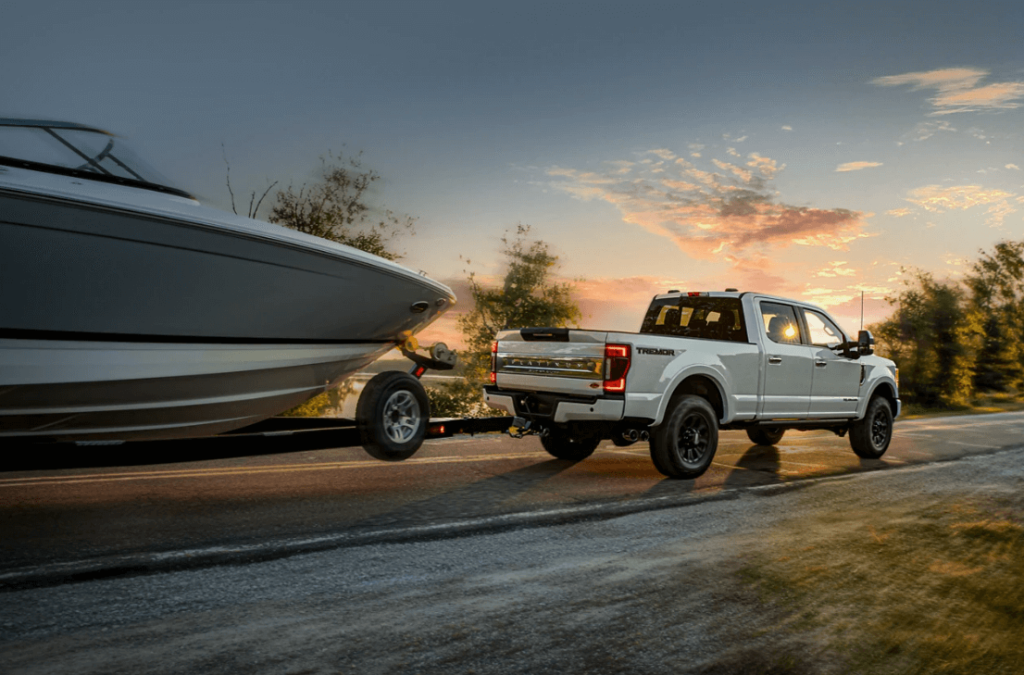
The method you use to attach your trailer to the 2018 F-250 significantly impacts the maximum weight you can legally and safely pull. Conventional towing refers to a trailer attached to a hitch receiver at the rear bumper. 5th-wheel or gooseneck towing involves a hitch mounted in the center of the truck bed, directly over the rear axle, which allows for better weight distribution and higher capacities.
Conventional Towing Breakdown
For the 2018 model year, Ford utilized a high-strength, boxed steel frame that allowed for impressive “off-the-bumper” stats. However, you must pay attention to whether you are using a weight-carrying hitch or a weight-distributing hitch. Most of the maximum ratings require a weight-distributing setup to keep the front wheels of the truck firmly on the ground.
- Gas 6.2L (3.73 Axle): 12,000 lbs to 13,000 lbs
- Gas 6.2L (4.30 Axle): 15,000 lbs
- Diesel 6.7L (All Ratios): 18,000 lbs
5th-Wheel and Gooseneck Towing Specs
If you are pulling a large luxury RV or a heavy flatbed, you are likely using the bed-mounted hitch. The 2018 F-250 was available with an optional 5th-wheel/Gooseneck Prep Package from the factory. Interestingly, because the F-250 is a Single Rear Wheel (SRW) truck, its gooseneck capacity is often limited by its Gross Combined Weight Rating (GCWR) rather than the hitch itself.
- Maximum 5th-Wheel (Gas): 15,000 lbs to 15,800 lbs
- Maximum 5th-Wheel (Diesel): 18,500 lbs
- Practical Note: Even if the engine can pull 18,500 lbs, always check your tire load ratings. Your rear tires are often the “weak link” when it comes to the heavy pin weight of a 5th-wheel trailer.
Configuration Impact on Max Towing
It is important to remember that these “maximum” numbers usually apply to specific configurations. A Regular Cab 4×2 truck will almost always have a higher towing capacity than a Crew Cab 4×4. This is because the weight of the extra cab space and the 4WD components counts against your GCWR. When you add 400 lbs of cab and 300 lbs of 4WD hardware, you effectively subtract 700 lbs from your total towing potential.
Understanding GCWR, Payload, and Axle Ratio Impacts
When looking at the 2018 F-250 towing capacity, many owners focus solely on the maximum trailer weight. However, the Gross Combined Weight Rating (GCWR) is the figure that truly governs your limits. The GCWR is the maximum allowable weight of the entire setup, including the truck, passengers, cargo, fuel, and the trailer itself. If you load up your truck bed with heavy equipment, you must subtract that weight from your available towing capacity to ensure you stay within the legal and safe limits of the vehicle.
The Critical Role of Payload
In the world of heavy-duty trucks, you will often run out of payload capacity before you hit your maximum towing limit. Payload includes everything sitting on the truck’s chassis, including the tongue weight of your trailer. For the 2018 F-250, tongue weight should typically be 10-15% of the total trailer weight for conventional towing.
- Check the Sticker: Always reference the yellow “Tire and Loading Information” sticker on your driver-side door jamb for your truck’s specific payload capacity.
- Weight Distribution: Using a weight-distribution hitch can help manage how that payload is spread across the axles, improving stability even if it doesn’t technically increase the capacity.
- Passenger Weight: Remember that a crew of four adults can easily add 800 pounds to your load, directly reducing what you can hitch to the back.
How Axle Ratios Change the Game
The “shortness” or “tallness” of your rear differential gears significantly impacts how much the 2018 F-250 can pull, especially with the 6.2L gas engine. A higher numerical ratio provides more torque at the wheels to get heavy loads moving from a dead stop.
- 3.73 Axle Ratio: The standard offering for the gas engine, providing a balance between highway fuel economy and moderate towing.
- 4.30 Axle Ratio: The preferred choice for gas-powered towing. This ratio increases the GCWR and makes it much easier to pull heavy trailers up steep grades.
- 3.31 or 3.55 Ratios: Commonly found on the 6.7L Diesel models; the engine’s 925 lb-ft of torque is so massive that it doesn’t require the aggressive gearing needed by the gas V8.
Configuration Analysis: Cab Styles and Drivetrain Effects
The physical build of your truck—how much it weighs before you ever hitch a trailer—dictates its final towing performance. Because the 2018 F-250 has a fixed Gross Vehicle Weight Rating (GVWR) of 10,000 pounds for many configurations, any extra weight added by luxury features or larger cabs reduces the remaining capacity for hauling.
Cab Size and Bed Length Factors
The 2018 Ford F-250 was offered in Regular Cab, SuperCab, and Crew Cab configurations. As the cab gets larger, the truck gets heavier. A Regular Cab 4×2 is the “lightweight” of the group, which paradoxically gives it the highest raw payload and towing numbers in certain categories. Conversely, a Crew Cab Long Bed model is the heaviest configuration, which can eat into your available towing “budget.”
4×2 vs. 4×4 Drivetrain Impact
While 4×4 is a non-negotiable feature for many who tow on job sites or boat ramps, it comes with a weight penalty. The transfer case, front differential, and extra drive shafts add roughly 400 to 500 pounds to the truck’s curb weight.
- 4×2 Advantage: If you are looking for the absolute maximum payload and conventional towing figures on paper, the 4×2 models usually win because they aren’t carrying the extra weight of the 4×4 system.
- Practical Tip: If you frequently tow in snowy conditions or off-road, the slight reduction in towing capacity of the 4×4 is a worthy trade-off for the added traction and safety.
- Wheelbase Considerations: Longer wheelbases (Crew Cab models) generally offer a more stable towing platform, reducing the “tail wagging the dog” feeling when encountering crosswinds or passing semi-trucks.
Conclusion
The 2018 Ford F-250 remains a gold standard for heavy-duty performance, offering a massive range of towing capabilities from 12,000 to 18,000 pounds. To maximize your truck’s potential, you must look beyond the brochures and understand how your specific engine, axle ratio, and cab configuration work together. Whether you choose the high-torque 6.7L Power Stroke for heavy 5th-wheel hauling or the reliable 6.2L gas V8 for daily utility, staying within your GCWR and payload limits is the key to a safe journey.
Ready to hit the road? Start by checking your driver-side door sticker to confirm your specific payload and then weigh your trailer fully loaded. Understanding these numbers ensures that your 2018 F-250 stays on the road for years to come. Safe hauling!
❓ Frequently Asked Questions
What is the difference between conventional and gooseneck towing on the 2018 F-250?
Conventional towing uses a rear hitch receiver and is capped at 18,000 lbs for the diesel. Gooseneck or 5th-wheel towing uses a hitch in the truck bed, allowing for a slightly higher maximum of 18,500 lbs due to better weight distribution over the rear axle.
How does the 6.7L Power Stroke Diesel improve towing performance?
The diesel engine produces 450 horsepower and 935 lb-ft of torque, which provides significantly better low-end pulling power and higher GCWR compared to the gas engine. This allows the diesel to maintain speed on inclines while hauling maximum loads.
Why does the axle ratio matter for 2018 F-250 towing?
A higher axle ratio (like 4.30) provides more torque to the wheels, which increases the truck’s ability to move heavy loads from a stop. For gas engines, moving from a 3.73 to a 4.30 ratio can increase the towing capacity by several thousand pounds.
What is the maximum payload capacity for the 2018 F-250?
The maximum payload capacity for a 2018 F-250 is 4,200 lbs, typically found in a Regular Cab 4×2 configuration with the gas engine. Heavy diesel engines and 4×4 systems reduce this payload capacity significantly.
Is a weight-distributing hitch required for maximum towing?
Yes, for conventional towing at the upper limits of the F-250’s capacity, Ford requires a weight-distributing hitch to ensure stability and proper weight transfer to the front axle. Always check the rating on the hitch receiver itself.
How do 4×2 and 4×4 drivetrains compare in towing capacity?
Generally, 4×2 models have a slightly higher towing and payload capacity because the truck itself is lighter without the front drivetrain components. However, 4×4 models are often preferred for towing in slippery conditions or off-road environments.