1994 Ford F350 7.3 Turbo Diesel: IDI vs. Powerstroke Guide

The 1994 Ford F350 is a pivotal transition year featuring both the mechanically-injected 7.3L IDI Turbo and the debut of the electronically-controlled 7.3L Powerstroke. Understanding the technical differences between these two engines is essential for proper maintenance and performance tuning.
🎯 Key Takeaways
Recommended Best Deal Products


- Identify your engine using the 8th VIN digit:‘K’ for IDI, ‘F’ for Powerstroke.
- The Powerstroke delivers 210 HP, while the IDI Turbo offers 190 HP.
- IDI engines require SCA coolant additives to prevent catastrophic cylinder wall cavitation.
- Powerstroke models rely on a High-Pressure Oil Pump (HPOP) for fuel injection.
- Expect 13-17 MPG depending on the rear-axle ratio and hauling weight.
The 1994 Ford F350 represents a pivotal moment in diesel history because it is a “split” production year. You cannot simply walk into a parts store and ask for 1994 diesel components without knowing exactly which 7.3L engine you have. Ford offered two distinct turbocharged 7.3L engines this year: the legacy Indirect Injection (IDI) Turbo and the then-revolutionary Direct Injection Powerstroke. While they share the same displacement, they are entirely different platforms with zero internal parts compatibility.

Prime for Young Adults — 6 Months Free
Students and 18–24s get six months of Prime free, then half price.
Start 6 Months Free As an Amazon Associate I earn from qualifying purchases.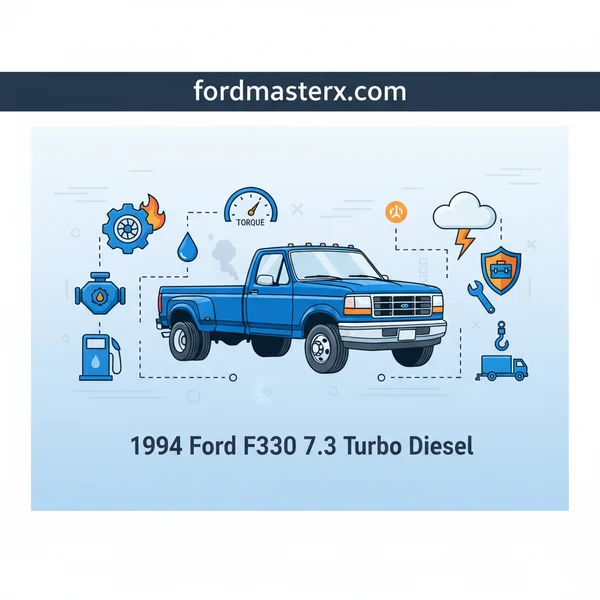
Identifying your specific engine is the most critical step for any owner or buyer. Misidentifying the engine leads to buying the wrong sensors, injectors, and cooling components. Whether you are looking for the mechanical simplicity of the IDI or the electronic tuning potential of the Powerstroke, you need to verify the hardware under the hood before turning a wrench or signing a title. This guide breaks down the visual and technical markers to ensure you know exactly what is powering your one-ton Ford.
Identifying the Engine: 7.3L IDI Turbo vs. 7.3L Powerstroke
Because 1994 was a transition year, both engines were available simultaneously. The 7.3L IDI Turbo was a refined version of the older International Harvester design, while the “1994.5” Powerstroke introduced the high-pressure oil (HEUI) injection system. Telling them apart is easy once you know where to look, starting with your paperwork and ending with a quick visual check of the engine bay.

The VIN Code Shortcut
The fastest way to identify your engine without opening the hood is to check the 8th digit of your Vehicle Identification Number (VIN). This digit is the factory engine code and is definitive for how the truck was built. Look at your VIN plate on the driver’s side dashboard or your door jamb sticker:
- VIN Code K: This indicates the 7.3L IDI Turbo Diesel. It is a mechanically injected engine.
- VIN Code F: This indicates the 7.3L Powerstroke Turbo Diesel (DI). It is electronically controlled.
- VIN Code M: Though less common in the F350 for this year, “M” signifies the naturally aspirated (non-turbo) IDI engine.
Visual Differences Under the Hood
If the VIN plate is missing or you suspect an engine swap, a quick look at the top of the engine will give you the answer. The layout of the fuel system is the “smoking gun” for identification. On a 7.3L IDI Turbo, you will see eight individual metal fuel lines running from a centralized injection pump (located at the front top of the engine) to each cylinder. These lines are clearly visible and look like a “spider” of tubing.
In contrast, the 7.3L Powerstroke has a much cleaner look on top. Because it uses an HPOP (High-Pressure Oil Pump) and electronic injectors located under the valve covers, you will not see those eight external fuel lines. Instead, you will see a large aluminum reservoir at the front of the “V” and a significant wiring harness plugging into the valve cover gaskets. Additionally, the factory air intake on a Powerstroke usually features a large plastic cover that explicitly says “Powerstroke,” whereas the IDI Turbo often has a simple “7.3 Turbo Diesel” tuna-can style air cleaner or a basic rectangular box.
The Ultimate 1994 Ford F350 7.3 Turbo Diesel Walkthrough
Recommended Best Deal Products


The 1994 Ford F350 marks a legendary transition in diesel history, housing either the final “Indirect Injection” (IDI) Turbo Diesel or the very first 7.3L Powerstroke. Known as the “million-mile motor,” these trucks are bulletproof if maintained correctly, but their age requires a specific, methodical approach to upkeep. This guide covers the essential maintenance and optimization steps required to keep your OBS (Old Body Style) Ford running at peak performance, ensuring reliability whether you are towing heavy loads or restoring a classic workhorse.
Step 1: Inspecting the Fuel Return System and Air Intrusion
What you need: 5/8″ open-end wrench, a set of Viton O-rings, a fuel return line kit (caps and hoses), and a clean rag.
Instructions: On the 1994 7.3 engine, especially the IDI Turbo, air intrusion is the primary cause of “hard starting” after the truck has sat overnight. Start by inspecting the plastic return caps located on top of each injector. If you see dampness or “wet” spots around the base of the injector, the internal O-rings have failed. Carefully remove the old lines and pop off the plastic caps using a flathead screwdriver. Lubricate two new Viton O-rings with clean diesel fuel, slide them onto the injector body, and press the cap down until you hear a distinct “click.” Replace the rubber fuel lines between the caps using high-quality diesel-rated hoses to ensure a vacuum-tight seal.
Pro Tip: Never use a screwdriver to pry against the injector body itself; you risk scoring the metal. If the caps are stubborn, a small amount of heat from a hair dryer can make the plastic more pliable for removal.

Audible — Listen Free for 30 Days
One free credit a month and thousands of titles included.
Listen Free for 30 Days As an Amazon Associate I earn from qualifying purchases.Step 2: Cooling System Treatment and Cavitation Prevention
What you need: Fleetguard DCA4 or Motorcraft VC-8 additive, cooling system test strips, and a gallon of heavy-duty diesel coolant.
Instructions: The 7.3L diesel is prone to “cavitation,” a process where tiny air bubbles implode against the cylinder walls, eventually vibrating holes through the metal into the water jacket. To prevent this, you must maintain Supplemental Coolant Additives (SCA). Dip a test strip into the radiator (when cold) and compare the color to the chart provided. If the SCA levels are low, add the required amount of DCA4 or VC-8. Ensure your coolant is a 50/50 mix of distilled water and low-silicate green coolant. Check the radiator cap for a cracked gasket, as a 1994 truck often suffers from pressure loss due to a worn 13-lb cap.
Pro Tip: If your coolant looks like chocolate milk or has an oily sheen, stop immediately; this indicates a failed oil cooler header, which is a common 7.3 failure point that requires immediate O-ring replacement.
Step 3: High-Volume Oil Change and HPOP Check
What you need: 15 quarts of 15W-40 heavy-duty diesel oil, a Motorcraft FL-1995 filter, a 15mm wrench, and a 5-gallon drain pan.
Instructions: If you have the 1994 Powerstroke model, the engine uses a High-Pressure Oil Pump (HPOP) to fire the fuel injectors. Because the oil is sheared at high pressures, regular changes are critical. Drain the oil from the pan (expect nearly 4 gallons) and remove the massive oil filter. Fill the new Motorcraft filter with fresh oil before installing it to prevent a “dry start.” Once the pan is refilled, check the HPOP reservoir (located at the front top of the engine). Remove the small 1/4″ drive plug; the oil level should be within one inch of the top. If it is low, the truck will experience a “no-start” or “stalling” condition because the injectors cannot fire without oil pressure.
Pro Tip: Always use a Motorcraft filter. Cheaper filters often lack the proper anti-drainback valve, causing the HPOP reservoir to empty overnight and leading to long cranking times in the morning.
Step 4: Turbocharger and Intake Tract Inspection
What you need: 7/16″ and 8mm deep sockets, a flathead screwdriver, and a bright flashlight.
Instructions: The 1994 factory turbo is a non-intercooled setup, meaning heat management is vital. Start by loosening the clamps on the rubber “boots” connecting the turbo to the intake manifold. Inspect the boots for oil-soaked soft spots or cracks. Next, remove the air intake tube from the front of the turbocharger. Reach in and gently wiggle the compressor wheel. There should be zero “in-and-out” play and very minimal “side-to-side” play. If the wheel can touch the housing walls, the turbo bearings are shot. Finally, look at the firewall behind the engine for black soot; this indicates leaking “up-pipes,” which will cause a significant loss in boost and increased Exhaust Gas Temperatures (EGTs).
Pro Tip: If you find oily residue in the intake, this is normal “blow-by” from the CCV (Crankcase Ventilation) system. However, excessive puddling suggests your piston rings may be worn, requiring a compression test.
Step 5: Glow Plug System Restoration
What you need: A digital multimeter, a 10mm deep socket, and eight Motorcraft (Beru) ZD-9 (for IDI) or ZD-11 (for Powerstroke) glow plugs.
Audible Premium Plus — Annual Membership
12 audiobook credits up front, plus the full Audible catalogue.
See Annual Plans As an Amazon Associate I earn from qualifying purchases.Instructions: 7.3 diesels are “cold blooded” and rely heavily on the glow plug system. If the truck smokes white or stumbles upon starting, the system is failing. Test each glow plug by removing the wire lead and measuring resistance between the glow plug tip and the engine block. You should see 0.5 to 2.0 ohms. If it shows “Open” or high resistance, the plug is dead. When replacing them, use ONLY Motorcraft/Beru plugs. Brands like Autolite are notorious for swelling inside the head, making them impossible to remove later. Inspect the glow plug relay (located on the passenger side valve cover) for burnt terminals or melted plastic, which indicates high resistance and a fire hazard.
Pro Tip: Never use starting fluid (ether) on a 7.3 with a working glow plug system. The glow plugs will ignite the ether prematurely, which can blow the head gaskets or shatter the piston rings instantly.
Step 6: Servicing the E4OD Transmission
What you need: 14 quarts of MERCON V fluid, a new transmission filter, a pan gasket, and a torque wrench.
Instructions: The 1994 F350 usually features the E4OD automatic transmission, which is sensitive to heat. Start by dropping the transmission pan and replacing the filter. Inspect the magnet in the bottom of the pan; a fine grey “dust” is normal, but metal chunks indicate internal failure. Check the wiring harness connector on the passenger side of the transmission; it is prone to getting soaked in oil, which causes “limp mode” or harsh shifting. Clean the connector with electronic cleaner. When refilling, ensure you use MERCON V. If you do a lot of towing, consider installing an aftermarket external transmission cooler to extend the life of the clutches.
Pro Tip: Pay attention to the “OD” light on the end of your shifter stalk. If it flashes while driving, the computer has stored a diagnostic code. Address these codes immediately to avoid a total transmission rebuild.
Step 7: Battery and Electrical System Grounding
What you need: Wire brush, battery terminal cleaner, and a voltmeter.
Instructions: A diesel engine requires massive amperage to turn over the high-compression cylinders. The 1994 Ford uses two batteries wired in parallel. Even if one battery is strong, a weak second battery will “drag down” the starter, leading to slow cranking speeds that won’t allow the engine to fire. Disconnect both batteries and clean the terminals until they shine. Follow the negative cables down to the engine block; these often become corroded or loose. A poor ground is the #1 cause of “ghost” electrical issues in OBS Fords. Check the alternator output with the engine running; you should see between 13.8V and 14.4V.
Pro Tip: If your starter sounds “tired,” don’t just replace the batteries. Upgrade to a modern gear-reduction starter (like the Denso style used in later 7.3 models). It spins the engine significantly faster, leading to near-instant starts.
✅ Final Checklist
- Verify that the cooling system has been tested for SCA levels to prevent cavitation.
- Ensure the HPOP reservoir is filled to within 1 inch of the top plug.
- Confirm all eight glow plugs show proper resistance and the relay clicks on when the key is turned.
- Check that there are no visible fuel leaks around the injector return caps.
- Verify the transmission fluid is at the “Full Hot” mark after a 15-minute drive.
Important Notes:
- Safety First: Always use heavy-duty jack stands when working under an F350; these trucks weigh nearly 8,000 lbs and can easily crush standard automotive ramps.
- When to Seek Help: If you suspect a “knock” that sounds like a hammer hitting a rail, it may be an injector “pintle” stuck open, which can melt a piston. Seek a professional diesel mechanic for injector flow testing.
- Estimated Time: A full baseline service (Steps 1-7) typically takes 6 to 10 hours for a DIYer.
- Cost Range: Expect to spend $400 – $800 on high-quality fluids, filters, and small components like O-rings and glow plugs.
Technical Performance: Horsepower, Torque, and Towing Specs
In 1994, the F350 was the workhorse of the Ford lineup. While both 7.3L options provided excellent low-end grunt for the era, the Powerstroke was introduced specifically to compete with the rising torque numbers from Cummins and Duramax. The IDI Turbo was no slouch, but it was limited by its mechanical injection timing and indirect combustion chamber design.

Factory Engine Output
The performance gap between the two engines is noticeable, especially when climbing grades with a heavy trailer. The Powerstroke offered a significant leap in torque, which is the figure that matters most for F350 owners. Here are the factory ratings for both 1994 options:
- 7.3L IDI Turbo: Approximately 190 horsepower at 3,000 RPM and 388 lb-ft of torque at 1,400 RPM.
- 7.3L Powerstroke: Approximately 210 horsepower at 3,000 RPM and 425 lb-ft of torque at 2,000 RPM.
The IDI Turbo produces its peak torque slightly lower in the RPM range, making it feel very “tractable” at low speeds. However, the Powerstroke maintains its pull much better at highway speeds and offers significantly more overhead for aftermarket performance tuning via electronic chips.
F350 Chassis Ratings and Towing
The 1994 F350 chassis was designed to maximize the potential of these diesel engines. Most F350 models from this year came with a 4.10 or 3.55 rear axle ratio. When properly equipped, a 1994 F350 dually (DRW) has a Gross Combined Weight Rating (GCWR) of approximately 17,000 to 18,500 pounds. For a conventional trailer, the max towing capacity usually hovered around 10,000 pounds, while fifth-wheel setups could push toward the 12,500-pound mark depending on the cab configuration and transmission. The payload capacity for a standard F350 dually in 1994 was impressive, often rated for over 4,000 pounds, making it a favorite for heavy slide-in campers and commercial flatbeds.
Reliability and Maintenance: Cavitation vs. HPOP Issues
Recommended Best Deal Products


When discussing the longevity of the 1994 Ford F350, both engine variants are considered “million-mile” candidates, but they fail in very different ways. Understanding these specific quirks is the key to keeping these heavy-duty rigs on the road for decades.
The IDI and the Cavitation Concern
The 7.3 IDI Turbo is a powerhouse of mechanical reliability, yet it faces a unique internal threat: cavitation. Because the cylinder walls in the 7.3 block are thinner than its 6.9 predecessor, internal vibrations can create tiny vacuum bubbles in the coolant. When these bubbles collapse, they act like miniature jackhammers, eventually pitting holes through the cylinder wall and allowing coolant to enter the combustion chamber.
- SCA Monitoring: Maintaining Supplemental Coolant Additives (SCAs) is the only way to prevent liner pitting. Owners must use test strips regularly to ensure the chemical barrier remains intact.
- Mechanical Simplicity: Beyond the cooling system, the IDI is remarkably robust. With no electronic sensors to fail, most “breakdowns” are simple fuel-delivery issues like air intrusion in the return lines.
The Powerstroke and the HPOP System
The 1994.5 Powerstroke swapped mechanical simplicity for electronic precision. Instead of a traditional injection pump, it utilizes a High-Pressure Oil Pump (HPOP). This system uses highly pressurized engine oil to fire the fuel injectors. While this provides significantly more torque, it makes the engine’s health entirely dependent on oil quality and pressure.
- Oil Shear: The HPOP system is incredibly hard on motor oil. If you skip oil changes, the oil breaks down and loses its ability to fire the injectors properly, leading to rough starts and lost power.
- Sensor Reliance: The Powerstroke relies on the Injector Control Pressure (ICP) sensor and the Injection Pressure Regulator (IPR). If these small electronic components fail, the truck will leave you stranded, a problem the IDI never has to worry about.
Ownership Considerations: Fuel Economy and Real-World Durability
Buying a 1994 F350 means embracing the reality of driving a classic heavy-duty truck. While you won’t get the creature comforts of a modern King Ranch, you gain a level of durability that is increasingly hard to find in the era of complex emissions equipment.
Real-World MPG Expectations
Expectations for fuel economy should be tempered by the truck’s aerodynamics and weight. Most owners of an F350 crew cab dually report similar numbers regardless of which 7.3 is under the hood. On average, you can expect between 13 and 17 MPG depending on your rear-end gear ratio.
- The Gear Factor: Trucks equipped with 4.10 gears will be great for towing but will suffer on the highway. Those with 3.55 gears often see a 2-3 MPG improvement during unloaded cruising.
- Electronic Efficiency: The Powerstroke generally offers slightly better fuel mapping at cruising speeds, though the IDI remains remarkably efficient if driven with a light foot.
Long-Term Value and Resale
The 1994 model year is currently seeing a massive surge in value. Because it is the last year of the “OBS” (Old Body Style) Ford trucks to feature both the classic mechanical diesel and the first generation of the legendary Powerstroke, collectors and hot-shotters alike are hunting for clean examples.
- The “Forever Truck” Status: The IDI Turbo is favored by “preppers” and those who want a truck that can run on alternative fuels like cleaned waste vegetable oil (WVO) with minimal modification.
- The Workhorse Appeal: The Powerstroke remains the gold standard for those who actually need to tow 10,000 pounds regularly. Its ability to be “chipped” or tuned for more power gives it a modern edge in performance.
Conclusion
Whether you choose the 1994 Ford F350 with the 7.3 IDI Turbo or the late-year Powerstroke, you are investing in one of the most reliable periods of Ford truck history. The IDI offers a “fix-it-with-a-wrench” simplicity that is perfect for the DIY mechanic, while the Powerstroke provides the raw grunt and technological advancement that defined the next two decades of diesel performance.
If you are currently shopping for one of these legends, your next step should be a thorough inspection of the cooling system maintenance records for an IDI or a scan of the HPOP pressures for a Powerstroke. Finding a rust-free frame with a documented service history is more important than which engine badge is on the fender.
Do you prefer the mechanical soul of the IDI or the electronic power of the 7.3 Powerstroke? Let us know in the comments below and share your best OBS Ford stories!
❓ Frequently Asked Questions
What are the main differences between the IDI Turbo and the Powerstroke?
The IDI (Indirect Injection) is a mechanical engine with a rotary injection pump, while the Powerstroke (Direct Injection) uses a High-Pressure Oil Pump (HPOP) and electronic injectors. The Powerstroke offers better performance and tunability, but the IDI is simpler to repair with basic hand tools.
What is the towing capacity of a 1994 Ford F350 7.3 turbo diesel?
Depending on the cab configuration and rear-axle ratio (4.10 vs 3.55), the 1994 F350 can tow between 10,000 and 12,500 pounds. While the engine can handle more, the chassis and braking system are the primary limiting factors for safety.
What is ‘cavitation’ and why does it affect 1994 7.3 engines?
Cavitation occurs when air bubbles implode against cylinder walls, eventually creating pinholes that leak coolant into the oil. This primarily affects the IDI block; it is prevented by using Supplemental Coolant Additives (SCA) to maintain a protective layer inside the water jacket.
What are common failure points on the 1994 7.3 Powerstroke?
Common issues include the Injection Control Pressure (ICP) sensor, the Cam Position Sensor (CPS), and leaks in the HPOP lines. Because it was the debut year for the electronic 7.3, the Under Valve Cover Harness (UVCH) can also become brittle and fail.
Can I add a performance chip to my 1994 7.3 turbo diesel?
You can add a performance chip to the 1994.5 Powerstroke to increase horsepower and torque easily via the PCM. However, the 1994 IDI Turbo is purely mechanical, so increasing power requires physical adjustments to the injection pump and turbo wastegate.
Why is 1994 considered a ‘transition year’ for Ford trucks?
1994 was unique because Ford produced the final mechanical IDI engines alongside the first electronic Powerstroke engines. This overlap means parts for a ‘1994 7.3’ are often not interchangeable, making engine identification the most critical step for any repair or upgrade.