
What Does Eco Mean in Cars? The Complete Guide for 2026

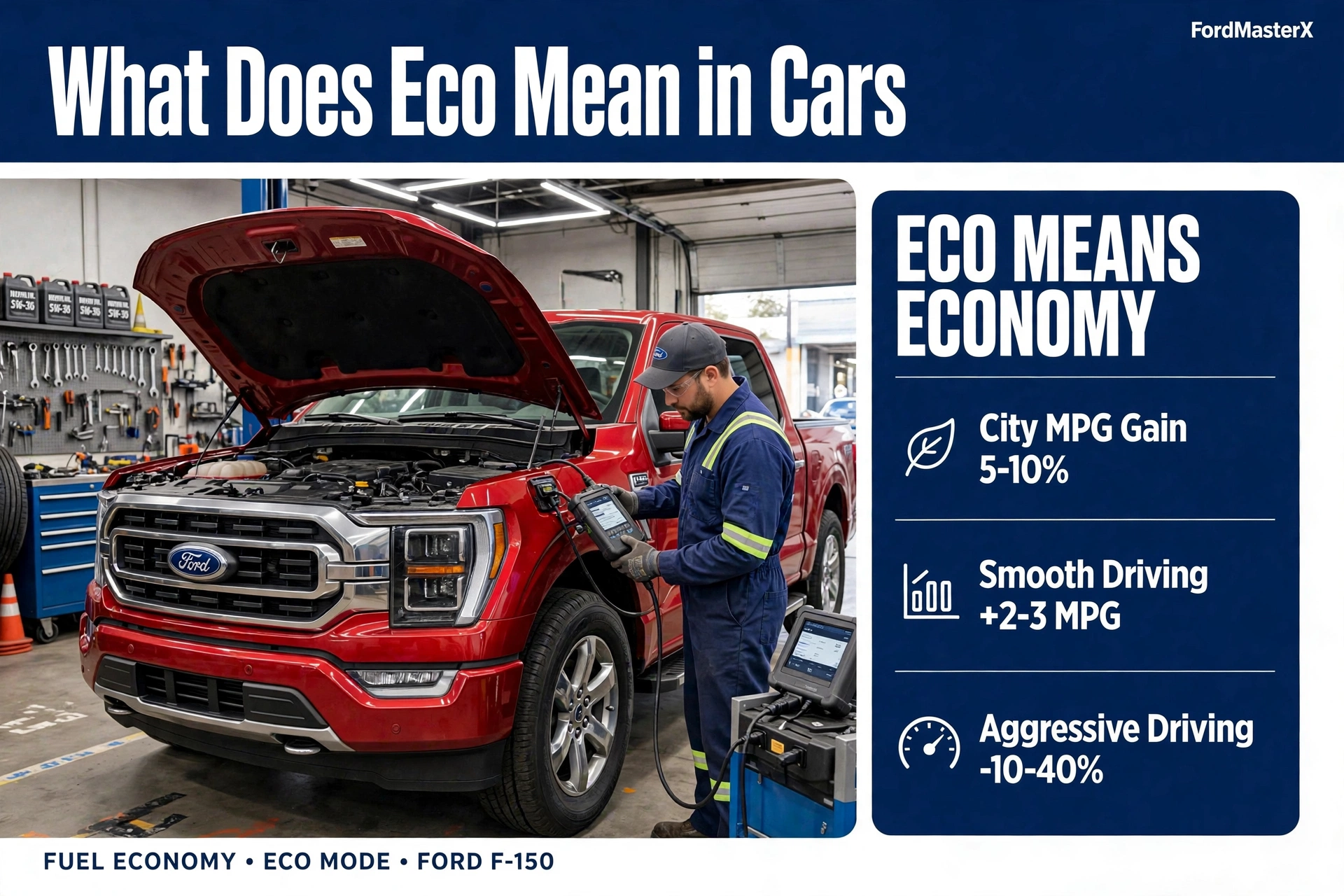
ECO means economy. It is a drive mode that trades a little power and comfort for better fuel economy, and on a Ford it does that by softening the throttle, shifting sooner, and cutting back the air conditioning. If you drive a Ford F-150, you have probably seen the Eco setting and wondered whether it is worth using. This guide explains Eco mode, Ford EcoMode, and EcoBoost, and gives a clear rule for when to switch Eco on and off.
What Does Eco Mean in a Car in 30 Seconds
Eco is short for economy. When you select Eco, your car changes how several systems behave so it burns less fuel. The engine responds more gently to the gas pedal, the transmission shifts into higher gears sooner, and the climate system uses less energy. The engine itself does not change. The computer simply drives the same truck in a calmer way.


Most modern cars offer Eco as one drive mode among several. A Ford F-150 lists Normal, Eco, Sport, Tow/Haul, Slippery, Deep Snow/Sand, and Mud/Ruts. Eco sits at the efficiency end and Sport at the performance end. Eco does not turn your truck into a hybrid, and it does not add power. An ECO indicator in the cluster means Eco drive mode is active. A separate green-leaf display is Ford’s EcoMode coaching score, not the mode itself. Chase explains the same basic idea in its guide to what Eco means in a car: Eco is short for economical, and the mode prioritizes fuel efficiency over performance.
5 Systems Eco Mode Changes in Your Ford


Eco mode is five small changes that work together.
Throttle Response Softens
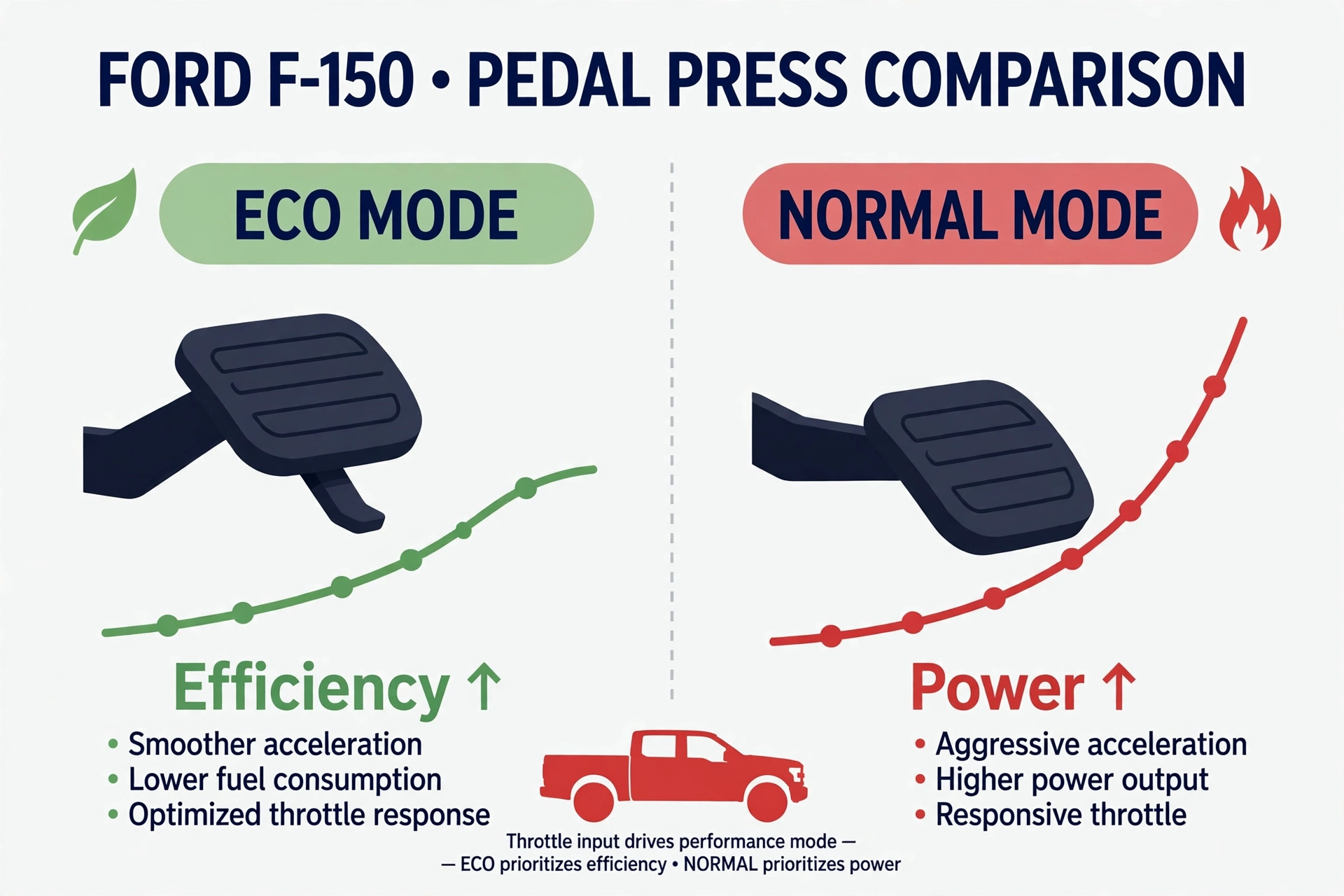
The gas pedal gets less sensitive. A small press asks for less power than the same press would in Normal mode, which stops sharp launches that waste gas at every green light. Ford’s 2025 F-150 Owner’s Manual says the Eco drive mode decreases accelerator pedal responsiveness to soften driver inputs. See the 2025 Ford F-150 Owner’s Manual drive mode section.
Shift Points Move Sooner


The transmission upshifts earlier and holds higher gears longer, which means lower engine speed and less fuel burned per mile. On the F-150 10-speed automatic, Eco mode moves through the gears quickly at light throttle and resists downshifting when you ease off the pedal.
Air Conditioning Output Drops
The climate system draws less power in Eco mode, so the cabin may feel a little warmer on a hot day. This is the trade-off most drivers notice first after the softer throttle.
Auto Start Stop Engages More Often


Ford’s auto start-stop system shuts the engine off at red lights and restarts it when you lift off the brake. In Eco mode it engages more readily, so the engine spends less time idling. Cutting idle time is one of the simplest savings Eco mode delivers in city traffic.
Cruise Control Returns More Gently
When adaptive cruise control is active, Eco mode brings the truck back up to the set speed more slowly after traffic clears. A hard burst to regain speed wastes fuel, so Eco mode trades a few seconds of patience for a smaller fuel bill.
| System | Normal Mode | Eco Mode |
|---|---|---|
| Throttle | Direct | Softer |
| Shift points | Balanced | Earlier upshifts |
| Air conditioning | Full | Reduced |
| Auto start-stop | Standard | More often |
| Cruise control | Standard recovery | Gentler return to set speed |
Ford EcoMode vs Eco Drive Mode in 2026


Ford uses the word Eco for two different systems, and mixing them up causes most of the confusion here. The first is the Eco drive mode described above, which changes how the truck drives. The second is called EcoMode. It does not change how the truck drives at all. It watches how you drive and scores you.


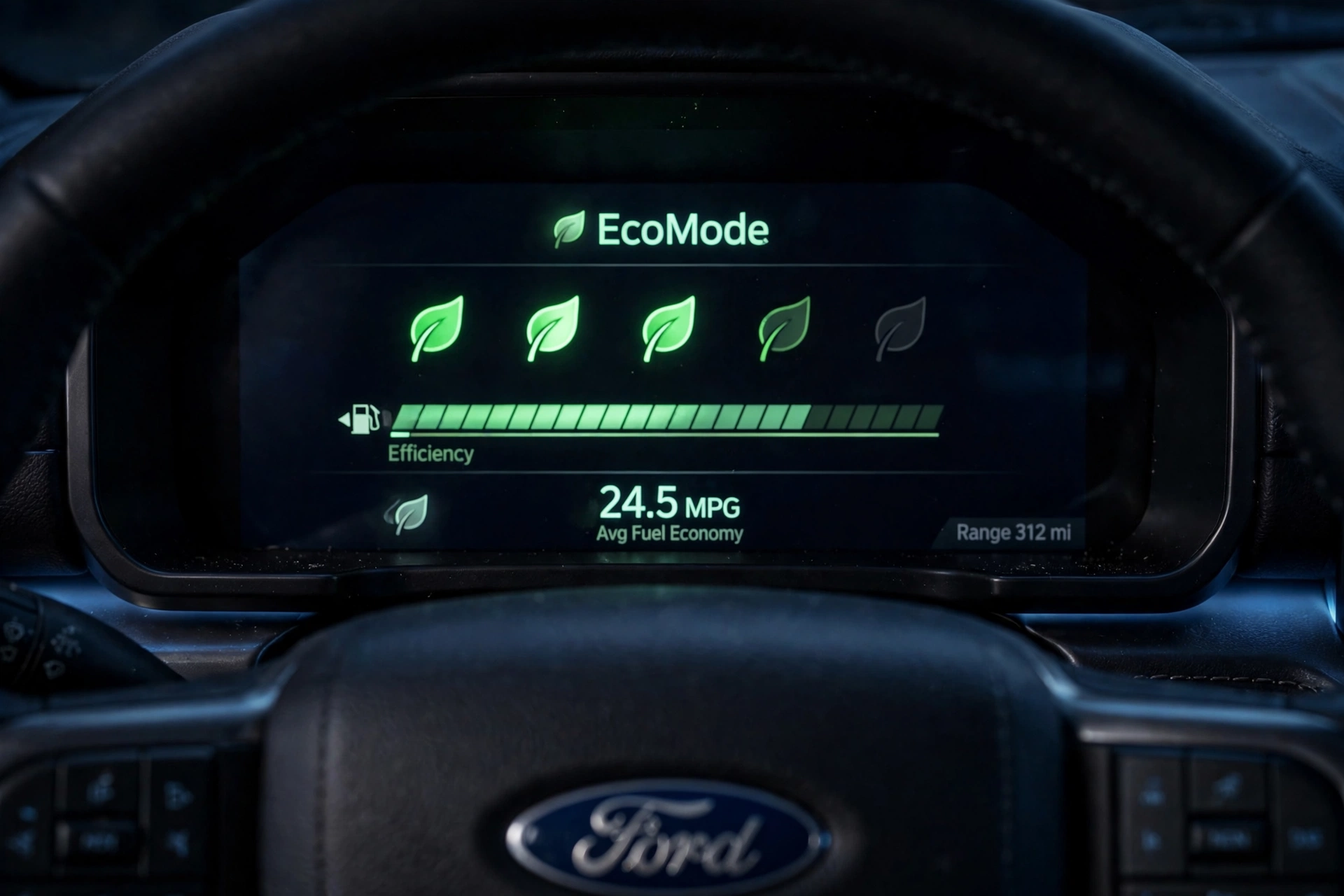
EcoMode is a coaching display. It monitors gear shifting, speed, and braking anticipation, then shows the result as leaves on the cluster. Short trips with a cold engine score lower. Ford fitted this display to models such as the Fiesta, the Focus, and the Transit, and to some F-150s with the Eco Coach display. If your truck shows leaves after a drive, that is EcoMode coaching you. Our guide to whether the Ford Focus is a good car covers a model from the era when Ford fitted this display.


The difference is simple. Eco drive mode changes the truck. EcoMode changes the driver. You can use both at once.
| Feature | Eco Drive Mode | EcoMode Display |
|---|---|---|
| What it is | A drive mode you select | A dashboard score display |
| What it changes | Throttle, shifting, A/C | Nothing; it reports on you |
| Where you see it | Drive mode control | Leaves in the cluster |
| Found on | 2021 and newer F-150 | Fiesta, Focus, Transit, some F-150s |
| Stays on after restart | No, select each trip | Yes, scores every trip |
Eco Mode vs EcoBoost in 4 Clear Differences
The second common mix-up is Eco versus EcoBoost. The names sound alike, but EcoBoost is an engine family and Eco is a drive setting. A truck can have both at the same time, but neither one is the other.
EcoBoost is Ford’s name for its turbocharged, direct-injection gasoline engines: a smaller engine that makes big-engine power when the turbos spool up. The 2.7L EcoBoost V6 makes 325 horsepower and 400 lb-ft of torque, and the 3.5L EcoBoost V6 makes 400 horsepower and 500 lb-ft of torque in 2021–2025 models. Ford lists the 2026 3.5L at 382 horsepower on its consumer pages (its March 2026 tech sheet still says 400); torque stays at 500 lb-ft. The 2.7L is the mileage leader of the pair, rated 19 mpg city and 25 mpg highway in two-wheel-drive form (EPA, 2024–2025).
Here are the four differences that matter. First, EcoBoost is hardware under the hood, while Eco mode is software you switch on and off. Second, EcoBoost adds power through turbocharging, while Eco mode reduces power delivery to save fuel. Third, EcoBoost works whenever the engine runs, while Eco mode only works when you select it. Fourth, EcoBoost affects towing and payload, while Eco mode is a setting you should switch off when you tow. If you are unsure which EcoBoost sits in your truck, our guide on how to tell a 2.7 from a 3.5 EcoBoost shows the badges, VIN clues, and engine bay differences. For the engine side, see the Ford 2.7 EcoBoost specs and the 3.5 EcoBoost cam phaser replacement guide, the pillar page for our EcoBoost engine coverage.


How Much Gas Does Eco Mode Really Save in 2026
Eco mode saves fuel, but the amount depends on where and how you drive. It works best in the city, where stops and starts give the softer throttle many chances to save fuel. On a steady highway cruise, the engine already runs efficiently, so Eco mode has little left to improve.
The best-known independent test is less flattering than the marketing. Consumer Reports tested Eco mode in city and highway driving and found no measured fuel-economy benefit in either case. Its verdict: Eco mode is not a magic button; its value is encouraging smooth driving, worth 2 to 3 mpg around town. Manufacturers still quote 5 to 10 percent for mixed driving, but on the highway, expect almost nothing.
The bigger number belongs to your right foot, not to the Eco button. FuelEconomy.gov, run by the U.S. Department of Energy and the EPA, reports that aggressive driving can lower gas mileage by roughly 15 to 30 percent at highway speeds and 10 to 40 percent in stop-and-go traffic. That is why Eco mode helps: it makes aggressive driving harder to do by accident. The same source reports that driver feedback displays help the average driver improve fuel economy by about 3 percent, and motivated savers by about 10 percent. An Oak Ridge National Laboratory study published in 2017 reached the same stop-and-go finding, and the U.S. Department of Energy’s Alternative Fuels Data Center cites a 2018 UC Davis study with a 6.6 percent average gain from in-vehicle feedback. FuelEconomy.gov publishes the full figures on its driving more efficiently page.
The verdict is clear. Eco mode alone showed no measured gain in Consumer Reports tests, and little on the highway. Eco mode plus smooth driving is worth far more, because smooth driving removes the 10 to 40 percent penalty aggressive driving adds. The button helps, but your habits decide the result.
| Driving Situation | Eco Mode Gain | Source |
|---|---|---|
| City driving, CR tests | No measured benefit | Consumer Reports |
| Mixed driving, typical | 5 to 10% | Manufacturer estimates |
| Steady highway cruise | No measured gain | Consumer Reports |
| Feedback display, average | About 3% | FuelEconomy.gov |
| Aggressive driving, city | 10 to 40% loss | DOE / ORNL |
5 Steps to Use Eco Mode on a Ford F-150
Using Eco mode takes five seconds.
Step 1 Select Eco Mode


Select Eco on the drive mode control before you pull away. The cluster confirms the selection.
Step 2 Confirm the Indicator
Check that the cluster shows Eco. Ford does not let you set Eco as the default mode on the F-150, so you repeat this step at the start of every trip.
Step 3 Accelerate Gently
Press the pedal smoothly and let the transmission shift early. The softer throttle helps, but it cannot stop a hard launch if you floor the pedal. Look well ahead so you rarely need the brakes.
Step 4 Watch the Coaching Display
Where your truck has the EcoMode leaf display, glance at it at the end of the trip and use the score to adjust your next trip.
Step 5 Switch Back When Needed
Change back to Normal or Tow/Haul before you merge onto a fast highway, climb a steep grade, or hook up a trailer. Eco mode softens exactly the response you need in those moments.
Should You Use Eco Mode?
One quick check before you pull away
USE ECO – City Commute
+2-3 MPG
Smooth driving around town can add 2 to 3 mpg (Consumer Reports).
SMALL GAIN – Steady Highway
0%
No measured benefit at a steady cruise (Consumer Reports). Normal mode is fine.
SWITCH OFF – Towing a Trailer
Use Tow/Haul mode instead. Eco mode cuts the response you need.
SWITCH OFF – Merging or Steep Grades
Switch to Normal or Sport for quick acceleration, then switch back.
YOUR HABITS MATTER MOST
10-40%
Fuel lost to aggressive driving in stop-and-go traffic (FuelEconomy.gov).
ECO IS NOT ECOBOOST
Eco is a drive setting you switch on. EcoBoost is a turbo engine family. A truck can have both.
When to Use Eco Mode and When to Switch Off
Eco mode is right for some trips and wrong for others. City commuting is the best case: stop-and-go traffic gives the softer throttle constant work to do, and that is where smooth driving pays off most. Steady highway cruising is the weakest case, because at a constant 65 mph the engine already runs near its efficient point, so Eco mode adds almost nothing.
Towing is the clearest no. A trailer needs full throttle response and lower gears, the opposite of what Eco mode does. Use Tow/Haul mode instead, and check the Ford F-150 towing capacity chart to confirm your truck and trailer combination before you hook up. Steep grades and fast merges are also no situations: switch to Normal, make the move, then switch back. On slippery roads use Slippery mode, not Eco.
| Driving Situation | Eco Mode | Why |
|---|---|---|
| City commuting | Use it | Smoother driving pays off |
| Steady highway cruise | Optional | Gain near zero |
| Towing a trailer | Switch it off | Tow/Haul |
| Merging, steep grades | Switch it off | Need full response |
| Rain, snow, or ice | Switch it off | Use Slippery mode |
| Heavy payload | Switch it off | Normal better |
6 Eco Mode Myths Ford Owners Still Believe
Here are the six claims we hear most often.
Myth 1 Eco Mode Damages the Engine
Eco mode cannot damage the engine or the transmission. It only changes software settings, and it puts the engine under less load, not more.
Myth 2 Eco Mode Always Saves Gas
Eco mode helps most in the city and adds almost nothing on the highway. A driver who floors the pedal at every light in Eco mode still burns more fuel than a smooth driver in Normal mode. The mode supports good habits. It does not replace them.
Myth 3 Eco Is Not EcoBoost
Eco is a drive setting. EcoBoost is an engine family with turbochargers and direct injection. Some owners think an EcoBoost badge means the truck is always in Eco mode. It does not. The badge describes the engine, and the dial describes the setting.
Myth 4 Eco Works the Same on Fords
It does not. The Eco drive mode on a 2025 F-150 changes throttle, shifting, climate, start-stop, and cruise recovery. An older Fiesta with the EcoMode display only shows leaves. Check your owner’s manual for what Eco does on your exact model and year.
Myth 5 Eco Mode Replaces Good Driving
The data says the opposite. FuelEconomy.gov reports that aggressive driving costs 10 to 40 percent in stop-and-go traffic, while Consumer Reports found no measured Eco-mode gain in its own tests. Eco mode is a helper for a smooth driver, not a fix for an aggressive one.
Myth 6 Eco Is Only for Hybrids
Eco mode is common on hybrids, but it is standard on many gasoline Fords too, including the F-150, Explorer, and Escape. Hybrids gain more because Eco mode also manages the electric motor and regenerative braking, but a gasoline truck still benefits from smoother driving.
Two maintenance habits protect the MPG that Eco mode works to save: fresh oil in the correct grade and the right tire pressure. Our guide on how often a car needs an oil change gives the Ford intervals by driving severity, and the Ford engine oil recommendation chart lists the correct specification.
What Eco Mode Means for Your Ford in 2026
Eco means economy, and on a Ford it means the truck drives more gently so it burns less fuel. Use it for city trips and daily commuting, where it encourages the smooth driving that saves fuel. Switch it off for towing, steep grades, fast merges, and slippery roads, where you need full response or a different mode. Keep Eco separate from EcoBoost: one is a setting, the other is an engine. Press the Eco button on your next city drive and let smooth driving do the heavy lifting. That combination is what turns a small dashboard setting into a smaller fuel bill.
5 Questions About What Eco Means in Cars
Does Eco Mode Save Gas?
In city driving, a little, but the gain comes from smoother driving, not the button itself. Consumer Reports found no measured Eco-mode benefit in its own tests. Smooth driving can add 2 to 3 mpg around town, while a steady highway cruise gains almost nothing.
Does Eco Mode Damage Your Engine?
No. Eco mode only changes software settings for the throttle, transmission, and climate system. It puts less load on the engine, not more.
Can I Leave Eco Mode On?
You can, but you should not. Eco mode is wrong for towing, steep grades, fast merges, and slippery roads. Switch it off for those trips.
Why Does Eco Mode Not Stay On?
Ford does not let you set Eco as the default drive mode on the F-150. The truck returns to Normal at each start, so you select Eco again every trip.
Is Eco Mode Good for Highway Driving?
It does no harm, but it adds almost nothing. At a steady highway speed the engine already runs efficiently.