
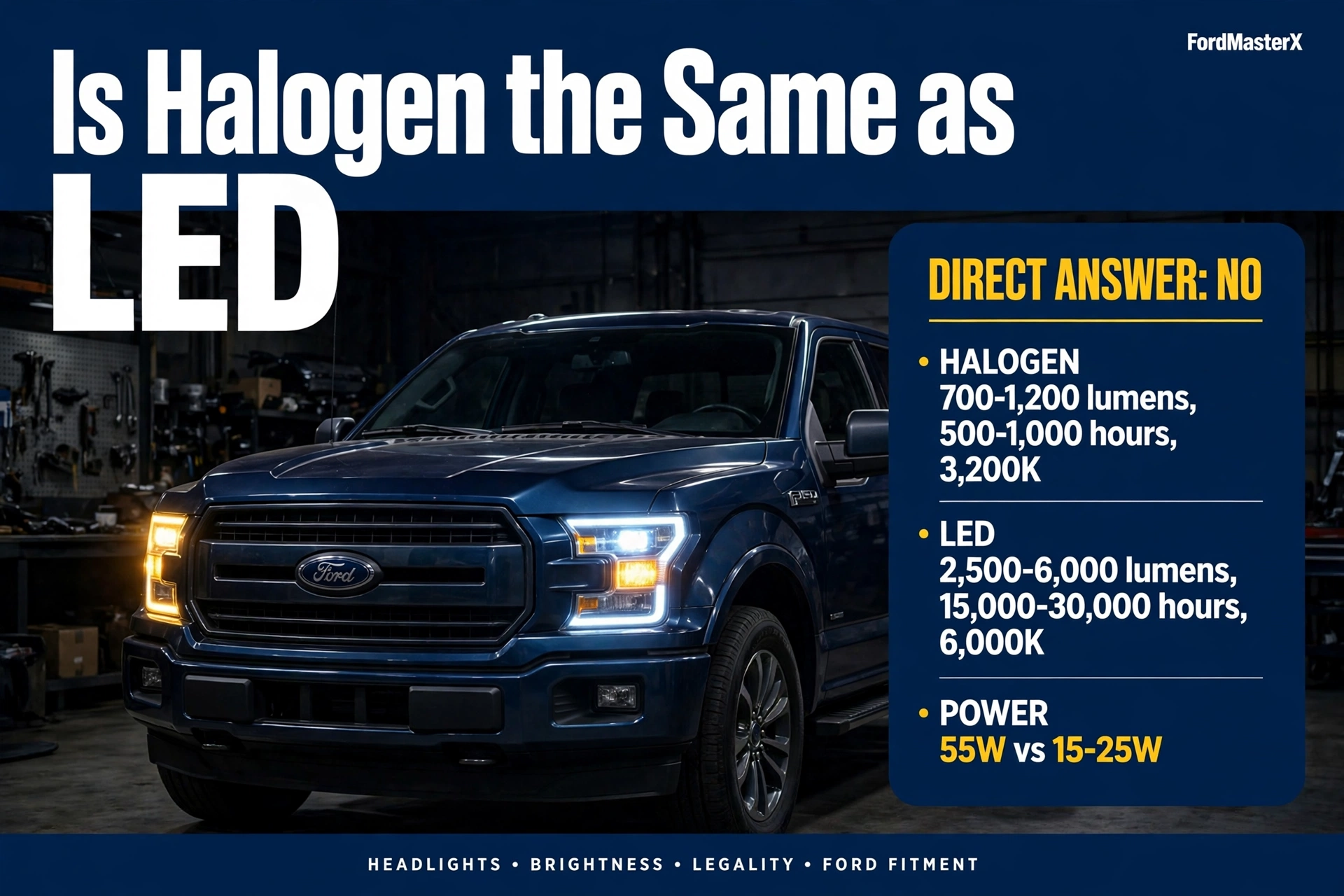
Is Halogen the Same as LED? 2026 Ford Headlight Guide

No, halogen is not the same as LED. Halogen is a heated tungsten filament inside a gas filled bulb, and LED is a semiconductor chip that makes light when current passes through it.
The two technologies share a socket size on many Fords, so an LED bulb can plug into a halogen socket. That shared socket is where the sameness ends, because the light source, the beam shape, the lifespan, and the law treat them as different things.
This guide gives you the direct answer first, then the numbers that prove it. It covers the Ford fitment by year and trim, the legality of a swap, and the cost ladder from a ten dollar halogen bulb to a full LED assembly. Every figure is tied to its source, and every Ford claim tells you to confirm it in your owner manual or on your old bulb.
The Short Answer Halogen Versus LED in 2026
A halogen bulb and an LED bulb can share an H11 or 9005 base, yet they make light in different ways and they need different housings to aim that light correctly.
| Feature | Halogen | LED |
|---|---|---|
| How it makes light | Heated tungsten filament in halogen gas | Semiconductor chips that release light |
| Typical brightness per bulb | 700 to 1,200 lumens | 2,500 to 6,000 lumens for kits; 2,000 to 4,000 for factory units |
| Typical lifespan | 500 to 1,000 hours | 15,000 to 30,000 hours for kits; 20,000 to 50,000 for factory units |
| Color temperature | 2,700K to 3,500K, warm yellow white | 5,000K to 6,500K, cool white |
| Power draw per bulb | About 55 watts | About 15 to 25 watts for matched output |
| Replacement cost per bulb | $10 to $60 | $40 to $200 per kit |
| Legal as a drop in bulb | Yes, it is the factory design | No, not in a halogen housing under federal rules |
Halogen Versus LED At a Glance
Direct answer and key numbers for Ford owners. The socket can match, but the technology does not.
| Feature | Halogen | LED |
|---|---|---|
| Brightness | 700-1,200 lumens | 2,500-6,000 lumens per kit |
| Lifespan | 500-1,000 hours | 15,000-30,000 hours per kit |
| Color | 2,700K-3,500K warm white | 5,000K-6,500K cool white |
| Power | About 55 watts | About 15-25 watts |
| Cost | $10-$60 per bulb | $40-$200 per kit |
Direct answer: No, halogen is not the same as LED. Halogen heats a filament, LED uses semiconductor chips, and an LED bulb is not a certified drop in replacement for a halogen housing.
Figures are typical U.S. guide ranges for 2026. Sources: LED Lighting Info; HID Nation; DriveOn; Chedina LED; FordMasterX headlight cost guide. Confirm bulb size in your owner manual.
First, brightness alone does not decide how well you see at night, because beam pattern and aim decide where that brightness lands. Second, a brighter bulb in the wrong housing can give you less useful light and more glare at the same time.
How Halogen Headlights Work in 3 Parts
A halogen headlight works like a household incandescent bulb, with one clever addition. Electricity heats a tungsten filament until it glows white hot, and that glow is the light you see on the road.
The bulb is a small quartz capsule filled with halogen gas, usually iodine or bromine. The gas catches tungsten that evaporates off the hot filament and returns it to the filament. That lets the bulb run hotter and brighter than a plain incandescent bulb without burning out at once.
Most of the energy becomes heat instead of light, so a halogen bulb draws about 55 watts to give you 700 to 1,200 lumens. The filament thins with every heat cycle, and that is why a halogen bulb lasts only 500 to 1,000 hours in typical use.
The Filament Sets the Beam
The filament is a tiny coil at one exact point inside the bulb. Your Ford headlight housing, whether it is a reflector bowl or a projector lens, is shaped around that one point.
Move the light source even a little, and the housing cannot focus it. That single fact explains most of the trouble with LED swaps, and it is the reason this guide keeps coming back to focal position.
Why Halogen Light Looks Yellow
Halogen light sits at about 2,700K to 3,500K on the Kelvin scale, and most factory halogen bulbs sit near 3,200K. That warm yellow white is the natural color of a hot filament, not a tint added to the glass.
Premium halogen bulbs add a blue coating to the glass to shift the color toward white, and they can reach about 4,000K. That coating filters out some light, so a whiter halogen bulb often trades a little brightness and lifespan for its color.
Why Halogen Still Fits Many Fords
Halogen is cheap, simple, and easy to replace at the side of the road. A basic H11 or 9005 halogen bulb costs $10 to $25 per pair, it plugs straight in, and it needs no driver, fan, or decoder.
That simplicity is why Ford still fits halogen headlights to base XL and XLT trims. It is also why a burned out halogen bulb is a ten minute job on most Fords, while a failed factory LED unit is an assembly replacement.
Your truck turns its lights on and off through its own sensors and switches. Our guide to the Ford F-150 automatic headlight sensor location shows where that sensor sits when the automatic setting acts up.
How LED Headlights Work in 3 Parts
An LED headlight makes light in a different way entirely. Current passes through semiconductor chips, and the chips release light directly, with no filament to heat and no gas to burn.
Because there is no filament, there is nothing to burn out in the old sense. The chips can last 15,000 to 30,000 hours in an aftermarket kit. Factory LED assemblies are rated at 20,000 to 50,000 hours, which is why many owners never replace a factory LED unit.
LED chips still make heat, and that heat gathers at the base of the chip. A good LED bulb or assembly carries that heat away with an aluminum heat sink, a small fan, or both, and a driver box controls the current.
The Chip Array Shapes the Beam
A factory LED headlight uses a cluster of small diodes placed to build a precise beam. Designers can place each diode where it needs to be, so the beam can be wide on the shoulder and sharp at the cutoff line.
That control is the real advantage of factory LED lighting. It is not just more lumens, it is lumens placed where your eyes need them, with less light thrown above the cutoff into oncoming drivers.
Why LED Light Looks White
Factory LED units run at about 5,000K to 6,000K, and aftermarket LED bulbs are often sold at 6,000K to 6,500K. That cool white is close to daylight, and it makes road signs and lane markings stand out at night.
Color temperature describes color, not brightness. A 6,500K bulb is not brighter than a 5,000K bulb by virtue of its color. A very blue bulb can give you less useful light than a whiter one at the same wattage.
Where HID Fits in the Picture
HID, also called xenon, is a third technology, and it sits between halogen and LED on most measures. An HID bulb makes light from an electric arc in xenon gas, it gives about 2,500 to 3,500 lumens, and it lasts about 2,000 to 5,000 hours.
HID needs a ballast to start the arc, and it takes a few seconds to reach full brightness. Our comparison of LED headlights versus HID headlights covers that technology in full, so this guide does not repeat it here.
LED switches on at once, uses less power than HID, and needs no ballast warm up.
Halogen Versus LED Brightness Lifespan and Color in 7 Numbers
Guides disagree on exact lumen figures because they test different bulbs, so this section uses the ranges that most guides agree on. The pattern is the same in every source: LED gives two to four times the lumens, lasts twenty to fifty times longer, and draws about half the power.
LED Lighting Info puts a standard halogen bulb at 700 to 1,200 lumens and a modern LED bulb at 3,000 to 6,000 lumens. It lists halogen at 3,000K to 3,500K and LED at 5,000K to 6,500K. Those figures match the ranges in the HID Nation and DriveOn guides, and they are the figures this guide uses throughout.
| Measure | Halogen | LED | What it means for you |
|---|---|---|---|
| Brightness per bulb | 700-1,200 lumens | 2,500-6,000 lumens per kit | LED can be much brighter, if the beam is aimed right |
| Lifespan | 500-1,000 hours | 15,000-30,000 hours per kit | A halogen bulb is a regular replacement; an LED kit can last years |
| Color temperature | 2,700K-3,500K | 5,000K-6,500K | Halogen looks yellow; LED looks white |
| Power draw | About 55 watts | About 15-25 watts matched | LED cuts the electrical load by more than half |
| Warm up time | Instant | Instant | Both switch on at once, unlike HID |
| Heat at the lens | High, lens stays warm | Low, lens stays cool | Halogen melts snow off the lens; LED can let snow build up |
| Dimming with age | Loses output before it fails | Loses output slowly over life | Replace halogen bulbs in pairs so both sides match |
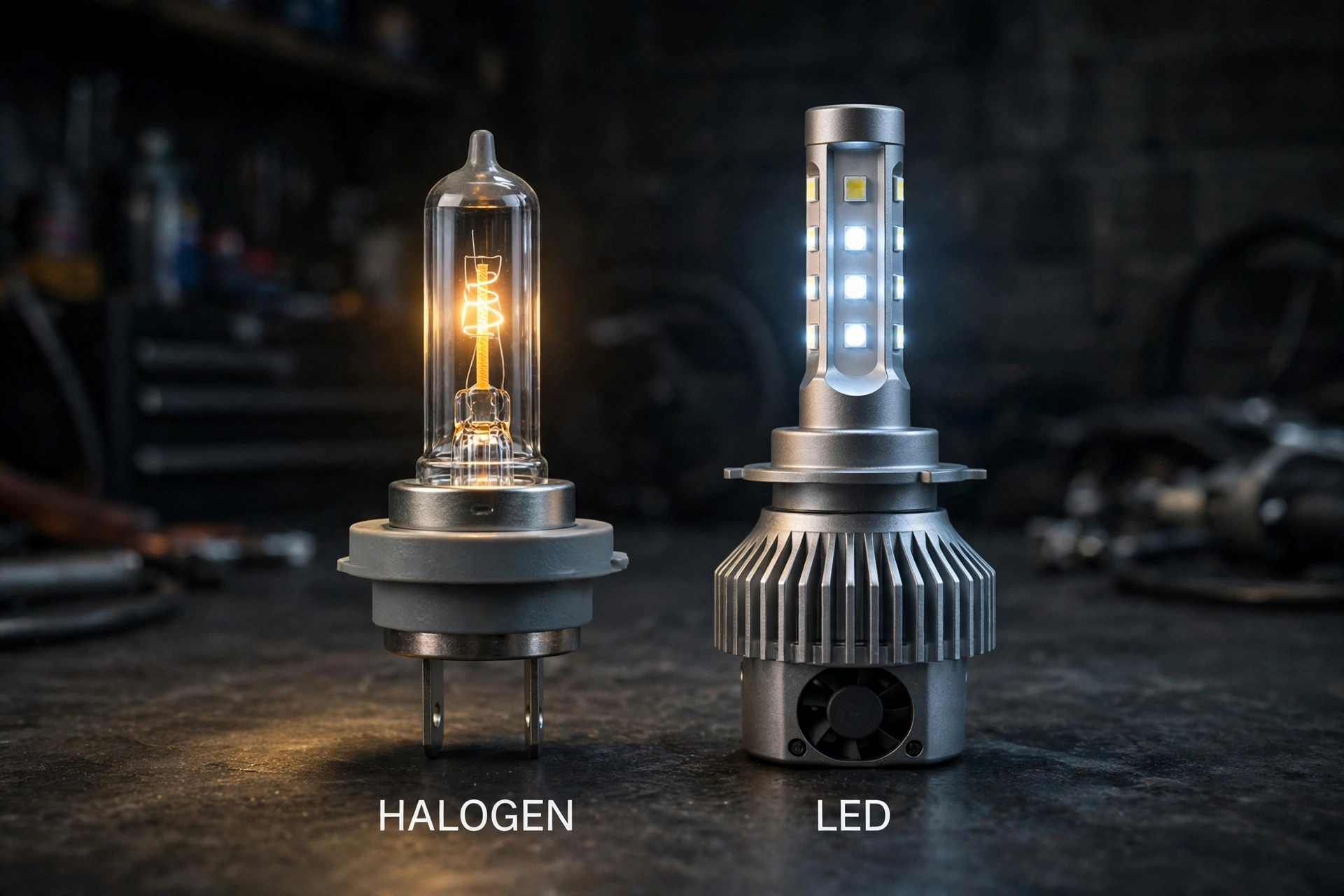
AI-generated illustration: a halogen bulb with its tungsten filament beside an LED bulb with semiconductor chips and a heat sink.
A standard halogen bulb lasts 500 to 1,000 hours, and a long-life halogen can reach about 2,000 hours. A high-performance halogen that burns brighter can last as little as 200 to 300 hours, so the brightest halogen is often the shortest lived.
Sylvania guides put their SilverStar Ultra halogen at about 1,500 lumens and about 3,700K, and their basic halogen at about 1,100 lumens and 3,200K.
Their LED H11 is listed at about 2,000 lumens and 6,000K, with a rated life of 10,000 to 30,000 hours. OSRAM Night Breaker is the other premium halogen name you will see in most guides, and it follows the same trade: more light, shorter life.
A halogen low beam draws about 55 watts, and a 9005 high beam draws 65 watts. An LED replacement that gives the same useful light draws about 15 to 25 watts, which is roughly 60 to 80 percent less energy.
That lower draw is also the source of a common fault. Your Ford body control module watches the current draw. An LED bulb that draws far less can trigger a bulb-out warning or flicker, which the swap section covers in full.
Some LED kit boxes claim 10,000 or 12,000 lumens per bulb, and those claims are not realistic for a road legal headlight bulb. Quality kits give 2,500 to 5,000 lumens per bulb in real use. A kit that claims far more is usually adding both bulbs together or testing in a lab with no housing.
Light bars follow the same physics at a larger scale. Our comparison of LED light bars versus halogen light bars shows how the two technologies differ when they are built as off-road bars instead of headlight bulbs.
Beam Pattern and Glare in Halogen Housings
Beam pattern matters more than raw lumens, and this is where most LED swaps fail. A halogen housing is built around a filament at one exact focal point, and an LED bulb puts its light in a different place.
A halogen filament is a small glowing coil that shines in all directions from one point. The reflector bowl or projector lens catches that light and shapes it into a beam with a sharp cutoff, bright on the road and dark above the cutoff line.
An LED retrofit bulb is a flat stalk with chips on two sides.
It shines from two flat faces instead of one small point, so the reflector cannot focus it the same way. Light spills above the cutoff, and that spill is the glare that blinds oncoming drivers.
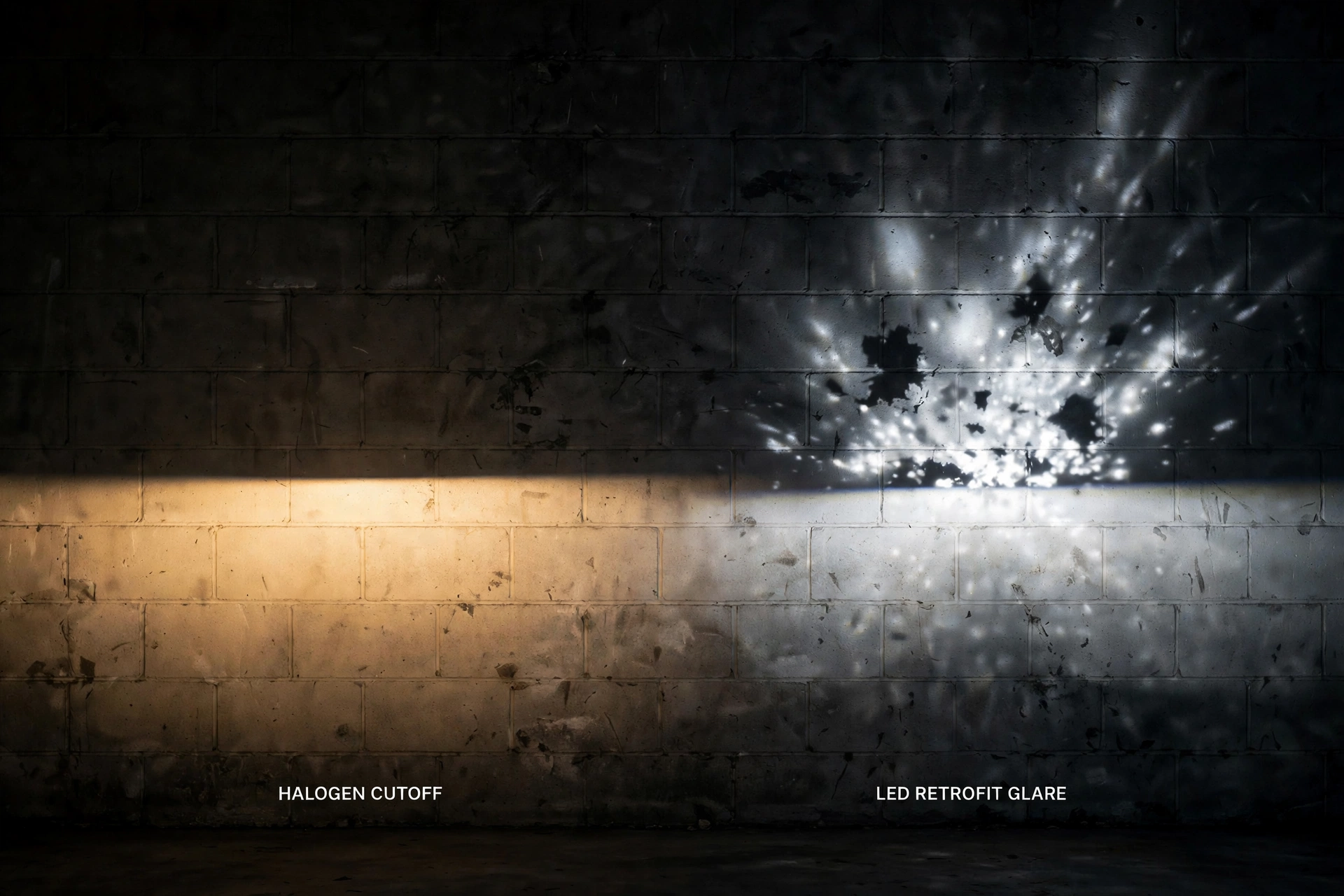
AI-generated illustration: a clean halogen beam cutoff on the left and scattered LED glare above the cutoff on the right.
A chip that sits 1 to 2 mm off the halogen focal point can turn a focused beam into hot spots and dark voids. The FordMasterX F-150 LED guide makes the same point. A poorly focused LED bulb can give worse downroad light than a well focused unit with fewer lumens, and it throws more glare at oncoming traffic.
That is why a brighter bulb can make your night driving worse. You see a bright wall of light close to the truck, and you think the upgrade worked. Meanwhile the road 100 feet ahead is darker than it was with the old halogen bulb.
Projector housings handle a swap better than reflector housings, because the projector lens shapes the beam more tightly. They do not fix the problem on their own, and a badly placed LED chip still scatters light in a projector housing.
A halogen bulb that points high will glare just as badly as a bad LED swap, and a new bulb of either type needs an aim check after fitting. Park facing a wall at night, check that the cutoff sits level on both sides, and use the aim screws or a shop aim if one side points high.
The IIHS tests complete headlamp systems for visibility and glare, and it rates them Good, Acceptable, Marginal, or Poor.
Its research ties Good-rated headlights to 19 percent fewer nighttime single-vehicle crashes and 23 percent fewer nighttime pedestrian crashes than Poor-rated headlights. The IIHS also states that technology alone does not guarantee a good rating, so a well-designed halogen system can outscore a poorly designed LED system.
Drive the same dark road with the old bulbs and the new bulbs, and watch the far edge of the beam, not the bright patch near the bumper. If the far road is darker or oncoming drivers flash you, the swap made things worse, no matter what the box claimed.
Are LED Bulbs Legal in Halogen Housings in 2026
Factory LED headlights are legal in every state. LED bulbs dropped into a halogen housing are a different matter, and the federal answer is no, they are not certified for road use.
The rule is Federal Motor Vehicle Safety Standard 108, known as FMVSS 108, and it is run by NHTSA. That standard certifies a headlamp as a complete system, with the housing, lens, reflector or projector, and the exact light source it was designed around tested together.
Paragraph S11 of FMVSS 108 says each replaceable light source must match a design filed under 49 CFR Part 564. NHTSA has said in published interpretation letters that no LED replaceable light source has been filed in that docket. That means no LED replaceable light source may be used in a replaceable bulb headlamp.
DriveOn reports the same federal position in plain terms: no LED replacement bulb made to drop into a halogen housing is certified equipment. The DOT does not approve, test, or certify individual bulbs. A box that says DOT approved is not proof of certification, because the DOT does not certify bulbs that way.
The federal rule binds makers and sellers, and it bars the sale of equipment that does not meet the standard. NHTSA does not police what an owner does to their own truck, so enforcement falls to state law and state inspection.
Virginia inspection rules state the swap in writing: retrofitting an HID or LED bulb to a halogen headlamp system does not conform to federal standards and shall be rejected. Texas requires lighting equipment to meet FMVSS 108, and other inspection states apply the same standard in their own checks.
States with no safety inspection, such as Florida and Michigan, have no such checkpoint. That does not make the bulb certified, and it does not help if the beam glares and an officer stops you for it.
The legal route is a complete LED headlamp assembly that was designed and certified as an LED system from the start. Swap the whole housing for a sealed LED unit that meets FMVSS 108, and you are on the same legal ground as a factory LED truck.
This section is general information, not legal advice. Headlight rules and inspection practice change, and they vary by state, so check your state inspection rules before you buy a kit.
Which Fords Came With Halogen and Which Came With LED
Ford did not switch its trucks to LED all at once. It moved trim by trim. The same model year can have halogen on a base truck and sealed LED on a higher trim, so year alone never settles the question.
Chedina LED gives the clearest F-150 bulb map by generation, and it matches the figures in the FordMasterX headlight cost guide. The table below follows that map, and you must still confirm your truck by owner manual or by the code on your old bulb.
| Ford F-150 years | Low beam | High beam | Notes |
|---|---|---|---|
| 1997-2003 | 9007 combined | 9007 combined | One dual filament bulb does both beams |
| 2004-2014 | H13 / 9008 combined | H13 / 9008 combined | One dual filament bulb; some 2013-2014 high trims used D3S HID |
| 2015-2020 halogen trims | H11 | 9005 | Separate bulbs; higher trims got factory LED |
| 2021-2024 base XL and XLT | H11 | 9005 | Halogen on base trims only |
| 2021 and newer mid and higher trims | Sealed LED | Sealed LED | No replaceable bulb; a failed unit needs an assembly |
Trucks from 2015 onward split the low and high beams into H11 and 9005, while 2004 to 2014 trucks use one H13 bulb for both beams. Do not buy H11 or 9005 LED bulbs for a factory LED truck, because there is no halogen bulb in that housing to replace.
The 2023 to 2026 F-250 and F-350 XL and XLT trims with factory halogen headlights take bulbs in the same sockets. Our guide to the best F-250 LED headlight bulbs covers the bigger trucks in detail. Factory LED Super Duty trims are sealed units, just like the F-150.
Older trucks use older bulb codes, and 9007 trucks still run the single combined bulb design.
Escape owners need their own chart, because the Escape changed bulb sizes across generations. Our 2009 Ford Escape bulb chart lists the exact bulb for that model year, and it is the right starting point before you order any bulb for an Escape.
The 2019 to 2023 Ranger with halogen headlights uses H11 for low beam and 9005 for high beam, and the factory LED Ranger has no user replaceable bulb. Focus owners should note that the 2012 and newer Focus uses H11 for low beam and H1 for high beam.
Trim packages break year-only tables on every Ford model. A Lariat, King Ranch, Platinum, Limited, or Raptor from 2018 onward may have sealed LED headlights while the XL next to it on the lot has halogen bulbs. Check the housing itself before you order.
Replacement Cost for Halogen and LED in 2026
Halogen wins on price at the counter, and LED wins on price over time. The right choice depends on how long you will keep the truck and whether you are replacing a bulb or a whole assembly.
| Job, one side | Halogen cost | LED cost |
|---|---|---|
| DIY bulb only | $10-$60 per bulb | $40-$200 per kit |
| Shop bulb swap | $60-$150 installed | Part + labor |
| National average, bulb job | $181-$213, RepairPal | No national average published for kits |
| Full assembly, part only | $50-$200 per side | $600-$1,200 per side |
| Full assembly, installed | $110-$650 per side | $700-$1,400 per side |
Our full cost breakdown in the guide to how much it costs to replace headlights gives the same ranges with shop and dealer prices. This section keeps to the comparison and does not rebuild those tables.
A basic halogen bulb costs $5 to $15, and a pair of basic halogen bulbs costs $10 to $25. Premium halogen bulbs cost $20 to $60 each, and they give you more light for a shorter life, so they are a regular cost, not a one-time buy.
An LED kit costs $40 to $120 per pair for most mid-range kits, and $60 to $200 per pair for kits with better cooling and drivers. A cheap kit with no heat sink and no driver can fail in months, so the lowest price is often the most expensive buy over time.
A factory LED headlight is a sealed unit with the LED board, driver, and control module built in, so a failed LED means a full assembly. One F-150 owner on f150forum reported a dealer quote of $1,800 for a single 2021 F-150 LED assembly, and found an aftermarket unit online for $370.
Cost per year is the fair way to compare them. A halogen bulb that costs $20 and lasts 750 hours costs far more per hour than an LED kit that costs $80 and lasts 20,000 hours. That holds even though the LED kit costs four times more at the counter.
That math only works if the LED kit actually lasts. A kit that flickers, throws a bulb-out warning, or burns out its driver in a year costs more than halogen. You pay for the kit, the fix, and the replacement halogen bulbs in between.
Swap LED Bulbs Into Halogen Headlights in 5 Checks
You can plug an LED bulb into a halogen socket on most Fords, and the bulb will light up. That physical fit is not the same as a safe swap, a legal swap, or a swap that helps you see better.
Run these five checks before you buy a kit, and stop at the first check that fails. A kit that fails any one of them is the wrong buy for your truck.
- Confirm the housing type. Look at the back of your headlight and check your owner manual. If your truck has a sealed factory LED or HID housing, there is no halogen bulb to replace, and no LED bulb kit will fit.
- Confirm the bulb code. Read the code on your old bulb or in your manual, such as H11, 9005, H13, or 9007. Order by that code, not by model year alone, because trim packages change the bulb.
- Check the chip position. Buy a kit whose chips sit at the same focal point as the halogen filament, with a thin stalk and chips on both sides. A thick stalk or chips set far from the filament point will scatter the beam.
- Check CANbus compatibility. LED bulbs draw less current, so 2015 and newer Fords often flag a bulb-out warning or flicker after a swap. Buy a decoder equipped, CANbus-ready kit, or plan for an anti-flicker module.
- Check the beam on a wall. Fit one side first, park facing a wall at night, and compare the cutoff and the far road against the halogen side. If the LED side throws light above the cutoff or leaves dark spots ahead, do not fit the second side.
Motor Advises gives the same warning in its comparison. A premium halogen bulb such as Sylvania SilverStar Ultra or OSRAM Night Breaker is the simplest legal upgrade for a halogen housing. It keeps the factory beam shape while giving you more light.
If your truck passes all five checks, the swap can still work well in a projector housing with a quality kit. Our guide to the best LED headlights for the F-150 lists kits that F-150 owners have used, and it explains the focal geometry that decides whether a kit works in your housing.
If your truck fails the beam check, the right upgrade is not a different LED bulb. It is a premium halogen bulb, or a complete LED assembly built for your truck, because those are the two options that keep a legal beam shape.
5 Mistakes That Ruin a Halogen to LED Swap
Most bad LED swaps fail for the same five reasons, and every one of them is easy to avoid. Read this list before you order, not after the kit arrives.
- Buying by lumens alone. A kit that claims 12,000 lumens per bulb is not giving you three times the useful light of a 4,000-lumen kit. It is usually adding both bulbs together, or testing with no housing, and the beam is what decides how far you see.
- Buying the cheapest kit. Cheap kits cut the heat sink, the driver, and the chip placement that make a kit work. They flicker, they overheat, and they fail early, so the $30 kit costs more than the $80 kit by the second replacement.
- Skipping the aim check. A new bulb of either type changes the aim, and a bulb that points high will glare at every driver you meet. Check the cutoff on a wall after every bulb change, and fix the aim before you drive at night.
- Ignoring the CANbus warning. A bulb-out warning is not a false alarm, it is your truck telling you the current draw is wrong. A decoder equipped kit or an anti-flicker module fixes it, and a kit without one will keep warning you.
- Replacing only one side. Halogen bulbs dim with age, so a new bulb on one side and an old bulb on the other gives you mismatched color and brightness. Replace halogen bulbs in pairs, and test LED kits as a pair before you judge them.
Owners order by model year and skip the trim check, then find the kit does not fit their housing. Our guide to the 2019 Ford Escape headlight bulb shows how one model year can carry different bulbs by trim, and the same warning applies to every Ford.
What Should You Buy for Your Ford in 2026
The verdict depends on your truck, your budget, and how much night driving you do. There is no single winner, because the best light for a base XL work truck is not the best light for a Platinum that already has factory LED.
Stay with halogen if your truck has halogen housings and you want the cheapest legal fix. A basic halogen bulb costs $10 to $25 per pair, it fits, it aims correctly, and it needs no decoder or extra parts.
Buy a premium halogen bulb if you want more light without changing the beam shape or the law. Sylvania SilverStar Ultra and OSRAM Night Breaker give you a whiter, brighter beam in the same housing, and they are the simplest upgrade for a halogen truck.
Buy a quality LED kit only if your truck has a projector housing, you have checked the chip position and CANbus fit, and you have tested the beam on a wall. A good kit gives you more light and a much longer life, and a bad kit gives you glare and a warning light.
Buy a complete LED assembly if you want factory LED light on a halogen truck and you want it done legally. A sealed LED assembly built for your truck is the only swap that is certified as a system. It is also the only swap that a state inspection will not reject for the bulb alone.
Do not buy an LED kit for a factory LED truck, because there is no bulb to replace. Do not buy an HID kit for a halogen housing, because the same beam and legality problems apply, and HID takes seconds to warm up.
For F-150 owners who have decided to buy, our guide to the best LED headlights for the Ford F-150 compares the kits by housing fit, beam control, and CANbus compatibility. You can pick by your generation and trim instead of by lumen claims.
6 Questions Ford Owners Ask About Halogen and LED
Is Halogen the Same as LED?
No, halogen and LED are not the same. Halogen heats a tungsten filament in gas, and LED uses semiconductor chips, so they differ in brightness, lifespan, color, power draw, and legality.
Can LED Bulbs Go in Halogen Headlights?
You can plug them in, because the socket matches, but the swap is not certified for road use under FMVSS 108. The beam can scatter and glare, and some states reject the swap at inspection.
Are LED Headlights Brighter Than Halogen Headlights?
Yes, factory LED units and quality LED kits are brighter, with 2,500 to 6,000 lumens against 700 to 1,200 for halogen. Brightness alone does not decide how well you see, because beam pattern and aim decide where the light lands.
How Long Do Halogen Bulbs Last?
A halogen bulb lasts 500 to 1,000 hours, and a long-life halogen can reach about 2,000 hours. An LED kit lasts 15,000 to 30,000 hours in real use, and a factory LED unit is rated at 20,000 to 50,000 hours.
Do LED Bulbs Use Less Power?
Yes, an LED bulb that gives the same useful light draws about 15 to 25 watts, against about 55 watts for a halogen bulb. That lower draw can trigger a bulb-out warning on 2015 and newer Fords, so buy a CANbus-ready kit.
Which F-150 Bulb Size Do I Need?
The 2004 to 2014 F-150 uses one H13 bulb for both beams, and the 2015 to 2020 halogen trims use H11 for low beam and 9005 for high beam. Base 2021 to 2024 XL and XLT trims use the same H11 and 9005 sizes, while higher trims use sealed LED units.
The Bottom Line for Your Ford in 2026
Halogen is not the same as LED, and the socket match is the only thing they share. Halogen is a hot filament, LED is a semiconductor chip, and that difference runs through brightness, lifespan, color, power, beam shape, cost, and the law.
Keep halogen if you want the cheapest legal fix. Buy premium halogen if you want more light in the same housing. Buy a quality LED kit or a full LED assembly only after you have checked the housing, the bulb code, the chip position, and the beam on a wall.
Check your owner manual, read the code on your old bulb, and test one side at night before you commit to a kit. That ten minute check is the difference between brighter night driving and a glare problem you paid for.