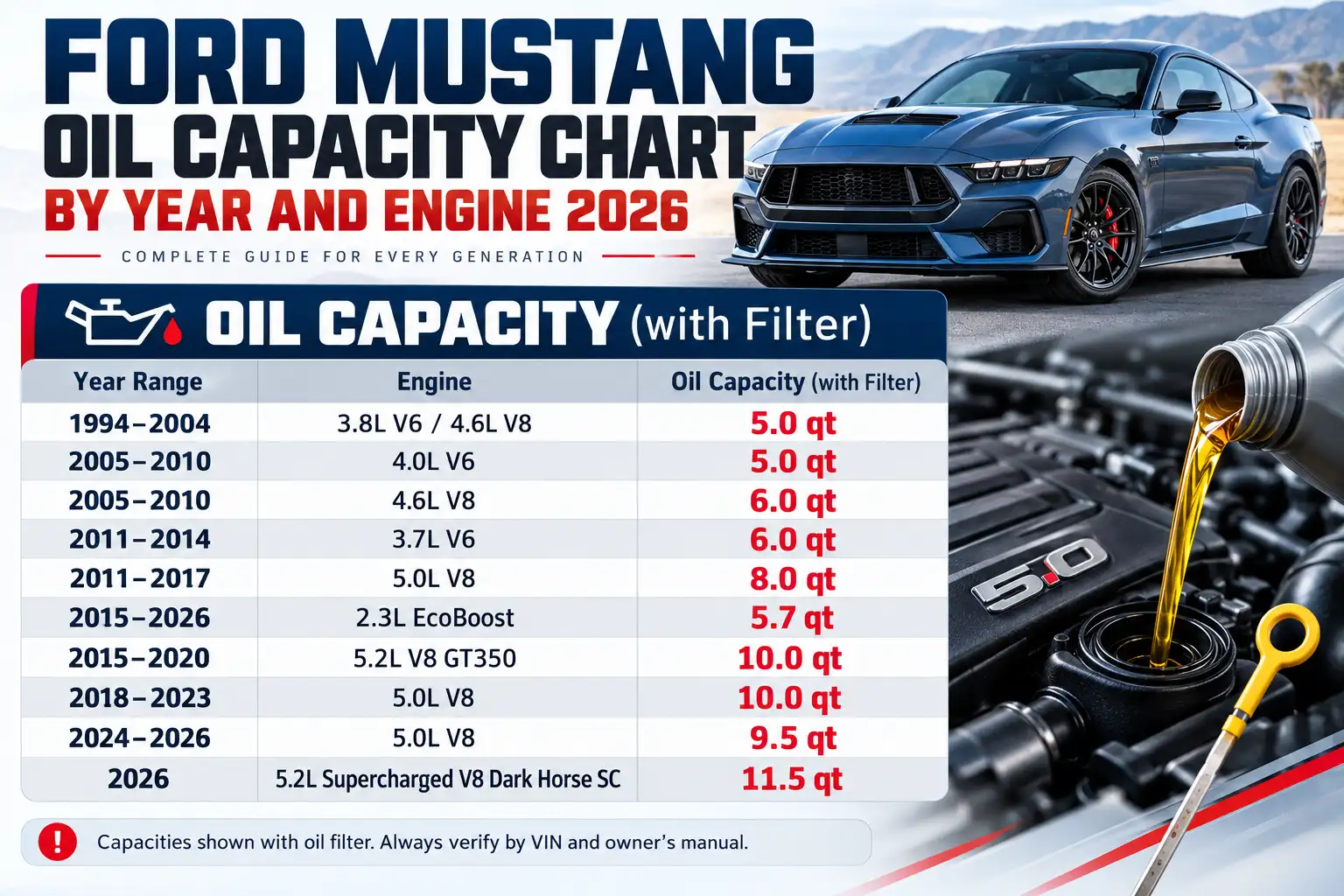
Ford Mustang Oil Capacity Chart by Year and Engine 1974-2026

The Ford Mustang oil capacity chart depends on your model year, engine, and performance trim. A 2026 Mustang EcoBoost takes 5.7 US quarts, while the 2026 Mustang GT 5.0L takes 9.5 quarts, both including a filter change. Shelby and classic engines can require very different amounts.
Identify the refill quantity before buying oil. Figures are for US-market gasoline-powered Mustangs, and capacities refer to an oil change with the filter unless a note says otherwise. Always check the manual supplied with your Mustang before filling the engine.
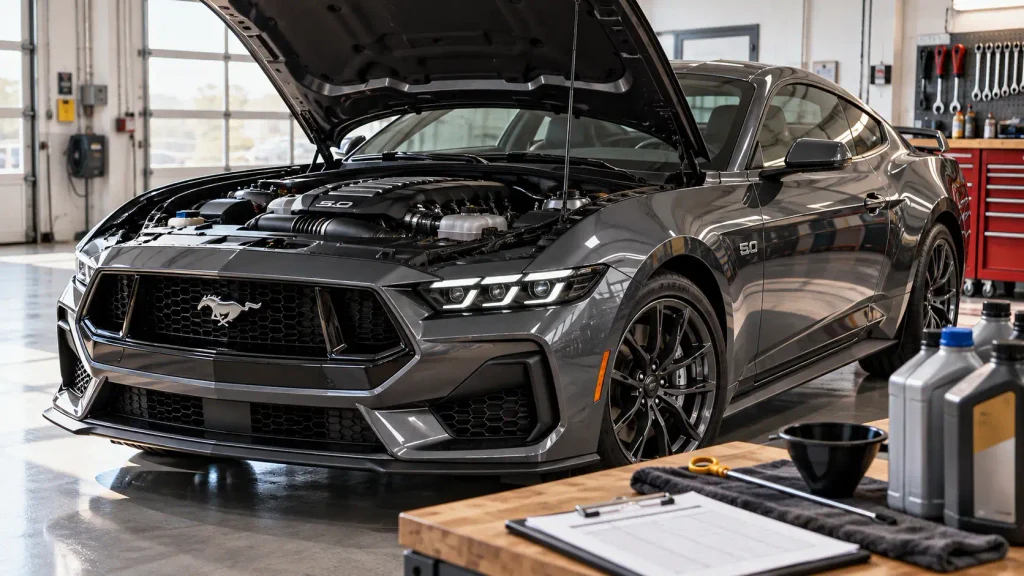
Ford Mustang Oil Capacity Chart
Quick-refill guide by year and engine · US quarts · oil filter included unless specified
2026 Quick Reference
5.0L Mustang GT: Capacity Changed by Generation
Swipe horizontally to view oil quantities and grades →
| Model Year | Engine / Trim | US Quarts | Liters | Oil Grade |
|---|---|---|---|---|
| Current Mustang / 2024–2026 | ||||
| 2024–2026 | 2.3L EcoBoost | 5.7 qt | 5.4 L | 5W-30 |
| 2024–2026 | 5.0L GT and standard Dark Horse | 9.5 qt* | 9.0 L | 5W-30 |
| 2026 | 5.2L Dark Horse SC | 11.5 qt | 10.9 L | 5W-50 |
| 2025–2026 | 5.2L Mustang GTD | 15.5 qt | 14.7 L | 5W-50 |
| S550 and Related Performance Models / 2015–2023 | ||||
| 2019–2023 | 2.3L EcoBoost | 6.0 qt | 5.7 L | 5W-30 |
| 2018 | 2.3L EcoBoost | 5.7 qt | 5.4 L | 5W-30 |
| 2018–2023 | 5.0L GT | 10.0 qt | 9.5 L | 5W-20 |
| 2021–2023 | 5.0L Mach 1 | 10.0 qt | 9.5 L | 5W-30 |
| 2020–2022 | 5.2L supercharged Shelby GT500 | 11.5 qt | 10.9 L | 5W-50 |
| 2015–2020 | 5.2L Shelby GT350 and GT350R | 10.0 qt | 9.5 L | 5W-50 |
| 2015–2017 | 2.3L EcoBoost | 5.7 qt | 5.4 L | 5W-30 |
| 2015–2017 | 3.7L V6 | 6.0 qt | 5.7 L | 5W-20 |
| 2015–2017 | 5.0L GT | 8.0 qt | 7.6 L | 5W-20 |
| Older Models / 1974–2014 | ||||
| 2013–2014 | 5.8L Shelby GT500 | 8.5 qt | 8.0 L | 5W-50 |
| 2012–2013 | 5.0L Boss 302 | 8.5 qt | 8.0 L | 5W-50 |
| 2011–2014 | 3.7L V6 | 6.0 qt | 5.7 L | 5W-20 |
| 2011–2014 | 5.0L GT | 8.0 qt | 7.6 L | 5W-20 |
| 2007–2012 | 5.4L Shelby GT500 | 6.4 qt | 6.1 L | 5W-50 |
| 2005–2010 | 4.0L V6 | 5.0 qt | 4.7 L | 5W-30 |
| 2005–2010 | 4.6L GT V8 | 6.0 qt | 5.7 L | 5W-20 |
| 2003–2004 | 3.8L V6 | 5.0 qt | 4.7 L | 5W-20 |
| 2003–2004 | 4.6L GT, Mach 1, or Cobra V8 | 6.0 qt | 5.7 L | 5W-20 |
| 1999–2002 | 3.8L V6 | 5.0 qt | 4.7 L | Manual-specific |
| 1999–2002 | 4.6L GT V8 | 5.0–6.0 qt† | 4.7–5.7 L | Manual-specific |
| 1994–1998 | 3.8L V6 or 5.0L V8 | 5.0 qt | 4.7 L | Manual-specific |
| 1996–1998 | 4.6L GT, two-valve V8 | 5.0 qt | 4.7 L | Manual-specific |
| 1996–1998 | 4.6L Cobra, four-valve V8 | 6.0 qt | 5.7 L | Manual-specific |
| 1979–1993 | 2.3L naturally aspirated, V6, or 5.0L V8 | 5.0 qt | 4.7 L | Manual-specific |
| 1979–1986 | 2.3L turbocharged four-cylinder | 5.5 qt‡ | 5.2 L | Manual-specific |
| 1974–1978 | Mustang II 2.3L, 2.8L V6, or 5.0L V8 | 5.0 qt | 4.7 L | Manual-specific |
Important: Confirm the exact year, trim, oil grade and Ford manual supplied with the vehicle before refilling. Older models and revised manual editions can differ.
* Some 2024 GT guides show 10.0 qt; Ford online documentation cited in the article lists 9.5 qt. Check your manual edition.
† 1999–2002 4.6L GT is a range, not a fill target. ‡ Verify turbo 2.3L. § GTD requires its own Ford procedure. Liters are rounded.
Ford Mustang Oil Capacity Chart by Year and Engine


This reference groups Mustang engines by the production years in which their oil-fill specifications generally apply. Liter figures are rounded conversions; Ford’s metric rounding may differ.
| Model Years | Engine or Mustang Trim | Oil With Filter | Approx. Liters | Normal Oil Grade |
|---|---|---|---|---|
| 2024–2026 | 2.3L EcoBoost | 5.7 qt | 5.4 L | 5W-30 |
| 2024–2026 | 5.0L GT and standard Dark Horse | 9.5 qt* | 9.0 L | 5W-30 |
| 2026 | 5.2L Dark Horse SC | 11.5 qt | 10.9 L | 5W-50 |
| 2025–2026 | 5.2L Mustang GTD | 15.5 qt | 14.7 L | 5W-50 |
| 2019–2023 | 2.3L EcoBoost | 6.0 qt | 5.7 L | 5W-30 |
| 2018 | 2.3L EcoBoost | 5.7 qt | 5.4 L | 5W-30 |
| 2018–2023 | 5.0L GT | 10.0 qt | 9.5 L | 5W-20** |
| 2021–2023 | 5.0L Mach 1 | 10.0 qt | 9.5 L | 5W-30 |
| 2020–2022 | 5.2L supercharged Shelby GT500 | 11.5 qt | 10.9 L | 5W-50 |
| 2015–2020 | 5.2L Shelby GT350 and GT350R | 10.0 qt | 9.5 L | 5W-50 |
| 2015–2017 | 2.3L EcoBoost | 5.7 qt | 5.4 L | 5W-30 |
| 2015–2017 | 3.7L V6 | 6.0 qt | 5.7 L | 5W-20 |
| 2015–2017 | 5.0L GT | 8.0 qt | 7.6 L | 5W-20 |
| 2013–2014 | 5.8L Shelby GT500 | 8.5 qt | 8.0 L | 5W-50 |
| 2012–2013 | 5.0L Boss 302 | 8.5 qt | 8.0 L | 5W-50 |
| 2011–2014 | 3.7L V6 | 6.0 qt | 5.7 L | 5W-20 |
| 2011–2014 | 5.0L GT | 8.0 qt | 7.6 L | 5W-20 |
| 2007–2012 | 5.4L Shelby GT500 | 6.4 qt | 6.1 L | 5W-50 |
| 2005–2010 | 4.0L V6 | 5.0 qt | 4.7 L | 5W-30 |
| 2005–2010 | 4.6L GT V8 | 6.0 qt | 5.7 L | 5W-20 |
| 2003–2004 | 3.8L V6 | 5.0 qt | 4.7 L | 5W-20 |
| 2003–2004 | 4.6L GT, Mach 1, or Cobra V8 | 6.0 qt | 5.7 L | 5W-20*** |
| 1999–2002 | 3.8L V6 | 5.0 qt | 4.7 L | Manual-specific |
| 1999–2002 | 4.6L GT V8 | 5.0–6.0 qt† | 4.7–5.7 L | Manual-specific |
| 1994–1998 | 3.8L V6 or 5.0L V8 | 5.0 qt | 4.7 L | Manual-specific |
| 1996–1998 | 4.6L GT, two-valve V8 | 5.0 qt | 4.7 L | Manual-specific |
| 1996–1998 | 4.6L Cobra, four-valve V8 | 6.0 qt | 5.7 L | Manual-specific |
| 1979–1993 | 2.3L naturally aspirated, V6, or 5.0L V8 | 5.0 qt | 4.7 L | Manual-specific |
| 1979–1986 | 2.3L turbocharged four-cylinder | 5.5 qt‡ | 5.2 L | Manual-specific |
| 1974–1978 | Mustang II 2.3L, 2.8L V6, or 5.0L V8 | 5.0 qt | 4.7 L | Manual-specific |
Chart notes:
- Ford labels the 2026 5.2L and Mustang GTD figures simply as quantity; check their dedicated engine instructions for service details.
- * The current Ford online documentation lists 9.5 qt for the 2024–2026 5.0L, although some older published guides show 10.0 qt for the 2024 GT. Use the edition applicable to your car.
- ** Standard 2018–2023 GT specifications commonly list 5W-20. Ford’s guidance for performance use and special trims can differ, so check the exact manual.
- *** This is the 2003–2004 factory-listed normal grade. Some earlier 4.6L engines specify 5W-30.
- † Ford’s earlier 2001–2002 documentation and later editions do not all give the same 4.6L GT refill number. For these cars, use the exact year and printing of the owner’s manual rather than treating the range as a target.
- ‡ Period aftermarket references commonly list 5.5 qt for the turbo 2.3L; verify the factory manual and original oil-pan configuration before using that quantity.
What Oil Capacities Apply to 2024 to 2026 Mustangs


The 2026 Ford Mustang owner’s manual, April 2026 edition, lists 5.7 qt for the 2.3L EcoBoost, 9.5 qt for the 5.0L V8, and 11.5 qt for the 5.2L engine. The first two specifications explicitly include a new oil filter. See the official 2026 Mustang owner’s manual.
For the 2.3L and 5.0L engines, this manual specifies SAE 5W-30 meeting Ford WSS-M2C971-A1. Its 5.2L section specifies SAE 5W-50 meeting WSS-M2C931-E1. Do not apply the 5.2L specification to the ordinary 5.0L Dark Horse.
The regular Dark Horse uses a naturally aspirated 5.0L V8. The Dark Horse SC uses a different, supercharged 5.2L engine. Likewise, the GTD has its own oil system and capacity, covered below.
If you own a 2024 GT, check your manual edition carefully. Ford’s online 2024 5.0L specifications show 9.5 qt, while some earlier third-party charts show 10.0 qt. The manual issued for your vehicle takes priority.
How Much Oil Do 2015 to 2023 Mustangs Need


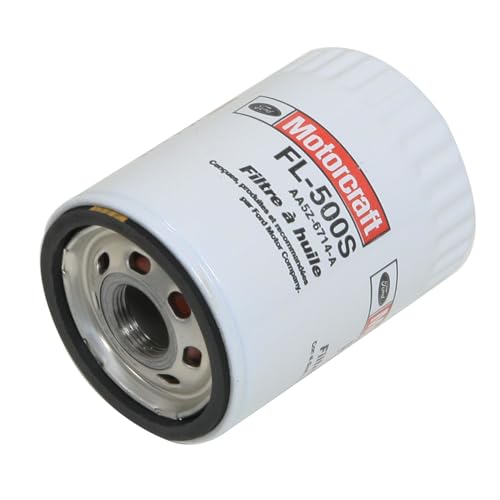
The major S550 Mustang GT capacity change came in 2018, when the standard 5.0L V8 moved from 8.0 qt to 10.0 qt with a filter change. Using an earlier GT capacity for a 2018–2023 engine can leave it underfilled.
EcoBoost Four-Cylinder Engines
Most 2015–2018 2.3L EcoBoost Mustangs list 5.7 qt, while 2019–2023 models generally list 6.0 qt. The normal oil grade is SAE 5W-30, subject to the manual’s Ford approval and any track-use instructions.
Coyote V8 Engines
The 2015–2017 5.0L GT generally needs 8.0 qt. The 2018–2023 GT generally needs 10.0 qt, but the recommended viscosity should still be checked by exact year and trim.
The larger capacity arrived with the third-generation Coyote. For technical differences between the earlier and later engines, see the Gen 3 Coyote engine specifications.
V6 and Mach 1 Models
The 2015–2017 3.7L V6 uses 6.0 qt with the filter. The 2021–2023 Mach 1 uses 10.0 qt and Ford’s Mach 1 supplement specifies SAE 5W-30, rather than treating every 5.0L Mustang as the same application.
What Oil Capacity Fits 1979 to 2014 Mustangs
Older Mustangs use several unrelated engine families. A 5.0L Windsor V8 in a Fox Body is not the same engine as the 5.0L Coyote introduced for 2011.
Fox Body and SN95 Models
For most 1979–1993 naturally aspirated Fox Body engines, 5.0 qt with filter is the standard reference. Some factory-turbocharged 2.3L engines have different published figures, so match the engine and oil-pan setup.
For 1994–1998 models, the 3.8L V6, earlier 5.0L V8, and two-valve 4.6L GT commonly use 5.0 qt. The four-valve Cobra 4.6L uses 6.0 qt. Consult your owner’s manual for the original viscosity rather than applying a later retroactive recommendation automatically.
New Edge and S197 Models
The 2003–2004 Ford manuals specify 5.0 qt for the 3.8L V6 and 6.0 qt for the 4.6L GT and Mach 1. Earlier 1999–2002 4.6L refill data varies between documentation editions, which makes an exact-year manual check essential.
The 2005–2010 Mustang 4.0L V6 generally takes 5.0 qt, while its 4.6L GT V8 takes 6.0 qt. For 2011–2014, the 3.7L V6 takes 6.0 qt, and the 5.0L GT takes 8.0 qt. Shelby and Boss models have their own entries in the performance section.
What Oil Do Classic Mustangs Before 1979 Need
For 1965–1973 classic Mustangs, the original engine and oil pan determine the refill amount. Common 170/200 inline-six engines use about 4.0 qt; factory 289/302 Windsor V8s commonly use 5.0 qt. Published historical references put the 351W around 5.0–5.5 qt and the 351C around 6.0 qt, depending on the setup.
The 1974–1978 Mustang II generally uses 5.0 qt with filter for its factory 2.3L, 2.8L V6, and 5.0L V8 configurations.
Modified classic Mustangs may have larger aftermarket oil pans. For 390, 428 Cobra Jet, Boss, or other specialty engines, confirm the exact pan, filter, and dipstick calibration. A generic classic-Mustang number is not safe enough for those configurations.
How Shelby and Performance Mustang Oil Capacities Differ
A performance Mustang’s oil requirement may be very different from the standard GT, even when the engines share a displacement.
| Performance Model | Oil Capacity | Required Normal Grade |
|---|---|---|
| 2012–2013 Boss 302 | 8.5 qt | 5W-50 |
| 2007–2012 Shelby GT500 5.4L | 6.4 qt | 5W-50 |
| 2013–2014 Shelby GT500 5.8L | 8.5 qt | 5W-50 |
| 2015–2020 Shelby GT350 and GT350R | 10.0 qt | 5W-50 |
| 2020–2022 Shelby GT500 5.2L | 11.5 qt | 5W-50 |
| 2021–2023 Mach 1 | 10.0 qt | 5W-30 |
| 2026 Dark Horse SC 5.2L | 11.5 qt | 5W-50 |
| 2025–2026 Mustang GTD | 15.5 qt | 5W-50 |
The 2020 Shelby GT500 is particularly easy to misidentify online. Ford’s 2020 GT500 supplement specifies 11.5 qt, with SAE 5W-50 meeting WSS-M2C931-C. Do not substitute the 10-qt GT350 refill figure.
The newer Mustang GTD lists 15.5 qt (14.7 L) and SAE 5W-50 meeting WSS-M2C931-E1 in its dedicated Ford GTD manual. Its oil-level check procedure also differs from a conventional Mustang, so follow the GTD instructions rather than a general dipstick guide.
Which Mustang Engine Oil Grade Is Correct by Year
Oil capacity and oil viscosity are separate specifications. A 2026 Mustang GT needs 9.5 qt of oil meeting its current SAE 5W-30 and Ford WSS requirements. That does not mean every earlier 5.0L GT uses the same grade.
Across Mustang generations, Ford has specified 5W-20, 5W-30, and 5W-50 for different engines and performance trims. An SAE grade describes viscosity, while a Ford WSS approval identifies a technical performance specification for that particular oil application.
Ford’s 2024 online Mustang 5.0L page, for example, specifies 5W-30 and WSS-M2C961-A1, while the April 2026 manual lists WSS-M2C971-A1 for its 5.0L. For a broader explanation of these approvals, consult our Ford engine oil recommendation chart.
Use track-use or extreme-cold alternatives only when your own model’s manual permits them. Do not assume a heavier grade is better for daily driving.
Why Mustang Oil Capacity Sources Sometimes Disagree
Mustang oil figures can disagree because a source covers a different engine, the oil filter is excluded, or an owner’s manual has been revised. A standard GT, a Mach 1, and a supercharged Shelby are not interchangeable references.
The 2024 Mustang GT illustrates the problem: Ford’s current 2024 Mustang 5.0L online specification lists 9.5 qt, but older third-party charts may still list 10.0 qt. Verify your car’s specific manual edition before deciding how much to pour.
Another common mistake is using an F-150 Coyote capacity for a Mustang. Our Ford 5.0 Coyote oil capacity chart focuses on the F-150 application; the Mustang-specific figures in the chart above should be used for Mustang engines.
How to Verify Mustang Oil Level After Changing Oil
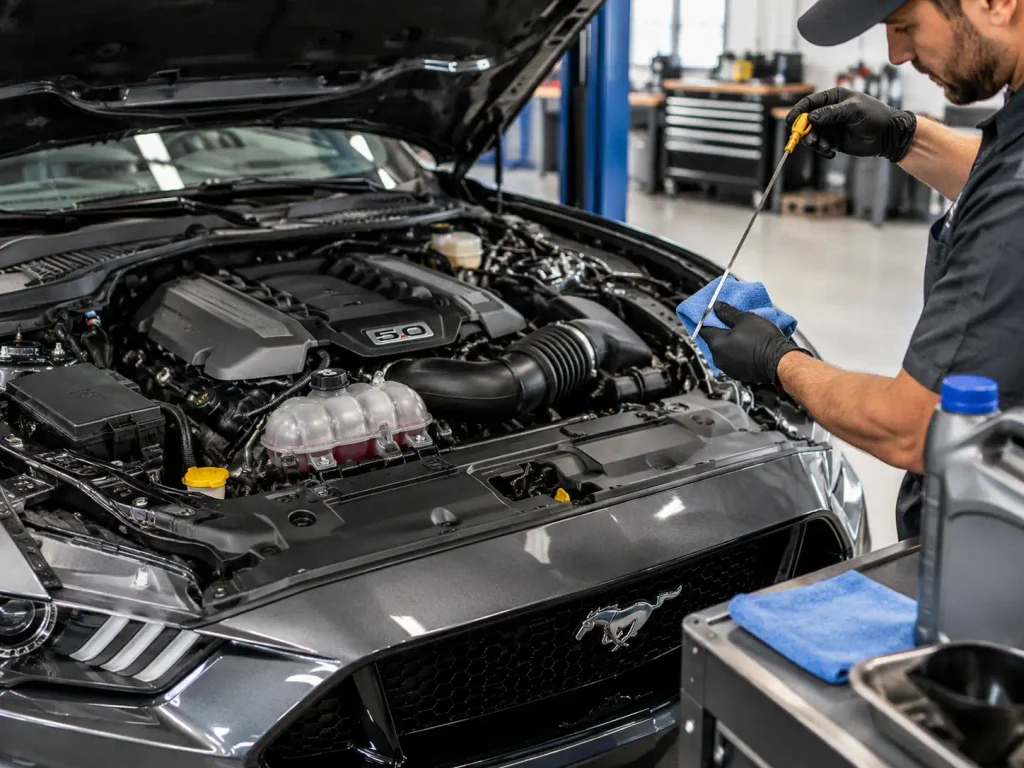
A refill figure is only a starting point; verify the actual level.
- Park level and shut down safely. Apply the parking brake. Follow the owner’s manual instructions for engine temperature and the waiting period before checking.
- Use the proper dipstick procedure. On conventional engines, remove the dipstick, wipe it, fully reinsert it, and read the level again. The GTD has a different procedure.
- Check the marked range. The oil should register between the specified minimum and maximum markings. Do not overfill to compensate for uncertainty.
- Top up gradually if needed. Add only the correct approved oil in small amounts, allowing time for it to settle before rechecking.
- Inspect for leaks and reset the monitor. Check for leaks. Reset the oil-life monitor using your Mustang’s year-specific instructions.
If the dipstick reading looks wrong, stop and verify the amount drained, the correct filter, and the manual’s measurement conditions before adding more oil.
Which Mustang Oil Capacity Should You Use
Choose the Ford Mustang oil capacity chart entry for your exact year, engine, and trim. The difference between an 8.0-qt early S550 GT, a 10.0-qt later S550 GT, and a 9.5-qt current S650 GT shows why displacement alone is not enough.
Start with the year-and-engine table, then check the relevant special-model note and the oil grade. If a source disagrees with the manual delivered with your Mustang, follow Ford’s vehicle-specific documentation and verify the oil level using the prescribed procedure. That final check matters more than simply emptying a fixed number of bottles into the engine.
Ford Mustang Oil Capacity Frequently Asked Questions
How Much Oil Does a 2026 Mustang GT Take?
A 2026 Mustang GT with the standard 5.0L V8 takes 9.5 US quarts (9.0 L) with a filter change. The April 2026 Ford manual specifies SAE 5W-30 meeting WSS-M2C971-A1; verify the manual associated with your vehicle before servicing it.
Does a Mustang EcoBoost Need Six Quarts?
Some do. Most 2019–2023 Mustang EcoBoost 2.3L engines specify 6.0 qt, while 2015–2018 and 2024–2026 versions generally specify 5.7 qt. Match the engine to its model year instead of rounding 5.7 qt up to six.
Is the Dark Horse Oil Capacity Different From the GT?
The standard 5.0L Dark Horse generally shares the 9.5-qt capacity shown for current S650 5.0L models. The 2026 Dark Horse SC is different: its supercharged 5.2L engine specifies 11.5 qt and SAE 5W-50.
Why Do Some Mustang Manuals Show Different Capacities?
Manuals can be updated, and some online guides use specifications from different engines or editions. Check the printing date, engine designation, and whether the figure includes the oil filter, then follow the manual supplied with your particular car.
What Does Oil Capacity With Filter Mean?
It means the stated refill amount accounts for changing the engine oil filter during a routine oil change. If the filter is not changed, the amount required can differ. Replace the filter when the scheduled service calls for it and always confirm the final oil level.
Does a Mustang GT Use the Same Oil Capacity as an F-150?
Not necessarily. A Mustang GT and Ford F-150 can both use a 5.0L Coyote V8 while requiring different oil refill quantities. Always select the model-specific specifications rather than relying on an engine-displacement-only search result.