Ford Fusion Oil Capacity Chart for Every Engine and All Year 2026

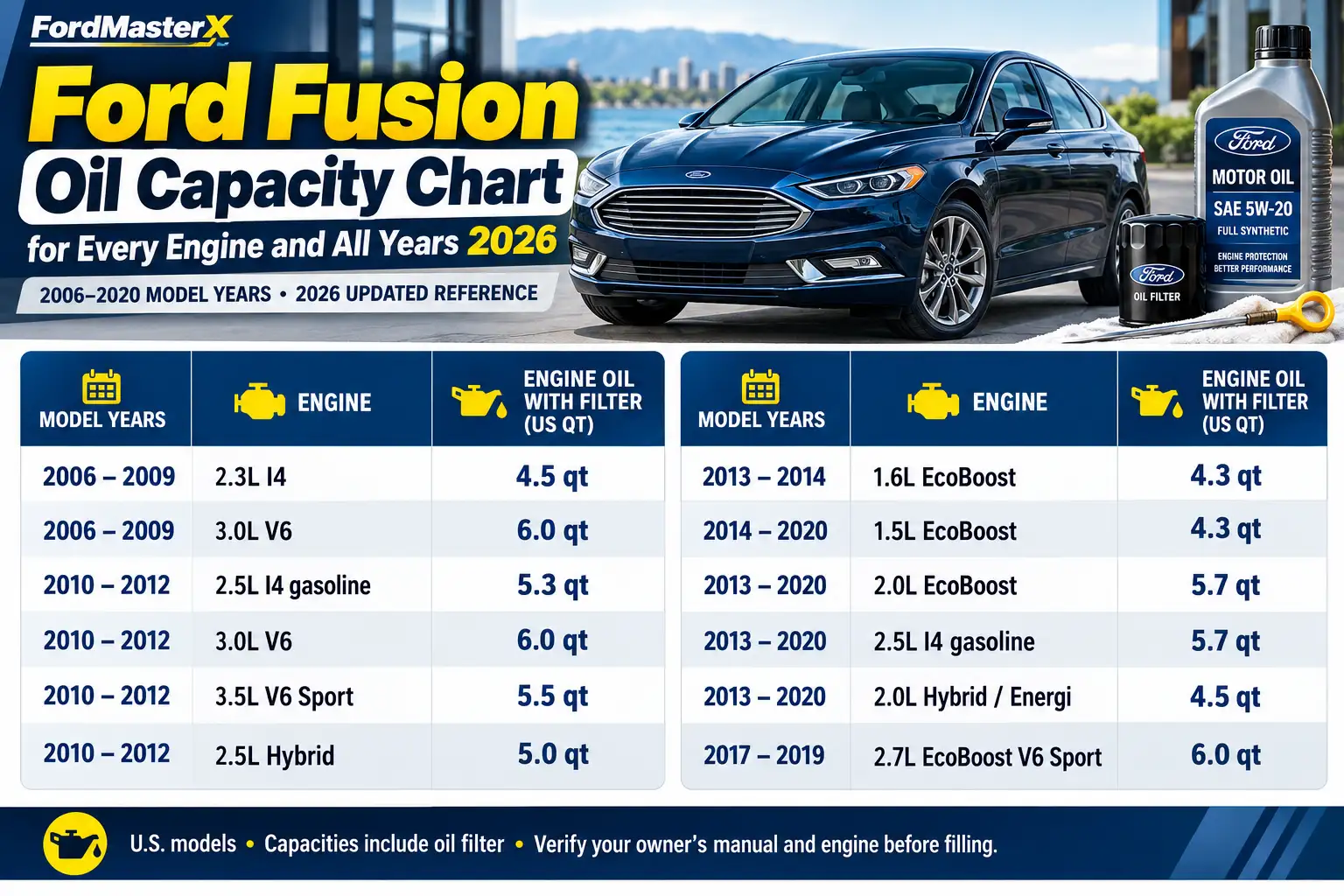
The Ford Fusion oil capacity chart depends on your model year and engine. Across U.S.-market 2006–2020 models, an oil-and-filter change calls for roughly 4.3 to 6.0 US quarts, with different specifications for Duratec, EcoBoost, Hybrid, and Energi engines.
Find your exact engine in the chart below before buying oil. Capacities include the filter unless noted, and the recommended SAE grade and Ford WSS approval can change even when two engines have the same displacement.
Ford Fusion Oil Capacity
Compare oil-and-filter refill quantities across U.S. Fusion engines, 2006–2020.
Each bar compares its capacity with the 6.0-quart maximum shown. Match your year and engine; this is a quick reference, not a substitute for the full year-by-year chart.
*2010 2.5L caution: Ford manual printings disagree (5.0 vs 5.3 qt).
All amounts are U.S. quarts with a new oil filter. Capacities are grouped for comparison; oil viscosity and Ford WSS specification are engine- and year-specific.
Use the complete year-by-year table and the owner’s manual for your vehicle. Verify the final level on the dipstick.
Ford Fusion Oil Capacity Chart by Year 2006 to 2020


This chart covers factory U.S.-market engine combinations, not the European Mondeo or aftermarket engine swaps. Each capacity includes a new oil filter. Match both the SAE grade and WSS approval.
| Model Year | Engine | Oil With Filter | Oil Viscosity | Ford Oil Specification |
|---|---|---|---|---|
| 2006 | 2.3L Duratec I4 | 4.5 qt (4.25 L) | SAE 5W-20 | WSS-M2C930-A |
| 2006 | 3.0L Duratec V6 | 6.0 qt (5.7 L) | SAE 5W-20 | WSS-M2C930-A |
| 2007 | 2.3L Duratec I4 | 4.5 qt (4.25 L) | SAE 5W-20 | WSS-M2C930-A |
| 2007 | 3.0L Duratec V6 | 6.0 qt (5.7 L) | SAE 5W-20 | WSS-M2C930-A |
| 2008 | 2.3L Duratec I4 | 4.5 qt (4.25 L) | SAE 5W-20 | WSS-M2C930-A |
| 2008 | 3.0L Duratec V6 | 6.0 qt (5.7 L) | SAE 5W-20 | WSS-M2C930-A |
| 2009 | 2.3L Duratec I4 | 4.5 qt (4.25 L) | SAE 5W-20 | WSS-M2C930-A |
| 2009 | 3.0L Duratec V6 | 6.0 qt (5.7 L) | SAE 5W-20 | WSS-M2C930-A |
| 2010 | 2.5L Duratec I4 † | 5.3 qt (5.0 L) | SAE 5W-20 | WSS-M2C930-A |
| 2010 | 3.0L Duratec V6 | 6.0 qt (5.7 L) | SAE 5W-20 | WSS-M2C930-A |
| 2010 | 3.5L Duratec V6 | 5.5 qt (5.2 L) | SAE 5W-20 | WSS-M2C930-A |
| 2010 | 2.5L Hybrid I4 | 5.0 qt (4.7 L) | SAE 5W-20 | WSS-M2C930-A |
| 2011 | 2.5L Duratec I4 | 5.3 qt (5.0 L) | SAE 5W-20 | WSS-M2C930-A |
| 2011 | 3.0L Duratec V6 | 6.0 qt (5.7 L) | SAE 5W-20 | WSS-M2C930-A |
| 2011 | 3.5L Duratec V6 | 5.5 qt (5.2 L) | SAE 5W-20 | WSS-M2C930-A |
| 2011 | 2.5L Hybrid I4 | 5.0 qt (4.7 L) | SAE 5W-20 | WSS-M2C930-A |
| 2012 | 2.5L Duratec I4 | 5.3 qt (5.0 L) | SAE 5W-20 | WSS-M2C945-A |
| 2012 | 3.0L Duratec V6 | 6.0 qt (5.7 L) | SAE 5W-20 | WSS-M2C945-A |
| 2012 | 3.5L Duratec V6 | 5.5 qt (5.2 L) | SAE 5W-20 | WSS-M2C945-A |
| 2012 | 2.5L Hybrid I4 | 5.0 qt (4.7 L) | SAE 5W-20 | WSS-M2C945-A |
| 2013 | 1.6L EcoBoost I4 | 4.3 qt (4.1 L) | SAE 5W-20 | WSS-M2C945-A |
| 2013 | 2.0L EcoBoost I4 | 5.7 qt (5.4 L) | SAE 5W-30 | WSS-M2C946-A |
| 2013 | 2.5L Duratec I4 | 5.7 qt (5.4 L) | SAE 5W-20 | WSS-M2C945-A |
| 2013 | 2.0L Hybrid and Energi | 4.5 qt (4.3 L) | SAE 5W-20 | WSS-M2C945-A |
| 2014 | 1.5L EcoBoost I4 | 4.3 qt (4.1 L) | SAE 5W-20 | WSS-M2C945-A |
| 2014 | 1.6L EcoBoost I4 ‡ | 4.3 qt (4.1 L) | SAE 5W-20 | WSS-M2C945-A |
| 2014 | 2.0L EcoBoost I4 | 5.7 qt (5.4 L) | SAE 5W-30 | WSS-M2C946-A |
| 2014 | 2.5L Duratec I4 | 5.7 qt (5.4 L) | SAE 5W-20 | WSS-M2C945-A |
| 2014 | 2.0L Hybrid and Energi | 4.5 qt (4.3 L) | SAE 0W-20 | WSS-M2C947-A |
| 2015 | 1.5L EcoBoost I4 | 4.3 qt (4.1 L) | SAE 5W-20 | WSS-M2C945-A |
| 2015 | 2.0L EcoBoost I4 | 5.7 qt (5.4 L) | SAE 5W-30 | WSS-M2C946-A |
| 2015 | 2.5L Duratec I4 | 5.7 qt (5.4 L) | SAE 5W-20 | WSS-M2C945-A |
| 2015 | 2.0L Hybrid and Energi | 4.5 qt (4.3 L) | SAE 0W-20 | WSS-M2C947-A |
| 2016 | 1.5L EcoBoost I4 | 4.3 qt (4.1 L) | SAE 5W-20 | WSS-M2C945-A |
| 2016 | 2.0L EcoBoost I4 | 5.7 qt (5.4 L) | SAE 5W-30 | WSS-M2C946-A |
| 2016 | 2.5L Duratec I4 | 5.7 qt (5.4 L) | SAE 5W-20 | WSS-M2C945-A |
| 2016 | 2.0L Hybrid and Energi | 4.5 qt (4.3 L) | SAE 0W-20 | WSS-M2C947-A |
| 2017 | 1.5L EcoBoost I4 | 4.3 qt (4.1 L) | SAE 5W-20 | WSS-M2C945-A |
| 2017 | 2.0L EcoBoost I4 | 5.7 qt (5.4 L) | SAE 5W-30 | WSS-M2C946-A |
| 2017 | 2.5L Duratec I4 | 5.7 qt (5.4 L) | SAE 5W-20 | WSS-M2C945-A |
| 2017 | 2.7L EcoBoost V6 Sport | 6.0 qt (5.7 L) | SAE 5W-30 | WSS-M2C946-A |
| 2017 | 2.0L Hybrid and Energi | 4.5 qt (4.3 L) | SAE 0W-20 | WSS-M2C947-A |
| 2018 | 1.5L EcoBoost I4 | 4.3 qt (4.1 L) | SAE 5W-20 | WSS-M2C945-A |
| 2018 | 2.0L EcoBoost I4 | 5.7 qt (5.4 L) | SAE 5W-30 | WSS-M2C946-A |
| 2018 | 2.5L Duratec I4 | 5.7 qt (5.4 L) | SAE 5W-20 | WSS-M2C945-A |
| 2018 | 2.7L EcoBoost V6 Sport | 6.0 qt (5.7 L) | SAE 5W-30 | WSS-M2C946-A |
| 2018 | 2.0L Hybrid and Energi | 4.5 qt (4.3 L) | SAE 0W-20 | WSS-M2C947-A |
| 2019 | 1.5L EcoBoost I4 | 4.3 qt (4.05 L) | SAE 5W-20 | WSS-M2C945-B1 |
| 2019 | 2.0L EcoBoost I4 | 5.7 qt (5.4 L) | SAE 5W-30 | WSS-M2C946-B1 |
| 2019 | 2.5L Duratec I4 | 5.7 qt (5.4 L) | SAE 5W-20 | WSS-M2C945-B1 |
| 2019 | 2.7L EcoBoost V6 Sport | 6.0 qt (5.7 L) | SAE 5W-30 | WSS-M2C946-B1 |
| 2019 | 2.0L Hybrid and Energi | 4.5 qt (4.3 L) | SAE 0W-20 | WSS-M2C947-B1 |
| 2020 | 1.5L EcoBoost I4 | 4.3 qt (4.05 L) | SAE 5W-20 | WSS-M2C945-B1 |
| 2020 | 2.0L EcoBoost I4 | 5.7 qt (5.4 L) | SAE 5W-30 | WSS-M2C946-B1 |
| 2020 | 2.5L Duratec I4 | 5.7 qt (5.4 L) | SAE 5W-20 | WSS-M2C945-B1 |
| 2020 | 2.0L Hybrid and Energi | 4.5 qt (4.3 L) | SAE 0W-20 | WSS-M2C947-B1 |
- 2010 2.5L † exception: Ford’s first-printing owner guide listed 5.0 qt (4.7 L); its later fourth printing listed 5.3 qt (5.0 L). Check the guide supplied for your own vehicle and verify the final dipstick level rather than treating either printing as universal.
- 2014 1.6L ‡ exception: The 1.6L EcoBoost continued in limited manual-transmission configurations alongside the newer 1.5L EcoBoost. Do not assume every 2014 car has both choices.
- 2013 Hybrid manual editions: The original 2013 U.S. Hybrid guide specified 5W-20 under WSS-M2C945-A, as shown in the chart. A later Ford online manual recommends 0W-20 under WSS-M2C947-A and permits 5W-20 if 0W-20 is unavailable. Check the manual version that applies to your car.
- 2014 Hybrid updated grade: The second-printing 2014 Hybrid/Energi manual specifies 0W-20, WSS-M2C947-A; review the 2014 Ford Hybrid specification if an older chart lists 5W-20.
- 2017–2019 Sport only: The 2.7L twin-turbo EcoBoost was offered in the Fusion Sport. The Fusion Sport did not continue for 2020. Check the corresponding model-year manual before adding an engine to the chart.
- Regional and manual differences: These are U.S.-market recommendations. Canadian Hybrid manuals sometimes show a different preferred SAE grade. Factory manual editions can differ; follow your car’s applicable guide.
For the earliest Fusion engines, the 2006 Ford Fusion owner’s guide is a useful primary reference. The year-specific Ford manual remains the final authority for every row.
How to Identify Your Ford Fusion Engine Correctly


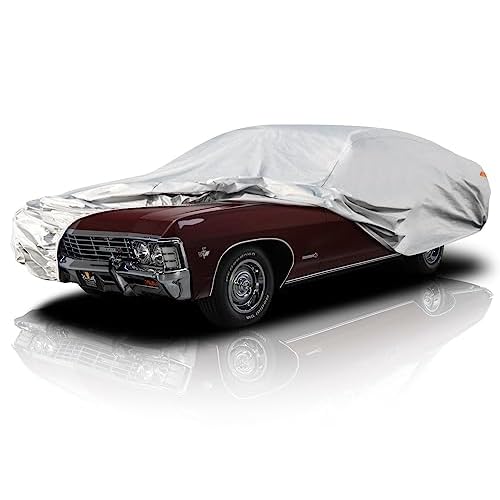
A 2.0L Fusion can be either a turbocharged EcoBoost or a Hybrid, so engine size alone is not enough to choose the right oil. Confirm the year and engine before reading across the chart.
- Check the model year and trim. Use your registration, door-jamb certification label, or original vehicle paperwork to establish the model year.
- Check the owner’s manual or engine information. Compare the engine description in the manual with the under-hood labeling. If you need access, follow the steps for opening the Ford Fusion hood.
- Confirm an uncertain configuration by VIN. A Ford dealer’s parts department or Ford’s vehicle records can help identify the original engine from your VIN.
Once the engine is identified, you can see why Ford changed its refill quantities between the first- and second-generation Fusion.
What Changed in Fusion Oil Capacity Before 2013


Early Duratec Engine Capacities
The 2006–2009 U.S. Fusion used a 2.3L four-cylinder or 3.0L V6. The 2.3L requires 4.5 qt, while the 3.0L takes 6.0 qt with a filter change. Ford specified SAE 5W-20 for these engines, but the engines require very different volumes.
Updated Engines From 2010
For 2010–2012, Ford replaced the 2.3L with a 2.5L four-cylinder and also offered 3.0L and 3.5L V6 engines. The later documented 2.5L figure is 5.3 qt; the V6 engines use 6.0 qt and 5.5 qt, respectively. The 2.5L Hybrid takes 5.0 qt, which is not the same as the nonhybrid 2.5L.
The 2010 2.5L is the major reference exception. Ford’s first-printing 2010 guide says 5.0 qt, while the fourth-printing 2010 guide says 5.3 qt. Follow the applicable manual and dipstick, especially on an older car with an unknown service history.
The 2013 redesign introduced turbocharged engine options with still more capacity differences.
How EcoBoost Oil Capacities Vary From 2013 to 2020
Smaller EcoBoost Engine Capacities
The 2013 Fusion 1.6L EcoBoost and the later 1.5L EcoBoost both have a specified refill of 4.3 qt with the filter. Both use SAE 5W-20. The 1.6L appears in 2013 and certain 2014 configurations.
Do not use another engine’s 5.7 qt figure.
Larger EcoBoost and Duratec Engines
The second-generation 2.0L EcoBoost and naturally aspirated 2.5L both use 5.7 qt with the filter. Their normal oil grades differ: 5W-30 for the 2.0L EcoBoost and 5W-20 for the 2.5L.
Ford also introduced the 2.7L twin-turbo V6 Fusion Sport for 2017–2019. It uses 6.0 qt of 5W-30. There is no regular-production 2020 Fusion Sport with this engine, so do not copy a 2019 Sport capacity into a 2020 engine list.
The Hybrid and Energi models require their own capacity and oil-grade checks.
How Hybrid and Energi Oil Capacities Compare
Earlier Fusion Hybrid Engines
The first-generation 2010–2012 Fusion Hybrid uses a 2.5L gasoline engine, but its oil refill is 5.0 qt, compared with the later-listed 5.3 qt for the regular 2.5L. Ford specified 5W-20 for these U.S. Hybrid models.
This is an easy mistake when shopping from a generic 2.5L capacity list. Match the Hybrid designation, not just the displacement.
Later Hybrid and Energi Engines
From 2013 onward, the Fusion Hybrid and plug-in Energi use a 2.0L gasoline engine with a 4.5 qt oil-and-filter capacity. That is 1.2 qt less than the 2.0L EcoBoost, which uses 5.7 qt.
The oil grade also changed across model years. The original 2013 U.S. Hybrid manual calls for 5W-20, while a later Ford digital edition recommends 0W-20. The revised 2014 and 2015–2020 U.S. Hybrid manuals specify 0W-20, with WSS approvals varying by year. If your Hybrid manual differs from a generic retailer lookup, use Ford’s instructions for your exact model year and market.
Which Oil Viscosity and Ford WSS Specification Applies
Capacity, viscosity, and approval are separate requirements. A 5.7 qt refill does not mean all 5.7 qt Fusion engines use the same oil.
- SAE 5W-20 appears in the regular Duratec engines and smaller EcoBoost engines, subject to the year shown in the chart.
- SAE 5W-30 is specified for the 2.0L EcoBoost and 2017–2019 2.7L Fusion Sport.
- SAE 0W-20 applies to U.S.-spec later Fusion Hybrid and Energi engines, while earlier Hybrid years call for 5W-20.
The WSS-M2C number is Ford’s required oil-performance specification. For example, late-model 5W-20 gasoline engines show WSS-M2C945-B1, while later U.S. Hybrids show WSS-M2C947-B1. Earlier Ford manuals use A-series approvals. Check the exact approval on the oil bottle rather than relying on viscosity alone.
For broader Ford-approved grades, see our Ford engine oil recommendation chart. For a Fusion refill, the engine-specific chart above and your model-year manual take priority.
Even with the right oil, the finished fill needs a dipstick check.
How to Check Oil Level After Refilling

The chart describes a service-fill quantity. Do not assume that pouring the stated amount guarantees the correct final level, especially if the old oil has not fully drained or the vehicle is not level.
- Park level and finish the oil-and-filter change. Refit the drain plug and correct filter as instructed for your engine, and keep oil off hot components.
- Add the specified oil carefully. Use the correct viscosity and approval, adding enough to approach the required refill amount without exceeding the maximum level.
- Allow the oil to settle as your manual directs. Ford’s later Fusion guides commonly instruct checking after the engine reaches operating temperature and has been switched off for about 15 minutes. Follow the exact procedure for your year.
- Read the dipstick and correct the level. Wipe, reinsert fully, and check that oil is between the marked limits. Add small amounts as needed; never fill above MAX. Check for leaks after running the engine.
Resetting the oil-life indicator is a separate maintenance action. For an older model, our 2012 Ford Fusion oil reset instructions cover that specific year.
If a refill quantity still conflicts with another chart, check the source’s model year, engine, and manual edition.
Why Published Ford Fusion Oil Capacities Sometimes Disagree
The 2010 2.5L illustrates why two legitimate Ford documents can produce different numbers. The first printing lists 5.0 qt, but the fourth printing lists 5.3 qt. The discrepancy is in Ford’s own editions, not proof that either number belongs to every 2.5L Fusion.
Another source of confusion is engine availability. A manual can mention an engine outside a particular year’s production lineup. The 2.7L Sport ended after 2019, so a 2020 capacity chart should not list it.
Third-party tables can merge 2.0L EcoBoost and 2.0L Hybrid or apply newer grades to older engines. Resolve discrepancies using the vehicle-specific manual and dipstick.
Which Oil Capacity Should Your Ford Fusion Use
Your correct Ford Fusion oil capacity chart entry is the one matching both the model year and the engine configuration. Duratec, EcoBoost, and Hybrid engines differ in capacity or oil requirements.
Match your model year and engine first. Read the chart’s oil-with-filter amount, confirm the SAE viscosity and WSS requirement, and check the manual that applies to your car. Check the 2010 manual-edition difference and Hybrid oil-grade changes.
After replacing the filter and adding oil, verify the final level on the dipstick. Do not treat chart quantities as guaranteed final dipstick levels.
Ford Fusion Oil Capacity Questions Answered
How Many Quarts of Oil Does a Ford Fusion Take?
A U.S.-spec 2006–2020 Ford Fusion generally takes 4.3 to 6.0 US quarts with an oil-filter change, depending on its engine. Locate your year and engine in the chart; there is no single capacity suitable for all Fusion models.
Does Ford Fusion Oil Capacity Include the Filter?
Yes. Every capacity in this article is a Ford service-fill quantity including a new oil filter. If you do not replace the filter or do not drain the engine completely, the actual refill can differ, so always check the dipstick.
What Oil Does a 2.5L Ford Fusion Use?
The conventional 2.5L Duratec generally calls for SAE 5W-20, but its oil capacity is 5.3 qt in later 2010–2012 documentation and 5.7 qt for 2013–2020. Earlier 2.5L Hybrid models use 5.0 qt. Check the manual edition for the 2010 gasoline model.
Is Ford Fusion Hybrid Oil Capacity Different?
Yes. The 2010–2012 2.5L Fusion Hybrid uses 5.0 qt, while the 2013–2020 2.0L Hybrid and Energi use 4.5 qt. That latter figure is not interchangeable with the 2.0L EcoBoost’s 5.7 qt specification.
Can I Use 5W-30 Instead of 5W-20 in My Fusion?
Not unless Ford approves it for your exact engine and conditions. A 2.0L EcoBoost may call for 5W-30 even when a 2.5L or 1.5L Fusion of the same year calls for 5W-20. Use the year-specific owner’s manual and its Ford WSS approval before substituting an oil grade.