Ford F150 Brake Pad Size Chart by Year: 1997-2026 Front and Rear

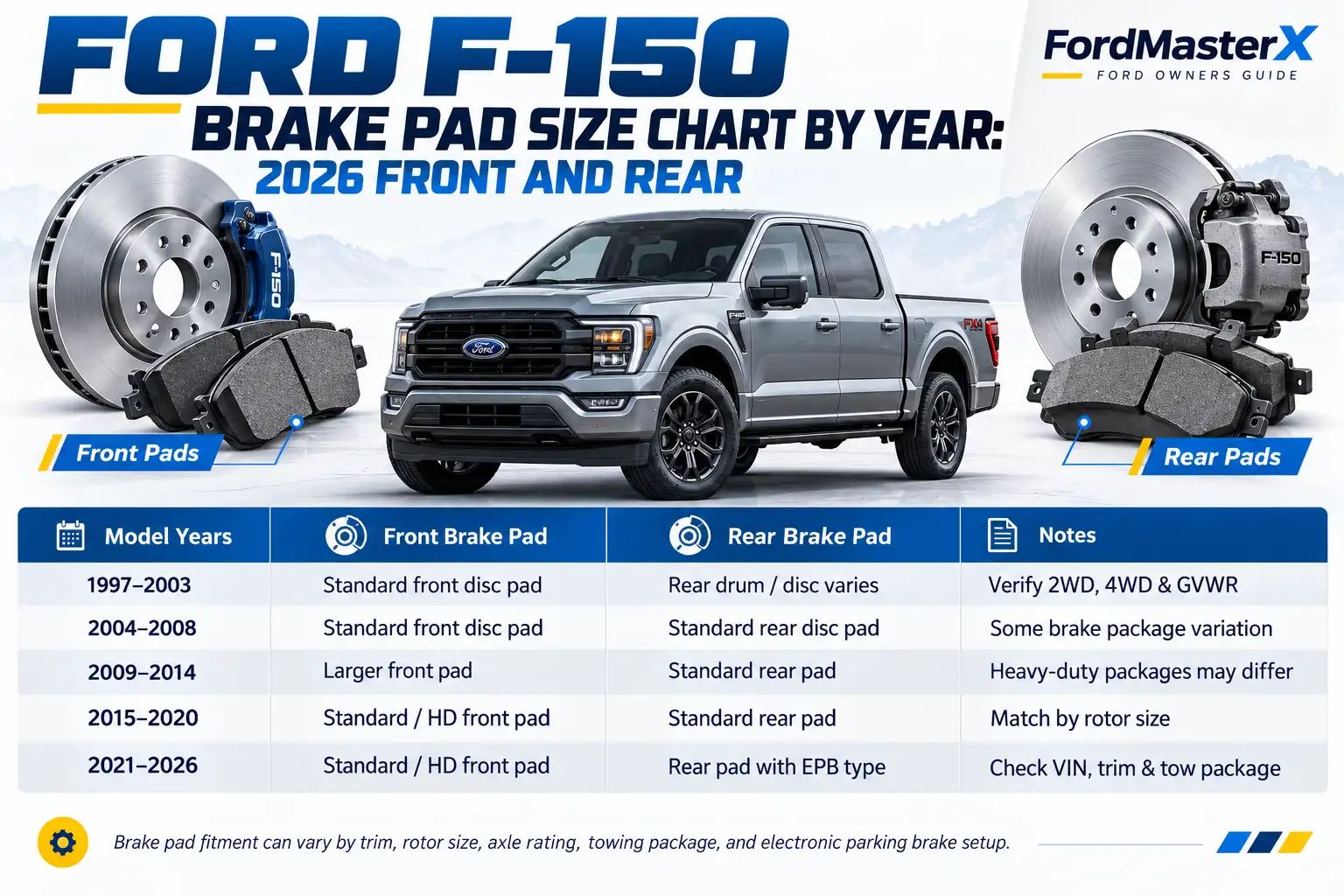
The Ford F150 brake pad size chart is not a single measurement for every truck. Front and rear pads use different backing plates, and the correct shape can change with model year, caliper and parking brake configuration. For example, the older D679 front pad measures approximately 166 × 57 × 17 mm in one manufacturer’s catalogue, while the D2382 front pad family found on newer applications is about 192 × 68 × 16 mm in another.
Use the chart below to identify a documented pad family, then confirm the exact replacement against your truck’s VIN and installed brake hardware. The numbers describe example new pad assemblies, not the amount of friction lining remaining on a worn pad.
Brake Pad Size Chart | 1997–2026
Manufacturer-documented aftermarket examples, not universal OEM dimensions. Match your VIN, caliper and parking brake setup before ordering.
Swipe table sideways to see sizes and notes →
| Model years | Axle / configuration | FMSI | W × H × T (mm) | Fitment checks |
|---|---|---|---|---|
| 1997–2003 | Front | D679 | 166 × 57 × 17 | Older-body shape; confirm caliper and Heritage exception. |
| 1997–2003 | Rear disc | D711 | 142 × 49 × 16 | Rear-disc trucks only. Drum-equipped trucks need shoes. |
| 2004–2008 | Front | D1083 | 175.8 × 58.8 × 19.9 | New-body examples; 2004 Heritage differs. |
| 2004–2011 | Rear | D1012 | 158.6 × 49.8 × 17.9 | Confirm exact caliper and model-year application. |
| 2009 | Front | D1083 | ≈176 × 59 × 20 | Select applications; check original part. |
| 2010–2014 | Front | D1414 | 194.4 × 69.3 × 18.1 | Height can differ by brand or inner/outer pad. |
| 2012–2014 | Rear | D1602 | 149 × 55 × 17 | Check model and brake hardware. |
| 2015–2020 | Front | D1414 / D2087 | ≈194 × 68–69 × 18–19 | Alternative listings, NOT interchangeable by default. |
| 2015–2020 | Rear · manual PB | D1602 | 149 × 55 × 17 | Select manual parking brake applications. |
| 2015–2020 | Rear · electric PB | D1790 | 149 × 52 × 18 | Select electric parking brake applications. |
| 2017–2020 | Front · select | D2382 | ≈192 × 68 × 16 | Special configurations incl. certain Raptor listings. |
| 2021 | Front · select | D2087 | 194.3 × 67.8 × 18.1 | Carryover listings; VIN/build check needed. |
| 2021–2026 | Front · select | D2382 | ≈192 × 67.5–68 × 15.8–16 | Brand-specific sample dimensions; verify fit. |
| 2021–2024 | Rear · select | D2383 | 149 × 52.4–54.2 × 16.2 | One kit: inner/outer heights differ. |
| 2025–2026 | Rear · select | D2383 | Verify exact kit | Shape listed; thickness not universal; verify VIN. |
How to use: W × H × T is a sample new pad assembly size, not a wear limit. “≈” marks rounded measurements. FMSI codes identify shape families; check an application catalogue and the original service part before purchase.
How to Read F150 Brake Pad Measurements


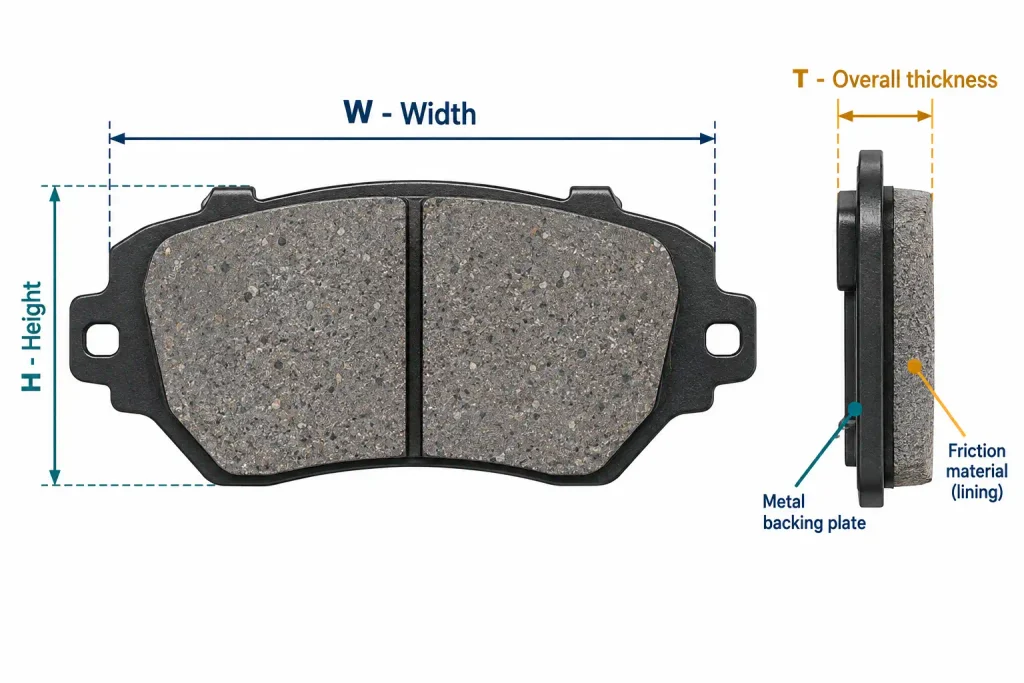
Brake pad dimensions describe the pad assembly rather than the brake rotor. Three measurements matter:
- Width: The overall horizontal length of the steel backing plate, measured from end to end.
- Height: The vertical dimension of the backing plate. Some inner and outer pads have different heights.
- Overall thickness: The combined thickness of the backing plate, friction material and any included shim, as specified by that manufacturer.
An FMSI number such as D1083 or D1790 identifies a brake pad shape family. It is not automatically an original Ford part number, and pads sharing a shape may have different overall thicknesses or included hardware.
A rotor’s diameter is another measurement altogether. If you’re checking the disc rather than the pads, use our Ford F150 brake rotor size chart.
Ford F150 Brake Pad Size Chart for 1997 to 2026

This table gives documented aftermarket pad examples, organized by model year and axle. All dimensions are width × height × overall thickness in millimeters. They are not blanket factory specifications for every trim in a given year. When a reference covers only some configurations, the final column explains what must be checked.
| Model years | Position | FMSI pad family | Example size in mm | Fitment notes |
|---|---|---|---|---|
| 1997–2003 | Front | D679 | 166 × 57 × 17 | Common original-generation shape; confirm caliper and whether a 2004 truck is Heritage. |
| 1997–2003 | Rear disc | D711 | 142 × 49 × 16 | Disc-equipped trucks only; rear-drum trucks use shoes, not these pads. |
| 2004–2008 | Front | D1083 | 175.8 × 58.8 × 19.9 | New-body applications; do not assume 2004 Heritage uses this shape. |
| 2004–2011 | Rear | D1012 | 158.6 × 49.8 × 17.9 | Documented common rear application; check model-year and caliper specifics. |
| 2009 | Front | D1083 | About 176 × 59 × 20 | Listed on select 2009 applications; verify against the truck. |
| 2010–2014 | Front | D1414 | 194.4 × 69.3 × 18.1 | Documented front family; some manufacturers report slightly different inner/outer heights. |
| 2012–2014 | Rear | D1602 | 149 × 55 × 17 | Documented rear application; verify model and braking hardware. |
| 2015–2020 | Front | D1414 / D2087 | About 194 × 68–69 × 18–19 | Both references appear in catalogues; do not treat the codes as interchangeable without a fitment check. |
| 2015–2020 | Rear with manual parking brake | D1602 | 149 × 55 × 17 | Manual parking brake applications; confirm before ordering. |
| 2015–2020 | Rear with electric parking brake | D1790 | 149 × 52 × 18 | Electric parking brake applications; different pad profile. |
| 2017–2020 | Front, select configurations including Raptor | D2382 | About 192 × 68 × 16 | Configuration-specific listing, not the standard pad for every 2017–2020 truck. |
| 2021 | Front, select catalogue applications | D2087 | 194.3 × 67.8 × 18.1 | Some catalogues carry this earlier shape into 2021; VIN and build details are essential. |
| 2021–2026 | Front, select applications | D2382 | About 192 × 67.5–68 × 15.8–16 | Documented new-generation shape; figures describe example brands, not all replacements. |
| 2021–2024 | Rear, select applications | D2383 | 149 × 52.4–54.2 × 16.2 | Example kit has 52.4-mm inner and 54.2-mm outer heights. |
| 2025–2026 | Rear, select applications | D2383 | Confirm exact kit thickness | D2383 is catalogued for these years, but a universal assembly dimension was not established. Verify by VIN and product number. |
Chart notes: Values come from the listed manufacturers’ specific replacement pads. Brand-to-brand rounding, friction compounds and shims can change reported thickness. A slash between FMSI codes means there are multiple listings, not that the pads can be swapped. Rear drum-equipped trucks have brake shoes instead of rear disc pads. The 2021–2026 F-150 Lightning must also be checked under its own model-specific application.
For older applications, Carlisle Brake & Friction’s pad drawings identify D679 at 166 × 57 × 17 mm and D711 at 142 × 49 × 16 mm. The manufacturer’s dimensions describe its own pad products; the FMSI reference is the more useful starting point for cross-brand searching.
Which Pads Fit 1997 to 2003 F150 Trucks


The key difference on 1997–2003 F-150 trucks is whether the rear brakes use drums or discs. Many trucks have front disc brakes with rear drums. Others have rear discs, so an online listing for rear disc pads does not necessarily fit your truck.
The D679 front pad family is approximately 166 mm wide and 57 mm high. For trucks with rear discs, D711 appears in manufacturer application records, with a roughly 142-mm width and 49-mm height. A truck with rear drums needs brake shoes instead, and those are sized using different dimensions.
A 2004 F-150 Heritage is an important exception. It retains the older-body configuration, so do not automatically use the 2004 new-body pad listings. Check the specific model and the actual caliper before buying.
Which Pads Fit 2004 to 2011 F150 Trucks
The redesigned 2004 F-150 introduced the D1083 front brake pad family on many new-body trucks. One manufacturer’s reference dimensions are 175.8 mm wide, 58.8 mm high and 19.9 mm thick. The D1012 rear pad family measures approximately 158.6 × 49.8 × 17.9 mm.
Those figures are consistent with the manufacturer entries in Allied Nippon’s brake pad catalogue. They are useful for identifying shapes, but the catalogue’s broad “Ford truck” category should not be read as proof that every vehicle within its date range uses the same pad.
The 2009 model year deserves extra attention. Some fitment records still list D1083 front pads, while 2010 listings begin showing the wider D1414 family. Match the catalogue to the actual truck, particularly if you are comparing parts saved from an earlier F-150.
What Changed for 2012 to 2014 F150 Pads
Many 2012–2014 F-150 front pad catalogues list the D1414 family. A typical documented example measures about 194 mm wide, 68–69 mm high and 18 mm thick. It is visibly longer than the D1083 shape used on many earlier F-150s.
The D1602 rear family also appears for 2012–2014 applications. Brembo’s P24168N version measures 149 × 55 × 17 mm. That makes it smaller in overall width than the earlier D1012 rear family, which measures about 159 mm wide.
These figures help distinguish the families, but year alone is not a sufficient part-number lookup. Confirm the brake hardware and original application, especially for specialized F-150 configurations.
How 2015 to 2020 Parking Brakes Affect Fit
For 2015–2020 F-150 rear brake service, manual versus electric parking brake is one of the most important fitment checks. Catalogues identify two different rear pad families that may appear for trucks from this period.
Manual Parking Brake Applications
The D1602 family is documented for select manual parking brake trucks. A Brembo example measures 149 mm wide, 55 mm high and 17 mm thick. It should only be ordered when the vehicle application and caliper match that family.
Electronic Parking Brake Applications
The D1790 family is documented for select electric parking brake trucks. Brembo’s P24200N version measures about 149 × 52 × 18 mm, demonstrating that a similar width does not mean an identical pad shape.
If your F-150 has an electric parking brake, follow the Ford-approved rear brake service procedure, including maintenance mode where specified, before retracting the rear caliper pistons. Do not force an electronically actuated caliper piston with an ordinary clamp.
On the front axle, D1414 and D2087 references both appear in product catalogues covering parts of this era. Compare the complete part application, rather than assuming every front pad with a width close to 194 mm fits.
Which Pads Fit 2021 to 2026 F150 Models
The 2021 redesign brought another set of pad references. On newer F-150 applications, the D2382 front family measures approximately 192 mm wide and 67.5–68 mm high. One ceramic replacement listing gives a new assembly thickness of 15.8 mm, while another lists about 16 mm. Those are product-specific measurements, not a universal factory thickness.
The D2383 rear family is also documented. A 2021–2024 replacement from Dacomsa’s brake pad catalogue has a 149-mm plate length, 52.4-mm inner height, 54.2-mm outer height and 16.2-mm overall assembly thickness.
D2382 front and D2383 rear replacement shapes also appear in 2025–2026 aftermarket listings. However, a matching FMSI family is not enough to confirm fit for a particular 2026 truck. Rear rotor configuration, truck build details and specialized service packages can affect which complete kit belongs on the vehicle.
Ford’s later-model parts records also contain distinct rear service numbers, including BRF-2032 and BRF-2033. These are Motorcraft service part numbers, not measurements. Their different application notes show why selecting pads by model year alone can be misleading.
Treat the F-150 Lightning as its own application. Do not assume a gasoline F-150 pad will fit a Lightning just because an aftermarket listing groups both vehicles under the same model name.
How to Verify F150 Brake Pad Fitment Before Buying
The chart narrows the search to a likely brake pad family. These four steps establish whether that family actually belongs on your truck.
- Record the truck details. Note the model year, engine, trim, drive type and whether you are replacing front or rear pads. For rear brakes, identify the parking brake type and, where applicable, rotor configuration.
- Look up the original service part. Use the truck’s VIN with the Ford and Motorcraft brake parts catalogue or a Ford dealer’s parts department. Note the front or rear service number and all fitment qualifiers.
- Cross-reference the replacement. Match the original part to the aftermarket manufacturer’s application listing and FMSI family. Confirm the listing covers the exact truck, not simply “F-150 2018” or another broad year range.
- Check the actual hardware. Compare the old pad’s backing-plate outline, retaining ears, hardware and inner/outer pad differences with the new parts. Measuring a used pad’s worn friction lining is not a valid way to establish its original overall thickness.
Once the shape is confirmed, you can select a suitable friction compound and kit. Before installing, also check that the caliper slides freely and the rotor is serviceable. Never install pads that bind in the bracket or require alteration to make them fit.
When F150 Brake Pad Thickness Requires Attention
New pad assembly thickness and remaining friction-lining thickness are different measurements. The 17-mm or 18-mm values in the chart describe a particular new brake pad product, including its backing plate and related layers. They are not instructions to replace pads whenever the whole assembly measures less than that number.
To evaluate wear, inspect the friction material only, on both the inner and outer pads. Follow the minimum lining thickness stated in the service information for your specific truck. Ford service documentation is not uniform across every model and market, so there is no responsible single wear-limit number for all 1997–2026 F-150 applications.
Uneven inner-to-outer or tapered wear can indicate a hardware problem, not simply normal pad consumption. Our guide to symptoms of bad caliper slide pins explains the relevant wear patterns and warning signs.
If the pads are cracked, separating from their backing plates, grinding against the rotor or wearing unevenly, inspect the brake system before continuing to drive. Have a qualified technician diagnose any braking problem you cannot verify safely.
How to Confirm the Right F150 Brake Pads
The Ford F150 brake pad size chart helps you identify common pad families, but matching dimensions alone does not guarantee fitment. A 1999 truck may use D679 front pads and D711 rear pads if equipped with rear discs. A 2018 truck may need different rear pad families depending on its parking brake. A 2026 truck needs a check against current parts data and its build configuration.
Start with your model year and axle in the chart. Identify the installed brake hardware, then verify the manufacturer part number against the VIN. Confirm the replacement’s backing plate, retaining clips and fitment notes before purchasing. If those details disagree, follow the vehicle-specific parts information rather than forcing a close-looking pad to fit.
What F150 Brake Pad Size Questions Do Owners Ask
Are Ford F150 Front and Rear Brake Pads the Same Size?
No. Front and rear F-150 brake pads generally use different shapes and backing-plate dimensions. Some older trucks also have rear drums instead of rear discs, so they use brake shoes rather than rear brake pads.
Do All Ford F150 Model Years Use the Same Brake Pads?
No. F-150 brake pad families changed across generations and may differ within a model year. The actual caliper, rear brake design, package and original service part must match the replacement, even when the catalogue shows the correct year.
What Is the Difference Between D1602 and D1790 Brake Pads?
Both appear as rear pad references for certain F-150 applications, but their dimensions and shapes differ. A typical D1602 aftermarket pad is about 149 × 55 × 17 mm, while a Brembo D1790 example is about 149 × 52 × 18 mm. Verify the parking brake system and exact application before choosing one.
Can I Identify F150 Brake Pads Using Only Their Dimensions?
No. Dimensions are a useful secondary check, but two pads can have similar width and height while using different ears, shims or retaining hardware. Use the VIN, service part number, axle and caliper application first, then compare the physical shape.
Does F150 Brake Pad Thickness Include the Backing Plate?
The overall pad assembly thickness shown in this chart includes more than friction material and generally includes the backing plate and fitted layers as the manufacturer reports them. Remaining friction-lining thickness is measured separately and must be compared with the service limit for the actual truck.