Ford Check Engine Light Reset Without Scanner: 4 Methods That Work

On a 1996-or-newer Ford, disconnect the negative battery terminal for 15 minutes to clear the check engine light. Pulling the PCM power fuse for the same 15 minutes works too, and it keeps your clock and radio presets. Either method erases every stored code.
A 1995-or-older EEC-IV Ford needs a different procedure: jump the self-test input to signal return at the diagnostic connector. Disconnecting that truck’s battery does not erase the code, it stores a new one instead.
Most “reset the check engine light” guides miss three Ford-specific traps


Generic auto sites give one universal battery-disconnect method and stop there. That method hides three problems that are specific to how Ford built these systems.
First, clearing codes resets every OBD-II readiness monitor to “not ready.” Texas allows only one not-ready monitor on a 2001-or-newer vehicle, two for 1996-2000, before inspection fails.
Second, pre-1996 EEC-IV Fords do not use OBD-II monitors at all. Disconnecting their battery sets a new fault, code 19, instead of erasing anything.
Third, a permanent diagnostic trouble code cannot be cleared by a battery disconnect, a fuse pull, or a scan tool. It only clears once the underlying fault is fixed and the monitor that caught it runs clean again.
There is also a model-year wrinkle most sites skip. Light-duty Fords moved to OBD-II for the 1996 model year. Ford’s heavier F-250 and F-350 trucks did not fully convert until 1997.
Where is the PCM power fuse?


The PCM power fuse lives in the main power distribution box. That box sits under the hood near the battery on some models, in the under-dash panel on others.
Check your fuse box diagram for the exact slot and amperage before you pull anything. Our 2013 Ford F-150 fuse box diagram shows one example of how the printed label maps to the physical fuse.
The fuse box lid lists every fuse by number and amperage. Match that number to your own year’s chart, never a chart built for a different generation.
4 ways to clear a Ford check engine light without a scanner


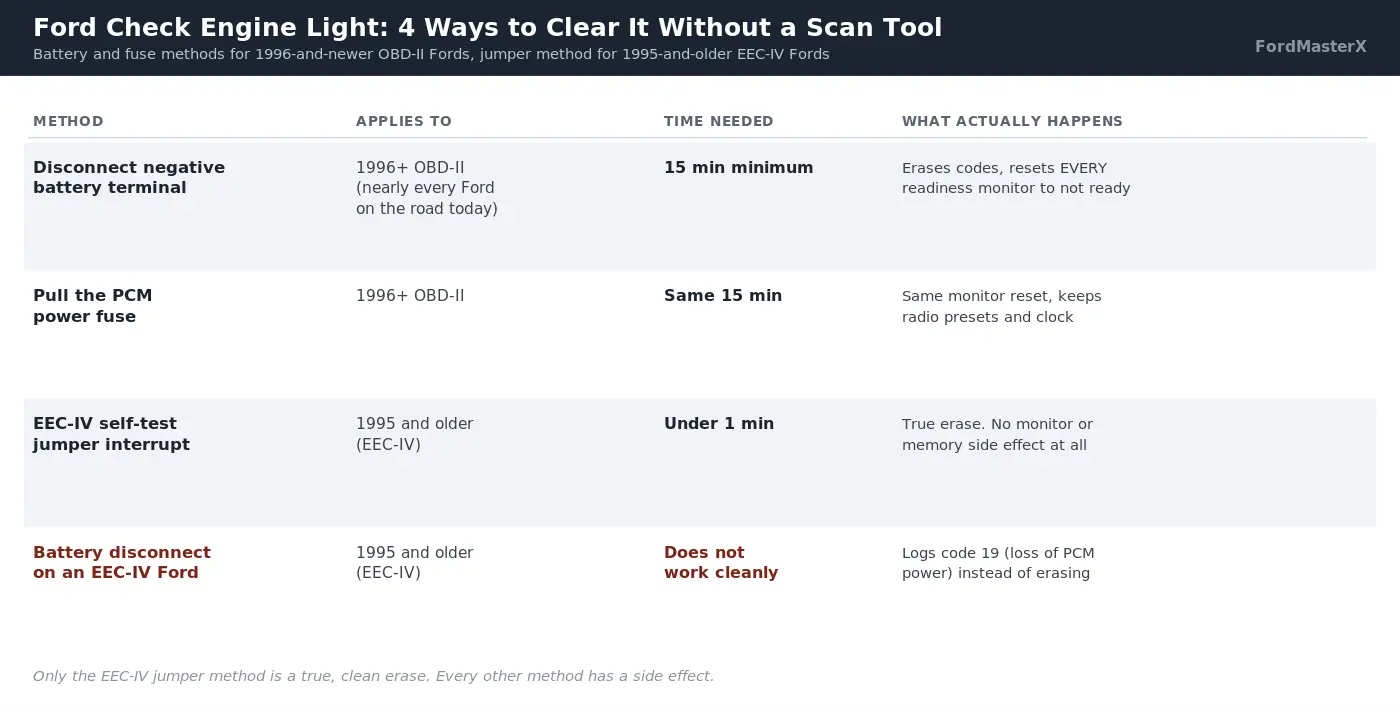
These four methods cover every Ford on the road. They split by the two computer systems Ford has used since the 1980s.
| Method | Applies to | Time needed | What actually happens |
|---|---|---|---|
| Disconnect negative battery terminal | 1996-and-newer OBD-II (nearly every Ford on the road today) | 15 minutes minimum | Erases codes, resets every readiness monitor to not ready |
| Pull the PCM power fuse | 1996-and-newer OBD-II | Same 15 minutes | Same monitor reset, keeps radio presets and the clock |
| EEC-IV self-test jumper interrupt | 1995-and-older EEC-IV | Under 1 minute | True erase, no monitor and no memory side effect |
| Battery disconnect on an EEC-IV Ford | 1995-and-older EEC-IV | Does not work cleanly | Logs code 19 (loss of PCM power) instead of erasing |
Three independent EEC-IV references describe the jumper procedure the same way. Bridge STI to SIG RTN, then interrupt the test mid-code to erase Continuous Memory. All three also warn against disconnecting the battery for this.
Does pulling the PCM fuse work as well as disconnecting the battery?
Yes, for the same 1996-and-newer OBD-II trucks. Both cut power to the PCM’s keep-alive memory, so both erase stored codes.
The fuse method has one real advantage. Your radio presets, clock and seat memory stay set, because the rest of the vehicle’s electrical system never loses power.
A small fuse puller tool makes this easier than fingers alone, and it costs less than one dealer visit.
How do you clear codes on a 1995-or-older Ford without a scan tool?
Pre-1996 Fords use EEC-IV, not OBD-II. The self-test jumper is the only clean way to erase codes on these.
- Set the parking brake, put the transmission in Park, and turn off every electrical load.
- Start the engine, let it reach full operating temperature, then shut it off and wait 10 seconds.
- Find the diagnostic connector and its self-test input (STI) wire or pigtail.
- Confirm the STI and SIG RTN pins with a digital multimeter before you jumper anything.
- Jumper the STI pin to the signal return (SIG RTN) pin on the connector.
- Turn the key to ON without starting the engine.
- Count the flashes against your own engine’s EEC-IV code chart. Two sources checked here describe the pass pattern differently: 11-10-11 in one, 111 in another. Match your own chart rather than memorizing one number.
- To erase Continuous Memory codes, pull the jumper the moment codes begin flashing again.
Do not disconnect the battery to do this instead. It stores code 19 for loss of PCM power. That can cause a rough idle until the PCM relearns its idle and fuel trim values.
Worth knowing: one of the three EEC-IV references checked gives two different numbers for code retention. One section says 20 to 80 restarts, another says 40 warm-up cycles. Treat either as a rough window, not an exact count.
Check engine light symptom to fix guide
Readers usually have a symptom in mind, not a method. This maps the common ones to the right next step.
| What is happening | What to do |
|---|---|
| Light comes back within a day of clearing it | The fault is still present. Clearing codes never fixes anything on its own |
| Light will not turn off at all, even after a battery disconnect | Likely a permanent code (PDTC). It clears only after the repair and a clean monitor run |
| Radio asks for a security code after reconnecting the battery | Normal on models with an anti-theft radio lock. Find your code before you start |
| Rough or uneven idle for the first few drives | Expected after a battery or PCM fuse disconnect. The PCM is relearning idle and fuel trim |
| Failed state inspection right after clearing codes | Readiness monitors reset to not ready. Drive 2 to 3 days of mixed city and highway miles first |
Why does the check engine light come back after you clear it?
Clearing a code never fixes what triggered it. The PCM sets the light again the moment the same fault reappears, sometimes within one drive cycle.
If the light returns fast, stop clearing it and start diagnosing instead. That means reading live PCM data, not just a stored code.
Our OBD2 scanner picks for Ford trucks cover tools that read that live data. Our Ford diagnostic tool comparison covers the step up from a basic scanner.
Will clearing the code make you fail a state emissions inspection?
It can, temporarily. Every readiness monitor resets to “not ready” the moment you clear codes, no matter which method you use.
Texas fails a 2001-or-newer vehicle with two or more not-ready monitors, and allows only one. Vehicles from 1996 to 2000 get a looser allowance of two.
Ohio’s E-Check program expects about 2 to 3 days of mixed city and highway driving before monitors finish resetting. Older vehicles can take longer. Do not clear codes right before an inspection appointment.
Quick reference: Ford check engine light reset by era
The rows readers look up most, in one place.
| Era | Best method | Time | Side effect |
|---|---|---|---|
| 1996-and-newer OBD-II | Disconnect negative battery terminal | 15 min minimum | Resets readiness monitors, loses radio presets and clock |
| 1996-and-newer OBD-II | Pull the PCM power fuse | 15 min minimum | Resets readiness monitors, keeps radio presets and clock |
| 1995-and-older EEC-IV | Self-test jumper, STI to SIG RTN | Under 1 minute | True erase, no side effect |
| Any Ford, any era | Permanent code (PDTC) | Cannot be forced | Clears only after the repair and a clean monitor run |
Not sure which era applies to your Ford? Check your build year against 1996 as the dividing line, 1997 for F-250 and F-350 Super Duty trucks.
Clearing a code buys you a quiet dashboard for a few days at most. Fixing the fault behind it is the only thing that keeps the light off.