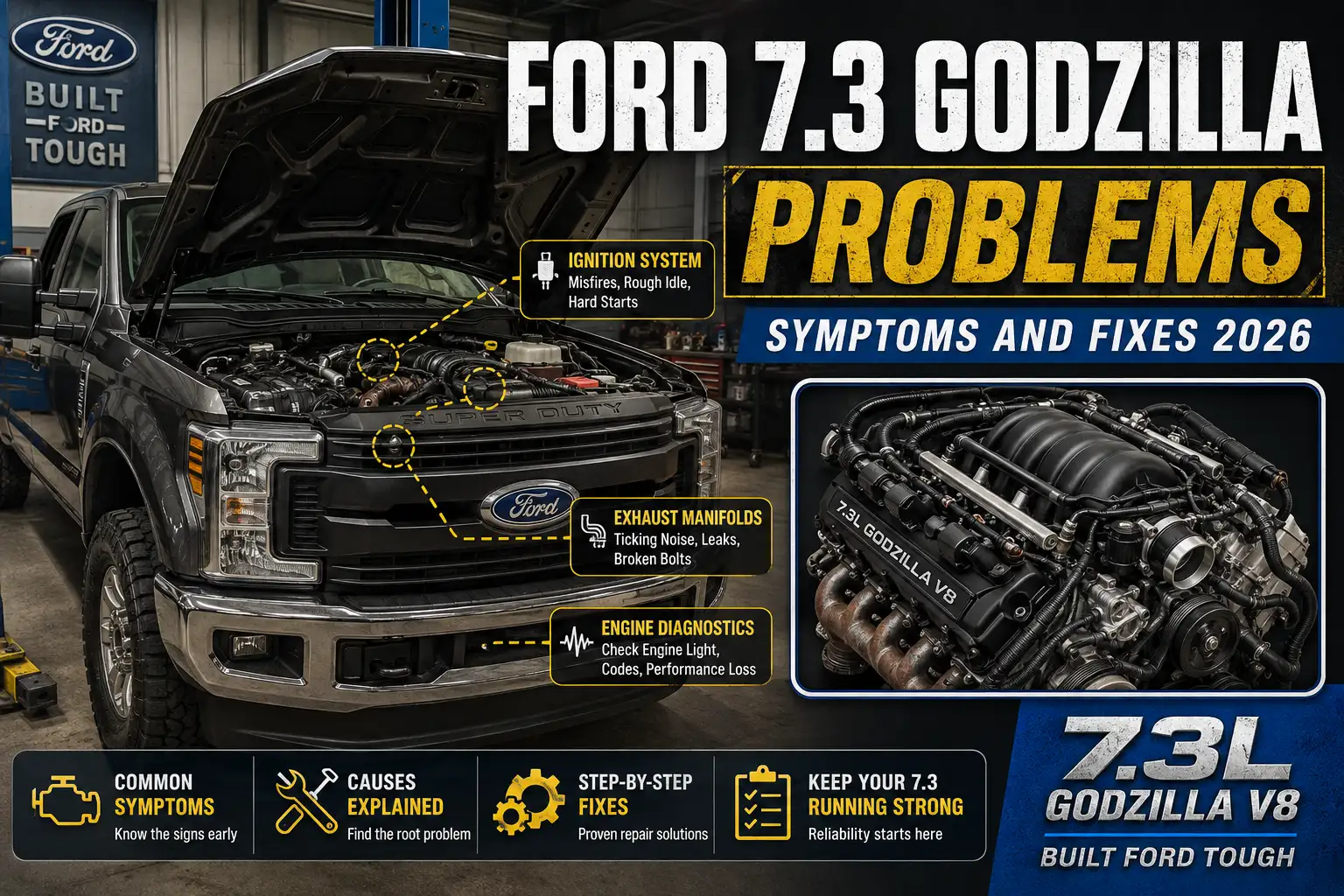
Ford 7.3 Godzilla Problems: Symptoms and Fixes 2026

Ford 7.3 Godzilla problems range from relatively simple ignition faults to documented camshaft and valve-tappet wear that can require major engine work. The most concerning combination is an upper-engine ticking or tapping noise with rough running, a cylinder misfire, or P0301 through P0308 codes.
Ford’s current TSB 25-2572 covers specific 2020 through 2025 vehicles equipped with the 7.3L and directly connects those symptoms with excessive camshaft or valve-tappet wear. Ford also previously issued Customer Satisfaction Program 24B27 for an oil-pump calibration condition associated with prolonged idling.

Prime for Young Adults — 6 Months Free
Students and 18–24s get six months of Prime free, then half price.
Start 6 Months Free As an Amazon Associate I earn from qualifying purchases.
The right diagnosis depends on the symptoms, model year, application, and service history. A misfire without mechanical ticking should not automatically be treated as an internal engine failure.
Use symptoms and scan data to separate a basic ignition misfire from a possible camshaft or valve-tappet problem.
Read Stored Codes
Scan for P0300 and cylinder-specific P0301 through P0308 codes. Save pending codes and freeze-frame data before clearing anything.
Listen at Idle
Check for a persistent upper-engine ticking or tapping noise. Ticking combined with a misfire raises concern for internal valvetrain wear.
Test Ignition Parts
Inspect or swap the spark plug, plug wire, and ignition coil on the affected cylinder. If the misfire moves, follow the ignition fault.
Check Ford Service History
Verify whether applicable PCM calibration work under CSP 24B27 was completed, especially on 2020 through 2024 Super Duty trucks.
Escalate Internal Diagnosis
If ticking and the same-cylinder misfire remain, Ford’s service path moves toward oil-filter inspection and camshaft and tappet evaluation.
Focus on the plug, wire, coil, connector, or related ignition diagnosis rather than assuming internal engine damage.
Camshaft and valve-tappet wear becomes a higher-priority diagnostic path and may require professional internal inspection.

Audible — Listen Free for 30 Days
One free credit a month and thousands of titles included.
Listen Free for 30 Days As an Amazon Associate I earn from qualifying purchases.What 5 Symptoms Point to 7.3 Godzilla Problems
Recommended Best Deal Products

Ford’s own service information gives us five useful warning signs to watch for. The symptoms matter most when they appear together rather than individually.
| Symptom | What It Can Point To | Priority |
|---|---|---|
| Upper-engine ticking or tapping | Camshaft or tappet wear | High |
| P0301 through P0308 | Ignition or internal mechanical problem | High |
| Rough running | Misfire or valvetrain issue | Medium to high |
| Check Engine Light | Stored engine fault requiring diagnosis | Medium |
| Lack of power | Misfire or ignition issue in applicable cases | Medium |
Upper Engine Ticking
A persistent tick or tap from the upper part of the engine at idle deserves attention. Ford TSB 25-2572 specifically starts its diagnostic procedure by asking whether an upper-end ticking or tapping noise is present at idle.
Noise alone does not prove the camshaft has failed. Ford’s procedure requires additional diagnosis before technicians open the engine.
Cylinder Misfire Codes
P0301 through P0308 indicate misfires on individual cylinders. Ford lists those exact codes as possible symptoms in its current 7.3L camshaft and tappet bulletin.
The critical question is whether the misfire follows an ignition component when the spark plug, plug wire, and ignition coil are moved to another cylinder.
Rough Engine Operation
Camshaft or tappet wear can eventually produce rough engine operation because the affected cylinder no longer operates correctly.
Ford’s 24B27 documentation also states that affected engines can progressively run rough because of cylinder misfire after excess cam-lobe and tappet wear develops.
Loss of Power
Loss of power has more than one possible cause.
For example, Ford TSB 20-2370 documented misfire and lack of power on certain 2020 F-53 motorhome chassis because of damaged spark-plug wires. That bulletin does not apply generally to every F-250 or F-350 with the Godzilla engine.
Check Engine Light
Do not start replacing parts based only on a Check Engine Light.
Audible Premium Plus — Annual Membership
12 audiobook credits up front, plus the full Audible catalogue.
See Annual Plans As an Amazon Associate I earn from qualifying purchases.Scan the PCM first. Record stored and pending codes and preserve freeze-frame information if your scanner supports it. A cylinder-specific P030x code gives you a much stronger diagnostic starting point.
If the misfire comes with an upper-engine tick, the internal valvetrain path deserves closer attention.
If Your 7.3 Ticks Check Cam and Tappet Wear
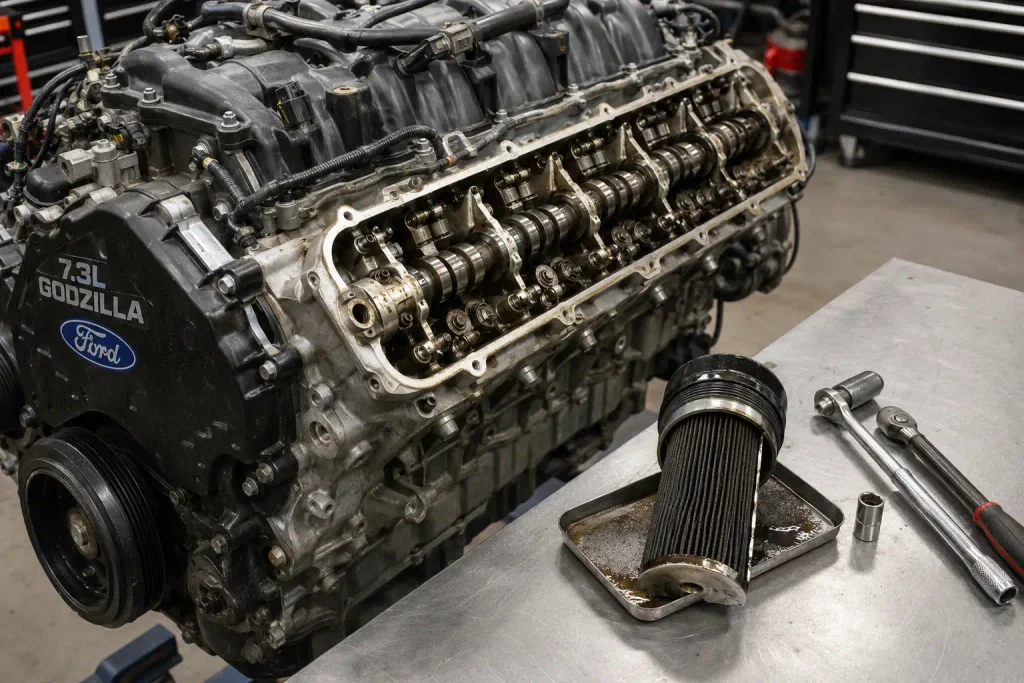
An upper-engine tick combined with a persistent misfire is the most concerning Ford-documented 7.3 Godzilla problem.
Ford issued TSB 25-2572 on November 25, 2025. It superseded TSB 25-2322 and covers the following applications equipped with the 7.3L engine.
| Ford Application | Model Years Covered by TSB 25-2572 |
|---|---|
| F-Super Duty | 2020-2025 |
| F-53 Motorhome and F-59 | 2020-2025 |
| E-Series | 2021-2025 |
| F-650 and F-750 | 2021-2025 |
Ford states that affected trucks may have excessive camshaft and/or valve-tappet wear. Symptoms can include tapping at idle, rough performance, misfire, a malfunction indicator lamp, and P0301 through P0308 codes.
Ford’s diagnostic sequence is much more useful than assuming every tick requires a new engine.
First, the technician confirms the ticking noise. If an active misfire exists, Ford instructs the technician to swap the spark plug, spark-plug wire, and ignition coil with known-good components from another cylinder.
If the misfire moves with those ignition parts, Ford directs the technician back to normal Workshop Manual diagnostics instead of continuing with the camshaft procedure.
If the ignition components pass, Ford then isolates the noisy cylinder, removes and opens the oil filter, and checks for excessive metal debris. Excessive debris leads to a long-block replacement path.
If the oil filter passes inspection, Ford calls for cylinder-head removal and inspection of the camshaft lobes and tappets. When damage is limited to the camshaft or tappets, the bulletin directs replacement of the camshaft and all valve tappets. Collateral engine damage can instead require long-block replacement.
That sequence is why diagnosing the engine before ordering parts matters.
Why Prolonged Idling Can Increase Valvetrain Wear
Prolonged idling deserves special attention on some earlier Godzilla-powered trucks because Ford connected it with a lubrication-related condition.
Customer Satisfaction Program 24B27 addressed the Variable Displacement Oil Pump, or VDOP. Ford reported that the pump could deliver oil at low pressure or capacity during idle conditions on affected vehicles.
Ford stated that routine prolonged idling could lead to reduced lubrication and excess wear on the camshaft lobes and valve-tappet surfaces. As the wear progressed, owners could experience cylinder misfires, rough running, engine tapping, and an illuminated Check Engine Light.
Supplement #1 expanded the program to 2020 through 2024 Super Duty trucks, along with applicable 2021 through 2025 Econoline vehicles. Ford listed a U.S. affected population of 36,289 vehicles across the program’s listed 6.8L and 7.3L applications. This number is the campaign population, not a count of failed 7.3 Godzilla engines.
Ford’s service action was a PCM calibration update rather than an immediate mechanical repair for every affected truck.
The supplement extended the program through July 31, 2025, with no mileage limit during the program period. That date has now passed, so a 2026 owner or used-truck buyer should check the truck’s VIN and Ford service history to see whether 24B27 was completed.
A work truck with substantial idle time deserves a closer inspection for tapping, misfire codes, and documented campaign completion.
If It Misfires Without Ticking Check Ignition First
A 7.3 Godzilla misfire does not automatically mean the camshaft or tappets are damaged.
Ford’s current TSB supports an ignition-first approach. When an active P0301 through P0308 misfire exists, the procedure swaps the plug, plug wire, and coil from the suspect cylinder with known-good components.
If the misfire moves to the other cylinder, Ford tells the technician to stop using the camshaft bulletin and follow normal ignition-system diagnostics.
This creates a useful owner-level decision:
- Misfire with no mechanical ticking: Check normal ignition and fuel-related causes first.
- Misfire that follows a plug, wire, or coil: Repair that ignition fault.
- Misfire that stays on the same cylinder with upper-engine ticking: Internal diagnosis becomes more important.
- Ticking without a confirmed affected cylinder: Do not assume tappet failure. Continue proper diagnosis.
There is also a separate Ford bulletin worth understanding.
TSB 20-2370 covers certain 2020 F-53 motorhome chassis built on or before September 28, 2020. Ford documented P0300, P0316, and P0301 through P0304, plus misfire or lack of power, caused by damaged spark-plug wires.
Ford’s correction included replacing all eight spark-plug wires and modifying the passenger-side engine-compartment air baffle.
That exact repair should not be generalized to every Super Duty because the bulletin’s application is specifically the 2020 F-53.
Which 7.3 Godzilla Years Have the Most Concern
There is no reliable public Ford failure-rate table that proves one Godzilla model year has the highest percentage of failures.
What we can compare accurately is the amount of official Ford documentation covering each year.
| Model Year | Official Documentation | What to Check |
|---|---|---|
| 2020 | 24B27 Super Duty coverage and TSB 25-2572 | Campaign history, ticking, P030x codes |
| 2021 | 24B27 and current TSB coverage | Idle history, PCM update, engine noise |
| 2022 | 24B27 and current TSB coverage | Same checks |
| 2023 | 24B27 and current TSB coverage | PCM calibration and symptoms |
| 2024 | 24B27 and current TSB coverage | PCM campaign completion |
| 2025 | TSB 25-2572 coverage | Ticking, rough operation, misfires |
| 2026 | Not listed in TSB 25-2572 | Normal pre-purchase and maintenance inspection |
The 2020 through 2024 Super Duty years deserve extra attention because those model years were included in the expanded 24B27 campaign, while TSB 25-2572 later provides a diagnostic path through the 2025 model year.
That does not make 2020 or 2021 automatically bad years.
A truck that received the required calibration, has clean maintenance records, little unnecessary idle time, no mechanical tapping, and no persistent misfire is a very different purchase from a neglected fleet truck with unknown idle hours.
For 2026, the engine remains in production, but there is not enough long-term 2026-specific data to make a credible reliability ranking.
How to Diagnose 7.3 Godzilla Problems in 5 Steps
Use this order before assuming your engine needs internal work.
Step 1 Read Stored Codes
Connect a capable scan tool and record all current, pending, and history codes.
Pay particular attention to P0301 through P0308. Do not clear the codes before saving useful diagnostic information.
Step 2 Listen at Idle
Let the engine reach the conditions where the noise occurs.
A distinct upper-engine ticking or tapping noise at idle is the entry condition for Ford’s TSB 25-2572 diagnostic procedure. Without that noise, Ford says the bulletin does not apply and normal diagnostics should be used.
Step 3 Rule Out Ignition Parts
For a cylinder-specific misfire, inspect the plug, wire, ignition coil, connectors, and related components.
Ford’s technician procedure swaps the plug, wire, and coil with another cylinder. If the misfire follows the components, the problem is outside the camshaft bulletin.
Step 4 Check Ford Service History
Check whether CSP 24B27 applied to your VIN and whether the PCM calibration was completed.
This is especially relevant to 2020 through 2024 Super Duty trucks that fall within the campaign’s affected VIN population.
Step 5 Escalate Internal Diagnosis
If the engine continues to tick and the misfire does not follow ignition components, the next Ford diagnostic steps require professional-level testing and potentially engine disassembly.
Ford uses cylinder isolation, oil-filter inspection, cylinder-head removal, and camshaft/tappet inspection before choosing between reassembly, camshaft and tappet replacement, or long-block replacement.
This is the point where most owners should move from driveway diagnosis to a qualified Ford technician or experienced engine shop.
Quick 7.3 Godzilla Problem Decision Matrix
Use the symptom combination to choose your first diagnostic path.
| What You Notice | Check First | Why |
|---|---|---|
| P030x without ticking | Ignition system | Misfire does not prove internal damage |
| P030x plus upper-engine tick | Cam and tappet diagnostic path | Matches Ford TSB symptoms |
| Misfire moves after swapping parts | Plug, wire, or coil | Ford procedure exits the cam TSB path |
| Heavy idle history plus rough running | 24B27 history | Ford linked prolonged idle with reduced lubrication |
| Metal in opened oil filter | Internal engine damage | Ford procedure moves toward long-block replacement |
| Applicable 2020 F-53 P0300 to P0304 | Spark-plug wiring | Covered by TSB 20-2370 |
| Used truck with no symptoms | Records and VIN history | Helps identify prior campaign work |
The biggest mistake is treating a cylinder misfire as proof of lifter failure.
Ford deliberately puts ignition testing ahead of internal engine inspection. That same diagnostic order makes sense for owners.
Is the Ford 7.3 Godzilla Still Reliable
The 7.3 Godzilla has a documented valvetrain issue, but Ford’s service information does not support calling every 7.3L unreliable.
Ford still offers the 7.3L gas V8 in the 2026 Super Duty. Current Ford specifications rate it at 430 hp at 5,500 rpm and 485 lb-ft at 4,000 rpm.
For a used truck, condition matters more than internet reputation.
A stronger used 7.3L candidate has:
- No persistent upper-engine tapping.
- No active P030x misfire.
- Documented oil-change history.
- Completed Ford campaign work where applicable.
- Reasonable engine and idle hours for its use.
- No metallic debris or evidence of previous internal-engine failure.
Inspect further before buying if:
- The truck ticks loudly at idle.
- A cylinder-specific misfire returns after ignition repairs.
- The seller cannot document maintenance.
- It spent years in heavy-idle fleet service.
- 24B27 applied but service history cannot confirm completion.
The 7.3L is widely used in Super Duty trucks because it offers strong gas-engine towing capability. If towing capacity is part of your buying decision, use our Ford F-250 towing capacity chart to match the engine with the correct cab, axle, and trailer configuration.
The available evidence supports a qualified reliability verdict, not a blanket good-or-bad label.
What Maintenance Can Reduce 7.3 Godzilla Risk
Maintenance cannot guarantee that a camshaft or tappet will never wear, but correct oil service and early diagnosis remove avoidable risk.
Ford specifies 8.0 quarts with the oil filter for the 7.3L in the referenced Super Duty owner’s manual. The specified normal oil is SAE 5W-30 meeting Ford WSS-M2C961-A1. Ford lists SAE 0W-30 meeting WSS-M2C963-A1 as an alternative for extremely cold conditions.
For year-specific capacity information, use our Ford 7.3 gas oil capacity and specifications guide before servicing your truck.
Follow these priorities:
- Use the correct oil specification. The viscosity alone is not the complete requirement.
- Follow the Intelligent Oil-Life Monitor. Ford states that actual intervals change according to operating severity.
- Treat extended idling as severe use. Ford’s oil-life guidance shows extended idling can shorten expected oil-change intervals compared with normal highway use.
- Verify 24B27 history on applicable trucks. The factory PCM update and aftermarket performance tuning are not the same thing.
- Investigate new ticking early. A developing mechanical problem is easier to assess before metal contamination spreads through the engine.
- Do not ignore recurring misfire codes. Diagnose the affected cylinder instead of repeatedly clearing the Check Engine Light.
Ford’s current TSB shows why early diagnosis matters. Once excessive metal appears in the oil filter or collateral damage extends beyond the cam and tappets, the repair path can move from valvetrain work to long-block replacement.
What 7.3 Godzilla Owners Should Do Next
The safest way to approach Ford 7.3 Godzilla problems is to diagnose the symptom combination rather than assume every tick or P030x code means a failed engine.
A simple misfire should start with ignition diagnosis. A persistent upper-engine tick combined with a misfire that stays on the same cylinder deserves deeper investigation under Ford’s TSB 25-2572 procedure. Trucks covered by 24B27 also deserve a service-history check, especially if they accumulated substantial idle time.
If you are buying a used 7.3L, scan it for codes, listen carefully at idle, review maintenance and campaign records, and check engine hours. Those checks provide far more useful information than judging the entire engine family from isolated failure stories.
Frequently Asked Questions
Does the Ford 7.3 Godzilla Have Lifter Problems?
Yes, Ford has officially documented excessive camshaft and valve-tappet wear on specified 7.3L applications. TSB 25-2572 covers upper-engine ticking, rough operation, misfire, MIL illumination, and P0301 through P0308 on listed 2020 through 2025 applications.
Ford’s documentation does not provide a percentage showing how many 7.3L engines experience the problem.
What Causes 7.3 Godzilla Ticking at Idle?
One documented cause is excessive camshaft or valve-tappet wear. Ford also connected reduced lubrication during prolonged idle conditions on vehicles affected by CSP 24B27 with excess cam-lobe and tappet wear.
A ticking sound alone is not enough to confirm internal damage.
Which Ford 7.3 Godzilla Years Have Problems?
Ford documentation covers 2020 through 2025 F-Super Duty trucks under TSB 25-2572, while CSP 24B27 included affected 2020 through 2024 Super Duty vehicles.
That coverage identifies vehicles requiring attention. It does not prove every truck in those years develops the problem.
What Is Ford CSP 24B27 for the 7.3 Godzilla?
CSP 24B27 was a PCM software-update program addressing a condition where the Variable Displacement Oil Pump could provide low oil pressure or capacity during idle on affected vehicles. Ford linked repeated prolonged idling under that condition with reduced lubrication and possible camshaft-lobe and tappet wear.
Supplement #1 listed an expiration date of July 31, 2025. Owners should now check VIN-specific service history for completion.
Can Bad Spark Plug Wires Cause a 7.3 Godzilla Misfire?
Yes. Ford TSB 20-2370 documented damaged spark-plug wires causing misfire, lack of power, and P0300, P0316, or P0301 through P0304 on certain 2020 F-53 motorhome chassis.
That bulletin is application-specific and should not be assumed to cover every F-250 or F-350.
Can a 7.3 Godzilla Need a Complete Engine Replacement?
Yes, but Ford does not jump directly from a ticking noise to engine replacement.
Under TSB 25-2572, excessive metal debris in the oil filter can lead to long-block replacement. If the filter passes, technicians inspect the camshaft, tappets, and related engine areas. Damage limited to the cam and tappets can instead be repaired by replacing the camshaft and all tappets.
Is the 7.3 Godzilla a Good Engine to Buy Used?
It can be, provided the individual engine has good maintenance records, no persistent mechanical ticking, no unresolved misfire, and completed Ford service actions where applicable.
For 2020 through 2024 trucks, verify 24B27 history. For 2020 through 2025 applications, be aware of the symptoms covered by TSB 25-2572 before buying.