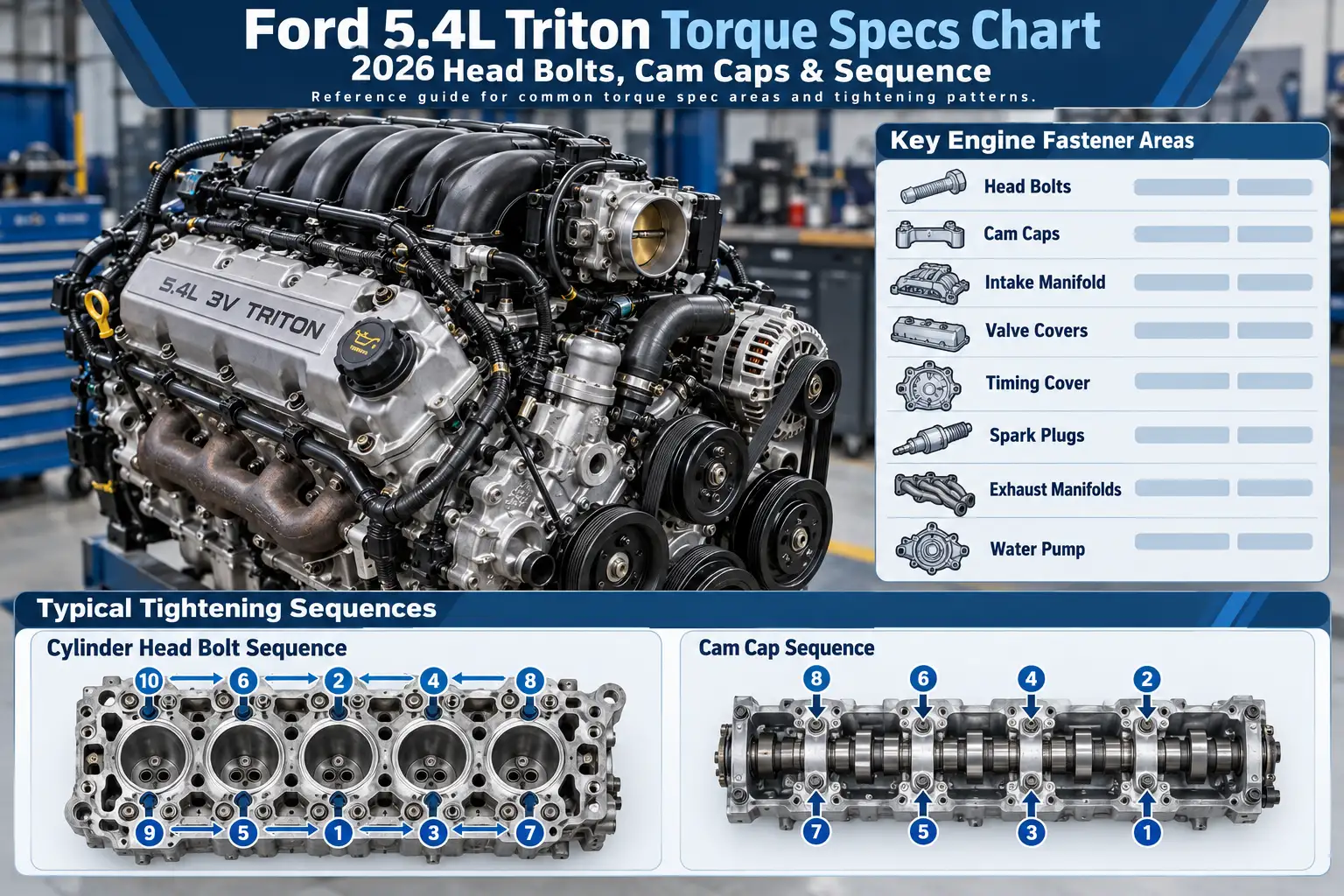
Ford 5.4L Triton Torque Specs Chart: 2026 Head Bolts, Cam Caps & Sequence

Ford 5.4 Triton torque specs depend on whether you have the 2-valve (2V) or 3-valve (3V) V8, the vehicle application, and the fastener being tightened. For example, a documented 2008 5.4L 3V cylinder-head procedure calls for 30 lb-ft followed by two separate 90-degree turns, not 30 lb-ft alone.
Use the application-specific tables below to find confirmed specifications for head bolts, cam phasers, manifolds, spark plugs, and lower-engine fasteners. These values are reference examples from identified Ford service procedures, not blanket specifications for every 5.4L Triton. Match your truck and the exact fastener against the correct Ford Workshop Manual before assembly.
FordMasterX / Quick Reference
Ford 5.4L Triton Torque Stages
Selected 2V and 3V service-procedure examples. Follow each torque and angle stage in the specified bolt order. Values are not universal across all vehicles.
Cylinder Head Bolts
2003 F-150 5.4L 2V and 2008 F-350 5.4L 3V
Use new head bolts. Follow the correct LH/RH head-bolt sequence.
VCT Cam Phaser Bolts
2008 F-350 5.4L 3V application
Use new phaser bolts. The angle is an additional rotation, not another torque setting.
Spark Plug Design Difference
2008 F-150 5.4L 3V. Confirm the actual plug design before installation.
Early Build / Black Boot
25 lb-ft
34 Nm. Original early-design plug.
Late Build / Brown Boot
106 lb-in
12 Nm. Revised plug design.
Before tightening: Verify year, engine, fastener design, new-bolt rules, and the complete Ford Workshop Manual sequence for your exact application.
How to Identify a Ford 5.4L 2V or 3V
Recommended Best Deal Products


The engine version matters more than the 5.4L displacement label. Ford used different versions of this Modular V8 across F-Series trucks, vans, and SUVs, and the changeover did not happen across every model at once.
Identify the 2-Valve Engine
The older 5.4L 2V uses two valves per cylinder and a single overhead camshaft on each bank. A 2003 F-150 5.4L SOHC is a useful example of a factory 2V application. Its service specifications must not automatically be transferred to a later 3V truck.
Identify the 3-Valve Engine
The 5.4L 3V uses three valves per cylinder and variable camshaft timing, including cam phasers. The redesigned 2004 F-150 introduced the 3V, while Ford’s transition across other vehicle lines occurred on different schedules. Do not identify a 2004 truck solely from the year: the older-body F-150 Heritage was also sold that year.
Check the VIN and vehicle build information, engine identification labels, and the applicable workshop-manual engine description. This guide excludes specialized 5.4L 4V and aftermarket-modified applications.
What Are Ford 5.4 Triton Torque Specs by Component
The chart below puts the most useful verified, application-labeled values in one place. A staged entry means you must perform every stage in the factory-prescribed bolt order. Angles are additional rotations, not additional lb-ft readings.
| Component | Verified Engine Application | Tightening Specification | Critical Detail |
|---|---|---|---|
| Cylinder head bolts | 2003 F-150 5.4L 2V SOHC | 40 Nm (30 lb-ft), then +90°, then +90° | New bolts; follow LH/RH sequence |
| Spark plugs | 2003 F-150 5.4L 2V SOHC | 18 Nm (13 lb-ft) | Apply to the specified plug/head design |
| Camshaft bearing cap bolts | 2003 F-150 5.4L 2V SOHC | 10 Nm (89 lb-in) | Preserve cap position and tightening order |
| Intake manifold bolts | 2003 F-150 5.4L 2V SOHC | 2 Nm (18 lb-in), then 25 Nm (18 lb-ft) | Two-stage application-specific procedure |
| Exhaust manifold nuts | 2003 F-250 5.4L 2V SOHC | 25 Nm (18 lb-ft) | Not the stud torque |
| Exhaust manifold studs | 2003 F-250 5.4L 2V SOHC | 12 Nm (9 lb-ft) | Different from the nuts |
| Cylinder head bolts | 2008 F-350 5.4L 3V | 40 Nm (30 lb-ft), then +90°, then +90° | New torque-to-yield bolts |
| Cam phaser sprocket bolts | 2008 F-350 5.4L 3V | 40 Nm (30 lb-ft), then +90° | Replace specified bolts |
| Camshaft bearing cap bolts | 2008 F-350 5.4L 3V | 10 Nm (89 lb-in) | Tighten in the correct sequence |
| Intake manifold bolts | 2008 F-350 5.4L 3V | 2 Nm (18 lb-in), then 10 Nm (89 lb-in) | Not the 2V final torque |
| Exhaust manifold studs | 2008 F-350 5.4L 3V | 12 Nm (9 lb-ft) | New studs specified |
| Exhaust manifold nuts | 2008 F-350 5.4L 3V | 25 Nm (18 lb-ft) | New nuts specified |
| Spark plugs, early build | 2008 F-150 5.4L 3V, black coil boot | 34 Nm (25 lb-ft) | Confirm original plug design |
| Spark plugs, late build | 2008 F-150 5.4L 3V, brown coil boot | 12 Nm (106 lb-in) | Revised plug design |
| Ignition coil hold-down bolts | 2008 F-150 5.4L 3V | 6 Nm (53 lb-in) | Small fastener; use a suitable wrench |
| Valve cover bolts | 2008 F-150 5.4L 3V | 10 Nm (89 lb-in) | Follow cover bolt sequence |
| Main bearing cap vertical fasteners | 2008 F-150 5.4L 3V | 40 Nm (30 lb-ft), then +90° | New fasteners required |
| Main bearing side bolts | 2008 F-150 5.4L 3V | 30 Nm (22 lb-ft), then +90° | New side bolts required |
| Connecting rod bolts | 2008 F-150 5.4L 3V | 43 Nm (32 lb-ft), then +105° | New bolts required |
| Crankshaft pulley bolt | 2008 F-150 5.4L 3V | 90 Nm (66 lb-ft), loosen 360°, 50 Nm (37 lb-ft), then +90° | New bolt; do not skip loosening stage |
How to read this chart: +90° means rotate the fastener an additional quarter-turn after completing the preceding stage. lb-in means inch-pounds, not foot-pounds; 12 lb-in equals 1 lb-ft. The chart does not replace the workshop-manual bolt-position diagrams, holding tools, sealing instructions, or fastener-replacement requirements.
Which Torque Specs Apply to Ford 5.4L 2V Engines
Recommended Best Deal Products

The 2003 F-150 5.4L SOHC 2V service procedure specifies three head-bolt stages: 40 Nm (30 lb-ft), +90°, and +90°, using new cylinder-head bolts. Each bank has its own tightening-order diagram. Do not turn this into a conventional 30/60/85 lb-ft sequence.
That same 2003 application lists 18 Nm (13 lb-ft) for spark plug installation and 10 Nm (89 lb-in) for camshaft bearing cap bolts. The 2V intake manifold procedure uses a light 2 Nm (18 lb-in) first stage followed by 25 Nm (18 lb-ft).
For a 2003 F-250 5.4L 2V, exhaust manifold studs and nuts have separate specifications: 12 Nm (9 lb-ft) for studs and 25 Nm (18 lb-ft) for nuts. This distinction matters because a stud is not tightened as though it were its retaining nut.
You can review the 2003 Ford F-150 5.4L SOHC head installation procedure for the documented head-bolt stages and its bank-specific sequence illustrations. Use the matching vehicle manual if you work on a different 2V application.
Which Torque Specs Apply to Ford 5.4L 3V Engines
The 3-valve engine adds variable camshaft timing, making the phaser retaining bolts especially important. On the 2008 F-350 5.4L 3V, Ford-derived specifications list 40 Nm (30 lb-ft) followed by 90° for the VCT phaser sprocket bolts, with replacement hardware required.
The same 2008 application specifies 40 Nm (30 lb-ft) +90° +90° for new cylinder-head bolts and 10 Nm (89 lb-in) for camshaft bearing cap bolts. Its intake manifold tightening stages are 2 Nm (18 lb-in) and 10 Nm (89 lb-in). That is substantially different from the 2003 2V intake manifold’s second stage.
The 2008 3V exhaust manifold uses 12 Nm (9 lb-ft) for studs and 25 Nm (18 lb-ft) for nuts; the service procedure calls for new hardware. These figures come from the 2008 Ford F-350 5.4L cylinder-head specifications.
If a repair also involves timing-chain removal, inspect the Ford 5.4 timing chain mark and alignment guide for component orientation, but use the matching factory diagrams and prescribed holding tools to set final timing. A torque number by itself cannot establish correct cam-to-crank synchronization.
Why 5.4L Spark Plug Torque Changes by Build Date
Recommended Best Deal Products

Spark plug torque is one of the easiest 5.4L specifications to misapply. The 2008 F-150 5.4L 3V service instructions distinguish early-build and late-build plug designs rather than supplying one universal number.
| 2008 F-150 5.4L 3V Configuration | Documented Installation Torque | Identification Clue |
|---|---|---|
| Early build | 34 Nm (25 lb-ft) | Black ignition-coil boot |
| Late build | 12 Nm (106 lb-in) | Brown ignition-coil boot |
These boot colors are clues from the specific 2008 service instructions, not a universal way to identify every replacement part installed over the engine’s lifetime. Confirm the plug’s physical design, correct replacement part, and vehicle-specific instructions.
The early-style 3V spark plugs can also be difficult to remove. The workshop procedure gives temperature, hand-tool, loosening, and soaking instructions; removal torque is not the installation torque. Avoid treating the torque felt while breaking a plug loose as a target for installing the new one.
The 2008 Ford F-150 5.4L spark plug service procedure documents both build configurations and lists 6 Nm (53 lb-in) for the ignition coil hold-down bolts.
If you are identifying the correct coil before service, use the Ford 5.4 Triton firing order and cylinder layout to find cylinders 1 through 8. Cylinder location and spark plug tightening torque are separate checks.
How to Tighten 5.4L Head and Phaser Bolts
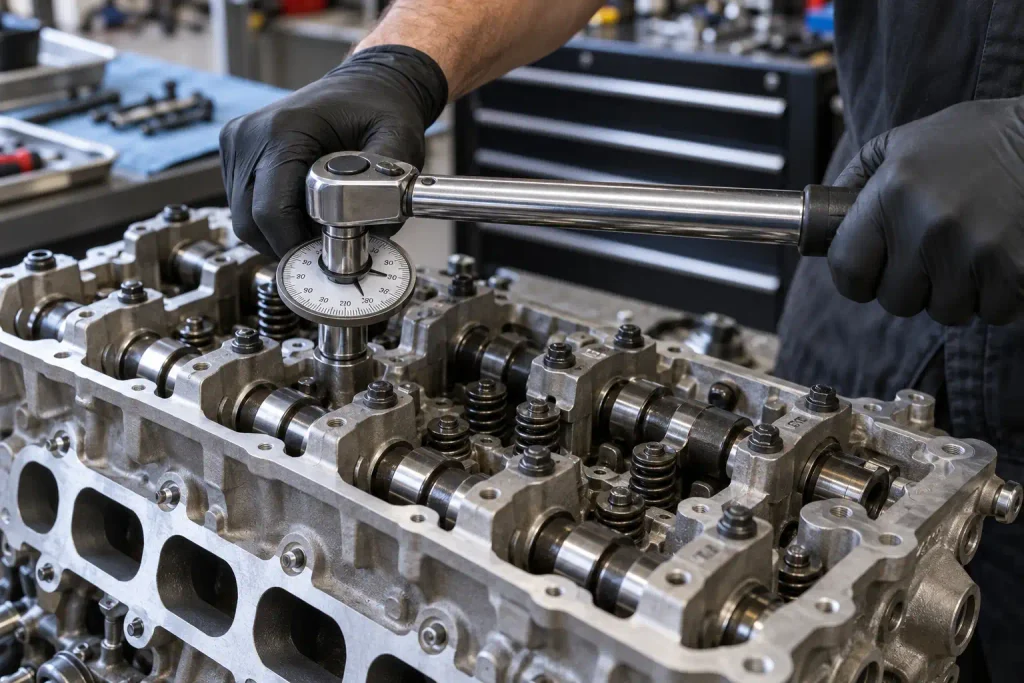
Head bolts and phaser bolts can require an initial torque followed by measured angular rotation. Stopping at the first lb-ft figure leaves the procedure incomplete.
Understand Head Bolt Stages
For the documented 2003 F-150 2V and 2008 F-350 3V applications, the head-bolt procedure uses 40 Nm (30 lb-ft), then an additional 90°, then another 90°. Complete each stage in the correct cylinder-head tightening order for the relevant bank.
Use new head bolts where required. The documented procedures identify them as torque-to-yield hardware, which must not be reused. The workshop manual also specifies how the bolts and gasket surfaces must be prepared. Do not substitute general advice about oil, threadlocker, or anti-seize.
Understand Cam Phaser Bolt Stages
The 2008 F-350 5.4L 3V cam phaser sprocket bolt procedure calls for 40 Nm (30 lb-ft) and then another 90°, with new bolts. A listing that says “cam phaser torque: 30 lb-ft” without the final angle is incomplete for that application.
Correct phaser installation also depends on camshaft holding, chain positioning, and other engine-specific instructions. The bolt is not a substitute for proper timing setup.
Identify Single-Use Fasteners
Single-use fasteners extend beyond cylinder-head and phaser bolts. In the 2008 F-150 5.4L 3V lower engine, the documented main bearing vertical fasteners, main bearing side bolts, connecting rod bolts, and crankshaft pulley bolt are also replaced rather than reused.
The crankshaft pulley procedure is particularly easy to misread: 90 Nm, loosen one full turn, 50 Nm, then an additional 90°. Omitting the loosening stage changes the specified procedure. The 2008 Ford F-150 5.4L cylinder-block specifications list these lower-engine fasteners and staged instructions.
How to Verify 5.4L Torque Specs Before Assembly
A torque wrench cannot compensate for a specification taken from the wrong engine. Follow this four-step check before fastening a cylinder head, timing component, or bearing cap.
- Identify the exact engine. Record the model, year, engine configuration, and relevant vehicle identification. Check whether you have a 2V, 3V, or an excluded 4V application.
- Open the correct workshop procedure. Use Ford service information for your vehicle’s build and engine, not an unsourced universal chart. Read the removal and installation instructions, not just a specifications table.
- Match the fastener and its condition. Confirm whether the procedure applies to a bolt, stud, nut, or a particular bolt size. Check for new-bolt requirements, specified lubrication, sealant, and required special tools.
- Read every unit and stage. Distinguish lb-in from lb-ft, check the prescribed bolt order, and complete each angle stage. Do not make an extra final torque pass unless the workshop procedure specifically calls for one.
If the engine has previously been repaired, confirm that the installed heads, plugs, bolts, and phasers still match the assumed original configuration. After engine work involving the oil system, the Ford 5.4 Triton oil capacity chart provides related refill guidance by engine and application; verify fill amount against the vehicle’s own manual.
5 Common Torque Mistakes on Ford 5.4L Engines
| Mistake | What to Do Instead |
|---|---|
| Using a 2V intake torque on a 3V engine | Match the engine and application before using the value |
| Treating lb-in as lb-ft | Read the unit on the torque wrench and specification |
| Stopping after the initial 30 lb-ft on a phaser or head bolt | Complete the required additional angle stages |
| Reusing torque-to-yield bolts | Install new fasteners when the manual requires replacement |
| Copying a sequence from another year or engine | Follow the correct bank- and model-specific diagram |
A related trap is turning a torque-plus-angle procedure into several progressively higher lb-ft settings. The two approaches are not interchangeable. The final angle is measured with an angle gauge or suitable tool, not guessed by feel.
What to Check Before Tightening Ford 5.4L Bolts
The safest way to use Ford 5.4 Triton torque specs is to start with your engine configuration, then match the vehicle application and exact fastener. The differences are real: a documented 2003 2V intake manifold finishes at 25 Nm, while the referenced 2008 3V intake manifold finishes at 10 Nm. The 2008 3V spark plug specification even changes with the build-related plug design.
For high-consequence work, pay particular attention to new-bolt rules, tightening order, torque-to-yield stages, and the correct measuring units. The tables above provide researched starting points, but they do not reproduce every factory procedure. Before final assembly, confirm the matching Ford Workshop Manual and finish every prescribed stage in order.
5 Frequently Asked Questions About Ford 5.4L Torque Specs
What Are the Ford 5.4 Triton Head Bolt Torque Specs?
A documented 2003 F-150 2V and 2008 F-350 3V procedure both call for 40 Nm (30 lb-ft), then +90°, then +90°. New cylinder-head bolts are required. Use the tightening sequence shown for the correct cylinder bank and engine application.
Are Ford 5.4L 2V and 3V Torque Specs the Same?
No. Some figures match, but others differ substantially. For example, the documented 2003 F-150 2V intake manifold finishes at 25 Nm (18 lb-ft), while the referenced 2008 F-350 3V intake manifold finishes at 10 Nm (89 lb-in).
What Is the Ford 5.4L 3V Cam Phaser Bolt Torque?
The documented 2008 F-350 5.4L 3V procedure calls for 40 Nm (30 lb-ft), then an additional 90°, using a replacement phaser sprocket bolt. Do not stop at the initial 30 lb-ft or assume another application uses the same hardware.
How Tight Should Ford 5.4 Triton Spark Plugs Be?
It depends on the head and plug design. The documented 2003 F-150 2V figure is 18 Nm (13 lb-ft); the 2008 F-150 3V procedure lists 34 Nm (25 lb-ft) for the early design and 12 Nm (106 lb-in) for the late design.
Can You Reuse Ford 5.4 Triton Cylinder Head Bolts?
Not in the 2003 2V and 2008 3V procedures cited here. Those cylinder-head bolts are specified as torque-to-yield and must be replaced. Always inspect the exact vehicle’s service instructions before ordering or installing replacement hardware.