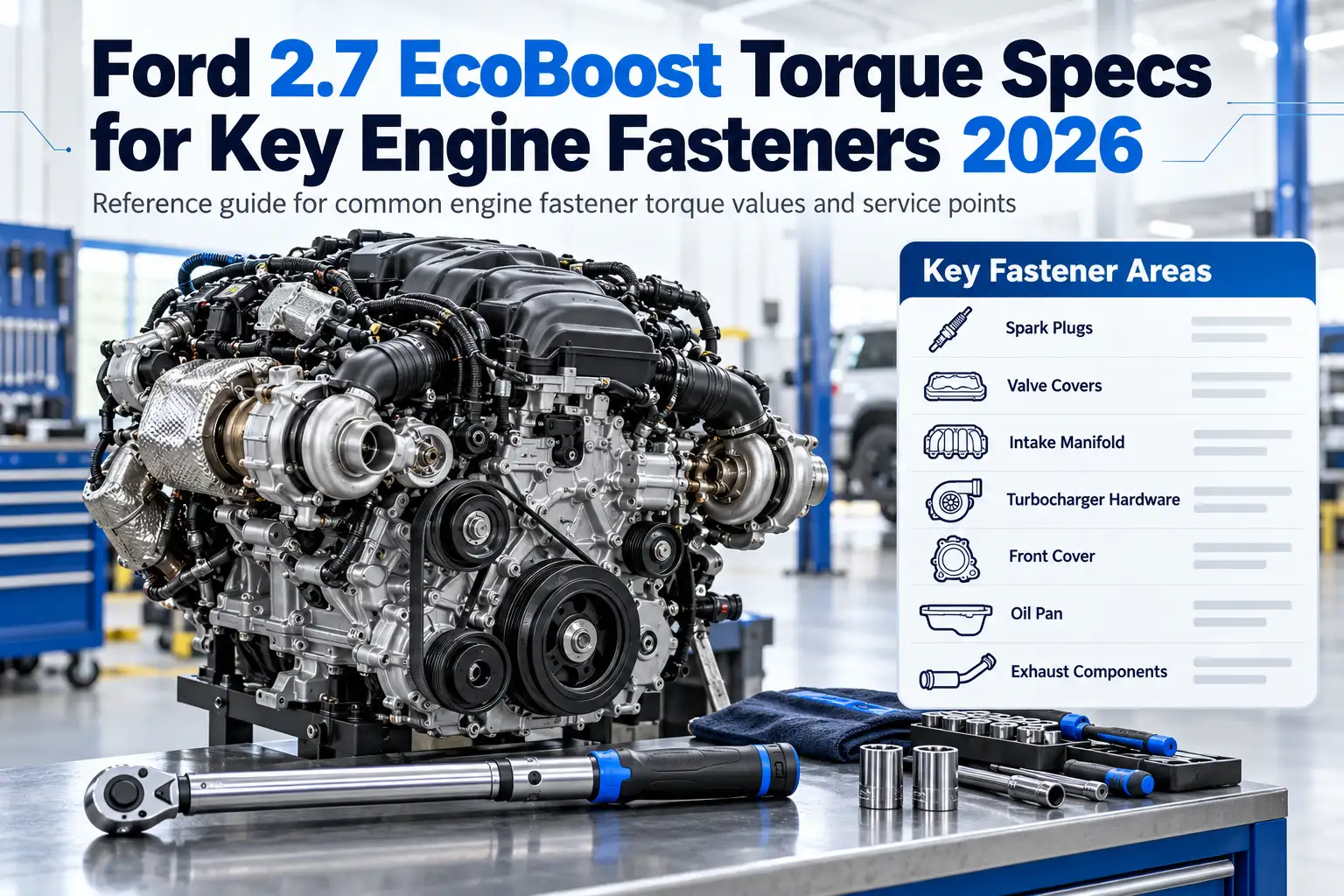
Ford 2.7 EcoBoost Torque Specs for Key Engine Fasteners 2026

Ford 2.7 EcoBoost torque specs depend on the exact fastener, model year, engine application, and repair procedure. There is no single torque value for every 2.7L EcoBoost bolt. Some fasteners require two measured torque passes; others require loosening and additional angle turns.
For example, an engine-builder bulletin specifies 31 in-lb followed by 89 in-lb for a particular 2015–2017 F-150 oil-pan procedure. A different bulletin gives a four-stage sequence for certain 2019–2022 Edge and Lincoln Nautilus cam-timing bolts. Neither procedure is a universal 2.7 EcoBoost setting.

Below are verified figures, applicable models, and components requiring the VIN-matched Ford Workshop Manual.
Torque is a complete procedure, not just a number. Check these five items before using any 2.7L EcoBoost fastener specification.
Identify F-150, Bronco, Edge, or Nautilus. Confirm model year, VIN, and any required build date.
Locate the precise bolt and component. A VCT bolt is not a timing-cover or cam-cap bolt.
Look for updated oil pans, replacement kits, and applicable Ford service bulletins.
Verify torque passes, loosening turns, angle steps, and numbered patterns in the Ford WSM.
Check in-lb versus ft-lb, wrench calibration, special tools, and new-bolt requirements.
All five checks match the current, vehicle-specific Ford Workshop Manual.
Missing a diagram, unclear bolt reuse rule, revised part, or conflicting torque figure? Do not guess.
Which Ford 2.7 EcoBoost Torque Specs Apply
Recommended Best Deal Products


Start with the truck or SUV, not just the engine badge. Ford used the 2.7L twin-turbo V6 in multiple models and revised its hardware over time.
| Application | What You Need to Know | Can You Copy Another Model’s Torques? |
|---|---|---|
| 2015–2017 F-150 2.7L | Early F-150 application; model-specific oil-pan guidance exists | No |
| 2018 and newer F-150 2.7L | Later engine generation and service procedures | No |
| Bronco 2.7L | Different installation and model-specific workshop instructions | No |
| Edge and Lincoln Nautilus 2.7L | AERA documents a 2019–2022 VCT repair procedure | No |
Engine output torque is not bolt torque. An engine’s advertised pound-feet describe crankshaft performance. Fastener torque tells a technician how tightly to install a particular bolt or nut.
For horsepower, displacement, and general performance data, see our Ford 2.7 EcoBoost engine specifications. The figures in that guide must never be used as installation torques.
The safe starting point is the VIN, the actual part being serviced, and the applicable workshop procedure.
What Mechanics Must Check Before Tightening Bolts
Five checks prevent most torque-chart mix-ups before the wrench touches a bolt.
- Identify the application. Record model, model year, engine displacement, and VIN. Check the build date when a bulletin specifies one.
- Name the exact fastener. A VCT unit bolt, camshaft bearing-cap bolt, and front-cover bolt are different fasteners, even when all sit near the timing system.
- Check for revised parts. A later oil pan, replacement cover, or service kit may call for a different installation procedure.
- Read every tightening stage. Look for torque passes, a deliberate loosening step, angle turns, tightening order, thread condition, and replacement requirements.
- Use the right tools and units. Select a calibrated wrench within its working range, plus an angle gauge and any specified holding tool.
Inch-pounds and foot-pounds are not interchangeable. One foot-pound equals 12 inch-pounds. A value printed in in-lb must not be entered as ft-lb on a digital wrench.
Keep the Ford Workshop Manual open. No summary replaces its diagrams and instructions.
How to Verify Critical 2.7L Engine Bolt Torques
Recommended Best Deal Products

The table separates verified torques from specifications requiring a vehicle-specific manual.
| Component | Verified Application | Torque or Tightening Stages | Evidence and Limits |
|---|---|---|---|
| Engine oil-pan bolts | 2015–2017 F-150 2.7L, AERA oil-pan resealing procedure | 31 in-lb, then 89 in-lb | AERA bulletin; follow its numbered bolt pattern. Confirm actual pan revision first. |
| VCT unit bolts | 2019–2022 Ford Edge and Lincoln Nautilus 2.7L | 30 ft-lb; loosen 360°; 37 ft-lb; then tighten 90° | AERA bulletin; new bolts and correct timing tools required. Not a blanket F-150 spec. |
| Crankshaft pulley bolt | 2016–2017 F-150 2.7L, Ford TSB 19-2384, stated build-date population | 225 Nm; loosen 360°; 35 Nm; then tighten 270° | Ford service bulletin; replace bolt and follow applicable WSM. |
| Cylinder-head bolts | Any 2.7L application | Use VIN-specific Ford WSM stages and sequence | A general verified head-bolt chart is not established by these bulletins. |
| Main-bearing and connecting-rod bolts | Engine internal assembly | Use matching engine assembly procedure | Position, bolt type, and reuse rules must be checked in WSM. |
| Valve-cover, intake, turbo, and front-cover fasteners | Various model years | Use component-specific Ford WSM values | Do not transfer nearby bolt values to these components. |
These document-specific examples do not replace current Ford workshop procedures.
Cylinder Head and Rotating Assembly
Cylinder-head bolts cannot be tightened safely from a single internet number. Installation involves an ordered sequence, exact stages, and fastener replacement rules in the relevant factory procedure.
Connecting-rod and main-bearing bolts also require exact factory procedures. Errors can damage critical engine components.
Ford TSB 19-2384 covers a defined group of 2016–2017 F-150 2.7L engines built from April 1, 2016, through January 1, 2017. Its cylinder-head service procedure specifically warns about the crankshaft pulley bolt, which must be replaced.
For that bulletin’s repair, Ford specifies:
- Hold the pulley using tool OTC 4754 or equivalent.
- Tighten the new crankshaft pulley bolt to 225 Nm, or 166 lb-ft.
- Loosen the bolt 360 degrees.
- Tighten to 35 Nm, or 26 lb-ft.
- Turn the bolt an additional 270 degrees.
These stages are recorded in Ford Technical Service Bulletin 19-2384. The bulletin warns that incorrect torque can loosen the pulley bolt and damage the timing gear and engine.
Do not apply this build-date-specific bulletin blindly to every 2.7L F-150 or Bronco. Check Section 303-01 of the workshop manual for your vehicle first.
Oil Pan and Valve Cover
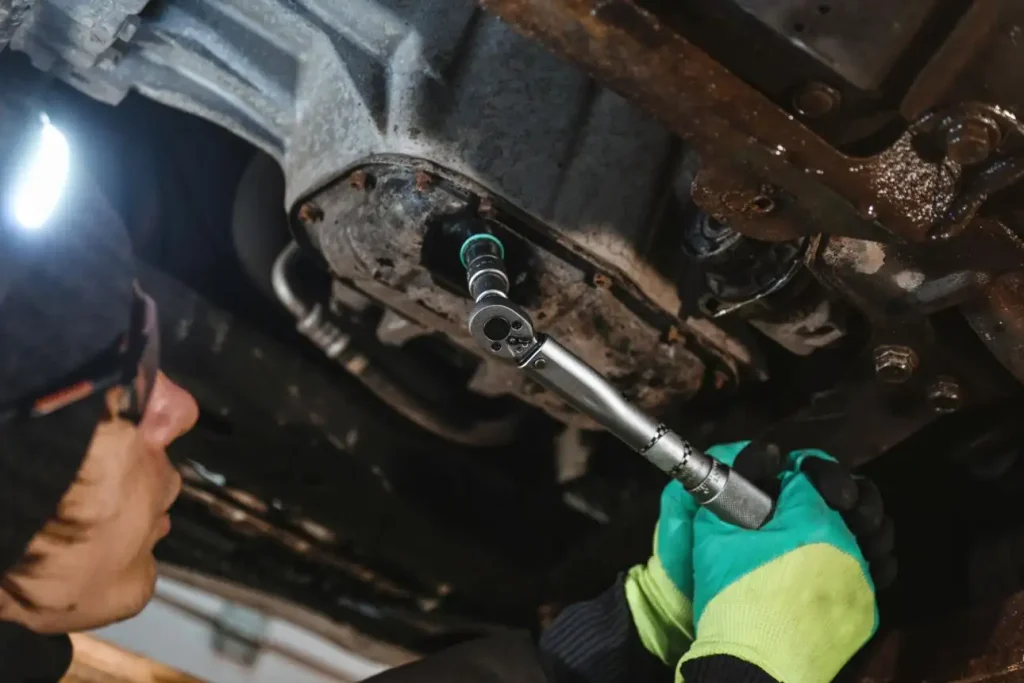
AERA’s bulletin for 2015–2017 Ford F-150 trucks with the 2.7L EcoBoost gives a two-pass oil-pan bolt procedure:
- Stage 1: 31 in-lb.
- Stage 2: 89 in-lb.
- Order: Follow the numbered Figure 2 bolt sequence, rather than tightening around the pan at random.
The AERA Engine Oil Pan Leak bulletin also identifies sealing details. It calls for a 4.5 mm RTV bead along the specified pan surface, 9 mm at designated cover joints, and installation and bolt tightening within 5–10 minutes of applying sealant.
Use the correct sealant and preparation method for the exact repair. The AERA instructions warn against metal scrapers on the mating flanges.
Valve-cover bolts do not automatically use the oil-pan setting. Locate the left- or right-hand valve-cover installation procedure in the WSM and follow the correct bolt pattern and gasket instructions.
If the oil pan has been updated, verify the replacement procedure before carrying over these numbers.
VCT and Timing Components
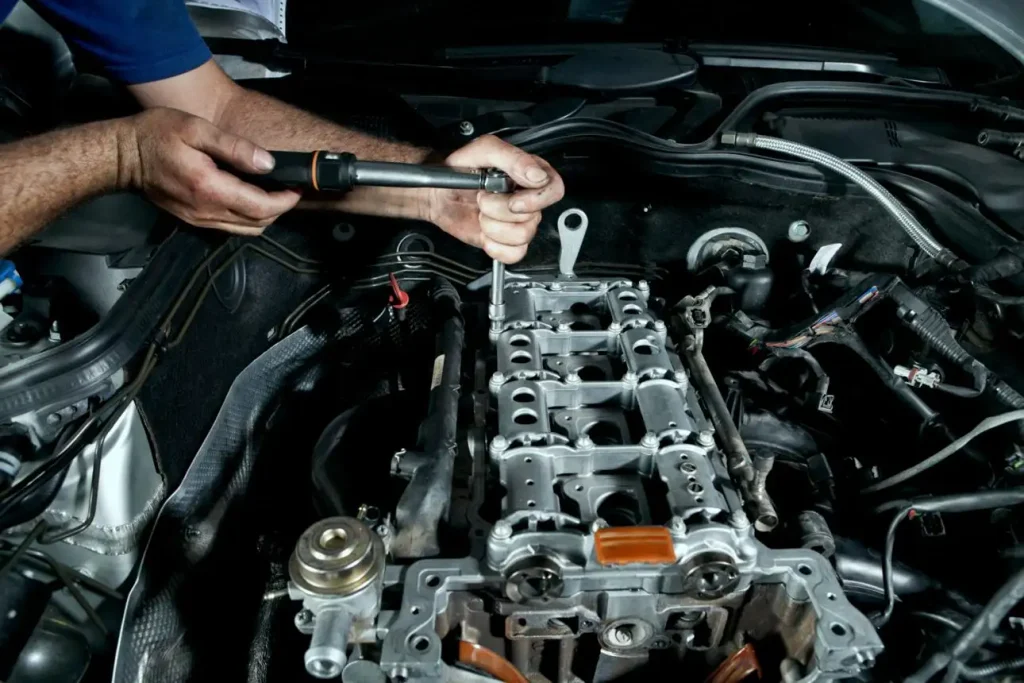
Variable cam timing, or VCT, controls camshaft timing. Its unit bolts are not interchangeable with timing-cover, chain-guide, or camshaft-cap bolts.
An AERA bulletin addresses cold-start ticking, tapping, or rattling on 2019–2022 Ford Edge and Lincoln Nautilus models equipped with the 2.7L EcoBoost. It lists four replacement VCT units and four new unit bolts, part number CP9Z-6279-C.
The bulletin specifies these stages for the VCT unit bolts:
- Tighten to 30 ft-lb.
- Loosen 360 degrees.
- Tighten to 37 ft-lb.
- Tighten an additional 90 degrees.
It also requires camshaft holding tool 303-1248 and different timing-mark references for the left- and right-hand assemblies. See the diagrams in the AERA 2019–2022 VCT service bulletin before positioning either side.
This bulletin does not establish the F-150 or Bronco VCT torque procedure. Those models need their own workshop instructions, including timing verification before startup.
Intake and Turbocharger Fasteners
Intake-manifold bolts, turbocharger mounting fasteners, oil-line connections, and exhaust-side hardware must be identified individually. No defensible single torque covers all of them.
The same caution applies to spark plugs, fuel-system fittings, throttle-body bolts, and sensor fasteners. Their materials, seals, and mounting locations differ.
Use the matching Ford removal-and-installation instructions, including seal and bolt replacement notes.
When You Must Not Use These Torque Values
A verified number becomes an incorrect number when the application changes.
Do not use the table above if any of these conditions apply:
- Your truck’s model year or engine version is outside the bulletin’s stated coverage.
- You cannot identify whether the fastener is original or part of a service-kit revision.
- The procedure requires a numbered bolt order, but you do not have the diagram.
- You have an old bolt where Ford requires a new one.
- A workshop instruction disagrees with an internet chart, or the correct units are uncertain.
- You are tightening wheels, suspension parts, brakes, or towing hardware rather than the specific engine component named.
Wheel lug nuts and other truck fasteners belong in a different reference. Use our general Ford F-150 torque specifications as a starting point for those categories, then confirm the value in your model-year owner or workshop manual.
Stop and identify the correct procedure before proceeding with an unknown fastener.
5 Torque Mistakes That Damage Ford EcoBoost Engines
Recommended Best Deal Products


1. Reading in-lb as ft-lb. The early F-150 oil-pan bulletin is written in inch-pounds. Selecting foot-pounds multiplies the intended torque by 12 and risks damaged threads or pan hardware.
2. Skipping the loosening stage. Both the cited VCT procedure and the crankshaft pulley procedure include a full 360-degree loosening stage. It is part of the prescribed installation, not an optional correction.
3. Reusing a replacement-only bolt. Ford’s pulley bulletin calls for a new bolt. AERA’s VCT repair also specifies new VCT unit bolts. Check every fastener’s replacement rule before assembly.
4. Guessing the bolt pattern. The oil-pan procedure includes a 17-position tightening diagram. An unverified perimeter pattern is not a substitute for that numbered drawing.
5. Copying another EcoBoost engine’s procedure. Ford’s 3.5L cam-timing design and service steps are not a 2.7L torque reference. Our 3.5 EcoBoost cam phaser replacement procedures cover that separate engine, not an interchangeable set of 2.7L values.
The fix is simple in principle: match the engine, part, procedure, and replacement hardware before setting the wrench.
How Revised Oil Pans Change Early F-150 Repairs
An oil leak on a 2015–2017 F-150 2.7L may require more than resealing the original pan. Ford issued TSB 23-2083, dated March 17, 2023, for oil leaks at the oil-pan RTV seal.
Ford directs qualifying trucks to a later-style replacement oil pan, listed as JT4Z-6675-E. It also requires inspection of the valve-cover design. Depending on the result, the technician may need new left and right valve covers to maintain the correct internal PCV arrangement.
The repair is unusually specific: Ford instructs technicians to combine portions of the 2015–2017 and 2018 F-150 Workshop Manual procedures in Section 303-01A. The official Ford oil-pan TSB 23-2083 gives the step references and parts list.
That is why the earlier AERA oil-pan figure must not be treated as automatic guidance for every replacement pan. Check the current service-kit instruction first.
For related service patterns, see common 2.7 EcoBoost problems and service bulletins.
When to Consult a Ford Engine Technician
Consult a Ford-qualified technician for cylinder-head, crankshaft pulley, timing, VCT, or internal engine work when the required tools or instructions are unavailable.
Also stop if a replacement part differs from the original, a required bolt sequence is missing, or the tightening stages appear contradictory.
Ford states that its bulletins are for trained technicians, not stand-alone DIY instructions.
A qualified shop can identify the VIN-specific WSM page, replacement bolts, and tightening stages.
Which Sources Verify These Engine Torque Procedures
Application-specific service documents provide the most reliable evidence.
| Document | Publication | What It Establishes |
|---|---|---|
| AERA Engine Oil Pan Leak on 2015–2017 Ford F-150 | AERA, 2024 | Oil-pan resealing torque passes, sealing notes, and numbered sequence |
| AERA Cold Start Ticking on 2019–2022 Ford and Lincoln 2.7L | AERA, 2023 | New VCT unit bolts, four torque stages, and timing-tool requirements |
| Ford TSB 19-2384 | Ford, December 2019 | Crankshaft pulley four-stage tightening during the specified 2016–2017 F-150 repair |
| Ford TSB 23-2083 | Ford, March 2023 | Revised early F-150 oil-pan and possible valve-cover replacement procedures |
For head bolts, connecting rods, main bearings, intake fasteners, valve covers, and other unlisted components, use the current Ford Workshop Manual for the specific VIN and repair. These four documents do not establish a universal numerical specification for those parts.
A bulletin neither replaces the workshop manual nor proves every vehicle has the defect.
What to Check Before Your Next Engine Repair
The safest way to use Ford 2.7 EcoBoost torque specs is to match the exact fastener to a model-year-specific procedure. Start by confirming the VIN, the installed hardware, and whether Ford has revised the service part or bulletin.
Three figures are firmly documented here: the early F-150 oil-pan tightening stages, the Edge/Nautilus VCT unit bolt stages, and the crankshaft pulley sequence in a narrowly defined F-150 service bulletin. None is a blanket setting for all 2.7L engines.
If your component is not covered by a verified source, get its Ford Workshop Manual procedure before installing the fastener. Sequence, angle, hardware condition, and timing matter too.
5 Common Ford 2.7 EcoBoost Torque Questions
What Is the Ford 2.7 EcoBoost Head Bolt Torque Sequence?
The cylinder-head sequence must come from the Ford Workshop Manual for your exact model year and engine application. The bulletins cited here do not provide one verified head-bolt stage chart that safely covers every 2.7L EcoBoost.
What Are 2.7 EcoBoost Oil Pan Bolt Torque Specs?
AERA documents 31 in-lb followed by 89 in-lb for its 2015–2017 F-150 2.7L oil-pan resealing procedure, with a numbered tightening order. If the pan has been replaced with a later revision, check Ford’s updated service procedure instead of assuming the original sequence applies.
Does the 2.7 EcoBoost Intake Manifold Use One Torque Value?
Do not assume so. Identify the exact intake component, fastener, engine version, and service procedure, then use the matching Ford Workshop Manual values and any required sequence.
Are 2015 and 2023 Ford 2.7 EcoBoost Torque Specs Identical?
No universal match can be assumed between those model years. They can involve different engine generations, vehicle installations, component revisions, and tightening procedures, so use the manual for the vehicle being repaired.
Can I Reuse 2.7 EcoBoost Torque to Yield Bolts?
Not when the applicable service instruction calls for replacement. The cited Ford crankshaft pulley repair requires a new bolt, and the AERA VCT procedure specifies new unit bolts. Check the replacement rule for each other fastener rather than assuming every angle-tightened bolt has the same policy.