7.3 Powerstroke IPR Sensor Failure: Symptoms & Diagnosis

The most common 7.3 Powerstroke IPR failure symptom is a no-start or hard-start condition when the engine is hot, as thinning oil leaks past worn internal seals. Other red flags include sudden stalling at idle and an erratic, surging engine speed caused by poor high-pressure oil regulation.
🎯 Key Takeaways
Recommended Best Deal Products

- A warm engine no-start usually signals internal IPR seal failure.
- Sudden stalling when braking often indicates a sticking IPR valve.
- Always check the ‘tin nut’ on the solenoid before replacing parts.
- Erratic or surging idle reflects inconsistent high-pressure oil regulation.
- Oil inside the electrical connector confirms an internal sensor leak.
If your 7.3 Powerstroke is stalling at stoplights or refusing to restart after a long drive, the Injection Pressure Regulator (IPR) valve is likely the culprit. This small but critical component manages the high-pressure oil that fires your fuel injectors. If it fails to maintain at least 500 PSI during cranking, your engine simply will not start. Understanding these symptoms early prevents you from getting stranded or unnecessarily replacing an expensive High-Pressure Oil Pump (HPOP).

Prime for Young Adults — 6 Months Free
Students and 18–24s get six months of Prime free, then half price.
Start 6 Months Free As an Amazon Associate I earn from qualifying purchases.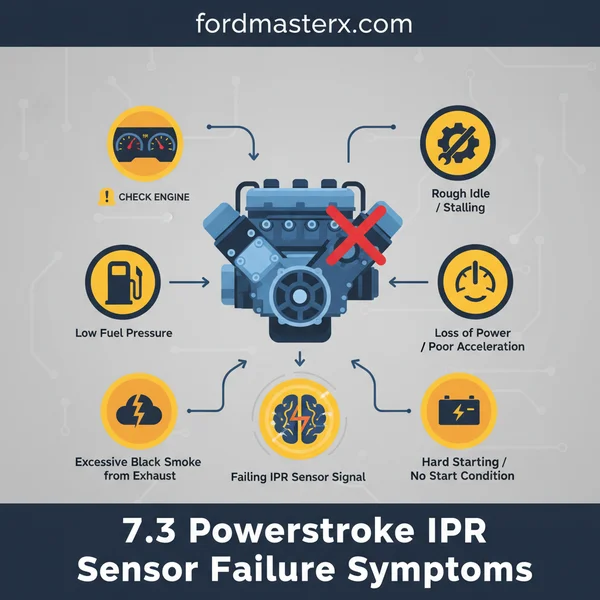
Identifying IPR failure is about recognizing patterns in how your truck responds to heat and load. Because the 7.3 is a HEUI (Hydraulic Electronic Unit Injector) system, it relies entirely on oil pressure to function. When the IPR valve malfunctions, it loses control over that pressure. This leads to unpredictable engine behavior that often mimics fuel starvation or electrical shorts. Pinpointing the IPR as the source of your trouble requires looking at three specific mechanical signs.
Core Symptoms of 7.3 Powerstroke IPR Valve Failure
The IPR valve is essentially a pulse-width modulated solenoid. It opens and closes rapidly to bypass oil back to the crankcase or send it to the injectors. When it fails, it usually does so in one of three ways: it sticks mechanically, the solenoid coil fails electrically, or the O-rings perish. These issues manifest in very specific ways during operation.
📤 Share
💾 Download
No-Start or Hard-Start When the Engine is Hot
This is the most common indicator of a failing IPR. You might notice the truck starts perfectly fine in the morning when the oil is thick and cold. However, after driving for 30 minutes and reaching operating temperature, the truck may crank indefinitely without firing after you shut it off. This happens because hot oil is thinner than cold oil. If the IPR internal seals or external O-rings are worn, the valve cannot command enough pressure to meet the high-pressure oil threshold required to trigger the injectors.
- The 500 PSI Rule: Your 7.3 needs a minimum of 500 PSI of injection control pressure (ICP) to start. A leaky IPR prevents the system from building this pressure when the oil is hot.
- The “Cool Down” Test: If your truck starts again after sitting for two hours or after pouring cool water over the IPR area, you are dealing with a heat-soaked IPR valve.
Sudden Stalling and Erratic Idle
Does your truck die the moment you let off the throttle to coast or come to a stop? This is often caused by an IPR valve that is sticking in the open position. When you decelerate, the PCM (Powertrain Control Module) commands the IPR to reduce pressure. If the valve sticks open too far or fails to react quickly enough, the pressure drops below the stall threshold, and the engine cuts out immediately. You may also experience a “searching” idle where the RPMs bounce up and down as the IPR struggles to find a steady pressure setting.
- Surging: You may feel the truck “lunge” slightly while holding a steady speed. This is the IPR failing to maintain a consistent duty cycle.
- Stoplight Stalling: If the truck dies as you slow down but starts back up immediately, the IPR is likely sticking mechanically.
How to Diagnose 7.3 Powerstroke IPR Failure Like a Pro: A Practical Walkthrough
The Injection Pressure Regulator (IPR) is arguably the most critical component in the 7.3L Powerstroke’s HEUI (Hydraulic Electronic Unit Injection) system. It is responsible for controlling the high-pressure oil that fires your injectors. When this valve fails, your truck may refuse to start, stall unexpectedly, or run like a box of rocks. This guide walks you through the systematic process of identifying failure symptoms, differentiating them from other common 7.3 issues, and verifying if your IPR valve or its solenoid has reached the end of its life. Following these steps ensures you don’t spend hundreds of dollars on parts you don’t actually need.
Step 1: Identifying “No-Start” or “Hard-Start” Conditions
What you need: A fully charged set of batteries and a basic OBD-II scan tool capable of reading Live Data (such as Forscan or an Edge Monitor).
Instructions: One of the primary symptoms of a failing IPR is a truck that cranks vigorously but refuses to fire. The 7.3L engine requires at least 500 PSI of injection control pressure (ICP) to start. If the IPR valve is stuck open or leaking internally, the High-Pressure Oil Pump (HPOP) cannot build the necessary pressure. Monitor your “ICP” and “IPR Duty Cycle” while cranking. If the IPR duty cycle climbs to 65% (the maximum) but the ICP stays below 500 PSI, the IPR is likely stuck open, venting oil back into the crankcase instead of sending it to the injectors. This symptom is often more pronounced when the oil is hot and thin.
Pro Tip: Before blaming the IPR for a no-start, check your engine oil level. Since the injectors fire using oil, being two quarts low can cause the exact same symptom as a total IPR failure.
Step 2: Recognizing Stalling at Operating Temperature
What you need: An infrared thermometer or simply your hand (carefully) to gauge engine heat.

Audible — Listen Free for 30 Days
One free credit a month and thousands of titles included.
Listen Free for 30 Days As an Amazon Associate I earn from qualifying purchases.Instructions: A classic failure mode for the IPR solenoid is “heat soaking.” The solenoid is an electromagnetic coil that slides over the IPR valve. As these age, the internal wiring expands with heat, causing an internal short or an open circuit once the engine reaches operating temperature. If your truck runs perfectly for 20 minutes and then suddenly dies as if the key was turned off—and won’t restart until it cools down—the IPR solenoid is the prime suspect. Pay attention to whether the stalling occurs under load or while idling at a stoplight; heat-related IPR failure usually happens regardless of the driving condition once the thermal threshold is met.
Pro Tip: If the truck stalls when hot, try pouring a bottle of room-temperature water over the IPR valve located behind the HPOP. If the truck starts immediately after cooling the valve, the solenoid is definitely failing.
Step 3: Observing Erratic or Rough Idle Symptoms
What you need: A keen ear and a scan tool to monitor IPR Duty Cycle percentage.
Instructions: A healthy 7.3L Powerstroke should have an IPR duty cycle between 8% and 14% at a warm idle. If you notice your idle surging, “loping,” or feeling particularly choppy, check the live data. If the duty cycle is jumping wildly (e.g., bouncing from 10% to 30% and back) while the engine is at a steady idle, the IPR is struggling to maintain consistent pressure. This often happens because the internal needle and seat of the valve are worn or contaminated with debris, causing the PCM to over-compensate constantly. This “hunting” for the right pressure results in an unstable RPM and a truck that feels like it wants to lunge forward at stoplights.
Pro Tip: Rough idle can also be caused by the ICP sensor. To isolate the IPR, unplug the ICP sensor. If the idle smoothes out, the sensor was the problem; if the rough idle persists, the IPR valve is the culprit.
Step 4: Checking for the Infamous “Tin Nut” Issue
What you need: A flashlight and a 3/4-inch (or 19mm) wrench.
Instructions: The IPR solenoid is held onto the valve stem by a thin, stamped steel nut often called the “tin nut.” Over years of engine vibration, this nut can back off and fall into the engine valley. When this happens, the solenoid is free to slide back and forth on the shaft. This leads to erratic signals and sudden engine stalling because the magnetic field is no longer properly aligned with the valve. Reach down behind the High-Pressure Oil Pump (located in the front “V” of the engine) and feel the back of the IPR. If the solenoid feels loose or wobbly, or if the nut is missing entirely, you have found your problem. This is a common “symptom” that isn’t a part failure, but a mechanical loosening.
Pro Tip: If the nut is missing, you don’t necessarily need a new IPR. You can buy just the nut or use a small amount of blue Loctite on a replacement to ensure it never vibrates off again.
Step 5: Inspecting for Oil in the Electrical Connector
What you need: A small flathead screwdriver and a clean rag.
Instructions: While the IPR doesn’t “leak” oil through the pins as often as the ICP sensor does, the O-rings on the IPR body can fail, or the solenoid casing can crack. Disconnect the two-pin electrical connector leading to the IPR. Look closely for signs of engine oil inside the plastic housing or on the wiring harness pins. Oil is an insulator and can interfere with the pulse-width modulated (PWM) signal sent by the PCM. If the connector is soaked in oil, the IPR’s internal seals have likely failed, allowing high-pressure oil to bypass the valve. This leads to a loss of pressure and “ghost” symptoms that feel like a fuel delivery issue but are actually electrical interference.
Audible Premium Plus — Annual Membership
12 audiobook credits up front, plus the full Audible catalogue.
See Annual Plans As an Amazon Associate I earn from qualifying purchases.Pro Tip: If you find oil in the connector, cleaning it with electronic cleaner is only a temporary fix. The presence of oil indicates the structural integrity of the valve or its seals is compromised.
Step 6: Analyzing Smoke and Power Loss
What you need: A clear stretch of road and your rearview mirror.
Instructions: IPR failure doesn’t always result in a dead engine; sometimes it manifests as a significant loss of power and excessive smoke. If the IPR is unable to close fully, the injection pressure will be lower than what the PCM is requesting. This results in poor fuel atomization. Look for white or light blue smoke during acceleration, accompanied by a “flat” feeling in the pedal. Because the injectors aren’t getting the pressure needed to “snap” shut, fuel is dribbled into the cylinder rather than sprayed. This mimics the symptoms of a dying HPOP or worn injectors, but checking the IPR’s ability to maintain pressure under load is the first diagnostic step.
Pro Tip: Use your scan tool to perform a “High Pressure Build Test.” If the IPR cannot maintain 2,500+ PSI under wide-open throttle (WOT), the valve is likely bypassing oil internally.
Step 7: Testing Solenoid Resistance (Ohm Test)
What you need: A digital multimeter set to the Ohms (Ω) setting.
Instructions: If you suspect the IPR failure is electrical, you can test the solenoid coil directly. Disconnect the harness from the IPR. Place your multimeter leads on the two pins of the IPR solenoid. A healthy solenoid should show a resistance reading between 10 and 20 Ohms. If the meter shows “OL” (Open Loop) or 0.00 (Short), the solenoid is dead and must be replaced. It is important to perform this test when the engine is hot, as many 7.3 IPR solenoids will test fine when cold but show an open circuit once they reach operating temperature (the “heat soak” failure mentioned in Step 2).
Pro Tip: You can replace just the solenoid (the gold/black cylinder) without removing the entire valve from the HPOP, which saves you from draining the oil reservoir.
Step 8: Scanning for Diagnostic Trouble Codes (DTCs)
What you need: An OBD-II scanner capable of reading Ford-specific manufacturer codes.
Instructions: Finally, check the computer for stored codes. While a failing IPR doesn’t always trigger a Check Engine Light (CEL), it usually leaves a “soft code” in the memory. Look specifically for P1211 or P1280. P1211 means “Injection Control Pressure Higher/Lower Than Desired,” which is the hallmark code for an IPR that cannot accurately control the oil flow. P1280 relates to the ICP sensor, but often these two systems “fight” each other, and an IPR failure will trigger ICP codes because the sensor is reporting the pressure fluctuations caused by the failing regulator. If you see P1211 and the truck is stalling, the IPR is almost certainly the culprit.
Pro Tip: Always clear the codes after your diagnosis, then drive the truck to see which specific code returns first to avoid chasing “phantom” codes from years ago.
✅ Final Checklist
- Verified that engine oil level is full and the oil is relatively clean.
- Confirmed “Tin Nut” is present and the solenoid is tight on the IPR shaft.
- Monitored IPR Duty Cycle at idle (should be 8% to 14%) and during cranking (minimum 500 PSI).
- Performed a “Hot Start” test to rule out thermal failure of the solenoid coil.
- Inspected the wiring harness for chaffing, which is common near the fuel bowl.
Important Notes:
- Safety Warning: The HEUI system operates at pressures up to 3,000 PSI. Never attempt to remove the IPR valve while the engine is running or while the system is pressurized.
- When to Seek Help: If you replace the IPR and still have low pressure, the issue may be a failing High-Pressure Oil Pump (HPOP) or internal injector O-ring leaks, which require more advanced mechanical teardown.
- Estimated Time: Diagnosis takes 30-60 minutes. Replacement takes 1-2 hours.
- Cost Range: A genuine Motorcraft IPR valve costs between $160 and $250. Avoid “cheap” aftermarket IPRs from Amazon or eBay, as they are notorious for failing within weeks.
Identifying Mechanical vs. Electrical IPR Malfunctions
Not every IPR issue requires a full component replacement. Sometimes, the failure is purely external and mechanical. Before you buy a new sensor, you should perform a “wiggle test” and a visual inspection of the valve’s physical state. The IPR is located on the back of the HPOP, tucked under the fuel bowl. It is a bit difficult to see but easy to feel for problems.
The “Tin Nut” and Spacer Inspection
One of the most frequent “false” failures of the IPR is a loose or missing tin nut. On the back of the IPR valve, a small tin nut holds the electromagnetic solenoid onto the valve stem. Over years of engine vibration, this nut can back off or even fall into the engine valley. If this happens, the solenoid will slide back and forth on the shaft. This prevents the magnetic field from properly moving the internal pintle, leading to erratic oil pressure and sudden stalling.
- Visual Check: Reach behind the HPOP and feel for the solenoid. If it wobbles or slides, your tin nut is loose.
- Symptoms: A loose nut usually causes stalling when hitting bumps or during rapid acceleration and deceleration.
Checking for Oil Intrusion and O-Ring Failure
The IPR can also fail electrically due to an internal seal breach. If the internal seal fails, high-pressure oil can push through the sensor and into the electrical connector. This creates a short or a high-resistance connection that confuses the PCM. Furthermore, the external O-rings on the IPR are a common leak point. If the “edge filter” or the O-rings are shredded, the valve will bleed off pressure internally, causing the hot no-start issues mentioned previously.
- Unplug the Connector: Pull the electrical plug from the IPR. If it is soaked in oil, the valve’s internal seal is shot, and the entire unit needs replacement.
- Inspect the Wiring: The pigtail wiring leading to the IPR is prone to heat-soak and brittle insulation. Look for exposed wires that might be shorting against the engine block.
- O-Ring Debris: If you remove the IPR and find the small O-ring is torn or missing, the valve cannot hold the pressure required for the HEUI system to function.
Physical Inspection Points: The Tin Nut and O-Rings
Before you assume the internal electronics of the IPR valve have completely fried, a physical inspection is mandatory. On the 7.3 Powerstroke, many “failed” sensors are actually victims of simple mechanical loosening or seal degradation. Because the IPR is located in a high-vibration environment at the back of the high-pressure oil pump (HPOP), physical wear is a constant threat.
The Notorious Tin Nut
The solenoid on the IPR valve is held in place by a small, thin nut commonly referred to as the “tin nut.” It is famous among 7.3 owners for vibrating loose and falling off into the engine valley. When this happens, the solenoid can slide back and forth on the valve stem, leading to erratic oil pressure regulation. If your truck is stumbling or stalling specifically when you hit bumps or change speeds, this is often the culprit.
- Solenoid Wobble: If the nut is loose, the electromagnetic field cannot consistently move the internal pintle.
- Missing Nut: A completely missing nut usually results in a “no-start” condition because the solenoid can no longer actuate the valve.
- Magnet Integrity: Check the solenoid itself for cracks or signs of overheating, which can occur if it has been vibrating loosely for an extended period.
O-Ring Deterioration and Seal Integrity
The IPR valve relies on a set of specialized O-rings and a backup ring to maintain high-pressure oil integrity. Over time, heat cycles and oil contaminants can cause these seals to become brittle or “nibbled.” When an O-ring fails, high-pressure oil bypasses the valve and leaks back into the crankcase, making it impossible for the HPOP to maintain the pressure required to fire the injectors.
- Internal Leaks: You won’t see these leaks on the ground; they happen inside the timing cover.
- Heat Sensitivity: Worn O-rings often manifest as “hot no-start” issues, where the oil becomes thin enough to leak past the damaged seal once the engine is at operating temperature.
- Debris Contamination: Small pieces of a torn O-ring can actually lodge inside the IPR valve, physically jamming it open or closed.
Diagnostic Factors: IPR Duty Cycle and Pressure Readings
If the physical components look solid, you need to look at the data. Diagnosing a 7.3 Powerstroke requires a scan tool capable of reading Live Data—specifically the IPR Duty Cycle (expressed as a percentage) and the ICP (Injection Control Pressure) in PSI. These two numbers tell the story of whether your IPR is functioning or failing.
Understanding the Duty Cycle
The IPR Duty Cycle represents how hard the PCM (Powertrain Control Module) is “commanding” the valve to close to build pressure. Under normal idling conditions, a healthy 7.3 Powerstroke typically shows a duty cycle between 12% and 14%. If your readings deviate significantly from standard benchmarks, the IPR is likely struggling.
- High Idle Percentages: If you see a duty cycle of 20% to 30% at a warm idle, the IPR is working overtime to compensate for a leak or a failing internal spring.
- Cranking Max-Out: During a “no-start” scenario, if the duty cycle climbs to 65% (the maximum command) while the ICP pressure stays below 500 PSI, the IPR is likely stuck open or has a blown seal.
- Static Readings: A duty cycle that stays frozen regardless of engine load usually indicates a wiring harness issue or a dead solenoid.
Correlating ICP and IPR Data
The relationship between the IPR and the ICP sensor is symbiotic. The PCM looks at the pressure (ICP) and adjusts the regulator (IPR) to match the desired state. When diagnosing failure, you must ensure the IPR is actually following the PCM’s commands. For example, if the PCM commands a higher duty cycle but the pressure drops or remains erratic, the IPR valve is physically failing to respond to the electrical signal.
- The 500 PSI Threshold: The 7.3 engine requires at least 500 PSI of injection pressure to fire the injectors. If the IPR cannot facilitate this, the truck will never start.
- Pressure Spikes: Sudden, unexplained jumps in ICP pressure followed by a stalling engine often point to an IPR valve that is sticking intermittently due to internal sludge or mechanical wear.
- Default Testing: Unplugging the ICP sensor forces the PCM to use a “default” strategy. If the truck runs better with the ICP unplugged, the issue might be the sensor; if it still runs poorly, the IPR valve is the primary suspect.
Conclusion
Identifying 7.3 Powerstroke IPR sensor failure symptoms requires a mix of physical inspection and data analysis. From the notorious loose tin nut to fluctuating duty cycles on your scan tool, the signs are usually there if you know where to look. Remember that while the IPR is a small component, its role in managing high-pressure oil makes it the “heartbeat” of your injection system. If you are experiencing stalling, rough idles, or hard starts, checking the IPR should be at the top of your list.
Next Steps: Start by inspecting the wiring harness for pigtail damage and ensuring the tin nut is tight. If those are clear, use a scan tool to monitor your duty cycle during a test drive. Don’t let a faulty valve keep your legendary 7.3 off the road—proper diagnosis today saves you from a tow truck tomorrow!
❓ Frequently Asked Questions
How do I tell if it’s the IPR or the ICP sensor?
Unplug the ICP sensor; if the truck starts and runs better on default values, the ICP is likely bad. If symptoms like stalling persist, the IPR is the primary suspect.
What does an erratic idle or ‘loping’ indicate?
This suggests the IPR is struggling to maintain consistent pressure in the high-pressure oil rails, often due to debris or a sticking internal plunger.
Why does my truck stall specifically when I slow down?
When you decelerate, the IPR must quickly reduce pressure; if it sticks, the engine cannot maintain the necessary oil pressure for idle, causing it to die.
Can I just replace the O-rings instead of the whole valve?
Yes, if the solenoid is functional and the valve isn’t internally scored, an inexpensive O-ring kit can often solve ‘no start when hot’ issues.
What IPR duty cycle should I see on a scanner?
At a warm idle, the duty cycle should typically be between 8% and 14%. Significantly higher percentages indicate the IPR is overcompensating for a leak or restriction.
Does debris in the oil affect the IPR?
Absolutely, the IPR has a tiny pilot hole and screen that can become clogged with metal shavings or carbon, causing immediate pressure regulation failure.