
6.0 Powerstroke Water Pump Replacement: Tools & Torque Specs

Successful 6.0 Powerstroke water pump replacement relies on having the 47mm fan clutch wrench and identifying your specific pulley size (90mm vs 100mm). All mounting bolts must be tightened to exactly 17 lb-ft to prevent leaks and front cover damage.
🎯 Key Takeaways
- Use a pneumatic fan clutch tool to save hours of labor.
- Torque all water pump mounting bolts to exactly 17 lb-ft.
- Verify 90mm or 100mm pulley diameter before ordering parts.
- Inspect the aluminum front cover for cavitation pitting during removal.
- Lubricate the new O-ring with clean coolant for a proper seal.
Replacing the water pump on your 6.0L Powerstroke is a critical maintenance task that requires specific tools and a clear understanding of your engine’s build date. To complete this job successfully, you must address the fan clutch assembly and identify whether your water pump utilizes a 90mm or 100mm pulley before you begin disassembly. Failure to use the correct pump size will lead to belt alignment issues and potential cooling system failure.
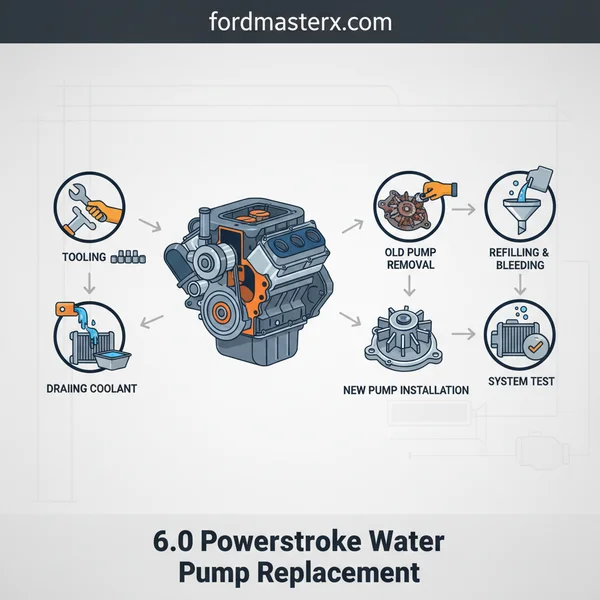
This guide provides the exact torque specifications and technical data needed to ensure a leak-free installation. By following this systematic approach, you will navigate the cramped engine bay and remove the heavy fan shroud assembly without damaging your radiator or cooling fins. Having the right specialized tools on hand will transform a frustrating afternoon into a straightforward repair.
Essential Specialized Tools for 6.0L Cooling System Repairs
You cannot effectively replace a 6.0 Powerstroke water pump with a standard socket set alone. The cooling fan and shroud are the primary obstacles, requiring tools that can reach into tight tolerances and break high-torque bonds. You will need a variety of extensions and specific wrenches to avoid stripping fasteners or wasting time on the shroud assembly.

The Fan Clutch Removal Tool
The most important tool in your arsenal is a pneumatic fan clutch wrench set or a dedicated 47mm/48mm fan clutch wrench. While some mechanics attempt to use a large crescent wrench and a hammer, this often results in rounded nuts or damaged water pump bearings. A pneumatic attachment that connects to an air hammer is the most efficient way to break the fan clutch loose without needing a pulley holding tool. Remember that the fan clutch on the 6.0L Powerstroke uses standard right-hand threads; you must turn it counter-clockwise to loosen it when facing the engine.
Socket and Extension Requirements
- 10mm and 13mm Sockets: These are required for the water pump mounting bolts and the fan shroud bolts.
- 8mm Socket: Essential for removing the bolts securing the cooling bottle and small trim pieces.
- Long Extensions: You will need at least 12 to 24 inches of extensions to reach the lower fan shroud bolts from the top or through the wheel well.
- Torque Wrench: A 3/8-inch drive torque wrench capable of measuring in pound-inches and pound-feet is non-negotiable for the water pump housing bolts.
How to Replace Your 6.0 Powerstroke Water Pump Like a Pro: A Practical Walkthrough
The 6.0L Powerstroke diesel engine is a powerhouse, but it is notorious for cooling system sensitivities. A failing water pump can lead to overheating, which in this specific engine often results in blown head gaskets or a ruptured EGR cooler. This guide covers the complete replacement of the water pump, providing you with the technical specifications and practical insights needed to ensure your cooling system remains pressurized and efficient. Following these steps carefully will prevent common pitfalls like O-ring leaks or fan shroud damage, saving you thousands in potential engine repairs.
Step 1: Cooling System Drainage and Initial Prep
What you need: Large drain pan (5-gallon capacity), 19mm wrench or pliers, and safety glasses.
Instructions: Ensure the engine is completely cool to the touch before starting to avoid severe burns. Begin by removing the cap from the degas bottle (the coolant reservoir) to vent the system. Locate the radiator drain petcock on the bottom driver-side corner of the radiator. Position your drain pan underneath and open the valve. Expect to drain approximately 4 to 5 gallons of coolant. While the fluid is draining, inspect it for any signs of “goo” or oil, which could indicate a failing oil cooler. Once the flow slows to a trickle, close the petcock. This step is crucial because a dry engine valley makes the subsequent component removal much cleaner and safer for the electrical sensors located nearby.
Pro Tip: If your coolant looks rusty or contains sediment, this is the perfect time to perform a full system flush with distilled water before installing the new pump to prevent premature seal failure.
Step 2: Air Intake and Degas Bottle Removal
What you need: 8mm socket, flat-head screwdriver, and a shop rag.
Instructions: To access the front of the engine, you must clear the top-side obstructions. Disconnect the Mass Air Flow (MAF) sensor plug and loosen the worm-gear clamps on the intake tube using your screwdriver or 8mm socket. Remove the air filter housing and the plastic intake ducting. Next, remove the two 8mm bolts securing the degas bottle to the cowl. You don’t necessarily need to disconnect all the small hoses if you can safely tuck the bottle out of the way, but removing it entirely provides significantly more room. Always cover the turbocharger inlet with a clean shop rag immediately after removing the intake to prevent any hardware or debris from falling into the compressor wheel.
Pro Tip: Use a piece of tape to label any small vacuum lines you disconnect to ensure they return to the correct ports during reassembly.
Step 3: Removing the Fan Shroud and Stator
What you need: 8mm and 13mm sockets, and an extension.
Instructions: The 6.0 Powerstroke uses a complex two-piece shroud system. First, remove the bolts holding the upper fan shroud (the plastic cover over the fan). Once the upper piece is out, you will encounter the fan stator—a metal ring that directs airflow. This is held in place by several 13mm bolts attached to the engine block. You may need to access some of these from underneath the vehicle. The stator is often a tight fit, so be patient while maneuvering it around the fan blades. Removing the stator is mandatory to provide enough clearance to use the fan clutch removal tools in the next step. Keep all hardware organized in a magnetic tray, as these bolts vary slightly in length.
Pro Tip: Be extremely careful not to “ding” the radiator fins with the metal stator during removal, as even a small nick can cause a high-pressure leak later.
Step 4: Loosening the Fan Clutch
What you need: Large fan clutch wrench (47mm) and a pneumatic fan clutch eliminator or a heavy hammer.
Instructions: This is arguably the most difficult part of the job. The fan clutch nut is located on the water pump pulley. On a 6.0 Powerstroke, this nut uses standard right-hand threads, meaning you turn it counter-clockwise to loosen (when facing the engine). Use the 47mm wrench on the nut. If you don’t have a pneumatic tool, you may need a helper to hold the pulley still with a secondary tool or use a “shock” method by hitting the wrench handle sharply with a heavy hammer. Once the nut breaks loose, spin the fan off the water pump shaft by hand. Carefully lift the fan and the clutch assembly out of the engine bay together.
Pro Tip: Store the fan clutch in an upright (vertical) position. Storing it flat can cause the viscous fluid inside to leak past the internal seals, leading to fan engagement issues later.
Step 5: Serpentine Belt Removal
What you need: 1/2-inch drive breaker bar or a long-handled ratchet.
Instructions: Locate the belt tensioner on the passenger side of the engine. Insert the 1/2-inch drive end of your breaker bar into the square hole on the tensioner arm. Pull the bar toward the driver’s side of the vehicle to compress the spring and release tension on the belt. With the tension released, slide the belt off the water pump pulley. You do not need to remove the belt entirely from all the other pulleys unless you plan on replacing it, but ensure it stays clear of the water pump area. Check the belt for cracks, fraying, or glazing; if it looks worn, this is the time to install a new one.
Pro Tip: Draw a quick diagram of the belt routing or take a photo with your phone before removal. The 6.0 belt path is surprisingly complex and easy to forget.
Step 6: Water Pump Extraction
What you need: 10mm socket, 6-inch extension, and a gasket scraper.
Instructions: The water pump is held to the front cover by four 10mm bolts. Use your socket and extension to remove these bolts in a crisscross pattern. Once the bolts are out, the pump might be stuck due to the internal O-ring seal. Give the pump a firm wiggle or a light tap with a rubber mallet to break the seal. As the pump pulls away, expect a small amount of residual coolant to spill out of the front cover. Once the pump is removed, use a plastic scraper or a Scotch-Brite pad to clean the mounting surface on the front cover. It must be perfectly smooth and free of old rubber bits or corrosion to ensure a leak-free seal.
Pro Tip: Inspect the “weep hole” of the old pump. If there is a trail of dried coolant (white crusty residue), it confirms the internal seal had failed.
Step 7: Installing the New Water Pump
What you need: New water pump, new O-ring, and clean engine coolant.
Instructions: Most high-quality replacement pumps come with a new O-ring already installed or in the box. Dip your finger in clean coolant and lubricate the O-ring thoroughly; this prevents it from tearing or “rolling” when you press the pump into the front cover. Align the pump and press it firmly into the opening. Reinstall the four 10mm bolts and tighten them by hand first to avoid cross-threading. Torque the bolts to 15-18 lb-ft (20-25 Nm). Do not over-tighten, as the front cover is made of aluminum and can strip easily. Spin the pump pulley by hand to ensure it moves smoothly without any grinding or resistance.
Pro Tip: Always double-check that the O-ring stayed in its groove during the installation; if it slips out, you will have a massive leak as soon as the system reaches operating pressure.
Step 8: Reassembly and Cooling System Refill
What you need: Ford Gold or Zerex G-05 coolant, and 4-5 gallons of distilled water.
Instructions: Reverse the disassembly process. Reinstall the serpentine belt, ensuring it is perfectly centered on all pulleys. Reattach the fan clutch (spin it on clockwise) and snug it down—the engine’s rotation will naturally keep it tight. Reinstall the stator, shroud, and air intake components. To refill, mix your coolant 50/50 with distilled water. Pour slowly into the degas bottle. Start the engine with the heater on high to help circulate the fluid. As the engine warms up and the thermostat opens, the coolant level will drop; continue topping it off until the level stabilizes at the “Cold Fill” line on the bottle.
Pro Tip: To avoid air pockets (airlocks), you can squeeze the upper radiator hose while the engine is running to help “burp” the air out of the system.
✅ Final Checklist
- Verify all four water pump bolts are torqued to 15-18 lb-ft.
- Check that the serpentine belt is properly seated in the grooves of every pulley.
- Ensure the fan clutch nut is snug and the fan spins freely without hitting the shroud.
- Confirm the degas bottle cap is tightened until it “clicks” to ensure the system can pressurize.
- Monitor the ground under the truck for 15 minutes after the first drive to check for leaks.
Important Notes:
- Safety Warning: Never open the degas bottle while the engine is hot. The system is under high pressure and can spray boiling coolant.
- When to Seek Help: If you find metal shavings in your old water pump, your front cover may be cavitated/eroded, which requires a much more intensive repair.
- Estimated Time: 3 to 5 hours depending on mechanical experience.
- Cost Range: $150 – $300 for parts (Pump and Coolant), compared to $600 – $900 at a professional shop.
Identifying Water Pump Variations: 90mm vs 100mm Pulleys
Before ordering parts, you must verify the diameter of your water pump pulley. Ford used two different sizes during the production run of the 6.0L engine, and they are not interchangeable. Installing the wrong size will cause the serpentine belt to be too tight or too loose, leading to premature belt wear or water pump bearing failure.

Determining the Correct Pump for Your Year
The water pump variations generally follow the engine build date, though many trucks have been modified over the years. The 90mm pulley was typically used on early model years, specifically 2003 and early 2004 engines. The 100mm pulley was introduced for the late 2004 through 2007 model years to improve cooling efficiency. If your truck has a build date after 09/2004, it almost certainly requires the 100mm version.
How to Measure the Pulley
If you are unsure of your truck’s history, use a set of calipers to measure the outer diameter of the pulley before ordering the new pump.
- 90mm Pump: Measures approximately 3.5 inches in diameter.
- 100mm Pump: Measures approximately 3.9 inches in diameter.
In addition to the pulley size, ensure your new pump includes the O-ring seal. Most high-quality aftermarket and Motorcraft pumps come with the seal pre-installed, but you should always verify the sealing surface is smooth and free of machining burrs.
Teardown: Removing the Fan Shroud and Fan Clutch
The teardown process is the most labor-intensive part of the 6.0L water pump replacement. You must create enough clearance to pull the water pump forward without hitting the radiator. This requires the removal of the cooling bottle, the intake ducting, and the massive two-piece fan shroud.
Step 1: Draining the System and Accessing the Fan
Start by draining the coolant from the radiator petcock located on the bottom driver-side corner. Once the system is empty, remove the two 8mm bolts holding the degas bottle (coolant reservoir) and move it aside. Next, remove the plastic intake snorkels to gain a clear view of the fan shroud. You do not necessarily need to remove the FICM (Fuel Injection Control Module), but doing so can provide much more arm room if you are struggling with the lower bolts.
Step 2: Loosening the Fan Clutch
Before you remove the serpentine belt, use your pneumatic fan clutch tool or large wrench to break the fan clutch nut loose. The tension from the belt helps hold the water pump pulley in place while you apply force. Turn the nut counter-clockwise. Once the nut is loose, do not spin it all the way off yet. Leave it threaded on by a few turns to support the fan while you work on the shroud bolts.
Step 3: Maneuvering the Fan Shroud
The 6.0L uses a complex shroud system. Remove the bolts securing the upper shroud to the radiator. There are hidden bolts halfway down the sides that are best accessed through the wheel wells or with a long extension from above. Once the bolts are removed, you must unclip the wire harness for the fan clutch stator. With the shroud loose, you can finally spin the fan clutch off the water pump snout and lift both the fan and the shroud out of the engine bay as a single unit. This prevents the heavy fan from falling and puncturing the radiator.
Technical Specifications: Torque Values and Bolt Patterns
When dealing with the 6.0 Powerstroke, precision is your best friend. Because the water pump mounts directly to the aluminum front cover, over-tightening is a recipe for stripped threads and a very expensive afternoon. Conversely, under-tightening leads to O-ring failure and coolant leaks that can be difficult to track down once the fan shroud is back in place.
Critical Torque Values for a Leak-Free Seal
The standard torque specification for the water pump mounting bolts on a 6.0L engine is 15 to 18 lb-ft (20 to 25 Nm). While this might feel “light” to those used to working on heavy-duty diesel components, it is exactly what the rubber O-ring requires to compress evenly against the front cover housing. Using a calibrated inch-pound or small foot-pound torque wrench is highly recommended to ensure you don’t warp the pump housing.
- Consistency is key: Always tighten in a star or “criss-cross” pattern to ensure the pump seats perfectly flat.
- Pulley Bolts: If you are reusing your pulley, the bolts typically require 23 lb-ft (31 Nm). It is much easier to snug these down while the belt is still providing tension.
- Dry vs. Lubricated: Specs are generally for dry threads. If you use anti-seize (which is a great idea for these bolts), reduce your torque value by about 10% to avoid over-stretching the hardware.
Managing Bolt Length and Placement
One of the most common mistakes during this job is mixing up the mounting bolts. The 6.0 Powerstroke water pump uses bolts of varying lengths depending on the specific year and whether the pump has a 90mm or 100mm pulley. Forcing a long bolt into a shallow hole can crack the front cover casting instantly.
Pro Tip: Take a piece of cardboard and draw a rough circle representing the pump. As you remove each bolt, poke it through the cardboard in its corresponding position. This simple trick ensures every bolt returns to its original home, maintaining the integrity of the threads and the seal.
Front Cover Integrity and Cavitation Prevention Strategies
The relationship between the water pump and the front cover is the “Achilles’ heel” of the 6.0 cooling system. Because the pump impeller spins at high speeds within an aluminum housing, the physical condition of that housing is just as important as the pump itself. If the front cover is compromised, even a brand-new pump won’t move coolant efficiently.
Identifying Cavitation and Front Cover Erosion
Cavitation occurs when air bubbles form and collapse with enough force to literally “pit” or eat away the aluminum front cover. Over time, this erosion creates a “valley” behind the impeller, which causes the pump to lose its prime and reduces flow. When you have the pump off, look for “pockmarks” or a rough, sandblasted texture on the cover surface.
- Visual Inspection: If you see significant metal loss or holes in the front cover, a new water pump is only a temporary fix; the cover itself may need replacement or repair.
- Impeller Clearance: Modern high-flow pumps or those with stainless steel impellers are designed to combat this, but they still require a smooth mating surface to function at 100% capacity.
Maintenance Practices to Prolong Pump Life
Preventing cavitation and pump failure starts with coolant chemistry. The 6.0 Powerstroke is notorious for “flash boiling” at the EGR cooler, which can introduce air into the system and lead to the very cavitation issues mentioned above. Maintaining the correct chemical balance is non-negotiable for engine longevity.
Using a heavy-duty Extended Life Coolant (ELC) that meets EC-1 specifications is the industry standard for these trucks. Unlike the old gold-colored silicate coolants, ELC is much more resistant to “dropout,” which is the process where coolant additives turn into a gooey sludge that clogs oil coolers and wears out water pump seals. Additionally, ensuring your cooling system is properly degas-ed (removing all trapped air) prevents the “bubbles” that cause physical erosion on the pump impeller and front cover.
Conclusion
Replacing the water pump on your 6.0 Powerstroke is a vital maintenance task that protects your engine from catastrophic overheating. By focusing on the right tools, adhering strictly to torque specifications, and keeping a close eye on the condition of your front cover, you can ensure your cooling system remains robust for years to come. Remember that a clean cooling system and the right ELC coolant are your best defenses against future failures.
As a next step, take a moment to inspect your coolant for any signs of contamination or “goo” and consider a full system flush during your pump replacement. If you found this technical breakdown helpful, be sure to check out our other guides on 6.0 Powerstroke maintenance to keep your rig running strong!
❓ Frequently Asked Questions
Why is it critical to inspect the front cover during water pump replacement?
The 6.0L front cover is made of aluminum and is prone to cavitation, where air bubbles erode the metal behind the impeller. If you ignore deep pitting, the new pump may leak or coolant could eventually breach the oiling system.
What are the benefits of upgrading to a billet impeller water pump?
OEM plastic impellers are known to crack or spin on the shaft over time, leading to mysterious overheating issues. A billet or metal impeller provides superior durability and consistent flow under high-stress towing conditions.
Can I replace the water pump without removing the entire radiator?
Yes, you do not need to pull the radiator. By removing the air intake, the upper fan shroud, and the fan clutch assembly, you will have sufficient clearance to access the pump.
What should I do if the water pump bolts are heavily corroded?
Corroded bolts can provide false torque readings or snap during installation. It is highly recommended to clean the threads with a wire wheel or replace them entirely with a new bolt kit if rust is present.
Which coolant is best to use after a water pump swap?
You should use an ELC (Extended Life Coolant) meeting EC-1 specifications. This prevents the silicate dropout and oil cooler clogging common with the original Ford Gold coolant.
How do I ensure all air is bled from the system after the install?
Fill the degas bottle, run the engine with the heater on high until the thermostat opens, and keep the cap off initially. Monitor the levels over the next few heat cycles as the system self-purges air through the degas bottle.