
2017 Ford Explorer Fuse Box Diagram: Both Panels, Every Fuse

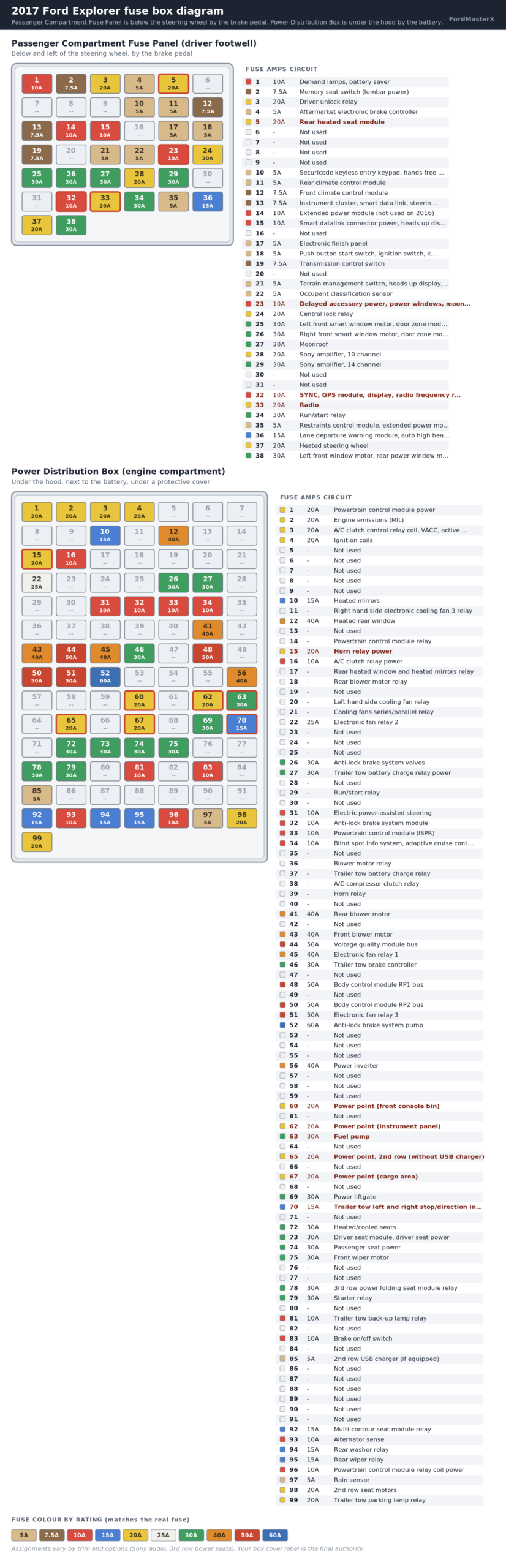
Your 2017 Ford Explorer has two fuse boxes. The Power Distribution Box sits under the hood, next to the battery. The Passenger Compartment Fuse Panel is below and left of the steering wheel, by the brake pedal.
The cigarette lighter and power point fuses are 60, 62, 65 and 67, all 20A, inside the Power Distribution Box.
What Most Fuse Guides Get Wrong About The 2017 Explorer


The 2017 Explorer is part of the 5th generation Explorer, Ford’s internal code U502, built from 2011 to 2019. Ford refreshed the Passenger Compartment Fuse Panel for the 2016 facelift. Two positions kept changing right at the 2016-to-2017 line.


Fuse 70 in the Power Distribution Box feeds the trailer tow stop and turn signal lamps. It is rated 20A on the 2016 Explorer and drops to 15A on every 2017, 2018 and 2019 Explorer.
Fuse 14 in the Passenger Compartment panel, the extended power module, is listed “not used” on the 2016 Explorer. It becomes a live 10A fuse starting in 2017.
A source that covers “2010 to 2020” in one combined table prints the older values for both positions. That is correct for a 2012 Explorer and wrong for yours. Confirm your year before trusting any single-table source on this generation.
Where Is The Fuse Box On A 2017 Ford Explorer?


The Passenger Compartment Fuse Panel is in the driver footwell, low and left of the steering column. It sits right beside the brake pedal, under a plastic cover.
The Power Distribution Box is in the engine bay, mounted next to the battery under a black plastic lid. The fuse legend is printed on the underside of that lid. Pull the two tabs or twist the latches to lift it straight up.


2017 Ford Explorer Passenger Compartment Fuse Panel: Complete Chart


This is every position in the driver footwell panel, including the empty slots. “Not used” positions are reserved by Ford and carry no fuse.
| Fuse | Rating | Circuit |
|---|---|---|
| 1 | 10A | Demand lamps, battery saver |
| 2 | 7.5A | Memory seat switch (lumbar power) |
| 3 | 20A | Driver unlock relay |
| 4 | 5A | Aftermarket electronic brake controller |
| 5 | 20A | Rear heated seat module |
| 6 | – | Not used |
| 7 | – | Not used |
| 8 | – | Not used |
| 9 | – | Not used |
| 10 | 5A | Securicode keyless entry keypad, hands free liftgate |
| 11 | 5A | Rear climate control module |
| 12 | 7.5A | Front climate control module |
| 13 | 7.5A | Instrument cluster, smart data link, steering column control module |
| 14 | 10A | Extended power module (not used on the 2016 Explorer) |
| 15 | 10A | Smart datalink connector power, heads up display |
| 16 | – | Not used |
| 17 | 5A | Electronic finish panel |
| 18 | 5A | Push button start switch, ignition switch, key inhibit |
| 19 | 7.5A | Transmission control switch (tow/haul) |
| 20 | – | Not used |
| 21 | 5A | Terrain management switch, heads up display, humidity sensor |
| 22 | 5A | Occupant classification sensor |
| 23 | 10A | Delayed accessory power, power windows, moonroof, folding mirror relay, DC inverter, window/moonroof switch illumination |
| 24 | 20A | Central lock relay |
| 25 | 30A | Left front smart window motor, door zone module |
| 26 | 30A | Right front smart window motor, door zone module |
| 27 | 30A | Moonroof |
| 28 | 20A | Sony amplifier, 10 channel (if equipped) |
| 29 | 30A | Sony amplifier, 14 channel (if equipped) |
| 30 | – | Not used |
| 31 | – | Not used |
| 32 | 10A | SYNC, GPS module, display, radio frequency receiver |
| 33 | 20A | Radio |
| 34 | 30A | Run/start relay |
| 35 | 5A | Restraints control module, extended power module |
| 36 | 15A | Lane departure warning module, auto high beam, EC mirrors, rear heated seats |
| 37 | 20A | Heated steering wheel |
| 38 | 30A | Left front window motor, rear power window motors (circuit breaker) |
2017 Ford Explorer Power Distribution Box: Complete Fuse And Relay Chart
This is every position in the engine-bay box. Relay-only slots carry no amperage rating, so they are marked with a dash.
| Fuse | Rating | Circuit |
|---|---|---|
| 1 | 20A | Powertrain control module power |
| 2 | 20A | Engine emissions (MIL) |
| 3 | 20A | A/C clutch control relay coil, VACC, active grille shutters |
| 4 | 20A | Ignition coils |
| 5-9 | – | Not used |
| 10 | 15A | Heated mirrors |
| 11 | – | Right hand side electronic cooling fan 3 relay |
| 12 | 40A | Heated rear window |
| 13 | – | Not used |
| 14 | – | Powertrain control module relay |
| 15 | 20A | Horn relay power |
| 16 | 10A | A/C clutch relay power |
| 17 | – | Rear heated window and heated mirrors relay |
| 18 | – | Rear blower motor relay |
| 19 | – | Not used |
| 20 | – | Left hand side cooling fan relay |
| 21 | – | Cooling fans series/parallel relay |
| 22 | 25A | Electronic fan relay 2 |
| 23-25 | – | Not used |
| 26 | 30A | Anti-lock brake system valves |
| 27 | 30A | Trailer tow battery charge relay power |
| 28 | – | Not used |
| 29 | – | Run/start relay |
| 30 | – | Not used |
| 31 | 10A | Electric power-assisted steering |
| 32 | 10A | Anti-lock brake system module |
| 33 | 10A | Powertrain control module (ISPR) |
| 34 | 10A | Blind spot information system, adaptive cruise control, front view camera, rear camera |
| 35 | – | Not used |
| 36 | – | Blower motor relay |
| 37 | – | Trailer tow battery charge relay |
| 38 | – | A/C compressor clutch relay |
| 39 | – | Horn relay |
| 40 | – | Not used |
| 41 | 40A | Rear blower motor |
| 42 | – | Not used |
| 43 | 40A | Front blower motor |
| 44 | 50A | Voltage quality module bus |
| 45 | 40A | Electronic fan relay 1 |
| 46 | 30A | Trailer tow brake controller |
| 47 | – | Not used |
| 48 | 50A | Body control module RP1 bus |
| 49 | – | Not used |
| 50 | 50A | Body control module RP2 bus |
| 51 | 50A | Electronic fan relay 3 |
| 52 | 60A | Anti-lock brake system pump |
| 53-55 | – | Not used |
| 56 | 40A | Power inverter |
| 57-59 | – | Not used |
| 60 | 20A | Power point, front console bin |
| 61 | – | Not used |
| 62 | 20A | Power point, instrument panel |
| 63 | 30A | Fuel pump |
| 64 | – | Not used |
| 65 | 20A | Power point, 2nd row (without USB charger) |
| 66 | – | Not used |
| 67 | 20A | Power point, cargo area |
| 68 | – | Not used |
| 69 | 30A | Power liftgate |
| 70 | 15A | Trailer tow left and right stop/direction indicator lamps (20A on the 2016 Explorer) |
| 71 | – | Not used |
| 72 | 30A | Heated/cooled seats |
| 73 | 30A | Driver seat module, driver seat power |
| 74 | 30A | Passenger seat power |
| 75 | 30A | Front wiper motor |
| 76-77 | – | Not used |
| 78 | 30A | 3rd row power folding seat module relay |
| 79 | 30A | Starter relay |
| 80 | – | Not used |
| 81 | 10A | Trailer tow back-up lamp relay |
| 82 | – | Not used |
| 83 | 10A | Brake on/off switch |
| 84 | – | Not used |
| 85 | 5A | 2nd row USB charger (if equipped) |
| 86-91 | – | Not used |
| 92 | 15A | Multi-contour seat module relay |
| 93 | 10A | Alternator sense |
| 94 | 15A | Rear washer relay |
| 95 | 15A | Rear wiper relay |
| 96 | 10A | Powertrain control module relay coil power |
| 97 | 5A | Rain sensor |
| 98 | 20A | 2nd row seat motors |
| 99 | 20A | Trailer tow parking lamp relay |
Which Fuse Is The Cigarette Lighter Or Power Point On A 2017 Explorer?
Four fuses in the Power Distribution Box cover the power points. Fuse 60 runs the front console bin outlet. Fuse 62 runs the instrument panel outlet.


Fuse 65 runs the 2nd row outlet on trims without a USB charger. Fuse 67 runs the cargo area outlet. All four of these are rated 20A.
The 2nd row USB charger, where equipped, runs on its own 5A fuse 85.
Which Fuse Is The Radio, SYNC Or Amplifier?
Fuse 33 (20A) in the Passenger Compartment panel runs the radio itself. Fuse 32 (10A) runs SYNC, the GPS module, the display and the RF receiver.
If your Explorer has the Sony audio upgrade, the amplifier runs on fuse 28 or fuse 29. Fuse 28 is rated 20A for the 10 channel system. Fuse 29 is rated 30A for the 14 channel system.


A base system with no Sony badge on the doors uses neither fuse.
My… Doesn’t Work: Symptom To Fuse
| Symptom | Check these fuses first |
|---|---|
| No power at any cigarette lighter or USB outlet | 60, 62, 65, 67 (Power Distribution Box), 85 (2nd row USB) |
| Radio, SYNC or screen is dead | 32, 33 (Passenger Compartment panel) |
| Horn does not sound | 15 and relay 39 (Power Distribution Box) |
| Heated or cooled seats do not warm or cool | 5 (Passenger Compartment panel), 72 (Power Distribution Box) |
| Power liftgate will not open or close electrically | 69 (Power Distribution Box) |
| Moonroof will not move | 27 (Passenger Compartment panel) |
| Power windows are dead | 23 (Passenger Compartment panel), 38 (Power Distribution Box) |
| A/C compressor will not engage | 3, 16 and relay 38 (Power Distribution Box) |
| Trailer lights do not work | 27, 37, 70, 99 (Power Distribution Box) |
| Engine will not crank | 79, relay 29 and relay 34 (Power Distribution Box) |
| Wipers are dead or stuck | 75, 94, 95 (Power Distribution Box) |
| Blower motor has no airflow at any speed | 41, 43 and relays 18, 36 (Power Distribution Box) |
How Do You Know If A Fuse Is Blown?
Pull the suspect fuse straight out with a fuse puller, the plastic tool clipped inside the lid. Hold it up to the light.
A good mini or cartridge fuse shows one continuous metal strip. A blown one shows a gap or a dark, melted spot in that strip.
A multimeter set to continuity or ohms gives a more certain answer than eyeballing it. That matters most on the darker cartridge fuses, where a hairline break is hard to see. Touch a probe to each end of the fuse.
Continuity means the fuse is good. No reading at all means it is blown.
Keep a small assortment of mini and cartridge fuses in the glovebox. A fuse assortment kit that covers both mini and the larger cartridge sizes fits this box. It costs less than one dealer visit and saves a second trip.
Any brand meeting the ATO/ATC or cartridge standard works. A basic digital multimeter earns its place in the glovebox too. It is the same tool you would use to check the battery.
Why Does The Same Fuse Keep Blowing?
A fuse that blows once from a momentary short is normal. A fuse that blows again within a week means the short is still there. Replacing it again just delays the next failure.
Common culprits on this generation are a chafed wiring harness or a corroded ground strap. A failing module can also draw more current than its fuse allows. None of those show up from staring at the fuse box.
You need to read live current draw with a scan tool. Our Ford diagnostic tool comparison covers what actually works on these Explorers.
If the symptom instead is a dead battery overnight with no blown fuse, that points to a parasitic draw. It is not a short.
Start with a battery health check before you chase wiring. Our 2017 Explorer battery guide covers what to test first.
What Changed Across The 5th Generation Explorer Fuse Panel?
If you have a 2013 Explorer instead, the fuse numbering is close but not identical to the 2017 box. Our 2013 Ford Explorer fuse box diagram covers the pre-facelift layout for the same generation.
A 3rd generation Explorer, built 2002 to 2005, has a completely different fuse panel in a different location. Do not use any fuse number from this page on that one. Our 2002 and 2003 Ford Explorer fuse box diagrams cover that generation on its own terms.
Quick Reference: The 2017 Explorer Fuses You Will Look Up Most
| Need | Fuse | Rating | Box |
|---|---|---|---|
| Cigarette lighter / front console power point | 60 | 20A | Power Distribution Box |
| Instrument panel power point | 62 | 20A | Power Distribution Box |
| Radio | 33 | 20A | Passenger Compartment panel |
| SYNC / GPS / display | 32 | 10A | Passenger Compartment panel |
| Horn | 15 | 20A | Power Distribution Box |
| Starter relay | 79 | 30A | Power Distribution Box |
| Fuel pump | 63 | 30A | Power Distribution Box |
| Anti-lock brake pump | 52 | 60A | Power Distribution Box |
| Heated/cooled seats | 72 | 30A | Power Distribution Box |
| Trailer tow stop/turn lamps | 70 | 15A | Power Distribution Box |
| Front/rear blower motor | 43 / 41 | 40A | Power Distribution Box |
| Moonroof | 27 | 30A | Passenger Compartment panel |
Ford does not publish one document listing both boxes with every trim variation called out. The label on the inside of each box cover is the final authority for your specific Explorer. That matters most if a previous owner has already swapped a fuse rating.


