
2006 Ford F-150 Towing Capacity: Engine & Config Charts

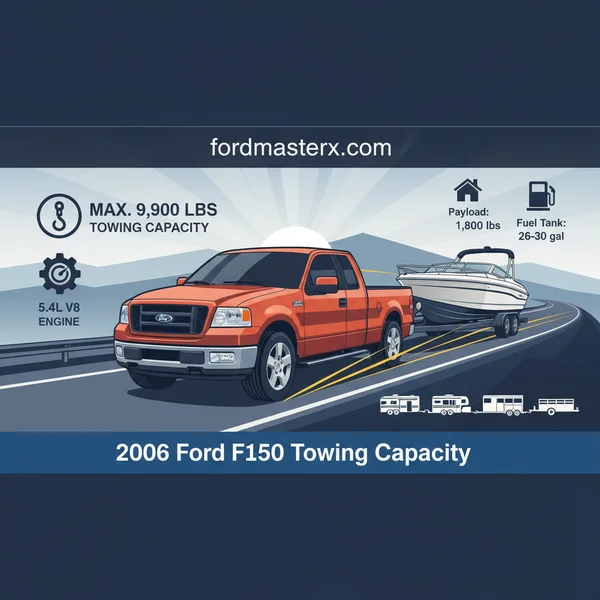
The 2006 Ford F-150 towing capacity ranges between 3,000 and 9,900 pounds depending on the specific powertrain and chassis configuration. To reach the maximum limit, the truck must be equipped with the 5.4L Triton V8 engine, a 3.73 axle ratio, and a weight-distributing hitch setup.
🎯 Key Takeaways
- Maximum towing peaks at 9,900 lbs with the 5.4L V8 engine configuration.
- Axle ratios like 3.55 and 3.73 significantly impact your truck’s total tow rating.
- A weight-distributing hitch is mandatory for any trailer loads exceeding 5,000 lbs.
- Payload capacity must account for passenger weight and trailer tongue weight combined.
- 4WD configurations generally have lower towing limits than equivalent 2WD models due to weight.
The 2006 Ford F-150 offers a maximum towing capacity ranging from 2,300 lbs to 9,900 lbs. This massive spread exists because your truck’s limit is not a single number; it is a calculation based on your engine, cab size, bed length, and specifically, your rear axle ratio. To safely hitch up a trailer, you must identify your specific configuration rather than relying on general “half-ton” estimates.
Understanding these limits is critical for more than just following the law. Exceeding your truck’s Gross Combined Weight Rating (GCWR) puts extreme stress on the 4R70E or 4R75E transmission and can lead to premature brake failure. By identifying your truck’s specific build, you can determine if you are equipped for a small utility trailer or a heavy-duty fifth-wheel camper. This guide breaks down the technical data you need to find that exact number.
2006 Ford F-150 Towing Capacity by Engine and Transmission
Your engine choice is the primary factor in determining your GCWR. In 2006, Ford offered three main powerplants, each paired with specific transmissions that dictate how much heat and weight the drivetrain can handle. If you have a manual transmission, your towing capacity is significantly lower than an automatic, regardless of the engine size.
The 4.2L V6 and 4.6L V8 Entry Points
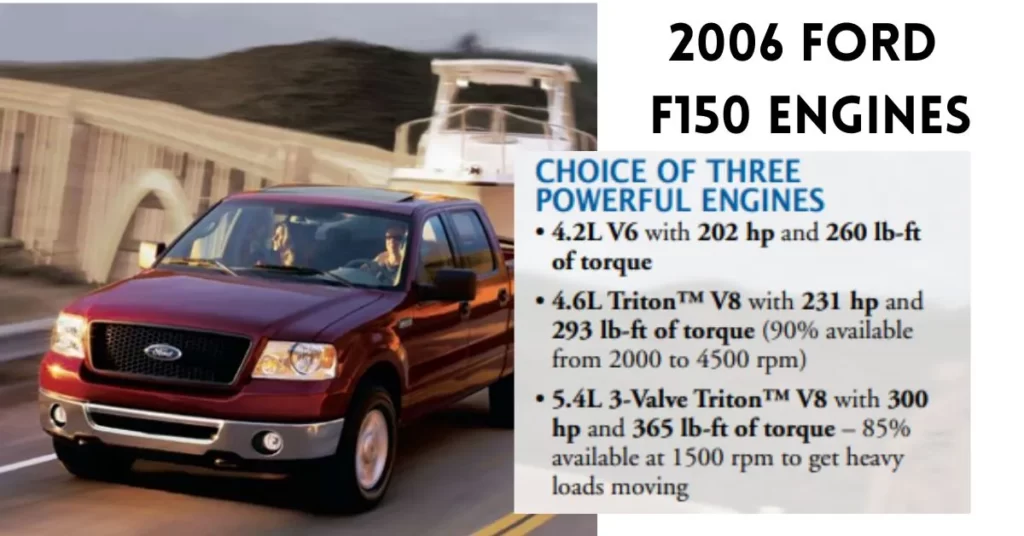
The 4.2L V6 was the base engine, primarily designed for fuel efficiency and light work. When paired with a 5-speed manual transmission, it is limited to a meager 2,300 to 3,700 lbs. Stepping up to the 4.6L SOHC V8 provides a more robust platform for moderate towing. This engine was the workhorse for many fleet trucks and offers a balanced towing range between 3,100 lbs and 7,200 lbs.
- 4.2L V6 (Manual): 2,300 – 3,700 lbs maximum.
- 4.2L V6 (Automatic): 5,100 – 5,700 lbs maximum.
- 4.6L V8 (3.55 Axle): 6,100 – 6,600 lbs maximum.
- 4.6L V8 (3.73 Axle): 6,500 – 7,200 lbs maximum.
For these smaller engines, the axle ratio is the “force multiplier.” A 4.6L V8 with a 3.73 rear axle can out-tow the same engine with a 3.55 axle by nearly 600 lbs because the gears allow the engine to stay in its power band more effectively at low speeds.
The 5.4L Triton V8 and Max Towing
If you are looking to hit the 9,000+ lb mark, you must have the 3-valve 5.4L Triton V8. This engine was specifically tuned for torque, producing 365 lb-ft, which is essential for moving heavy loads from a dead stop. This engine only came with an automatic transmission in 2006, as the manual gearboxes could not handle the torque output under load.
- 5.4L V8 (3.31 Axle): Approximately 7,000 – 8,000 lbs.
- 5.4L V8 (3.55 Axle): Approximately 8,200 – 8,700 lbs.
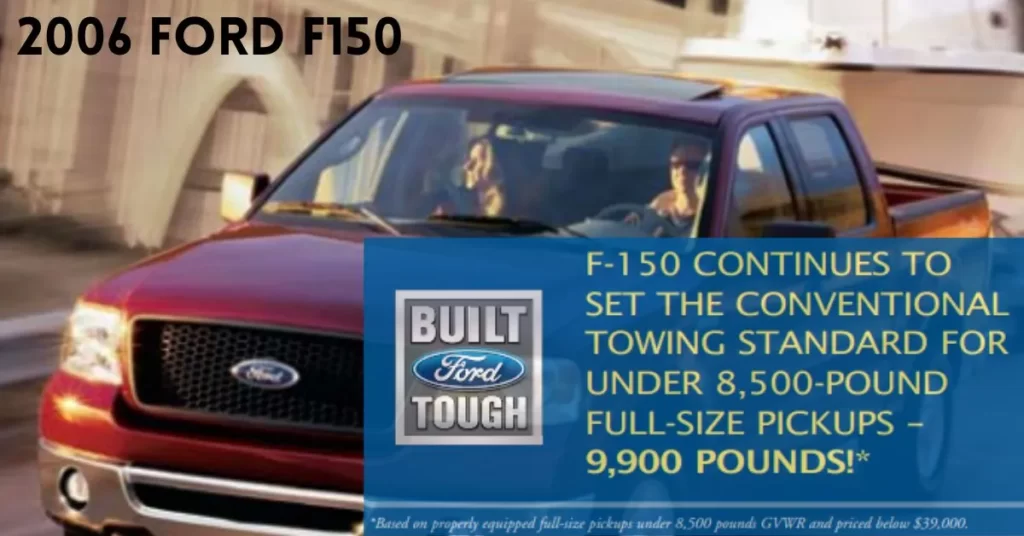
- 5.4L V8 (3.73 Axle): 9,200 – 9,900 lbs (Max Configuration).
Note that to reach the 9,900 lbs ceiling, you generally need a Regular Cab 4×2 configuration with the 8-foot bed and the 163-inch wheelbase. Adding 4×4 hardware or a larger cab adds “dead weight” to the truck, which must be subtracted from the total towing capacity.
Everything You Need to Know About 2006 Ford F150 Towing Capacity
Understanding the towing capacity of your 2006 Ford F150 is not just about knowing a single number; it is about ensuring the safety of your passengers, the longevity of your truck’s engine and transmission, and the legal compliance of your rig on the road. The 2006 model year was diverse, offering three different engines, multiple cab styles, and varying axle ratios that drastically alter how much weight you can pull. This guide provides a meticulous walkthrough to help you identify your specific vehicle’s limits, calculate your actual real-world capacity, and prepare your hardware for a successful haul.
Step 1: Locate and Decode the Safety Compliance Certification Label
What you need: A flashlight and a smartphone or notepad.
Instructions: Open the driver’s side door and look at the door pillar (the B-pillar) for a white sticker known as the Safety Compliance Certification Label. This is the “birth certificate” of your truck. You need to write down three specific values: the Gross Vehicle Weight Rating (GVWR), the Front Gross Axle Weight Rating (GAWR), and the Rear GAWR. Additionally, look at the bottom of the sticker for a two-digit code under the word “AXLE.” This code is critical because it tells you the gear ratio of your differential, which is often the deciding factor between a 5,000-lb capacity and a 9,000-lb capacity on the 2006 model.
Pro Tip: If the sticker is faded or missing, you can often find the axle ratio on a small metal tag bolted to the differential housing under the rear of the truck, though you may need a wire brush to clean it off.
Step 2: Identify Your Engine and Transmission Configuration
What you need: Your vehicle’s VIN or the original owner’s manual.
Instructions: The 2006 F150 came with three primary engines: the 4.2L V6, the 4.6L V8, and the 5.4L Triton V8. You also need to confirm if you have the 5-speed manual (only available on the V6) or the 4-speed automatic. Generally, the manual transmission has a significantly lower towing capacity because of the clutch’s limitations. Open your hood and check the emissions sticker or check the 8th digit of your VIN. “W” indicates the 4.6L V8, while “5” or “V” indicates the 5.4L V8. Knowing your engine is the first step in Narrowing down your Gross Combined Weight Rating (GCWR), which is the maximum allowable weight of the truck and trailer combined.
Pro Tip: The 5.4L Triton V8 is the “workhorse” of the 2006 lineup. If you have this engine combined with the 3.73 axle ratio, you are likely in the highest towing bracket for this year.
Step 3: Cross-Reference Your Axle Code for GCWR
What you need: The axle code from Step 1 and a 2006 Ford Towing Guide chart.
Instructions: Now that you have your engine and axle code, determine your Gross Combined Weight Rating (GCWR). For example, a 2006 F150 with a 5.4L V8 and a 3.55 axle ratio typically has a GCWR of 13,000 to 14,500 lbs, depending on the wheelbase. However, the same engine with a 3.73 axle ratio and the Heavy Duty Payload Package could see a GCWR of up to 15,300 lbs. If your axle code is “19,” you have a 3.55 ratio; “26” or “27” usually indicates a 3.73 ratio. Use these specs to find your maximum limit in the official manufacturer’s chart. This number represents the absolute ceiling for the weight of your truck, passengers, fuel, cargo, and the trailer combined.
Pro Tip: Always assume the lowest possible rating if you are unsure about your axle ratio. Overestimating capacity is the leading cause of transmission failure in mid-2000s F150s.
Step 4: Calculate Your Real-World Maximum Trailer Weight
What you need: A public truck scale (CAT scale) and your GCWR from Step 3.
Instructions: The “maximum towing capacity” advertised in brochures assumes a completely empty truck with only a driver. To find your actual capacity, take your truck to a scale with a full tank of gas and all your usual gear. Subtract this “curb weight” from your GCWR. For example, if your GCWR is 13,500 lbs and your truck weighs 5,800 lbs on the scale, your actual maximum trailer weight is 7,700 lbs. If you add 500 lbs of passengers and a toolbox, your towing capacity drops to 7,200 lbs. This step is vital because it prevents you from accidentally exceeding your GCWR by forgetting to account for the weight inside the truck.
Pro Tip: Don’t forget to include the weight of the weight-distributing hitch head itself, which can weigh 50–100 lbs, in your calculations.
Step 5: Check Tongue Weight and Payload Limits
What you need: A tongue weight scale or a bathroom scale with a lever system.
Instructions: Towing is limited by more than just the pulling capacity; the rear suspension must also support the downward force of the trailer. This is known as Tongue Weight (TW). For the 2006 F150, the tongue weight should be 10% to 15% of the total loaded trailer weight. If you are towing a 7,000-lb trailer, your tongue weight should be between 700 and 1,050 lbs. This tongue weight counts toward your truck’s “Payload” capacity (found on the door sticker). If your payload capacity is 1,500 lbs and your tongue weight is 1,000 lbs, you only have 500 lbs left for passengers and cargo in the bed before you exceed the Rear GAWR.
Pro Tip: If your truck’s rear end sags significantly, you are likely exceeding your tongue weight or payload. A weight-distributing hitch is mandatory for trailers over 5,000 lbs on the 2006 F150.
Step 6: Verify Hitch Class and Hardware Compatibility
What you need: A rag and a flashlight.
Instructions: Inspect the hitch receiver mounted to your F150’s frame. Look for a sticker or stamp indicating its Class. Most 2006 F150s equipped with a factory tow package feature a Class IV hitch. A Class III hitch is typically limited to 5,000 lbs unless a weight-distributing system is used. Ensure the hitch ball and the ball mount (the shank) are rated for the weight you intend to pull. It is a common mistake to use a 10,000-lb rated truck with a 3,500-lb rated ball. Match all components to the highest weight you expect to tow, ensuring every link in the chain is strong enough for the task.
Pro Tip: Check the hitch mounting bolts for rust or looseness. On a vehicle from 2006, frame corrosion near the hitch attachment points can significantly compromise towing safety.
Step 7: Perform a Mechanical “Tow-Ready” Inspection
What you need: Tire pressure gauge, fresh transmission fluid (if needed), and brake controller check.
Instructions: Towing puts immense strain on the 2006 F150’s 4-speed transmission. Check your transmission fluid; it should be bright red and smell sweet, not burnt. If you are towing near your maximum capacity, ensure you have an external transmission cooler installed (standard on most factory tow packages). Check your tire pressures—both on the truck and the trailer—and inflate them to the maximum “Cold PSI” listed on the sidewall for stability. Finally, test your electric brake controller. If your trailer has electric brakes, your truck must have a controller (either factory-integrated or aftermarket) to activate them; otherwise, you will likely overheat the truck’s brakes on a descent.
Pro Tip: Always tow in “Overdrive OFF” mode (usually a button on the end of the shifter) when pulling a heavy load to prevent the transmission from “hunting” for gears and overheating.
✅ Final Checklist
- Verified the axle ratio and engine type to determine the specific GCWR for your trim.
- Confirmed that the total weight of the loaded trailer plus the truck does not exceed the GCWR.
- Measured tongue weight to ensure it is 10-15% of the trailer weight and fits within the truck’s payload.
- Inspected the hitch, ball, and shank for weight ratings and structural integrity.
- Tested the trailer lights and the electronic brake controller for proper functionality.
Important Notes:
- Safety Warning: Never exceed the GVWR or GCWR. Doing so can lead to brake failure, tire blowouts, or loss of steering control.
- Professional Help: If you notice your engine temperatures rising quickly or hear “clunking” from the rear end while towing, consult a mechanic immediately to check your cooling system and differential.
- Estimated Time: Identifying your specs takes 30 minutes; a full scale-weighing and mechanical check takes 1-2 hours.
- Cost Range: Weighing at a CAT scale usually costs $12-$15. Installing an aftermarket brake controller or transmission cooler can cost $150-$400.
Comparing Cab Configurations: Regular vs. SuperCab vs. SuperCrew
While the engine provides the power, the cab configuration determines how much of that power is available for the trailer. Every pound of steel and glass added to the cab is a pound you cannot tow. This is why a Regular Cab F-150 almost always has a higher maximum towing capacity than a luxury-trimmed SuperCrew, even if they have the same engine and axle ratio.
How Cab Weight Reduces Your Towing Potential
The 2006 SuperCrew (four full doors) is the heaviest cab style. It offers the most interior comfort, but its high curb weight eats into the GCWR. For example, a 4×4 SuperCrew with the 5.4L engine and 3.73 gears is typically rated for 9,200 lbs, whereas the lighter Regular Cab with the same drivetrain is rated for the full 9,900 lbs. You are essentially “trading” 700 lbs of trailer weight for the extra passenger space.
- Regular Cab: Lightest weight, highest towing potential for work applications.
- SuperCab (Extended): The middle ground; offers extra storage with decent capacity.
- SuperCrew: Heaviest curb weight; limited to roughly 9,200 lbs maximum.
Identifying Your Truck’s Specific Build (Axle Ratios)
Before you trust a table, you must know your Axle Code. You can find this on the Safety Compliance Certification Label located on the driver’s side door jamb. Look for the word “AXLE” under the bar code. A two-digit code (like 19, 26, or B6) will tell you exactly what you have. Code 19 indicates a 3.55 ratio, while Code 26 indicates a 3.73 ratio. If you see a letter and a number (like B6), you have a Limited Slip differential, which is excellent for traction but doesn’t change the base towing math.
In addition to the axle, verify your wheelbase. A longer wheelbase (145″ vs 163″) generally provides more stability when towing, though it slightly increases the truck’s weight. When you combine the 5.4L engine, the 3.73 axle ratio, and the Heavy Duty Payload Package, you reach the peak of what the 2006 F-150 platform can handle.
Understanding GCWR, Axle Ratios, and the Heavy-Duty Payload Package
When you look at the 2006 Ford F-150 specs, you will see the term GCWR (Gross Combined Weight Rating). This is the maximum allowable weight of the entire setup, including the truck, the passengers, the fuel, and the loaded trailer. Many owners make the mistake of only looking at the trailer weight, but the GCWR is the ultimate “hard limit” for your drivetrain’s safety. If you load up the truck bed with heavy gear, you must subtract that weight from your maximum towing capacity to stay within the GCWR.
How Your Axle Ratio Dictates Your Towing Limit
The axle ratio is perhaps the most overlooked factor in determining how much your F-150 can pull. Essentially, a higher numerical ratio (like 3.73 or 4.10) provides more torque to the ground, making it easier to get a heavy load moving. For the 2006 model year, the difference is massive. A 5.4L V8 with a 3.55 axle ratio might be rated for 8,400 pounds, while the exact same truck with a 3.73 ratio jumps to 9,400 pounds or more.
- 3.31 Ratio: Best for fuel economy, but lowest for towing performance.
- 3.55 Ratio: The standard “all-around” gear for most 4×4 models.
- 3.73 Ratio: The “sweet spot” for frequent towing and heavy hauling.
- 4.10 Ratio: Usually reserved for the Heavy-Duty Payload Package or specialized off-road trims.
The Rare Heavy-Duty Payload Package (7-Lug Wheels)
If you see a 2006 F-150 with seven lug nuts on the wheels instead of the standard six, you have found a powerhouse. The Heavy-Duty Payload Package was designed for those who pushed their trucks to the limit. This package increased the GVWR to 8,200 pounds and included upgraded springs, a larger radiator, and an auxiliary transmission oil cooler. This specific configuration is what allows the F-150 to hit that legendary 9,900-pound maximum towing figure.
Critical Hardware Requirements for Maximum Towing Performance
Having a powerful engine is only half the battle. To safely reach the upper limits of the 2006 F-150’s towing capacity, your truck must be equipped with the right supporting hardware. Ford’s factory ratings assume you are using a frame-mounted hitch and proper weight-management tools. Without these, your actual safe towing capacity is significantly lower than what the brochure suggests.
The Difference Between a Bumper Ball and a Receiver Hitch
Many 2006 F-150s came with a hole in the rear bumper for a hitch ball. While convenient, this is strictly for light-duty towing. Most rear bumpers are only rated for 5,000 pounds of trailer weight and 500 pounds of tongue weight. To pull anything heavier, you must have a Class IV frame-mounted receiver hitch. Furthermore, Ford requires a weight-distributing hitch for any trailer over 5,000 pounds to prevent the front wheels from losing traction and steering control.
Essential Cooling and Control Upgrades
Heat is the number one enemy of the 2006 F-150’s 4R75E four-speed automatic transmission. If you plan on towing near the limit, especially in hilly terrain, these hardware components are non-negotiable:
- Auxiliary Transmission Cooler: Standard with the Tow Package, this prevents fluid breakdown during heavy climbs.
- Upgraded Radiator: Ensures the engine remains stable under the high-stress loads of a 9,000-pound trailer.
- Electric Brake Controller: Necessary to activate the trailer’s brakes; without this, the F-150’s stock brakes will likely overheat during descent.
- Towing Mirrors: The stock mirrors on the 2006 model are relatively small; telescoping tow mirrors are vital for visibility with 8-foot wide trailers.
Conclusion
The 2006 Ford F-150 remains a highly capable workhorse, provided you understand its specific configuration. Whether you have the fuel-efficient 4.2L V6 or the stout 5.4L Triton V8, knowing your axle ratio and GCWR is the key to a safe trip. Remember that the maximum 9,900-pound rating is only achievable with the right cab, gear ratio, and heavy-duty hardware in place.
Before you hitch up, take a moment to verify your truck’s specs using the door jamb sticker and ensure your trailer is loaded balanced. If you aren’t sure about your current setup, consider visiting a local scale to get an accurate weight of your truck and trailer combined. Stay safe, stay within your limits, and enjoy the haul!
❓ Frequently Asked Questions
What is the difference between the 4.6L and 5.4L V8 towing capacities?
The 5.4L V8 offers significantly more torque, allowing for a maximum tow rating of 9,900 lbs, whereas the 4.6L V8 is generally capped around 7,200 lbs. The 5.4L is the necessary choice for heavy campers or large equipment trailers.
Why is a weight-distributing hitch required for loads over 5,000 lbs?
A weight-distributing hitch levels the truck and trailer by redistributing tongue weight to the front axle and trailer wheels. Without it, the rear of the truck may sag, leading to dangerous steering instability and reduced braking effectiveness.
How do axle ratios like 3.55 and 3.73 affect towing?
A higher numerical ratio (3.73) provides more torque at the wheels, making it easier to pull heavy loads from a stop. Consequently, trucks with a 3.73 ratio have higher official towing capacities than those with a 3.55 ratio.
What is the Gross Combined Weight Rating (GCWR)?
GCWR is the total allowable weight of the truck, passengers, cargo, and the trailer combined. For the 2006 F-150, this rating can range from 8,500 lbs to 15,300 lbs depending on the engine and axle setup.
How does cab size affect the towing limit of the 2006 F-150?
The heavier the truck itself, the less weight it can tow; therefore, the SuperCrew models often have slightly lower maximum tow ratings than the lighter Regular Cab models when using the same engine.
Is the 2006 F-150 bumper rated for heavy towing?
No, the rear bumper hitch is typically limited to 5,000 lbs of trailer weight and 500 lbs of tongue weight. For any loads exceeding these limits, a frame-mounted Class III or IV receiver hitch is required.