
2001 Ford F150 Oil Type, Capacity, and Filter Guide

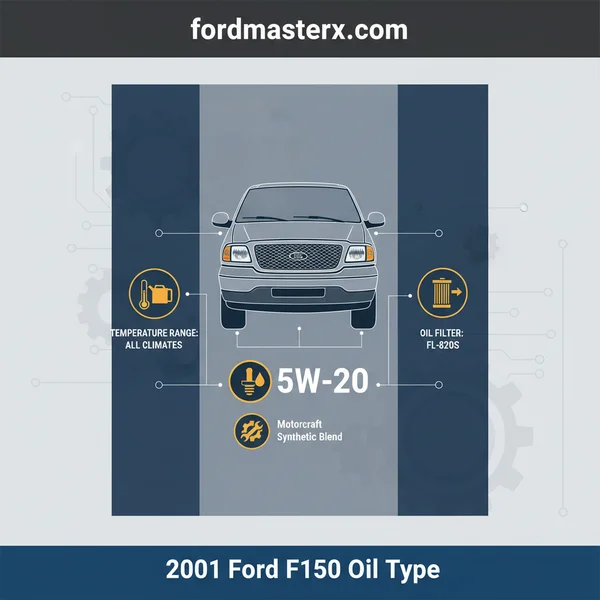
The recommended engine oil for all 2001 Ford F-150 engine options is SAE 5W-20 synthetic blend. While original manuals for the 4.2L V6 may list 5W-30, Ford later back-spec’d all three engines (4.2L, 4.6L, and 5.4L) to 5W-20 to improve fuel economy and cold-start lubrication.
🎯 Key Takeaways
- Use SAE 5W-20 oil for all 2001 F-150 engine variants.
- The oil capacity for all engines is exactly 6.0 quarts.
- Ford back-spec’d the 4.2L V6 from 5W-30 to 5W-20.
- Motorcraft FL-820S is the standard filter for V8 models.
- High-mileage synthetic blends are ideal for aging 2001 Triton engines.
For the 2001 Ford F-150, the recommended engine oil is 5W-20 synthetic blend across all three primary engine platforms: the 4.2L V6, the 4.6L V8, and the 5.4L V8. While your original factory owner’s manual might suggest 5W-30 for the V6 or early V8 builds, Ford officially updated their recommendations via technical service bulletins to standardize 5W-20 for these engines. Using the modern 5W-20 specification ensures your truck meets the lubrication requirements Ford established to maximize fuel economy and long-term engine protection.
Getting this specification right is about more than just following a chart; it is about protecting the internal components of a high-mileage workhorse. Your 2001 F-150 likely has significant miles on the odometer, and the modular Triton V8 and Essex V6 engines rely on precise oil pressure to operate timing chain tensioners and overhead cams. Feeding your engine the wrong viscosity can lead to unnecessary internal wear or “cold start” noise, which often signals that the top end of the engine is struggling for lubrication.
Official Oil Viscosity Recommendations for 2001 F-150 Engines
The 2001 model year represented a significant transition period for Ford’s lubrication strategy. When these trucks were first manufactured, the documentation for the 4.2L V6 and early 4.6L V8 engines often listed 5W-30 as the preferred weight. However, shortly after production, Ford issued Technical Service Bulletin (TSB) 02-1-9, which “back-spec’d” almost all their engines from that era to 5W-20. This change was retroactive, meaning that even if your oil fill cap says 5W-30, Ford’s current official stance is that 5W-20 is the superior choice for your vehicle.

The Ford Back-Spec: Why 5W-20 is Now Standard
You might wonder why Ford changed their recommendation years after the truck hit the road. The primary reason was a combination of stricter fuel economy standards and the need for better oil flow during cold starts. 5W-20 is a thinner oil that moves more quickly through the engine’s narrow oil passages when the temperature is low. This is critical for the 4.6L and 5.4L V8 engines because they utilize complex overhead cam (OHC) designs. If the oil is too thick when you turn the key, it takes longer to reach the cylinder heads. Over time, that split-second delay causes metal-on-metal friction. By switching to 5W-20, Ford ensured that internal components receive lubrication almost instantly, reducing startup wear significantly.
Recommended Oil Types by Engine
- 4.2L V6 Essex Engine: Ford officially back-spec’d this engine to 5W-20. For best results, use a high-quality synthetic blend that meets Ford’s WSS-M2C153-H specification.
- 4.6L V8 Triton Engine: This engine requires 5W-20. It is highly sensitive to viscosity changes due to the tight tolerances in the valvetrain and the hydraulic lash adjusters.
- 5.4L V8 Triton Engine: This engine also requires 5W-20. This applies to both the standard 2-valve 5.4L found in the XLT and Lariat models and the supercharged version found in the SVT Lightning.
While many owners of high-mileage trucks are tempted to switch to a thicker 10W-30 or 10W-40 oil to “quiet down” engine noise, this is generally discouraged for the 2001 F-150. Instead of increasing the thickness, stick with 5W-20 but choose a “High Mileage” formulation. These oils contain specific seal conditioners and extra detergents that help manage the gaskets and sludge buildup common in engines with over 150,000 miles.
Everything You Need to Know About Your 2001 Ford F150 Oil Change
Maintaining a legendary truck like the 2001 Ford F150 requires attention to detail, especially when it comes to lubrication. This guide covers everything from selecting the specific oil type required for the 10th-generation F150 to the physical process of performing the change yourself. Whether you have the 4.2L V6, the 4.6L V8, or the powerhouse 5.4L V8, consistency is key to hitting that 300,000-mile milestone. Following these steps ensures your engine remains protected against internal friction, heat buildup, and sludge accumulation, ultimately preserving your truck’s horsepower and fuel efficiency for years to come.
Step 1: Confirming Your Oil Type and Capacity
What you need: Owner’s manual, 6 quarts of 5W-20 motor oil, and a Motorcraft FL-820S oil filter (or equivalent).
Instructions: For the 2001 model year, Ford transitioned almost all F150 engines—including the 4.2L, 4.6L, and 5.4L—to 5W-20 viscosity oil. While older manuals might mention 5W-30, Ford issued a Technical Service Bulletin (TSB) recommending 5W-20 for better fuel economy and cold-start lubrication. You will need exactly 6.0 quarts (5.7 liters) of oil regardless of your engine size. It is highly recommended to use a synthetic blend or full synthetic oil to provide superior protection for high-mileage engines. Additionally, ensure you have a high-quality filter like the Motorcraft FL-820S, which features a silicone anti-drainback valve specifically designed for these Ford modular engines.
Pro Tip: If your truck has over 150,000 miles, consider using a “High Mileage” specific 5W-20 oil. These contain seal conditioners that help prevent the gaskets from drying out and leaking.
Step 2: Gathering Tools and Setting Up the Workspace
What you need: 13mm or 16mm wrench (depending on your specific drain plug), oil filter wrench, drain pan (minimum 7-quart capacity), funnel, shop rags, and nitrile gloves.
Instructions: Park your F150 on a level surface and engage the parking brake. If you have a 4WD model, you likely have enough ground clearance to slide under without jacks; however, 2WD models may require ramps or a floor jack with jack stands. Start the engine and let it idle for about 5 minutes. Warm oil flows much faster and carries more contaminants out of the engine than cold, viscous oil. Once warmed, shut off the engine and open the hood. Locate the oil fill cap on the passenger side valve cover and loosen it; this breaks the vacuum and allows the oil to drain more smoothly from the bottom.
Pro Tip: Spread a large piece of cardboard or a drop cloth under the work area. The 2001 F150 oil filter placement is notorious for dripping onto the front frame crossmember, and this will save your driveway from permanent stains.
Step 3: Draining the Old Engine Oil
What you need: Drain pan, wrench, and safety glasses.
Instructions: Slide under the vehicle and locate the oil pan. The drain plug is situated at the rear of the pan. Position your drain pan slightly behind the plug, as the oil will initially stream out with some force. Using your wrench, loosen the plug counter-clockwise. Once it is loose enough to turn by hand, apply inward pressure on the plug as you unscrew the final threads; this prevents oil from leaking over your hands prematurely. Quickly pull the plug away and let the oil drain completely. This process usually takes about 10 to 15 minutes. While the oil is dripping, inspect the drain plug’s rubber gasket for cracks or flattening.
Pro Tip: Use a magnetic drain plug if you don’t already have one. It will catch fine metallic particles circulating in your oil, providing an extra layer of protection and an early warning system for engine wear.
Step 4: Removing the Old Oil Filter
What you need: Oil filter wrench and shop rags.
Instructions: On the V8 engines, the oil filter is located on the driver’s side near the front bumper, often tucked behind the power steering cooling lines. On the V6, it is more centrally located. Position your drain pan under the filter area. Use the filter wrench to loosen the canister. Once loose, unscrew it by hand. Be prepared: as the seal breaks, oil will spill out and likely run down the frame of the truck. Completely remove the filter and set it face down in the drain pan. Use a clean rag to wipe the mounting surface on the engine block. Ensure the old rubber gasket came off with the filter and is not stuck to the engine.
Pro Tip: This is the messiest part of the job on a 2001 F150. You can create a “chute” out of an old soda bottle or aluminum foil to redirect the oil away from the frame and straight into your pan.
Step 5: Installing the New Filter and Drain Plug
What you need: New oil filter, clean oil, and the original drain plug.
Instructions: Before installing the new filter, dip your finger in clean oil and smear a light film over the new filter’s rubber gasket. This ensures a proper seal and makes it easier to remove during the next oil change. Screw the filter onto the threaded stud by hand. Once the gasket makes contact with the base, tighten it another 1/2 to 3/4 of a turn. Do not use a wrench to tighten the filter, as over-tightening can damage the gasket. Next, return to the drain plug. Wipe the threads clean, reinstall it into the oil pan, and tighten it to approximately 15-20 lb-ft of torque. It should be snug but not forced.
Pro Tip: “Pre-filling” the oil filter with about half a cup of fresh oil before installation can help the engine reach oil pressure faster upon the first start, reducing dry-start wear.
Step 6: Filling the Engine with Fresh 5W-20
What you need: 6 quarts of oil and a clean funnel.
Instructions: Place your funnel into the oil fill neck on the passenger side. Pour in 6 quarts of your 5W-20 oil. Pour slowly to avoid air pockets that might cause the oil to bubble back up the funnel. If you are using a large 5-quart jug, hold it sideways while pouring to prevent the “glugging” effect that leads to spills. Once the 6 quarts are in, remove the funnel and tightly replace the oil fill cap. Double-check that you haven’t left any rags or tools in the engine bay before proceeding to the next step.
Pro Tip: Always keep one empty quart container. When you are finished, you can use the funnel to pour the old oil back into the empty containers for easy transport to a recycling center.
Step 7: Verifying Oil Levels and Leak Check
What you need: The vehicle’s dipstick and a clean rag.
Instructions: Start the engine and let it run for about two minutes. While it’s running, look under the truck with a flashlight to verify there are no drips coming from the drain plug or the oil filter. Shut the engine off and let the truck sit for at least five minutes to allow the oil to settle back into the pan. Pull the oil dipstick (usually has a yellow handle), wipe it clean, reinsert it fully, and pull it out again. The oil level should be exactly between the two holes or within the crosshatched area on the stick. If it is slightly low, add the remaining portion of your 6th quart.
Pro Tip: Note the mileage of the oil change on a sticker or in a notebook. Even though the 2001 F150 is rugged, sticking to a 3,000 to 5,000-mile interval is the best way to ensure the timing chain tensioners (a common wear point) stay lubricated.
✅ Final Checklist
- Drain plug is tightened and not weeping oil.
- Oil filter is hand-tight and the old gasket was confirmed removed.
- Exactly 6 quarts of 5W-20 oil have been added to the system.
- The oil fill cap and dipstick are fully seated.
- The “Oil Pressure” gauge on the dashboard remains in the normal range after startup.
Important Notes:
- Safety: Never work under a vehicle supported only by a floor jack; always use rated jack stands. Avoid contact with hot exhaust manifolds during filter removal.
- Professional Help: If you notice heavy metallic flakes in the drained oil or if the drain plug threads are stripped, consult a professional mechanic immediately.
- Estimated Time: 30 to 45 minutes.
- Cost Range: $35–$60 depending on whether you choose conventional or full synthetic oil.
Oil Capacity and Filter Specifications by Engine Size
Knowing how much oil to buy is just as important as the viscosity. For the 2001 Ford F-150, the capacity is surprisingly uniform across the engine lineup, but the physical oil filter types vary between the V6 and V8 models. You should always use a dipstick check to finalize your oil level, but the following specifications provide the standard refill amounts when you are changing both the oil and the filter.

Engine Oil Capacity Breakdown
Your total oil capacity is the amount of fluid needed to bring the engine back to the “Full” mark on the dipstick after a complete drain. For a typical DIY oil change on a 2001 F-150, use these figures:
- 4.2L V6 Engine: 6.0 Quarts (5.7 Liters).
- 4.6L V8 Engine: 6.0 Quarts (5.7 Liters).
- 5.4L V8 Engine: 6.0 Quarts (5.7 Liters).
It is a common misconception that the V6 takes less oil because it has fewer cylinders. In the 2001 model year, all three engines utilize a 6-quart capacity. When shopping, it is most cost-effective to buy one 5-quart jug and a single 1-quart bottle. This ensures you have exactly enough to reach the top of the cross-hatch pattern on the dipstick without overfilling, which can cause aeration and foaming of the oil.
Oil Filter Compatibility and Part Numbers
Selecting the right filter is the final step in ensuring your 2001 F-150 stays healthy. Ford strongly recommends using Motorcraft filters because they feature a silicone anti-drainback valve. This valve prevents oil from draining out of the filter and back into the pan when the engine is turned off. Without it, your engine effectively starts “dry” every morning.
- 4.2L V6 Filter: Motorcraft FL-400S (or equivalent). This is a narrower, longer filter designed for the V6 mounting location.
- 4.6L & 5.4L V8 Filter: Motorcraft FL-820-S (or equivalent). This is the standard “fat” filter for the Triton V8 family. It is designed to handle the higher flow rates produced by the V8 oil pumps.
If you prefer aftermarket brands like WIX, Mobil 1, or Bosch, ensure the cross-reference matches these Motorcraft part numbers. Using a filter without a high-quality anti-drainback valve in a Triton V8 often results in a “tapping” or “rattling” sound for the first few seconds after a cold start.
Understanding Ford’s 5W-20 Back-Specification (TSB 02-1-9)
If you look at the original owner’s manual for some early 2001 Ford F-150s, you might see a recommendation for 5W-30 oil. However, shortly after these trucks hit the road, Ford issued a Technical Service Bulletin (TSB 02-1-9) that changed the game. This bulletin “back-specified” the 5W-20 viscosity for almost all of their modular engines, including the 4.6L and 5.4L V8s found in your truck.
Why the Switch to 5W-20?
Ford didn’t just change the recommendation on a whim. The move to 5W-20 was driven by a need for better fuel economy and improved engine lubrication during those critical first few seconds after a cold start. Because 5W-20 is slightly thinner than 5W-30, it reaches the top of the engine faster, protecting the overhead cams and valve train from premature wear. For 2001 F-150 owners, this means better protection in freezing climates and a slight bump in MPG.
Is 5W-30 Ever Better?
While 5W-20 is the official word from Ford, some high-mileage owners still prefer 5W-30, especially in extremely hot climates like Arizona or Texas. If your 5.4L Triton engine has developed the infamous “ticking” sound when warm, a slightly thicker oil can sometimes quiet the valve train. However, for 90% of drivers, the back-specified 5W-20 is the safest and most efficient choice.
- Better Flow: 5W-20 circulates faster during cold starts than 5W-30.
- Efficiency: Reduced internal friction leads to better fuel economy.
- Compatibility: This TSB applies to the 4.2L V6, 4.6L V8, and 5.4L V8 engines.
Choosing Between Conventional, Synthetic Blend, and Full Synthetic
By now, your 2001 F-150 likely has a lot of stories to tell—and a lot of miles on the odometer. Because these trucks are now two decades old, the type of oil you choose matters more than it did when the truck was new. You aren’t just lubricating parts; you are maintaining seals and clearing out old deposits.
The Case for High-Mileage Synthetic Blends
Ford originally filled these trucks with Motorcraft Synthetic Blend. It’s an excellent “middle ground” oil. For a 2001 model, a High Mileage Synthetic Blend is often the sweet spot. These oils contain specific additives called seal conditioners. Over time, the rubber seals in your engine can become brittle and shrink; seal conditioners help swell them back up, which can stop or prevent those annoying oil spots on your driveway.
Should You Go Full Synthetic?
If you use your F-150 for heavy towing or frequent off-roading, full synthetic is worth the extra cost. It handles extreme heat much better than conventional oil and won’t break down as fast under stress. If you are switching an old truck to full synthetic for the first time, just keep an eye on your gaskets. Synthetic oil is very “slippery” and has high detergent levels; it can sometimes clean out gunk that was actually helping a weak seal hold oil in, leading to new minor leaks.
- Conventional Oil: Fine for basic driving, but requires more frequent changes (every 3,000 miles).
- Synthetic Blend: The original factory standard; great for daily drivers with over 100k miles.
- Full Synthetic: The best choice for towing, hauling, and extreme temperature protection.
- Pro Tip: Always look for the API Starburst symbol on the bottle to ensure the oil meets modern engine protection standards.
Conclusion
Keeping your 2001 Ford F-150 on the road starts with what you pour into the crankcase. Whether you have the workhorse 4.2L V6 or the powerful 5.4L V8, using the recommended 5W-20 viscosity and a high-quality filter is the best way to ensure your truck hits the 200,000 or even 300,000-mile mark. While 5W-30 was common in the past, Ford’s updated recommendations favor the lighter 5W-20 for its superior flow and efficiency.
Your next steps are simple: check your current oil level using the dipstick, pick up a fresh Motorcraft FL-820S (or FL-400S for the V6), and choose a high-mileage oil that suits your driving habits. Regular maintenance is the cheapest insurance policy you can buy for your truck. Grab your supplies today and keep that legendary F-Series performance going strong!
❓ Frequently Asked Questions
Why did Ford change the recommendation for the 4.2L V6 from 5W-30 to 5W-20?
Ford issued a Technical Service Bulletin (TSB) stating that 5W-20 provides better fuel economy and reduced internal friction. This update applies to most 2001 models even if the original oil cap or manual says 5W-30.
What is the best oil brand for a high-mileage 2001 F-150?
Motorcraft is the factory-recommended brand, but any high-quality oil meeting Ford specification WSS-M2C153-H is suitable. For older trucks, a high-mileage full synthetic can help preserve seals and reduce consumption.
Does the 2001 F-150 4×4 require different oil than the 2WD model?
No, the oil type and capacity are determined by the engine size (4.2L, 4.6L, or 5.4L) rather than the drivetrain configuration. Both 2WD and 4×4 models use the same engine specifications.
What are the symptoms of using the wrong oil weight in a Triton engine?
Using oil that is too thick can lead to poor lubrication of the overhead cams and timing chain tensioners. This may cause ‘ticking’ sounds or premature engine wear, especially during cold starts.
Is there a difference in capacity between the 4.6L and 5.4L V8 engines?
Interestingly, both the 4.6L and the 5.4L V8 engines for the 2001 model year share the same oil capacity of 6.0 quarts. Always check the dipstick after filling to ensure the level is correct.
What oil filter should I use for the 4.2L V6 engine?
The 4.2L V6 typically uses the Motorcraft FL-400S oil filter. This is a different model than the FL-820S used in the V8 versions, so ensure you match the filter to your specific engine.