P0420 Code On Ford F-150 Causes And Real Fix Costs By Engine 2026

P0420 on a Ford F-150 means the powertrain control module has flagged low catalyst efficiency on Bank 1, the engine side that holds cylinder one. It is not an emergency code. Your truck will still drive normally in most cases, though you should not ignore it long term.
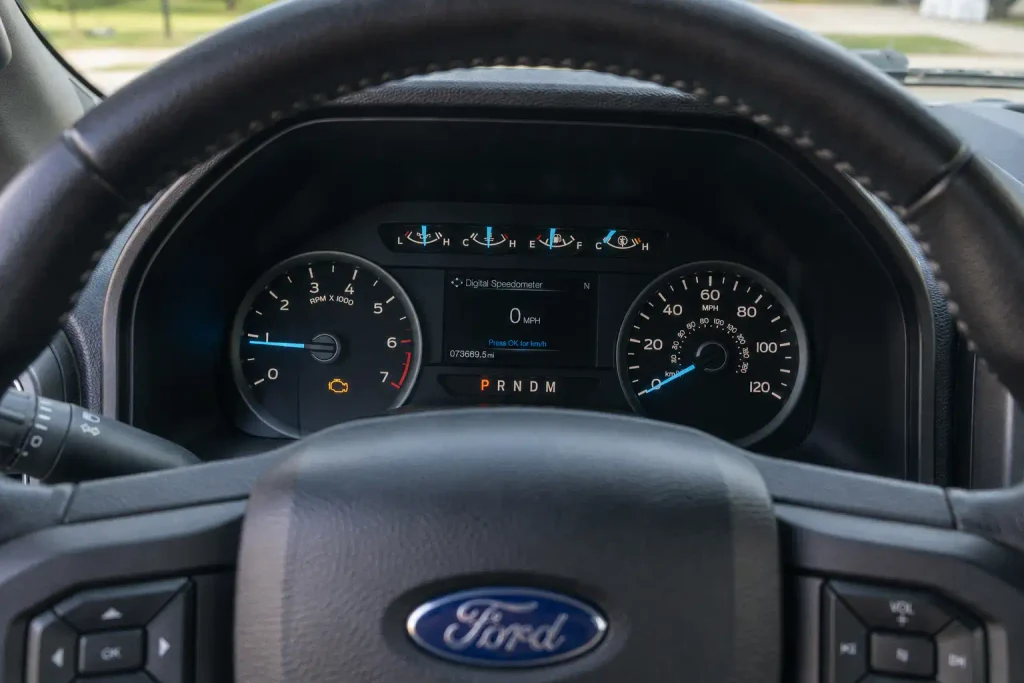
Ford has issued specific technical service bulletins for this exact code on several F-150 engines, and in many cases the real fix has nothing to do with the catalytic converter itself. Before you spend money on parts, here is what actually triggers P0420 on an F-150, broken down by engine, and what each real fix costs.

Prime for Young Adults — 6 Months Free
Students and 18–24s get six months of Prime free, then half price.
Start 6 Months Free As an Amazon Associate I earn from qualifying purchases.Ford F-150 Catalyst Code Diagnostic Guide
What it means, what to check first, and real repair costs
Diagnostic Path
Check For An Open TSB
Give your VIN to a dealer or shop before buying any parts
Inspect Sensors And Exhaust
Test both oxygen sensors and check for leaks near the manifold
Confirm The Converter
Replace it only after steps one and two rule out cheaper causes
TSBs By Engine
Real Repair Cost By Cause
Bar chart comparing three repair costs for Ford F-150 P0420. PCM reflash costs 150 to 300 dollars. Oxygen sensor replacement costs 394 to 453 dollars. Catalytic converter replacement costs 871 to 2055 dollars depending on model year.
What Determines The Real Cause Of P0420 On Your F-150
Recommended Best Deal Products


Four things decide whether P0420 on your F-150 is a low cost fix or an expensive one.

Audible — Listen Free for 30 Days
One free credit a month and thousands of titles included.
Listen Free for 30 Days As an Amazon Associate I earn from qualifying purchases.Engine And Model Year
Ford has published engine specific TSBs for this code. The 2018-2020 2.7L EcoBoost, the 2021 3.5L EcoBoost, and the 2022-2023 3.5L PowerBoost each have their own documented software fixes. Older V8 trucks are more likely dealing with a genuine mechanical issue.
Converter Origin
Aftermarket catalytic converters trigger P0420 far more often than OEM units, because they are not built to the exact efficiency threshold Ford’s PCM expects.
Mileage And Sensor Wear
Oxygen sensors are a normal wear item. High mileage trucks running original sensors are more likely to have a genuinely failing component behind the code, not just a software quirk.
Start with the cheapest, most common cause first: your PCM.
If Your F-150 Has A Known TSB Check This First
If your F-150 is a 2018-2020 model with the 2.7L EcoBoost, Ford’s TSB 24-2184 addresses false P0420 and P0430 codes caused by PCM calibration sensitivity. The fix is a PCM reprogram followed by a catalyst stabilization drive cycle, not a parts replacement.
A separate bulletin, TSB 22-2260, covers the same 2018-2020 2.7L trucks for a different trigger. High sulfur fuel can cause the same codes, and Ford’s fix is a de-sulfation drive cycle rather than new parts.
If you own a 2021 F-150 with the 3.5L EcoBoost built before March 2, 2021, TSB 21-2087 covers a PCM reprogram for a cluster of codes that includes P0420 and P0430.
For 2022-2023 F-150s with the 3.5L PowerBoost hybrid, TSB 25-2233 supersedes an earlier bulletin and prescribes a PCM reflash plus catalyst stabilization drive cycle for the same issue.
Owners have also reported the code appearing shortly after Ford’s Emission Recall 24E12 update on 2018-2020 2.7L trucks, according to forum reports on F150Forum. The recall itself is a separate PCM software update tied to emissions compliance.
Several owners describe the P0420 code showing up for the first time within days of that update being installed. That timing points back to calibration sensitivity rather than a sudden converter failure.
Audible Premium Plus — Annual Membership
12 audiobook credits up front, plus the full Audible catalogue.
See Annual Plans As an Amazon Associate I earn from qualifying purchases.A dealer visit with your VIN is the fastest way to check whether any of these bulletins apply to your truck. Independent shops can also pull TSB data through the same diagnostic databases, so a dealer trip is not strictly required just to check for an open bulletin.
A PCM reflash typically costs $150 to $300 at a dealer. That is a fraction of what an unnecessary converter replacement runs.
If your truck isn’t covered by a TSB, or the reflash didn’t clear the code, the next most common cause is a leak or a failing sensor, not the converter itself.
If You Hear Ticking Or Smell Rotten Eggs Check The Sensors
A rhythmic ticking near the exhaust manifold, especially on a cold start, usually points to a leak upstream of the converter rather than a problem inside it. A rotten egg smell from the tailpipe is another common symptom worth checking before you assume the worst.
The PCM compares readings from the upstream and downstream oxygen sensors to judge converter efficiency. If a downstream sensor is failing, its readings can falsely mirror the upstream sensor and trigger P0420 even when the converter is fine.
By Ford’s own convention, Bank 1 refers to the side of the engine containing cylinder one, which lines up with the passenger side on F-150 V6 and V8 engines. That matches which converter and sensor set to inspect first when you get this code.
A Motorcraft downstream oxygen sensor typically runs $45 to $113 depending on position and model year, based on current retail listings at PartsGeek. RepairPal estimates the full parts and labor cost of an F-150 oxygen sensor replacement between $394 and $453.
One workaround worth flagging: some owners install a spacer on the downstream sensor to physically pull it out of the direct exhaust stream and mask a marginal reading. This is illegal emissions tampering in most jurisdictions and is not something we recommend. It does not fix the underlying issue, it just hides it from the PCM.
If neither the software fix nor the sensors solve it, the converter itself may genuinely be failing.
If Nothing Else Fixes It Here Is The Real Converter Cost
A converter is a legitimate suspect once you have ruled out an open TSB and tested the sensors. A physical rattle when you tap the converter housing, or a code that keeps returning after a clean sensor test, both point toward a real failure.
Repair cost estimates vary widely by model year rather than following a simple trend, since national averages shift with parts availability and labor rates. RepairPal’s per year estimates for full catalytic converter replacement on an F-150 include the following.
| Model Year | Estimated Cost Range |
|---|---|
| 2004 | $1,998 to $2,055 |
| 2021 | $1,728 to $1,803 |
| 2022 | $871 to $957 |
| 2023 | $1,289 to $1,363 |
| 2025 | $1,152 to $1,237 |
Real owner reports back this up. One F150Forum member with 145,000 miles was quoted roughly $4,000 to replace both banks. Another owner of a 2006 F-150 with the 5.4L reported a $2,782 dealer quote covering both converters and new oxygen sensors, according to a thread on FordF150.net.
Whatever you replace it with, make sure the converter meets EPA or CARB emissions standards for your state. A cheap universal converter that isn’t compliant can trigger the same code again within a few thousand miles and will fail an emissions test outright.
Before paying out of pocket, check your truck’s age and mileage against Ford’s federal emissions warranty, which covers the catalytic converter for 8 years or 80,000 miles from the original in service date. A converter that fails within that window may be a warranty repair rather than a bill you have to cover yourself.
Whichever branch applies to you, here is the fastest way to confirm it.
How To Diagnose P0420 On Your F-150 In 3 Steps
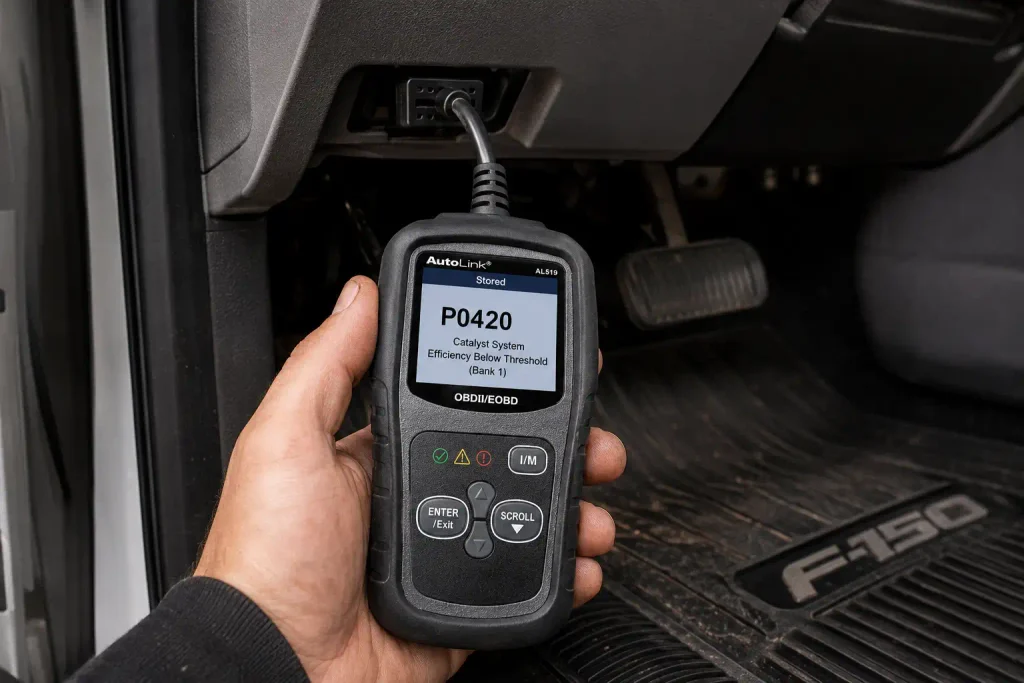
Work through these three checks in order before spending a dollar on parts.
| Step | What To Check | Typical Cost If Confirmed |
|---|---|---|
| 1 | Pull the code and check your VIN for an open TSB or recall | $150 to $300 for a reflash |
| 2 | Inspect for exhaust leaks and test both oxygen sensors | $45 to $453 depending on sensor and labor |
| 3 | Physically inspect and data test the converter itself | $871 to $2,055 depending on model year |
A basic scan tool is enough to pull the code and check freeze frame data before your first step. Our guide to the best OBD2 scanner for Ford F-150 covers models that read Ford specific PCM data, which matters for step two.
One more thing before you commit to a repair path.
P0420 Does Not Always Mean A New Catalytic Converter
Check for an open TSB on your engine and model year first. Move to the sensors and exhaust system next. Only replace the catalytic converter once you have confirmed it is the actual problem.
Your F-150 is safe to drive with a P0420 code in the meantime, but it will fail an emissions test and shouldn’t be left unaddressed for months. The fastest path forward is pulling the code yourself and checking your VIN against Ford’s open TSBs today.
5 Common Questions About P0420 On The Ford F-150
Is it safe to drive an F-150 with a P0420 code?
Yes, in most cases the truck drives normally with a P0420 code and won’t leave you stranded. You may notice slightly worse fuel economy or a faint exhaust smell. It will likely fail an emissions test, so get it diagnosed soon rather than ignoring it indefinitely.
Does P0420 always mean the catalytic converter is bad?
No. Many 2018-2020 2.7L EcoBoost and 2022-2023 3.5L PowerBoost trucks trigger this code purely from PCM software sensitivity, not a failed converter. Check for an open TSB tied to PCM behavior on your engine and model year before you authorize any parts replacement.
How much does it cost to fix P0420 on an F-150?
A PCM reflash under a Ford TSB typically runs $150 to $300 at a dealer. A full converter replacement, if it’s genuinely needed, ranges roughly $871 to $2,055 depending on model year and region, based on RepairPal’s per year cost estimates.
Will P0420 make my F-150 fail an emissions test?
Yes. A stored P0420 code indicates the catalyst monitor is not meeting its efficiency threshold, and most state emissions programs will fail the vehicle on that code alone. Clearing the code without fixing the underlying cause will not pass inspection, since the monitor will simply reset to not ready.
Can a bad oxygen sensor cause a false P0420 code?
Yes. A failing downstream sensor can send readings that closely mirror the upstream sensor, tricking the PCM into flagging low catalyst efficiency even when the converter is healthy. Check the oxygen sensor locations for your specific F-150 engine before assuming the converter itself has failed.