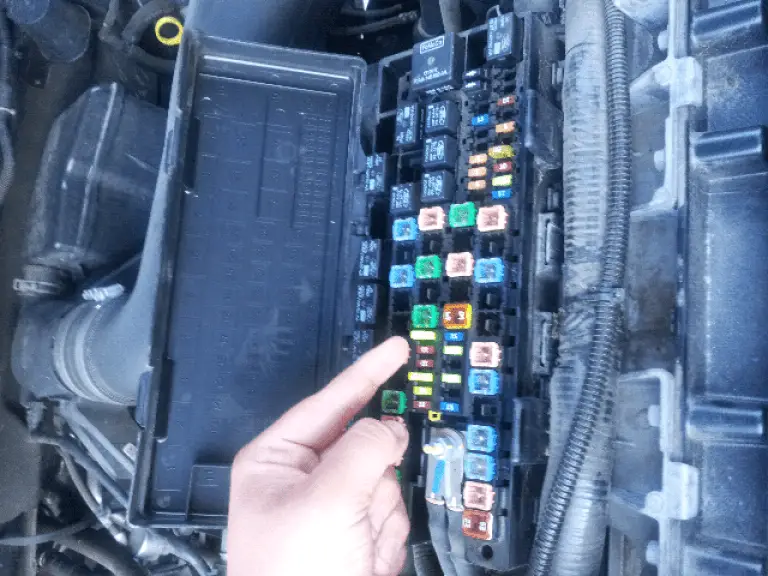
P0300 Code Ford F150: Causes, Diagnosis & Fix Guide 2026

The P0300 code Ford F150 means the powertrain control module detected a random or multiple-cylinder misfire. The code confirms that combustion is inconsistent, but it does not identify a failed spark plug, ignition coil, injector, sensor, or mechanical part.
Ford’s gasoline OBD documentation classifies P0300 as a general misfire DTC and monitors misfire continuously during the drive cycle on current systems. The correct diagnosis depends on your F-150 engine, stored companion codes, freeze-frame data, and exactly when the misfire occurs.

Prime for Young Adults — 6 Months Free
Students and 18–24s get six months of Prime free, then half price.
Start 6 Months Free As an Amazon Associate I earn from qualifying purchases.Before replacing parts, save the scan data and identify whether the problem happens at idle, during acceleration, on cold start, or across several operating conditions. That evidence usually gives you a much better starting point than the P0300 code alone.
P0300 Random Misfire Diagnosis
Follow the evidence from scan data to the correct system before replacing plugs, coils, injectors, or other parts.
Check Misfire Severity First
A flashing check engine light with severe shaking or power loss requires immediate attention.
Reduce load and diagnose immediately.
Save codes and continue diagnosis carefully.
Save Codes and Freeze Frame
Record RPM, load, coolant temperature, fuel trims, speed, and all stored or pending DTCs before clearing anything.
Look for P0301 Through P0308
A cylinder-specific code or dominant misfire counter gives you a much narrower diagnostic path.
Test plug, coil, injector, wiring, and compression.
Check air, fuel, timing, and mechanical systems.
Match the Misfire to the Driving Condition
Vacuum leak, PCV, fuel trim, injector.
Plug, coil, fuel delivery.
Ignition, injector, compression.
System-level or mechanical diagnosis.
Use the Correct F150 Engine Path
Different F150 engines have different ignition, fuel, intake, and valve-control systems.
Test Before Replacing Parts
Prove the fault with coil swaps, plug inspection, fuel trim analysis, fuel data, injector testing, compression, or timing checks as the evidence requires.
Confirm the Repair
Reproduce the original operating condition and confirm that misfire counters remain controlled and no pending P0300 returns.
How Serious Is P0300 on a Ford F150
Recommended Best Deal Products
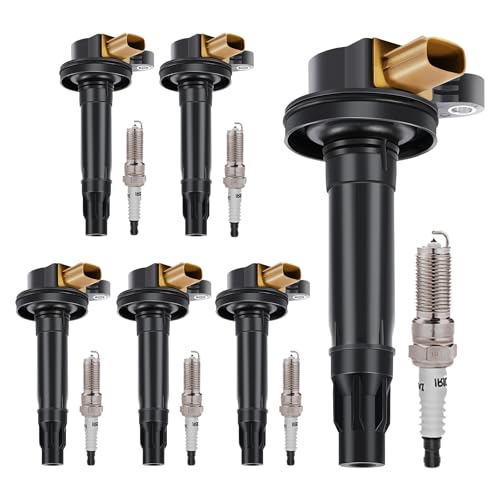


A P0300 can range from an intermittent misfire to a condition that can damage the catalytic converter.

Audible — Listen Free for 30 Days
One free credit a month and thousands of titles included.
Listen Free for 30 Days As an Amazon Associate I earn from qualifying purchases.If the check engine light is solid and the truck still runs normally, avoid hard acceleration and diagnose the problem soon. A mild intermittent misfire can become worse when engine load increases.
If the check engine light is flashing, Ford says engine misfire may be occurring and increased exhaust temperatures can damage the catalytic converter or other components. Ford specifically advises avoiding heavy acceleration and deceleration and having the truck checked as soon as possible.
Reduce load immediately if your F-150 also has:
- Severe shaking
- Major power loss
- Strong raw-fuel smell
- Repeated flashing check engine light
- Loud mechanical knocking
- Stalling or difficulty staying running
For more detail on how Ford warning lamps behave, see our Ford check engine light guide.
The next step is not replacing parts. It is preserving the evidence stored by the PCM.
What Scan Data Should You Check Before Replacing Parts
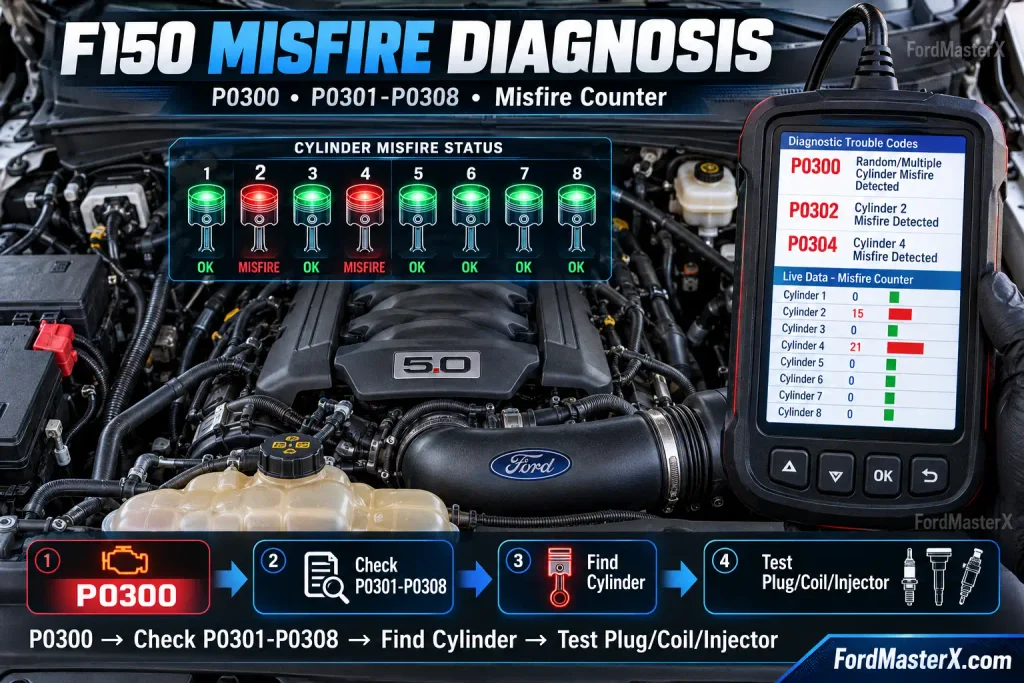
Do not erase P0300 immediately after connecting your scanner. Clearing the code can remove freeze-frame information that tells you what the engine was doing when the fault matured.
Start by recording the following data.
Check All Companion Codes
Look for P0301 through P0308 first.
These codes identify a cylinder-specific misfire:
- P0301 means cylinder 1
- P0302 means cylinder 2
- P0303 means cylinder 3
- P0304 means cylinder 4
- P0305 means cylinder 5
- P0306 means cylinder 6
- P0307 means cylinder 7
- P0308 means cylinder 8
Ford’s OBD documentation lists P0300 alongside the individual P0301 through P0310 misfire codes. A cylinder-specific code can turn a broad P0300 diagnosis into a much narrower test sequence.
Audible Premium Plus — Annual Membership
12 audiobook credits up front, plus the full Audible catalogue.
See Annual Plans As an Amazon Associate I earn from qualifying purchases.Also record lean, fuel-pressure, injector, crankshaft, camshaft, and timing-related DTCs. They can completely change the diagnostic direction.
Save the Freeze Frame
Record:
- Engine RPM
- Calculated engine load
- Coolant temperature
- Intake-air temperature
- Vehicle speed
- Short-term fuel trim
- Long-term fuel trim
- Fuel-pressure data when supported
A code that sets near idle requires a different diagnostic approach from one that appears during hard acceleration.
Check Misfire Counters
A capable scanner may expose cylinder misfire information through Mode $06 or Ford-enhanced data.
Ford’s OBD system uses crankshaft-speed information as part of misfire monitoring and calculates misfire rates over defined crankshaft revolution windows. Current Ford documentation shows monitoring can calculate misfire rates over 200 or 1,000 revolutions.
If one cylinder consistently accumulates most of the misfires, start with that cylinder instead of treating all cylinders equally.
If several cylinders on both banks misfire, move system-level problems such as air, fueling, timing, or mechanical condition higher on the list.
Which P0300 Symptom Does Your F150 Have
Recommended Best Deal Products


When the misfire occurs is one of the strongest clues available.
Use this table as a diagnostic direction, not as a final diagnosis.
| Symptom | Check First |
|---|---|
| Rough mainly at idle | Vacuum leaks, PCV system, fuel trims, injector balance |
| Misfire during acceleration | Plugs, coils, fuel delivery |
| Misfire under boost | Ignition strength, plug condition, fuel delivery |
| Misfire mainly on cold start | Ignition, injector leakage, compression, engine-specific issues |
| Misfire after hot restart | Fuel system, injector, mechanical condition |
| Multiple cylinders on both banks | Air, fuel, timing, sensor data, mechanical condition |
| One cylinder dominates counters | Plug, coil, injector, compression on that cylinder |
Misfire Mainly at Idle
A rough idle that improves as RPM rises should make you inspect air leaks and mixture control before buying ignition parts.
Look at both banks’ fuel trims. Strong positive correction at idle that improves as airflow increases can support an unmetered-air diagnosis.
If lean codes are also stored, our Ford P0171 code diagnosis covers the lean-mixture side in more detail.
Misfire Mainly Under Acceleration
A misfire that appears when you accelerate puts greater demand on the ignition and fuel systems.
A marginal plug or coil can work acceptably at light load but struggle when cylinder pressure rises. Fuel delivery problems can also become more obvious as engine demand increases.
Do not replace all coils based on this symptom alone. Identify the affected cylinders first.
Misfire on One Cylinder
When P0300 appears with one dominant P030X code, concentrate the diagnosis there.
Inspect that cylinder’s plug, coil boot, connector, injector operation, and mechanical sealing. A controlled coil swap can help prove a coil failure if the misfire moves with the coil.
If the misfire stays on the original cylinder after the coil moves, continue toward the plug, injector, wiring, and compression rather than buying another coil.
Which P0300 Causes Apply to Your F150 Engine
The same P0300 code does not justify the same first repair on every F-150 engine.
Engine generation matters because Ford has used different ignition, fuel-delivery, intake, and valve-control systems across the F-150 lineup.
P0300 on the 3.5L EcoBoost
On a 3.5L EcoBoost, start with the operating condition.
If the misfire appears mainly during acceleration or boost, inspect the spark plugs, coil boots, coils, and fuel-delivery evidence first. A weak ignition component can become much easier to detect under cylinder pressure than at idle.
For an idle-related problem, inspect intake plumbing and PCV-related air leaks and compare fuel trims between banks.
If your diagnostic data also points toward manifold-pressure measurement, our 3.5 EcoBoost MAP sensor location guide shows where the relevant sensor is located.
Cam timing should move higher in the diagnostic sequence when P0300 appears with camshaft-related codes, abnormal timing data, startup rattle, or other evidence of a VCT problem. Our 3.5 EcoBoost cam phaser replacement guide covers that system separately.
Do not diagnose cam phasers from P0300 alone.
P0300 on the 2.7L EcoBoost
The 2.7L EcoBoost needs an important model-year exception.
Ford TSB 19-2384 applies to certain 2016 and 2017 F-150s equipped with the 2.7L EcoBoost and built from April 1, 2016 through January 1, 2017.
Ford states that affected trucks may have rough idle in park or neutral at normal operating temperature combined with oil consumption greater than 1 quart in less than 3,000 miles. Applicable trucks may also store P0300 through P0306, P0316, P0524, or P06DD. Ford identifies cylinder-head valve-guide concerns as the potential cause.
That matters because replacing plugs and coils repeatedly would not correct a valve-guide problem.
If your 2016 or 2017 2.7L truck matches the build period, oil-consumption pattern, rough idle, and related codes, verify TSB applicability by VIN before continuing with routine ignition repairs.
For other 2.7L trucks, return to the normal evidence path: ignition, air, fuel, injector operation, and mechanical condition.
P0300 on the 5.0L Coyote
A 5.0L P0300 should be diagnosed from cylinder data and operating conditions rather than assuming the entire ignition system is worn.
If one cylinder leads the counters, inspect that cylinder’s plug and coil boot and use a controlled coil swap. If the misfire follows the coil, the evidence supports a coil fault.
If several cylinders misfire together, check air and fuel data before replacing multiple coils.
Ford’s current 5.0L specifications confirm the engine uses a coil-on-plug or coil-near-plug ignition arrangement, but exact spark-plug specifications vary by model year. For example, the 2025 F-150 5.0L manual specifies a 0.039 to 0.043 inch plug gap. That specification should not be applied automatically to older 5.0L engines.
Use the specification for your VIN and model year.
P0300 on the 4.6L and 5.4L Triton
Older 4.6L and 5.4L trucks still benefit from the same evidence-first approach.
Start with cylinder-specific misfire data if available. Inspect ignition components, vacuum and PCV plumbing, fuel delivery, and wiring before moving into mechanical testing.
If the code appeared immediately after timing, cylinder-head, intake, or major engine work, verify the work before replacing unrelated ignition parts.
A mechanical or cam-timing problem becomes more credible when P0300 is paired with abnormal compression, timing-related codes, unusual engine noise, or a clear repair-history connection.
For a broader Ford-wide explanation of this DTC, you can also reference our Ford P0300 random misfire guide. This F-150 guide focuses more narrowly on engine-specific diagnosis.
How to Diagnose P0300 Ford F150 in 6 Steps
Recommended Best Deal Products

The most efficient P0300 diagnosis moves from stored evidence and simple inspections toward tests that require more equipment.
Step 1 Save Every Code and Freeze Frame
Scan the PCM before disconnecting the battery or clearing codes.
Write down confirmed, pending, and permanent DTCs. Save the freeze frame and record when the problem happens.
Your goal is to answer one question first: What was the truck doing when the PCM detected the misfire?
Step 2 Identify the Misfire Pattern
Check P0301 through P0308 and available misfire counters.
Run the engine under the same general condition where the symptom occurs when it is safe to do so.
Watch whether:
- One cylinder dominates
- One bank is worse
- Several cylinders are scattered across both banks
- Misfires appear only as load increases
That pattern determines your next test.
Step 3 Inspect Ignition and Air Components
Before swapping anything, inspect the basics.
Check:
- Coil electrical connectors
- Coil boots
- Spark-plug wells
- Intake ducting
- PCV connections
- Vacuum hoses
- Wiring disturbed during recent repairs
- Evidence of moisture, oil, or carbon tracking
Ford’s current 3.5L EcoBoost uses coil-on-plug ignition, and the 2025 owner’s specification lists a 0.028 to 0.031 inch spark-plug gap. Use that only for the applicable engine and model year, not as a universal EcoBoost specification.
Step 4 Separate Ignition From Fuel Problems
If one cylinder clearly misfires more than the others, a controlled coil swap is useful.
Move the suspect coil to another cylinder, then reproduce the problem.
If the misfire moves with the coil, the coil becomes the supported diagnosis.
If the misfire remains on the original cylinder, reinstall the good coil and continue toward the spark plug, injector, wiring, or mechanical condition.
This approach is much more reliable than replacing an entire coil set because P0300 appeared.
Step 5 Check Fuel Trim and Fuel Delivery
Fuel-trim patterns help separate air and fueling problems.
If positive trims are strongest at idle and improve with higher airflow, look harder for unmetered air or PCV-related leakage.
If the truck becomes lean or loses fuel-pressure control mainly under load, fuel supply becomes more suspicious.
Compare commanded and actual fuel-pressure data when your scanner and engine support it.
Do not apply one universal fuel-pressure number across every F-150 engine. A 5.4L port-injected truck and a direct-injected EcoBoost use very different fuel systems.
Step 6 Test Mechanical Condition When Evidence Points There
Compression and leak-down testing belong later in the sequence unless earlier evidence already suggests mechanical trouble.
Move here when:
- The same cylinder continues misfiring after verified ignition testing
- Injector operation appears normal
- Mechanical noise is present
- Oil consumption is excessive
- Timing codes accompany P0300
- Recent engine work preceded the problem
- Relative compression identifies a weak cylinder
Compression results should be compared across cylinders using the Ford procedure for the exact engine. Do not diagnose an F-150 engine from a generic internet PSI number.
After correcting the cause, reproduce the original operating condition and confirm that misfire counters stay controlled and no pending P0300 returns.
What P0300 Diagnostic Mistakes Cost F150 Owners Money
The most expensive P0300 mistake is treating the code as a replacement-parts list.
Replacing Every Ignition Coil
P0300 does not mean all coils are bad.
Find the cylinder pattern first. Swap-testing one suspect coil is more useful than buying a full set without evidence.
Clearing the Code Immediately
Clearing DTCs before saving freeze-frame information removes valuable diagnostic context.
Record the conditions first. Clear the code after the cause has been repaired and you are ready to verify the result.
Blaming Oxygen Sensors First
Abnormal oxygen-sensor readings can be a result of a misfire rather than its cause.
Use fuel trims, companion DTCs, and other tests before replacing an O2 sensor because the exhaust data looks unusual.
If testing eventually points toward the sensor circuit itself, our Ford F150 oxygen sensor location guide can help identify sensor positions.
Assuming Every EcoBoost Misfire Is Carbon Buildup
A direct-injected engine can develop intake deposits, but P0300 alone does not prove carbon buildup.
Ignition faults, injectors, air leaks, fueling problems, valve problems, timing faults, wiring, and calibration concerns can create similar symptoms.
Test before choosing a repair.
Ignoring Ford Service Bulletins
Engine family and build date can matter.
The 2016 to 2017 2.7L EcoBoost example in TSB 19-2384 shows why VIN-specific service information deserves a place in P0300 diagnosis.
When Should a P0300 F150 Go to a Shop
P0300 becomes a professional-level diagnosis when you cannot safely or accurately prove the next step with the equipment you have.
Consider professional diagnosis when:
- The check engine light repeatedly flashes
- The truck shakes severely
- Multiple cylinders misfire with no obvious ignition problem
- Compression or leak-down testing is required
- Direct-injection fuel-pressure diagnosis is required
- Cam timing or VCT faults are suspected
- PCM programming or Ford service procedures are required
- The engine has abnormal mechanical noise
- The misfire remains after basic ignition and air-system testing
A good shop should diagnose the failure rather than simply replace several components and see what happens.
Quick P0300 Ford F150 Diagnostic Decision Guide
Use the evidence already stored in the truck to choose your next test.
| What You Find | Best Next Direction |
|---|---|
| P0300 plus one P030X | Test that cylinder first |
| One cylinder dominates misfire counts | Plug, coil, injector, compression |
| Misfire mainly under acceleration | Ignition and fuel delivery |
| Rough idle with positive trims | Intake and PCV leak diagnosis |
| Multiple cylinders on both banks | System-level air, fuel, timing, mechanical checks |
| P0300 plus cam timing DTC | VCT and mechanical timing diagnosis |
| 2016 to 2017 2.7L with high oil use and rough idle | Verify TSB 19-2384 applicability |
| Severe misfire with flashing CEL | Reduce load and diagnose immediately |
| No clear pattern after basic testing | Professional scan and mechanical diagnosis |
The key is progression. Start with codes and operating conditions, identify a pattern, test the most likely system, and prove the repair.
How to Fix P0300 Without Guessing at Parts
The correct P0300 code Ford F150 fix depends on what caused the PCM to detect the misfire.
Save the freeze frame before clearing codes. Check P0301 through P0308 and cylinder misfire data. Match the fault to the engine, model year, and operating condition. Then use targeted ignition, air, fuel, or mechanical testing.
Do not replace plugs, coils, injectors, or sensors simply because they appear on a list of possible P0300 causes.
When the evidence points beyond normal DIY testing, especially toward compression, cam timing, high-pressure fuel systems, or PCM programming, a professional diagnosis can cost less than repeated incorrect parts replacement.
5 Common Questions About P0300 on Ford F150
Can I Drive My Ford F150 With a P0300 Code
You should limit driving until you know how severe the misfire is. Ford warns that a flashing check engine light can indicate a misfire capable of increasing exhaust temperatures and damaging the catalytic converter, so avoid hard acceleration and have the truck checked promptly.
Can Bad Spark Plugs Cause P0300 on an F150
Yes. Worn, damaged, fouled, or incorrectly gapped plugs can cause random or multiple-cylinder misfires, especially when ignition demand increases under load. P0300 alone does not prove the plugs are bad, so check cylinder data and inspect the plugs before replacing them.
Can a Bad Ignition Coil Cause Ford F150 P0300
Yes, but a failing coil usually becomes much easier to prove once one cylinder shows higher misfire activity. Identify the suspect cylinder first, inspect the boot and connector, then use a controlled coil swap to see whether the misfire follows the coil.
Why Does My F150 P0300 Only Appear Under Acceleration
A load-related misfire can appear when cylinder pressure and fuel demand increase. Weak spark plugs, marginal coils, or fuel-delivery problems deserve more attention in that pattern, but scan data should determine which system you test first.
Can an Engine Problem Cause P0300 Even With Good Coils
Yes. Compression loss, valve problems, cam timing faults, injector issues, intake leaks, and fuel-delivery problems can all produce a multiple-cylinder misfire condition. The 2016 to 2017 2.7L EcoBoost TSB is a clear example where specific P0300-family symptoms can be associated with cylinder-head valve-guide concerns rather than ignition coils.