Is Diesel Heavier Than Water? Density & Floating Facts

No, diesel is not heavier than water; it is significantly less dense, which causes it to float on top of water when the two are mixed. While water has a density of approximately 1.0 kg/L, standard diesel fuel typically ranges between 0.82 and 0.85 kg/L.
Prime Day Pick
Limited-time Prime Day price. Check current discount on Amazon.
🎯 Key Takeaways
- Diesel is lighter than water with a specific gravity of approximately 0.85.
- Because it is less dense, diesel always floats on top of water.
- Water settles at the bottom of fuel tanks, causing potential corrosion.
- Fuel-water separators are essential to prevent engine damage from settled water.
- Temperature changes can slightly alter diesel density but it remains lighter.
To answer your question directly: diesel is lighter than water. In scientific terms, diesel fuel is less dense than water. This means that if you ever mix these two liquids in a container, the diesel will always rise to the top while the water settles at the bottom. This physical property is consistent across almost all types of diesel fuel, including standard consumer-grade pump diesel and off-road varieties.
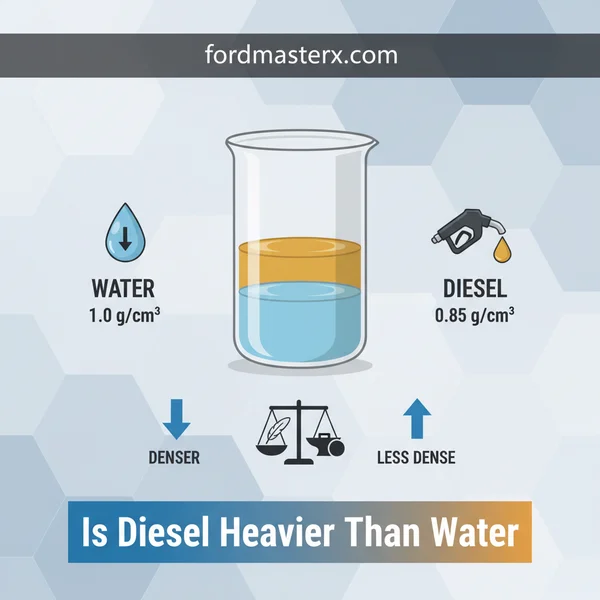
Understanding this density difference is vital for anyone who maintains a vehicle or manages fuel storage. Because water is heavier, it naturally seeks the lowest point in your fuel system. This can lead to serious mechanical issues, such as rust in the fuel tank, microbial growth, or “algae,” and damage to sensitive fuel injectors. Recognizing that the “heavier” water is lurking beneath your fuel is the first step in effective preventative maintenance.
Prime Day Pick
Limited-time Prime Day price. Check current discount on Amazon.
Density Comparison: Why Diesel Floats on Water
The Raw Data: Diesel vs. Water Density
To understand why diesel floats, you have to look at the specific density measurements of both liquids. Scientists measure density by calculating how much mass fits into a specific volume. For water, this measurement is incredibly stable and serves as the baseline for comparison. Standard freshwater has a density of approximately 1.0 gram per milliliter (g/ml) or 1,000 kilograms per cubic meter (kg/m³).

Diesel fuel, on the other hand, is a complex mixture of hydrocarbons that are significantly less packed together than water molecules. The density of diesel typically ranges between 0.820 and 0.860 g/ml. Here are a few key density benchmarks you should know:
Prime Day Pick
Limited-time Prime Day price. Check current discount on Amazon.
- Fresh Water: 1.00 g/ml (8.34 lbs per gallon)
- Salt Water: 1.03 g/ml (8.58 lbs per gallon)
- Typical No. 2 Diesel: 0.85 g/ml (7.09 lbs per gallon)
- Winter Grade (No. 1) Diesel: 0.82 g/ml (6.84 lbs per gallon)
As you can see, even the “heaviest” diesel is still roughly 14% to 18% lighter than water. Because these two liquids are immiscible—meaning they do not dissolve into one another—this density gap creates a clear, visible boundary between the fuel and the water.
Visualizing the Separation in Your Tank
Imagine your fuel tank as a giant salad dressing bottle. Just as oil floats on vinegar, your diesel sits on top of any water that has entered the system. This separation happens almost instantly. If you were to shake a jar containing both liquids, they might look cloudy for a few moments. However, as soon as the agitation stops, the water droplets will begin to “rain” down through the diesel until they form a distinct layer at the base.
Prime Day Pick
Limited-time Prime Day price. Check current discount on Amazon.
This “floating” rule is why most diesel vehicles are equipped with a component called a Water-in-Fuel (WIF) sensor. These sensors are usually located at the bottom of the fuel filter housing. Since the water sinks to the lowest point, the sensor can detect the presence of water before it reaches your engine, giving you a chance to drain it before it causes expensive damage.
Factors Affecting Diesel Specific Gravity and Weight
Understanding Specific Gravity
When you read technical data sheets for fuel, you will often see the term Specific Gravity (SG). This is simply a ratio of the fuel’s density compared to the density of water. Since water is the standard, it is assigned a value of 1.0. Any liquid with a specific gravity of less than 1.0 will float on water, while anything higher than 1.0 will sink.
Prime Day Pick
Limited-time Prime Day price. Check current discount on Amazon.
The specific gravity of most diesel fuel you buy at the pump is approximately 0.85. This number is a helpful shortcut for calculations. If you know you have 100 gallons of water, you know it weighs about 834 pounds. If you have 100 gallons of diesel, you simply multiply that water weight by the specific gravity (834 x 0.85) to find that your fuel weighs roughly 709 pounds. This weight difference is significant when you are calculating the payload or structural requirements for large storage tanks.
How Temperature Changes the Equation
While diesel is always lighter than water under normal conditions, its exact density is not a fixed number. It changes based on the temperature of the environment. Most liquids expand when they get warm and contract when they get cold. Diesel fuel is particularly sensitive to these thermal changes.
When the temperature rises, the molecules in the diesel move further apart. This makes the fuel less dense, meaning its specific gravity drops. Conversely, in freezing winter temperatures, diesel becomes more “dense” or thicker. While it still won’t become heavy enough to sink below water, these changes affect how the fuel flows and how much energy is packed into every gallon. Here is how temperature impacts the weight of your fuel:
- Hot Weather (90°F+): The fuel expands, the density drops, and the fuel becomes slightly “lighter” per gallon.
- Standard Temp (60°F): This is the industry standard for measuring density and weight.
- Cold Weather (32°F and below): The fuel contracts and becomes denser. However, as it cools, you also have to worry about “cloud point,” where wax crystals begin to form.
It is important to note that while diesel density changes with temperature, water density remains relatively stable until it hits the freezing point. Even in the coldest temperatures, the physical hierarchy remains the same: the water will remain at the bottom of the tank, often freezing into ice, while the diesel stays on top.
The Impact of Fuel Grade on Weight
Not all diesel is created equal. The specific blend of the fuel will also shift its weight. In many regions, suppliers switch between “Summer Blend” and “Winter Blend” diesel. Summer diesel (No. 2) is heavier and contains more energy per gallon. Winter diesel (No. 1) is often blended with kerosene to prevent gelling in cold weather. Because kerosene is even lighter than standard diesel, the winter blend will have a lower density and a lower specific gravity than the fuel you use in July. Regardless of the blend, the fundamental rule remains: water is the heavy outlier in your fuel system.
The Risks of Water Contamination in Diesel Fuel Systems
Because diesel is lighter than water, any moisture that enters your fuel tank will inevitably settle at the very bottom. This physical reality is bad news for your engine. Most fuel pickup tubes are positioned near the base of the tank to ensure you can use every drop of fuel, but this means they are also perfectly placed to suck up any accumulated water first.
Corrosion and Component Failure
Modern diesel engines rely on incredibly tight tolerances and high-pressure injection systems. Water is a major enemy of these precision parts. Unlike diesel fuel, water has zero lubricating properties. When it reaches the fuel pump or injectors, it causes metal-on-metal friction that leads to rapid wear and “pitting.” Furthermore, because water promotes oxidation, it can cause rust to form inside the metal lines and storage tanks. Even a small amount of rust can flake off, clogging injectors and leading to expensive repair bills or complete engine failure.
The Menace of “Diesel Bug”
One of the most frustrating risks of water contamination is microbial growth, commonly known as the “diesel bug.” Bacteria and fungi actually thrive in the dark, stagnant environment where the layer of diesel meets the layer of water. These microbes feed on the hydrocarbons in the fuel and use the oxygen in the water to survive.
- Sludge Formation: As these organisms grow and die, they create a thick, slimy sludge that looks like dark coffee grounds.
- Filter Clogging: This slime quickly coats fuel filters, starving the engine of fuel and causing it to stall.
- Acidic Byproducts: The waste produced by these microbes is often acidic, which accelerates the corrosion of your tank’s interior.
How Fuel-Water Separators Manage Density Differences
Engineers use the density difference between diesel and water to our advantage by installing fuel-water separators. These devices act as a first line of defense, catching the heavier water before it can reach the sensitive parts of the engine. It is a simple but effective application of physics that keeps your vehicle or equipment running smoothly.
The Role of Gravity in Filtration
Inside a fuel-water separator, the fuel flow is slowed down significantly as it enters a larger chamber. This decrease in velocity allows gravity to take over. Because water is roughly 15% heavier than diesel, the water droplets naturally lose their momentum and sink to the bottom of the separator bowl. Many of these separators use a “centrifuge” effect, spinning the fuel to force the heavier water particles outward and downward while the lighter diesel passes through the filter media and continues to the engine.
Why Regular Monitoring is Essential
The separator can only hold a finite amount of water before it becomes ineffective. Most modern separators feature a clear collection bowl at the bottom so you can visually inspect the contents. Because diesel is translucent (usually yellow or red) and water is clear and sits at the bottom, the separation line is usually quite easy to spot.
- Visual Checks: Get into the habit of checking the bowl during every pre-trip inspection or oil change.
- Sensor Alerts: Many modern trucks have a “Water in Fuel” (WIF) light on the dashboard that triggers when the water level in the separator reaches a certain height.
- Prevention: By monitoring the amount of water you find, you can gauge the health of your fuel source. If you find excessive water suddenly, it might be time to switch fuel stations.
Conclusion
Understanding that diesel is lighter than water is more than just a fun science fact; it is a critical piece of knowledge for any diesel owner. Because diesel has a lower density, water will always sink to the bottom of your tank, where it can cause rust, promote microbial growth, and damage expensive injection components. By utilizing fuel-water separators and staying vigilant about fuel quality, you can protect your engine from these heavy-hitting risks.
To keep your fuel system in top shape, make it a habit to inspect your separator bowl weekly and try to keep your fuel tanks full to minimize condensation. If you suspect your fuel has been heavily contaminated, don’t wait for the engine to sputter—address the moisture immediately to avoid a costly breakdown!
❓ Frequently Asked Questions
Why exactly does diesel float on top of water?
Diesel is a hydrocarbon-based fuel with a lower specific gravity than water, typically around 0.85 compared to water’s 1.0. This physical property causes the two liquids to separate into layers, with the heavier water sinking to the bottom.
How does temperature affect whether diesel is heavier than water?
As temperature rises, diesel expands and becomes even less dense, while water density also changes but at a different rate. Regardless of temperature fluctuations within normal operating ranges, diesel will always remain significantly lighter than water.
What happens if water gets into my diesel fuel tank?
Since water is heavier, it settles at the lowest point of the tank where it can promote microbial growth and cause corrosion. If the fuel pickup sucks up this water, it can lead to catastrophic damage to high-pressure fuel injectors.
Is there a difference between the weight of gas and diesel relative to water?
Both gasoline and diesel are lighter than water and will float, but gasoline is generally the lightest of the three. Diesel typically weighs about 7 pounds per gallon, whereas water weighs approximately 8.34 pounds per gallon.
Why is the density difference important for fuel-water separators?
Fuel-water separators exploit the fact that water is heavier by allowing the mixture to sit in a bowl where the water naturally sinks. This allows the clean, lighter diesel to be drawn from the top while the water is drained from a valve at the bottom.
Can additives change the density of diesel enough to make it sink?
No, standard performance additives are used in very small concentrations and do not significantly alter the overall density of the fuel. Diesel’s chemical composition ensures it remains less dense than water regardless of most common fuel treatments.