Ford Two Tone Paint Codes Chart: Primary and Secondary Colors by Year

A Ford two-tone paint code is not one code. It is two codes read together, and most touch-up guides only explain how to decode one of them. If you’re staring at a certification label wondering why your color doesn’t match anything on a single-color chart, that’s the reason.
This guide shows you exactly how to split your code into its primary and secondary halves, gives you a verified chart of real two-tone pairings, and explains why the same code pair can look completely different depending on how Ford applied it to your specific truck.

Prime for Young Adults — 6 Months Free
Students and 18–24s get six months of Prime free, then half price.
Start 6 Months Free As an Amazon Associate I earn from qualifying purchases.How To Read A Ford Two-Tone Paint Code
Your code is two values, not one — here’s how they break down
Find the Label
Driver-side door jamb or B-pillar (glove box on early Broncos)
Locate Paint Field
Look for “EXT PNT,” “PAINT,” or “COLOR” — ignore “WB”
Split the Code
First set = primary body color, second set = accent color
Cross-Reference
Match both codes separately against a verified color chart
Primary Code
Lower body color
Secondary Code
Accent / roof color
Standard Two-Tone
Roof and rear pillars only, body sides stay one color
Deluxe Two-Tone
Body sides between swage lines, chrome-separated

Audible — Listen Free for 30 Days
One free credit a month and thousands of titles included.
Listen Free for 30 Days As an Amazon Associate I earn from qualifying purchases.Combination Two-Tone
Standard roof application plus Deluxe side application
Victoria Two-Tone
Hood and part of the doors in the accent color
How To Read A Two-Tone Paint Code On Your Ford
Before you can use the chart below, you need to know you’re reading two separate values, not one.
- Find the certification label. On most Ford trucks and SUVs built in the last 45+ years, it’s on the driver-side door jamb or the B-pillar, the vertical post the door latches against. On some early Broncos (pre-1978), the tag was instead mounted inside the glove box door, so check there if the door jamb comes up empty.
- Locate the paint field. Look for a header reading “EXT PNT,” “EXT. P/C,” “PAINT,” or simply “COLOR.” Ignore anything under “WB,” that’s your wheelbase measurement in inches, not a color code, and it’s easy to mistake for one because it’s often printed close by.
- Split the code into two parts. According to Ford’s own certification label conventions, exterior paint is listed as a two-part code: the first set of characters identifies the primary (lower) body color, and the second set, if one is present, identifies the accent or two-tone color. If you only see one code, your truck left the factory in a single color.
- Write both parts down separately. You’ll need each one to cross-reference the chart, since the primary and secondary colors are frequently sold and named differently even though they appear on the same label.
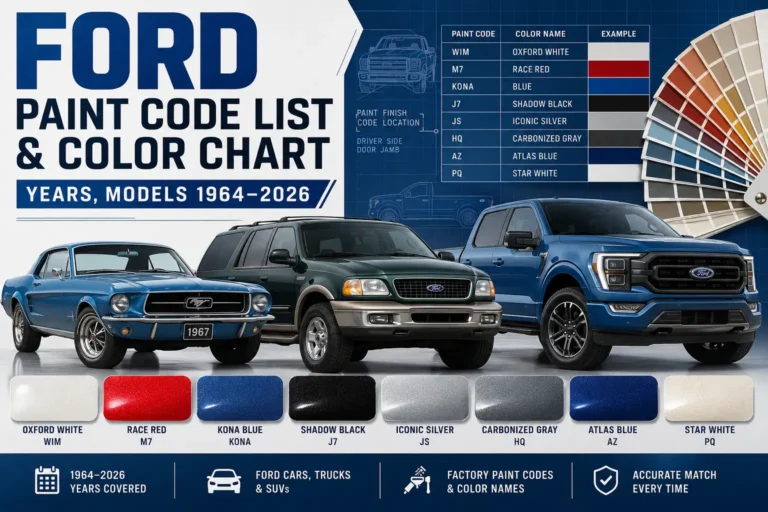
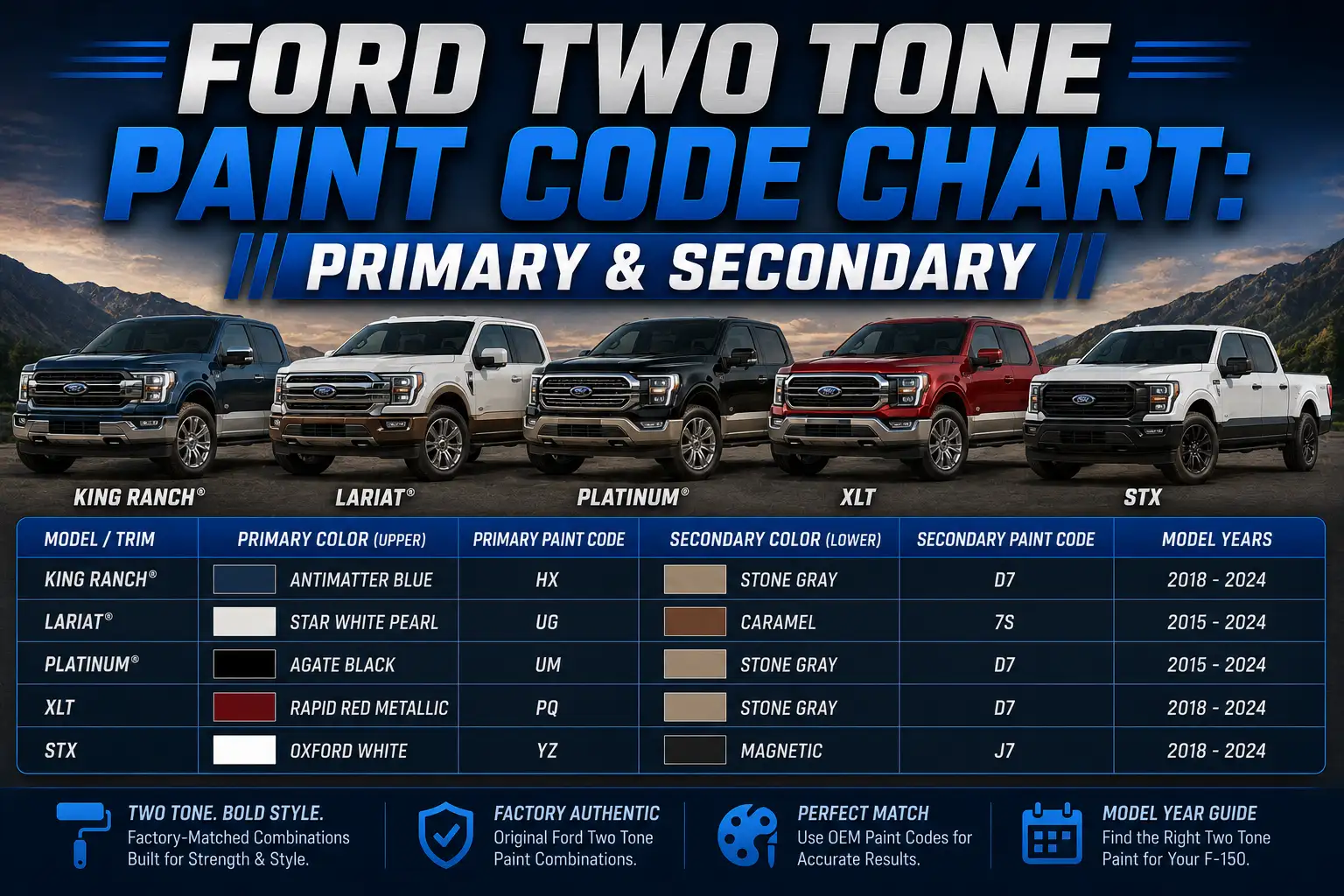
Ford Two-Tone Paint Code Chart (Primary and Secondary)
The table below pairs primary and secondary codes as they’ve been confirmed through Ford documentation, dealer parts records, and cross-verified owner reports. Codes marked “Community-Verified” come from multiple independent forum confirmations rather than an official Ford source, treat them as reliable but not dealer-guaranteed.
| Model | Years | Primary Code | Secondary Code | Color Pair | Confidence |
|---|---|---|---|---|---|
| Bronco (5th Gen) | 1970s | M | Y | Wimbledon White / Reef Aqua | Community-Verified |
| F-Series (F-100/F-150) | 1984–1986 | 3L | 9D | Dark Metallic Blue / White | Community-Verified |
| F-Series | Multiple pre-2000s | — | B5 | (varies) / Harvest Gold | Community-Verified |
| F-150 | 2000 | — | B2 or B5 | (varies) / Harvest Gold Metallic | Unverified |
| F-150 (Heritage Pkg, XLT) | 2023–2024 | Varies | Heritage Package | Modern two-tone callback to 1970s–1980s schemes | Manufacturer-Confirmed |
A note on gaps: Ford’s own paint documentation for two-tone combinations is inconsistent, especially for 1960s–1990s trucks, and several color-matching suppliers note that secondary color data is sometimes missing entirely from the factory record for a given VIN. If your exact pairing isn’t listed above, that’s common, not a sign you’re reading the label wrong. See the “When Your Code Isn’t In The Chart” section below.
Two-Tone Application Types Ford Actually Used
Two trucks can share the exact same code pair and still look completely different, because Ford offered several distinct ways to apply a two-tone scheme, and the code alone doesn’t tell you which one your truck got.
Standard (Regular) Two-Tone
Covered the roof and rear pillars only, leaving the body sides in a single color. This was the simplest and least expensive two-tone option offered on 1980s F-Series trucks.
Deluxe Two-Tone
Applied the accent color to the area between the body’s swage lines on the sides, typically separated from the primary color by a chrome or trim molding strip.
Combination Two-Tone
Combined Standard (roof) and Deluxe (side) application into one scheme, giving the truck accent color on both the roof and the body sides.
Victoria (Victorian) Two-Tone
Covered the hood and part of the doors with the accent color, a less common layout offered during the same 1980–1986 F-Series generation.
Audible Premium Plus — Annual Membership
12 audiobook credits up front, plus the full Audible catalogue.
See Annual Plans As an Amazon Associate I earn from qualifying purchases.Worth knowing if you’re restoring an 80s truck: Ford scaled back these options over time. By the 1986 model year, Ford had discontinued the versions that painted the roof and cab in the accent color, narrowing the two-tone lineup going forward.
If your label doesn’t match anything you can find, here’s your next step.
When Your Code Isn’t In The Chart
A faded, painted-over, or missing label doesn’t mean you’re out of options.
- Request an as-built lookup. If the physical label is gone or illegible, Ford can pull the original build sheet using your VIN. Note that the VIN itself does not encode paint color, it only unlocks the paint code through a dealer or Ford build sheet lookup.
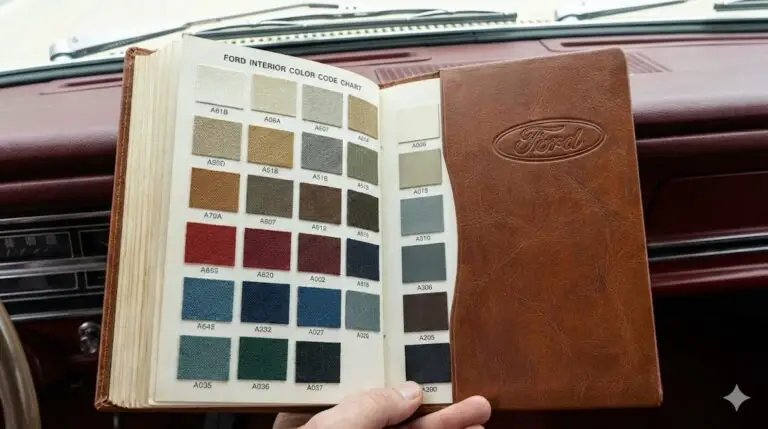
- Don’t trust a digital swatch alone. Screen colors vary by monitor, and even an accurate factory color name shifted in actual pigment density across production years. Always verify against a physical paint chip, or have a body shop pull a spectrophotometer reading from an unfaded area of the jamb.
- Expect some conflicting data. It’s common to find two sources listing different color names for the same code, especially for colors used across multiple Ford divisions decades ago. When sources disagree, prioritize a physical color book or dealer-sourced data over a forum post.
With your codes confirmed, here’s how to make sure the repaint actually holds up.
Getting An Accurate Two-Tone Repaint
Getting the code right is half the job, application matters just as much.
- Cross-reference with a professional color catalog. A PPG or DuPont color map matched to your truck’s specific production year accounts for formulation shifts that a generic code lookup won’t catch.
- Watch for the aluminum panel issue on newer trucks. On 2015 and newer F-150s, along with the Expedition and Explorer, aluminum body panels (hoods, tailgates, doors) are prone to paint adhesion failure if iron particles contaminate the surface before priming, a known issue documented in Ford technical service bulletins. If you’re two-toning a modern aluminum-bodied truck, confirm your body shop is certified for aluminum repair before work begins; using steel wool or steel brushes on these panels reintroduces the contamination and causes premature paint failure.
- Don’t assume your Bronco or Explorer follows F-150 conventions. Application layouts and code structures shifted by model and generation. If you’re working on an early Bronco specifically, see our Ford Bronco color code specifications for model-specific detail.
Here’s what owners ask most about two-tone codes.
Ford Two-Tone Paint Code FAQ
What does a two-tone Ford paint code look like on the label?
It appears as two linked codes under a field labeled “EXT PNT,” “PAINT,” or “COLOR.” The first code is your primary body color; the second, if present, is your accent or roof color.
Can I find my Ford’s two-tone colors from the VIN alone?
Not directly. The VIN doesn’t store color data itself, but it’s the key a dealer uses to pull your original build sheet, which does list both paint codes.
What’s the difference between Deluxe and Standard two-tone?
Standard covered only the roof and rear pillars; Deluxe applied the accent color to the body sides between the swage lines, usually separated by trim molding. Combination applied both.
Why do two sources list different color names for the same code?
Ford’s own two-tone documentation has known gaps, and aftermarket color databases sometimes disagree on obscure or older codes. When in doubt, verify against a physical paint chip or a dealer-sourced build sheet rather than a single online source.
Can I two-tone repaint a modern aluminum-body F-150 myself?
You can, but panel prep is unforgiving. Iron contamination on aluminum hoods and tailgates causes paint adhesion failure, so this is one repaint where using a shop certified for aluminum work is worth the cost.
Getting It Right The First Time
A Ford two-tone code isn’t one mystery character, it’s two, and now you know how to split them, where they show up on the label, and which of Ford’s four application types determines where the accent color actually lands on your truck.
If your exact pairing wasn’t in the chart above, that’s a known gap in Ford’s own two-tone records, not a dead end, an as-built lookup or a professional color book will get you the rest of the way. Confirm both codes before you order paint, and you’ll avoid the single most common two-tone mismatch owners run into.