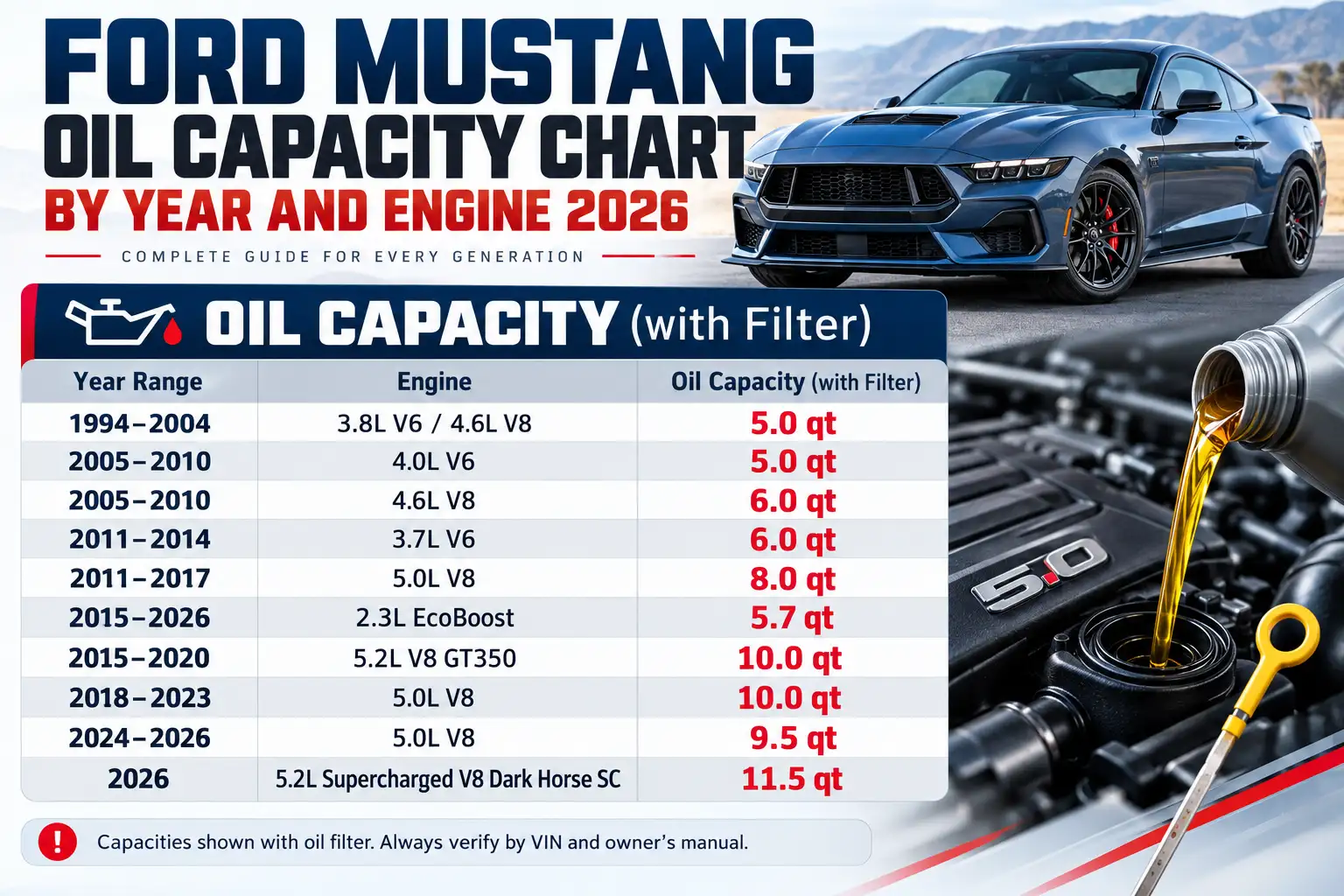
Ford Mustang Spark Plug Gap Chart By Engine & Year 2026 (EcoBoost, GT & V6)

The Ford Mustang spark plug gap chart is not a single specification for every engine. A 2008 Mustang GT 4.6L uses a different factory gap from a 2015 Mustang GT 5.0L, and the 2.3L EcoBoost specification also changes between published model-year manuals.
Use the chart below to match your Mustang’s year, engine, and special-edition status. Values are shown in inches and millimeters. Ford owner manuals take priority where available; historical aftermarket-reference figures are identified separately. Never force a non-adjustable plug to match a number from a general chart.
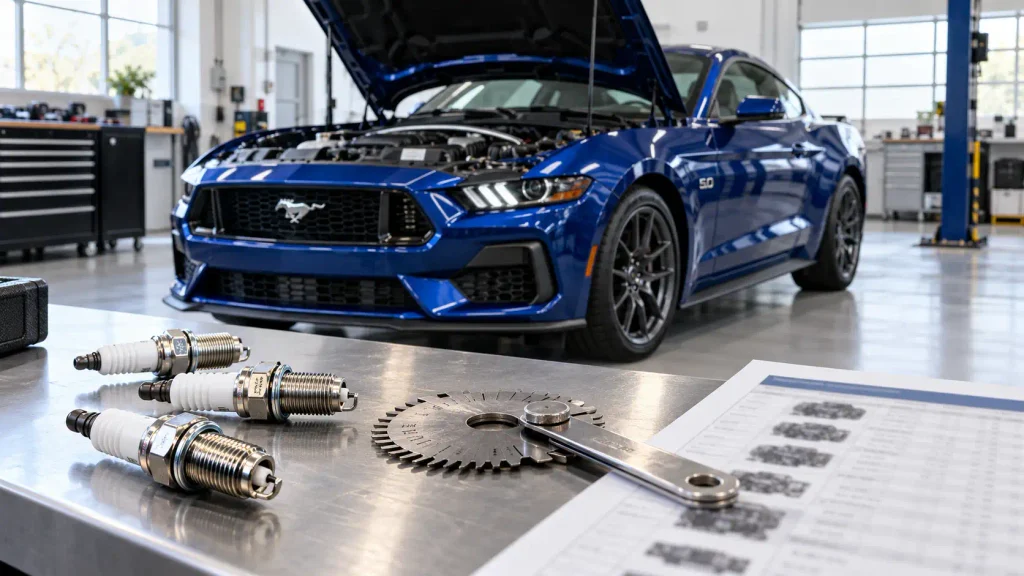
How to Read the Ford Mustang Spark Plug Gap Chart


Start with your model year, then find the exact engine and trim. Ranges indicate specified clearances, not permission to adjust non-adjustable plugs.
The chart covers documented 1979–2026 applications, not every engine variant. Ford manual identifies OEM data; historical reference identifies a Mustang-specific secondary guide. Check your emissions label before installation.
| Model Year | Mustang Engine or Version | Gap in Inches | Gap in mm | Reference or Exception |
|---|---|---|---|---|
| 1979 | 5.0L V8, 49-state version | 0.050 | 1.27 | Historical reference; emissions variant |
| 1979 | 5.0L V8, California version | 0.060 | 1.52 | Historical reference; emissions variant |
| 1980–1982 | 4.2L V8 | 0.050 | 1.27 | Historical reference |
| 1982–1985 | 5.0L V8, carbureted | 0.044 | 1.12 | Historical reference |
| 1984–1985 | 5.0L V8, CFI | 0.050 | 1.27 | Historical reference |
| 1986 | 5.0L HO V8 | 0.050 | 1.27 | Historical reference |
| 1987–1993 | 5.0L HO V8 | 0.054 | 1.37 | Historical reference |
| 1993 | 5.0L Cobra GT-40 | 0.050 | 1.27 | Historical reference; Cobra-specific |
| 1994–1995 | 3.8L V6 or 5.0L V8 | 0.052–0.056 | 1.32–1.42 | Mustang-specific historical reference |
| 1996–2002 | Standard 3.8L V6 or 4.6L V8 | 0.052–0.056 | 1.32–1.42 | Mustang-specific historical reference; exclude special Cobra applications |
| 2003–2004 | Standard V6 or 4.6L GT | 0.052–0.056 | 1.32–1.42 | 2004 Ford manual confirms 3.8L and 4.6L GT values |
| 2003–2004 | Supercharged 4.6L SVT Cobra | Check VECI label | Not applicable | Ford supplement directs owners to emissions decal |
| 2004 | 4.6L 4-valve Mach 1 | 0.052–0.056 | 1.32–1.42 | Ford owner manual |
| 2005–2007 | 4.0L V6 | 0.052–0.056 | 1.32–1.42 | Mustang-specific reference; Ford confirms 2008 |
| 2005–2007 | 4.6L GT, black coil boot | 0.040–0.050 | 1.02–1.27 | 4.6L plug design; do not regap where Ford prohibits it |
| 2008 | 4.0L V6 | 0.052–0.056 | 1.32–1.42 | Ford owner manual |
| 2008 | 4.6L GT, general owner-manual specification | 0.040–0.050 | 1.02–1.27 | Ford manual says gap is not adjustable |
| 2008–2010 | 4.6L GT, late-build brown coil boot | 0.039–0.043 | 0.99–1.09 | Build/plug-specific service reference; verify fitted part |
| 2009–2010 | 4.0L V6 | 0.052–0.056 | 1.32–1.42 | Mustang-specific historical reference |
| 2011–2014 | 3.7L V6 | 0.049–0.053 | 1.25–1.35 | Mustang-specific reference |
| 2011–2014 | 5.0L GT Coyote V8 | 0.049–0.053 | 1.25–1.35 | Mustang-specific reference |
| 2013–2014 | 5.8L supercharged Shelby GT500 | 0.033–0.037 | 0.85–0.95 | 2014 Ford Shelby supplement |
| 2015 | 2.3L EcoBoost | 0.027–0.031 | 0.70–0.80 | Ford 2015 second-printing manual |
| 2015–2017 | 3.7L V6 | 0.049–0.053 | 1.25–1.35 | Ford manual family; check exact year |
| 2015–2023 | Standard 5.0L Mustang GT | 0.049–0.053 | 1.25–1.35 | Ford manual family; excludes special 5.2L models |
| 2016–2023 | 2.3L EcoBoost | 0.028–0.031 | 0.70–0.80 | Ford S550 manuals checked for representative model years |
| 2016–2017 | 5.2L GT350 or GT350R | 0.049–0.053 | 1.25–1.35 | Mustang-specific secondary chart; verify Ford supplement |
| 2018–2020 | 5.2L GT350 or GT350R | 0.033–0.037 | 0.84–0.94 | Mustang-specific secondary chart; verify Ford supplement |
| 2020–2022 | 5.2L supercharged Shelby GT500 | 0.035–0.039 | 0.90–1.00 | Ford 2020 GT500 supplement: 0.037 ± 0.002 |
| 2021–2023 | 5.0L Mach 1 | 0.049–0.053 | 1.25–1.35 | Ford Mach 1 specifications, verify model year |
| 2024–2026 | 2.3L EcoBoost S650 | 0.026–0.030 | 0.65–0.75 | Ford S650 owner manuals |
| 2024–2026 | Standard 5.0L GT, including street Dark Horse where applicable | 0.049–0.053 | 1.25–1.35 | Ford S650 5.0L specifications |
Scope note: The table does not substitute a number for an unverified special edition. Earlier Fox Body four-cylinder and V6 applications, certain older SVT models, custom engines, and later 5.2L specialty vehicles need their own factory label, supplement, or service specification. A missing numeric value means the factory application must be checked individually.
What Gap Fits 1979 to 1993 Fox Body Mustangs


Fox Body owners need to distinguish engine, induction system, and emissions calibration. A widely used Mustang reference compiled by Late Model Restoration from AllData lists two different 1979 5.0L settings: 0.050 inch for 49-state cars and 0.060 inch for California applications.
The same reference lists 0.044 inch for 1982–1985 carbureted 5.0L engines, but 0.050 inch for the 1984–1985 CFI versions. CFI refers to central fuel injection. They are not interchangeable.
For the 1987–1993 5.0L HO, the historical figure is 0.054 inch. The 1993 Cobra GT-40 is separately listed at 0.050 inch. Confirm these figures against the emissions label and actual plug.
Engine swaps and aftermarket heads can invalidate a year-only chart.
Which Gap Fits 1994 to 2004 Mustangs


Most standard SN95 and New Edge engines use the familiar 0.052–0.056-inch reference range. That includes commonly listed 3.8L V6 and naturally aspirated 4.6L V8 applications, but not every SVT or supercharged variant.
Ford’s 2004 Mustang owner’s guide confirms 0.052–0.056 inch for the 3.8L V6, 4.6L SOHC GT, and 4.6L four-valve Mach 1. A four-valve Mach 1 is not a supercharged Cobra.
Why the 2003 and 2004 Cobra Is Different
The 2004 SVT Cobra supplement does not provide a universal numeric gap in its plug-parts table. It directs owners to the Vehicle Emissions Control Information, or VECI, decal for the spark plug gap. Some secondary catalogs publish a narrower Cobra figure, but Ford’s instruction to consult the decal is the safer application-specific answer.
Supercharged or swapped engines require application-specific specifications.
Which Gap Fits 2005 to 2014 Mustangs
The S197 generation has one of the most easily missed changes: 2005–2010 V6 Mustangs use a 4.0L engine, not the later 3.7L V6. The 3.7L arrives for the 2011 model year, along with the Coyote 5.0L V8.
Ford’s 2008 Mustang owner’s guide gives 0.052–0.056 inch for the 4.0L V6 and 0.040–0.050 inch for the 4.6L V8. Ford adds a critical footnote: the 4.6L V8 plug gap is not adjustable.
Why Black and Brown Coil Boots Matter
Some 4.6L three-valve service references distinguish early black-coil-boot plugs from later brown-coil-boot plugs. The early specification is 0.040–0.050 inch; a later brown-boot specification is approximately 0.039–0.043 inch.
These figures depend on the installed plug and build date; do not bend non-adjustable electrodes. For broader product-selection context, the site’s Ford 4.6L spark plug buying guide discusses replacement options; verify Mustang-specific fitment independently before purchasing.
The 2011–2014 3.7L V6 and standard 5.0L GT use 0.049–0.053 inch in Mustang-specific reference data. Shelby engines must be checked separately, particularly the supercharged 5.8L GT500.
Which Gap Fits 2015 to 2026 Mustangs
A newer Mustang’s engine badge is not enough to choose a gap. In particular, the 2.3L EcoBoost appears with different published values across S550 and S650 model years.
Ford’s 2015 Mustang owner’s manual, second printing specifies 0.027–0.031 inch for the 2.3L EcoBoost, while the 3.7L V6 and 5.0L V8 both use 0.049–0.053 inch. Ford’s 2016 manual and several later S550 publications list the EcoBoost at 0.028–0.031 inch. Use the value for your manual printing.
How S650 EcoBoost Specifications Differ
The 2026 Mustang owner’s manual identifies a 2.3L gap of 0.026–0.030 inch, while its 5.0L V8 specification remains 0.049–0.053 inch. The 2024 and 2025 S650 references also support the narrower 2.3L range.
These values appear in Ford’s 2026 Mustang owner’s manual. Prioritize your vehicle’s manual.
What About the 5.0L Dark Horse
The street 5.0L S650 specification is 0.049–0.053 inch. The Dark Horse R racing program is a separate application, and a 5.2L supercharged specialty engine must not be grouped with ordinary 5.0L GT data. Verify the exact trim and engine before selecting plugs.
How Cobra GT350 and GT500 Gap Specs Differ
A standard GT value is not a Shelby specification. Supercharged and specialty engines can have narrower specified plug gaps, even if their exterior appearance resembles another Mustang.
For the 2013–2014 GT500 5.8L, Ford’s 2014 Shelby supplement specifies 0.033–0.037 inch and identifies Motorcraft CGSF-12YP plugs. The 2020 GT500 5.2L supplement specifies 0.037 ± 0.002 inch, equivalent to 0.035–0.039 inch.
For the 2016–2020 GT350, Mustang-specific secondary charts show an apparent change from 0.049–0.053 inch in 2016–2017 to 0.033–0.037 inch for 2018–2020. Treat those figures as a lookup aid until checked against the exact Ford GT350 supplement and replacement plug. The 2003–2004 Cobra requires the VECI decal check discussed earlier.
Identify the specialty engine and factory plug before using the chart.
Why Ford and Aftermarket Gap Charts Sometimes Disagree
An aftermarket chart may provide a convenient average or a recommended replacement-plug setting. A Ford manual may specify the factory-installed application, a different printing, or a revised part. These may differ.
The 2015 EcoBoost illustrates the issue. Ford’s December 2014 second-printing manual states 0.027–0.031 inch, while one aftermarket 2015–2025 Mustang chart groups the 2015 EcoBoost under 0.026–0.030 inch. Ford’s 2016 first-printing manual then shows 0.028–0.031 inch.
When values disagree, prioritize the original manual for your VIN and build, the VECI decal, applicable Ford service information, and the plug manufacturer’s application-specific instructions. Never average ranges or substitute F-150 specifications.
How to Check Mustang Spark Plug Gap Correctly
Confirm both part number and gap before installing a pre-gapped plug.
- Confirm the application. Match your Mustang’s year, engine, and trim to the correct Motorcraft or approved replacement plug. Check the VECI label for older or special applications.
- Inspect the tip. Look for a cracked insulator, bent ground electrode, or damaged fine-wire center electrode. Replace damaged plugs instead of trying to straighten them into service.
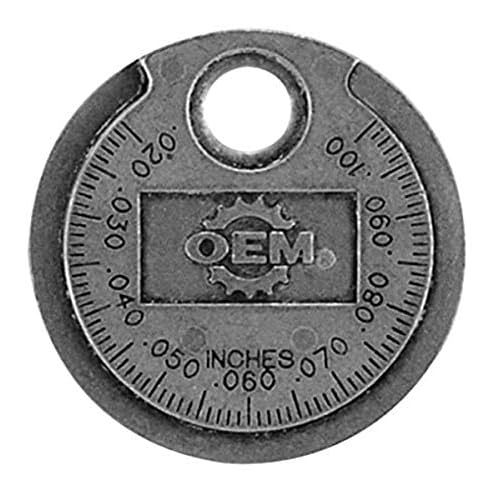
- Measure with a wire-style gauge. Select the wire diameter corresponding to the specification and check the clearance gently between the center and ground electrodes. Do not jam a wedge gauge into a fine-wire plug.
- Adjust only when permitted. If both Ford and the plug manufacturer allow adjustment, move only the ground electrode with an appropriate tool. Do not pry against a platinum or iridium center electrode. If Ford identifies the plug as non-adjustable, obtain the correct replacement instead.
NGK warns against applying force to fine-wire electrodes. Measurement does not authorize adjustment.
When Modified Mustangs Need Different Plug Gaps
The chart describes stock or specifically identified factory applications. A tuned EcoBoost, aftermarket-supercharged GT, nitrous setup, or engine with changed compression may require a different plug type and gap.
Higher cylinder pressure can increase the voltage needed to fire across the gap. A performance tuner may specify a narrower clearance, but there is no safe universal Mustang setting based only on horsepower. Follow the matched plug maker’s guidance and the calibration provider’s documented instructions.
A misfiring modified engine needs diagnosis, not repeated gap reductions.
What Wrong Plug Gaps Can Do to Your Mustang
An incorrect plug gap can contribute to misfires, hesitation, reduced power, fouling, or poor fuel economy. An excessively wide gap can exceed available ignition voltage.
Misfires also result from worn plugs, faulty coils, wiring, and other faults.
Start by verifying the plug part number, condition, and factory specification. If symptoms persist, the site’s Ford ignition coil resistance guide offers broader coil-checking context, although the actual test must match your Mustang’s ignition system. A model-specific diagnostic procedure is preferable to relying on a generic resistance number.
Which Mustang Spark Plug Gap Should You Use
The correct Ford Mustang spark plug gap chart entry is the one matching your actual model year, engine, and factory plug application. Do not assume the same number works for a Fox Body 5.0L, a three-valve 4.6L GT, a newer EcoBoost, and a supercharged Shelby.
Use the chart as a fast reference, then confirm it against the owner’s manual or emissions decal. That second check is especially valuable for early-versus-late 4.6L plugs, 2015–2026 EcoBoost changes, and performance editions with separate supplements.
For your next plug replacement, identify the engine and part number first. Measure the gap carefully and adjust only when the manufacturer expressly permits it. The right plug for the right application matters more than copying a generic number.
Ford Mustang Spark Plug Gap Questions by Engine
What Is the Spark Plug Gap on a 5.0 Mustang GT
The standard 2011–2026 Mustang GT 5.0L is commonly specified at 0.049–0.053 inch, or 1.25–1.35 mm, across the model years covered in the factory and Mustang-specific references reviewed here. Verify your exact year and original engine application rather than using this number for a modified motor or a different 5.2L specialty engine.
What Spark Plug Gap Does a Mustang EcoBoost Use
For the 2015 2.3L EcoBoost, Ford’s second-printing manual gives 0.027–0.031 inch; representative 2016–2023 S550 manuals show 0.028–0.031 inch. The 2024–2026 S650 manuals give 0.026–0.030 inch. Check the owner manual for your specific model year instead of assuming all EcoBoost Mustangs share one setting.
Is the Spark Plug Gap Different for a Shelby GT500
Yes. The 2013–2014 5.8L GT500 has a documented 0.033–0.037-inch specification, while the 2020 5.2L GT500 supplement gives 0.035–0.039 inch. These values do not apply to every Shelby ever sold. Identify the exact model, supercharged engine, and matching Ford supplement before installation.
Can You Adjust the Spark Plug Gap on a 2008 Mustang GT
No, not on the 4.6L V8 plugs covered by Ford’s 2008 owner guide. Ford lists 0.040–0.050 inch and expressly states that the gap is not adjustable. Use the specified replacement plug and confirm any early- or late-build plug differences instead of bending its electrode.
Should a Supercharged Mustang Use the Factory Spark Plug Gap
Not automatically. A factory-supercharged Shelby should follow its own Ford specification, while an aftermarket-supercharged Mustang may require a plug and gap selected for its tune and hardware. Consult the supercharger supplier, plug manufacturer, and calibration provider. Do not copy a narrower gap from an unrelated boosted engine.