
Ford Idaho Center Amphitheater Seating Chart 2026 Complete Guide

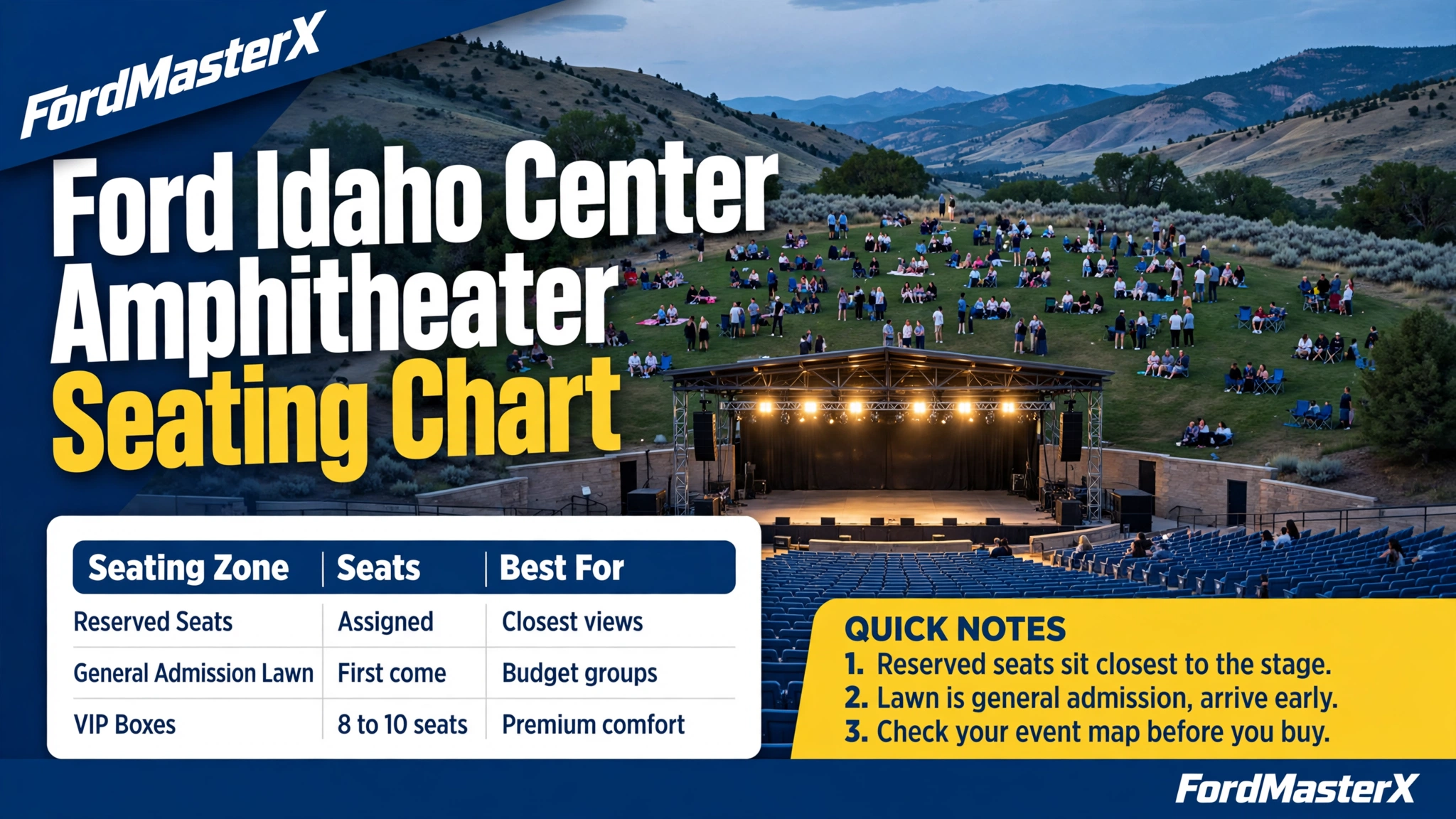
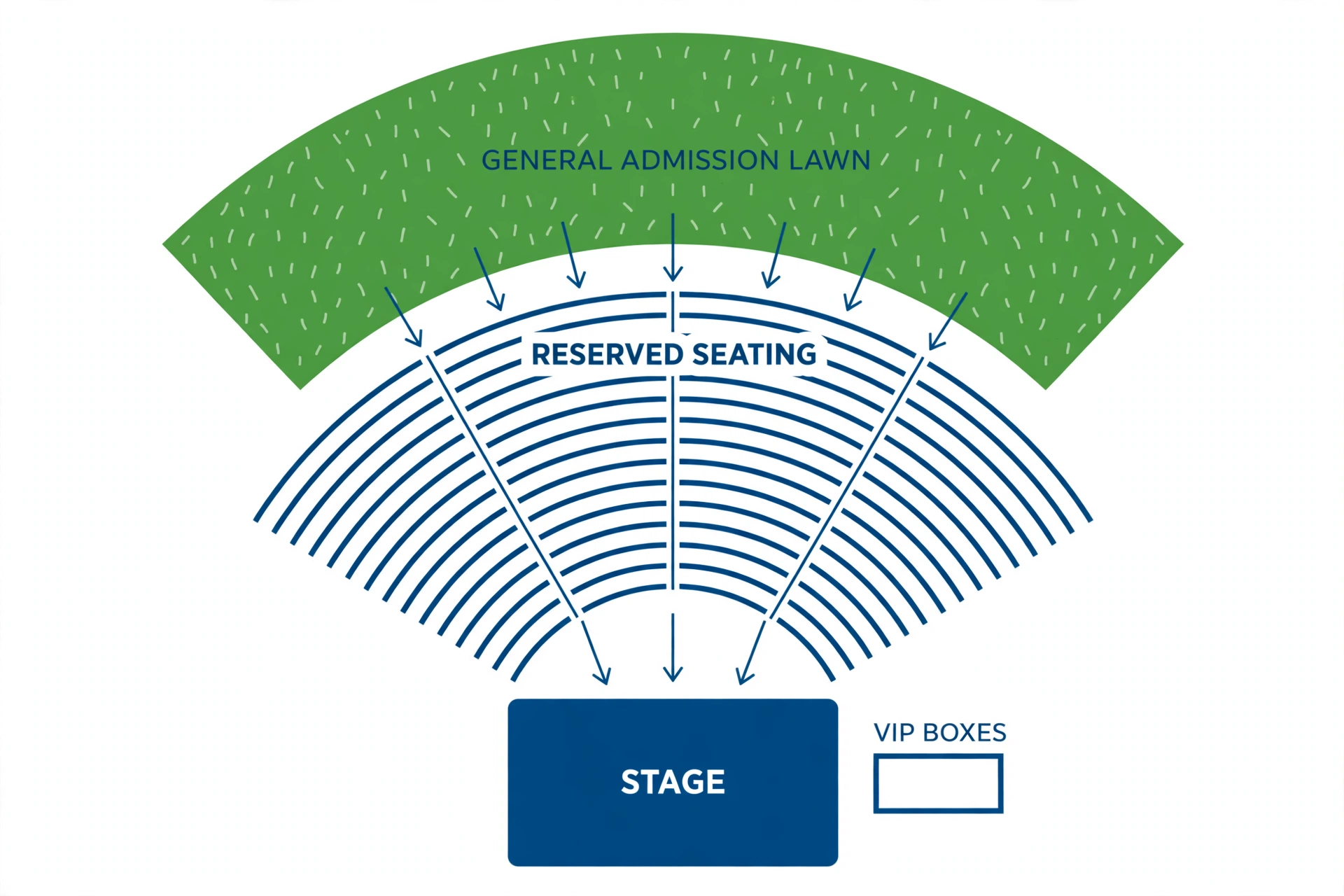
The Ford Idaho Center Amphitheater seating chart has three zones. Reserved seats sit in front of the stage with an assigned section, row, and seat, VIP boxes sit on an elevated deck to the right of the stage, and the general admission lawn spreads across the grassy hillside behind the reserved seats.
The outdoor amphitheater holds up to 10,500 guests. Smaller shows use a reduced layout closer to 3,000, so the zones on sale change with the event.


This guide reads the chart zone by zone, using the venue’s own promoter guide, its official 2026 amphitheater policies, and independent seating guides, so you can match a zone to your night before you pay.
5 Facts About the Ford Idaho Center Amphitheater
The Ford Idaho Center Amphitheater is the outdoor venue at the Ford Idaho Center complex in Nampa, Idaho, about 15 miles west of Boise. It sits beside the indoor arena, the Horse Park, and the Sports Center, so first confirm which building your ticket is for.
The amphitheater opened on June 15, 1998, with a concert by Shania Twain on her Come On Over Tour. It has hosted summer concerts ever since, including shows by Tim McGraw, Bob Dylan, Jack Johnson, and James Taylor.
The address is 16200 N Idaho Center Blvd, Nampa, ID 83687, directly off Interstate I-84, about 20 minutes from the Boise airport. The box office sits at 16114 Idaho Center Blvd on the same complex.
The stage measures 60 feet wide by 40 feet deep. That large stage carries full concert production, which is why the amphitheater is the Treasure Valley’s main outdoor concert venue.
The Ford in the name does not make the building a car dealership or a factory. It is a live-event complex, and the amphitheater is its open-air anchor.
Our Ford Idaho Center arena seating chart guide covers the indoor arena next door, which has its own chart and its own setups. An arena ticket is not an amphitheater ticket, even on the same night.
The Wikipedia entry for the Ford Idaho Center lists the amphitheater’s 1998 opening, the 10,500 capacity, and the 60-by-40-foot stage in one place.


How Capacity Works From 3,000 to 10,500


Capacity at this amphitheater is a range, not a single number. The venue’s official promoter guide lists the amphitheater at 3,000 to 10,500, with many variations in between.
| Setup | Capacity | What It Means for the Chart |
|---|---|---|
| Small show | About 3,000 | Reduced layout, fewer zones open |
| Full show | Up to 10,500 | Reserved seats plus full lawn open |
That range is the first thing to check before you buy. A small show may sell reserved seats only, while a full show opens the whole lawn behind them.
The 10,500 figure is the maximum, not the size of every night. Your event page shows which zones are actually on sale for your show.


Smaller shows feel closer and more intimate. The stage, the reserved seats, and the front of the lawn all sit within easy sight and sound of each other.
Ford Idaho Center Amphitheater Seating at a Glance
Nampa, Idaho. Outdoor amphitheater, opened 1998. 16200 N Idaho Center Blvd. 60-by-40-foot stage.
| Setup | Capacity | What changes |
|---|---|---|
| Small show | About 3,000 | Reduced layout, fewer zones open |
| Full show | Up to 10,500 | Reserved seats plus full lawn open |
Capacity: Ford Idaho Center official promoter guide. Opening and stage size: Wikipedia. Clear bag limit is 14 by 14 by 6 inches per the venue’s 2026 Amphitheater Policies. The venue does not publish a numbered section list, so check the seating map for your event.
Which Zones Make Up the Amphitheater Seating Chart
The amphitheater chart is built from three zones: reserved seating in front of the stage, the general admission lawn behind it, and VIP boxes on an elevated deck to the right of the stage.
No official source found for this guide publishes a numbered section list for the amphitheater. Ticketing pages show section and row details for one event at a time.
Reserved Seating in Front of the Stage


Reserved seating gives you an assigned seat in a designated section directly in front of the stage. You buy a specific section, row, and seat, and that chair is yours for the night.
These seats offer the best sightlines and sound in the venue. They sit closest to the 60-by-40-foot stage, with a straight, unobstructed view of the performers.
Lower-numbered seats sit closer to the center of the stage, and higher-numbered seats sit farther out toward the sides. That center-out pattern is the standard layout for this venue’s reserved sections.
Reserved seats cost more than lawn tickets. You pay for the assigned chair, the closeness, and the certainty of knowing exactly where you will sit.
General Admission Lawn on the Hillside
Lawn seating is the general admission option at the back of the amphitheater, on the grassy hillside beyond the reserved sections. You buy a lawn ticket, not a seat, and you choose your spot when you arrive.
Spaces are first come, first served. Arrive early if you want a spot near the front of the lawn, because the best ground goes to the earliest arrivals.
Lawn tickets are the most affordable tickets in the venue, with prices as low as about $40 for some events. That price makes the lawn the natural choice for groups, families, and casual nights out.
Low-back lawn chairs with legs of 8 inches or shorter are allowed for select events, and the official 2026 policies allow one beach towel per person up to 36 by 72 inches. Blankets are now a prohibited item, so check your event’s own amphitheater policy before you pack.
VIP Boxes on the Elevated Deck


VIP boxes sit to the right of the main stage on elevated concrete decking. Each box holds eight seats, with the option to add two more, and the boxes offer the widest and most comfortable seating in the venue.
The perks include in-seat wait service, access to private bars, and VIP parking. That package suits a group that wants comfort and service above all else.
VIP seating is sold through Live Nation premium seating. The venue guide lists [email protected] and 206-802-3143 for box inquiries.
How to Read Your Ticket


A reserved ticket at the amphitheater gives you three facts in one line. The section is your block of seats, the row is your distance from the stage inside that block, and the seat is your chair along that row.
Read the three facts in that order. Section first, because it puts you on the right side of the reserved area. Row second, because it sets your distance from the stage, and seat last, because it fixes your exact chair.
Seat numbers run in order along a row, with lower numbers closer to the center of the stage. That center-out pattern is a useful buying aid when you compare two listings in the same row.
Treat that pattern as a guide, not a venue guarantee. The amphitheater has not published a seat-number direction rule or a row map in text form. The event map for your show is the final authority on both.
A lawn ticket has no section, row, or seat at all. It grants access to the grassy hillside, and your spot depends on when you arrive and where space is open.
Our Ford Center seating chart with seat numbers explains the same section, row, and seat code for an indoor arena, where the pattern works the same way.
Reserved Seats or Lawn for Concerts
Reserved seats win on closeness and certainty. You know your exact chair before you arrive, and you sit close enough to see the performers clearly.
Lawn seats win on price, space, and mood. You pay the lowest price in the venue, you spread out on the grass, and you enjoy the open sky over the hillside.
The trade is distance and control. From the back of the lawn you watch the show on the video screens as much as on the stage, and a late arrival can leave you with a poor spot.
A rear reserved seat usually beats a front lawn spot for a favorite artist. The reserved chair keeps you close, while the lawn spot still leaves you behind the whole reserved section.
For a casual night with friends, the lawn is the better buy. Bring a low-back chair or a beach towel where allowed, arrive early, and pick a spot with a clear line to the stage.
Our Ford Field concert seating chart guide makes the same point for a stadium show: pay for closeness only when the seat is genuinely close.
Best Seats for 3 Night Types
The best seat changes with the night. A great spot for a favorite artist can be a poor pick for a relaxed group evening, because the two nights ask for different things.
Best Seats for a Close-Up Concert Night
Pick a reserved seat in the center, a few rows up from the stage. That spot gives you distance, height, and a straight view of the production.
Front-row reserved seats put you closest to the performers. That closeness has a cost: you look up at the stage, and the speakers at the sides can block part of the view.
Side reserved seats cost less and still give you a close view. Check the event map for a limited-view flag before you buy a far-side seat.
Best Seats for a Casual Group Night


Pick the lawn and arrive early. A spot near the front of the hillside keeps the stage in clear view, and the grass gives your group room to spread out.
Lawn tickets are the cheapest way in, so a group can buy together without a big bill. First come, first served means the group should arrive together to claim one patch of ground.
Bring only what the event policy allows. Low-back chairs with legs of 8 inches or shorter are allowed for select events, and one beach towel per person up to 36 by 72 inches is allowed under the 2026 policies.
Best Seats for a Premium Night
Pick a VIP box to the right of the stage. The elevated deck gives you a wide, comfortable view, and the in-seat wait service means you never leave your seat for a drink.
Each box holds eight seats, with the option to add two more. That size fits a small group or a client night better than a single pair of reserved seats.
Book early, because boxes are limited and sell through premium seating. Contact the premium seating team listed in the zones section above before the show you want sells out.
Our Akins Ford Arena seating chart guide shows how a smaller arena compares when you want a closer, indoor alternative.
What the Amphitheater Does Not Publish About Rows
No official venue page found for this guide lists the amphitheater’s numbered sections, the rows in each section, or the seats in each row.
Ticketing pages show your section and row only when you open a specific event. That map is the only reliable source for your exact seat.
Be careful with lookalike venue data. Search results for other Ford-named venues describe their own section numbers, but those numbers belong to other buildings in other cities.
Those numbers do not belong to the Ford Idaho Center Amphitheater in Nampa. Do not use a Ford Field or Ford Center chart to pick an amphitheater seat.
The same warning applies to generic seating-chart PDFs. A detailed chart file surfaced in search results, but its venue could not be verified, so this guide does not use it.
Accessible Seating and Entry in 3 Steps
No official page found for this guide maps accessible seats section by section, so check the event page filter and contact the box office.
Step 1: Use the event page filter. Open your event on the official ticketing page and look for the accessible or ADA seating option. That filter shows the accessible seats on sale for your night.
Step 2: Contact the box office before you buy. The box office sits at 16114 Idaho Center Blvd, and ticketing runs through IC Tickets. Ask which accessible and companion seats match your event’s setup, because the chart changes with each configuration.
Step 3: Arrive early and use the main entrance. Give yourself time to reach your seat before the crowd builds, and ask an usher for the accessible route. Do not buy a standard seat and hope to move on the night, because accessible seating is limited.
7 Event-Day Rules for Parking, Bags and Entry
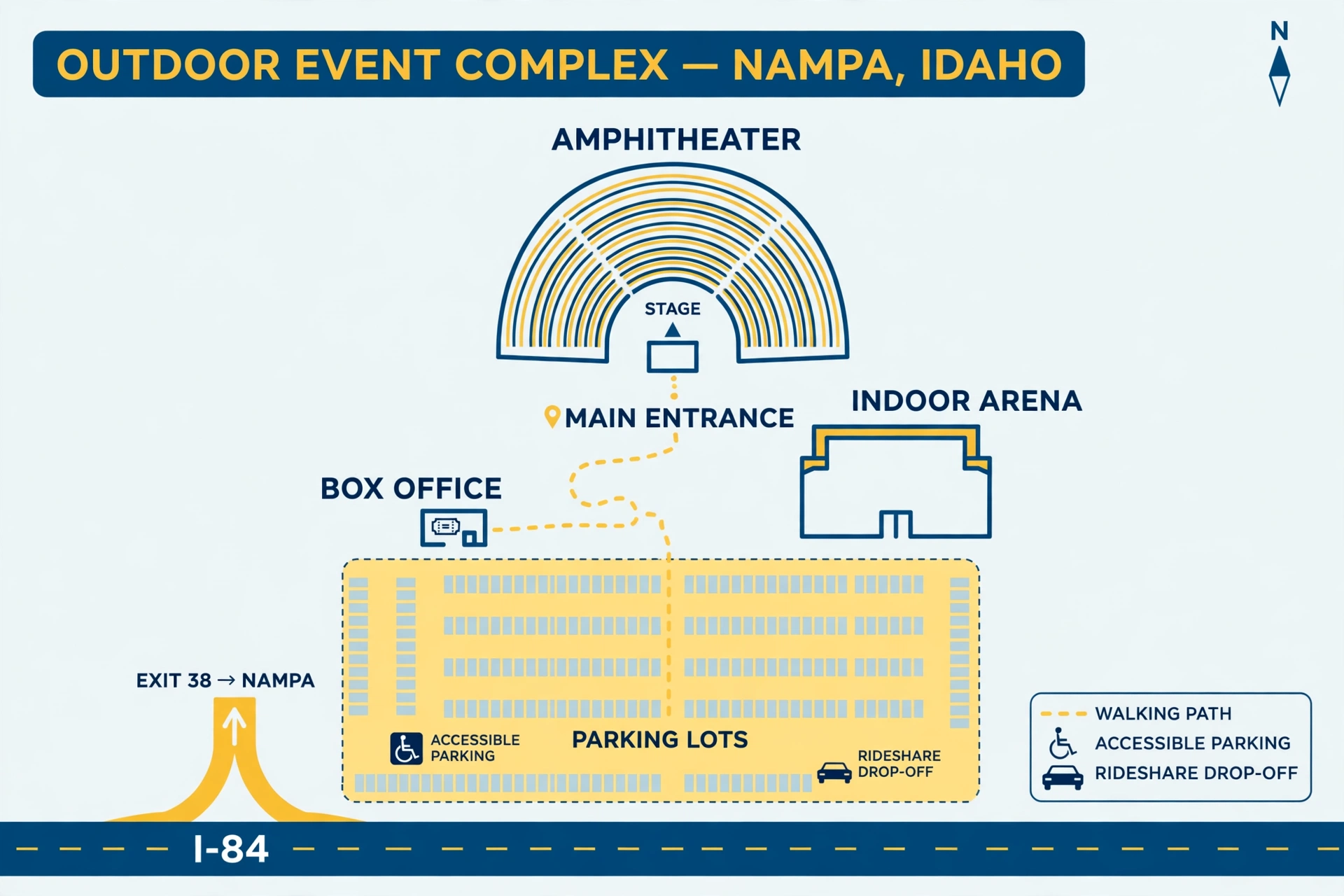
Rule 1: Arrive early. The complex’s surface lots fill fast on a full night, and the lots nearest the doors fill first. The lawn rewards early arrivals too, so the same early start helps twice.
Rule 2: Use Interstate I-84. The complex sits directly off I-84, and the Snake River Stampede notes exit 38 for the venue. Follow the event signs from the exit.
Rule 3: Confirm the building on your ticket. The arena is indoors and the amphitheater is outdoors, on the same complex. A ticket that says amphitheater is not an arena ticket, even on the same night.
Rule 4: Bring a clear bag only. The venue’s official 2026 Amphitheater Policies set the clear bag limit at 14 by 14 by 6 inches, one bag per person.
All bags are subject to search. Diaper bags and medical bags are allowed after a search.
Rule 5: Leave banned items at home. The 2026 policies ban backpacks, coolers, umbrellas, selfie sticks, glass bottles, and laser pointers.
Strollers and wagons, outside food and drink, signs and flags, video cameras, professional cameras with detachable lenses, weapons, and blankets are also banned. Check your event page, because some items vary by show.
Rule 6: Expect cashless concessions. Concession stands take debit, credit, and mobile payments such as Google Pay and Apple Wallet. Bring a card or a phone, not cash.
Rule 7: Plan the ride home before the encore. Agree on a meeting point with your group before you go in. Rideshare drop-off is on the complex, near the parking lots, and the lots empty slowly after a full show.
How to Choose Your Seat in 5 Checks
Step 1: Confirm the building. Check that your ticket says amphitheater, not arena. The two buildings share one complex and one address, but their charts are different.
Step 2: Confirm the setup. Find out whether your event is a small show or a full show. That setup decides whether the lawn is open and how many reserved sections are on sale.
Step 3: Pick your zone by night type. Use the best-seats section above: center reserved seats for a close-up concert, the lawn for a casual group night, and a VIP box for a premium night.
Step 4: Open the interactive map. The Nampa Amphitheater seating chart guide explains the reserved and lawn layout.
Ticketing platforms such as Ticketmaster carry an interactive map for each event. Compare your section against the stage before you pay.
Step 5: Read the row and seat on the listing. Your exact section, row, and seat appear on the listing itself. If a listing hides them, pick one that shows them.
7 Questions About the Ford Idaho Center Amphitheater Seating Chart
How Many Seats Does the Amphitheater Hold
It depends on the setup. The promoter guide lists 3,000 to 10,500, with 10,500 as the maximum for a full show.
Where Is the Ford Idaho Center Amphitheater
The amphitheater is at 16200 N Idaho Center Blvd, Nampa, ID 83687, directly off Interstate I-84 about 15 miles west of Boise. The box office is at 16114 Idaho Center Blvd.
Is the Ford Idaho Center Amphitheater Outdoors
Yes. The amphitheater is the outdoor venue in the complex, with a grassy hillside lawn and no roof over the seats. The indoor arena beside it is a separate building with its own chart.
What Are the Best Seats Here
For a close-up concert, a center reserved seat a few rows up is the best all-round pick. For a casual group night, the front of the lawn is best, and VIP boxes are the premium choice across event types.
Does the Amphitheater Have Lawn Seating
Yes. The general admission lawn sits on the grassy hillside behind the reserved seats, and spots are first come, first served. Lawn tickets are the cheapest tickets in the venue.
Amphitheater Versus Arena Differences
The amphitheater is the outdoor venue that hosts summer concerts, with a capacity of 3,000 to 10,500. The arena is the indoor building that hosts concerts, rodeo, and graduations year-round, with a capacity of 12,279.
How Do I Buy Amphitheater Tickets
Ticketing runs through IC Tickets, the venue’s official ticketing affiliate, and through Ticketmaster event pages. You can also buy in person at the box office at 16114 Idaho Center Blvd, Nampa, ID 83687.
3 Checks Before You Buy Your Seat
The Ford Idaho Center Amphitheater seating chart rewards buyers who check three things before they pay: the building, the setup, and the zone. A small show and a full show are different nights, and an arena ticket is not an amphitheater ticket, so a quick check now saves a disappointing night later.
Check once, then buy with confidence.
Start with the reserved seats facing the stage, move to the lawn only when you want a casual, low-cost night, and use the event map to confirm your exact section and row. That short routine works for concerts, festivals, and family shows alike.
Sources Behind This Seating Guide
Capacity, building size, parking, and ticketing facts are from the venue’s promoter guide. Opening date, stage size, and tenant history are from Wikipedia’s Ford Idaho Center entry.
Zone, VIP box, and lawn details are from the Nampa Amphitheater seating guide. Bag limits, prohibited items, and cashless concessions are from the venue’s official 2026 Amphitheater Policies page.
Other sources: Vivid Seats and TicketSmarter venue pages, the God and Country Festival visitor guide, and the Ford Idaho Center arena seating guide on this site.