Ford F350 Gear Ratio Chart: 2011-2026 Year and Engine

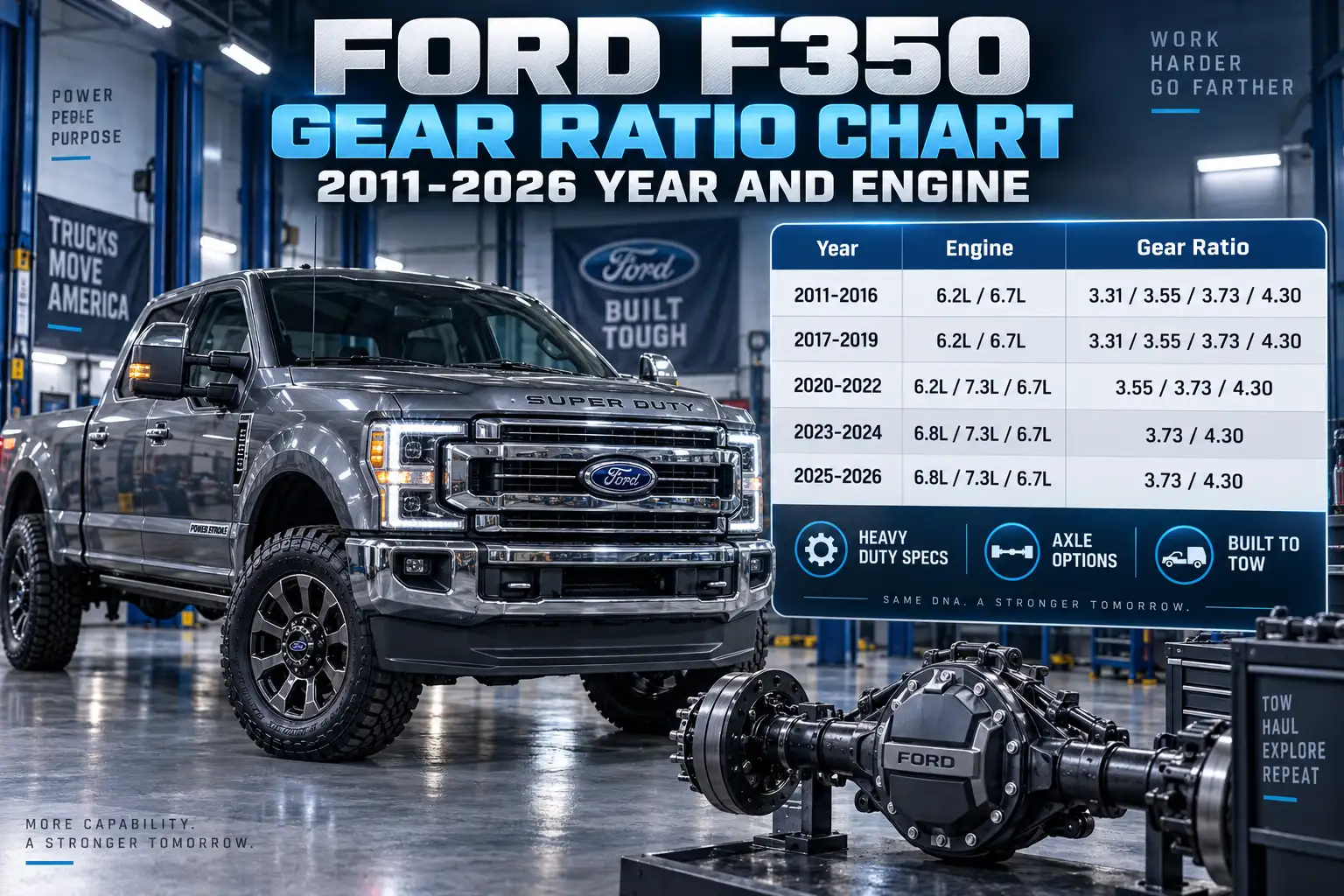
The Ford F350 gear ratio is not one fixed number. Depending on the model year, engine, single rear wheel or dual rear wheel setup, Ford has used ratios ranging from 3.31 to 4.30 on many modern F-350 pickups, with additional ratios appearing on older trucks and special configurations.
For example, Ford’s 2026 towing guide lists 3.31 and 3.55 ratios for F-350 SRW diesel trucks, while gas SRW models use 3.73 and 4.30. F-350 DRW diesel configurations add 4.10 and, on some configurations, 4.30.

Prime for Young Adults — 6 Months Free
Students and 18–24s get six months of Prime free, then half price.
Start 6 Months Free As an Amazon Associate I earn from qualifying purchases.
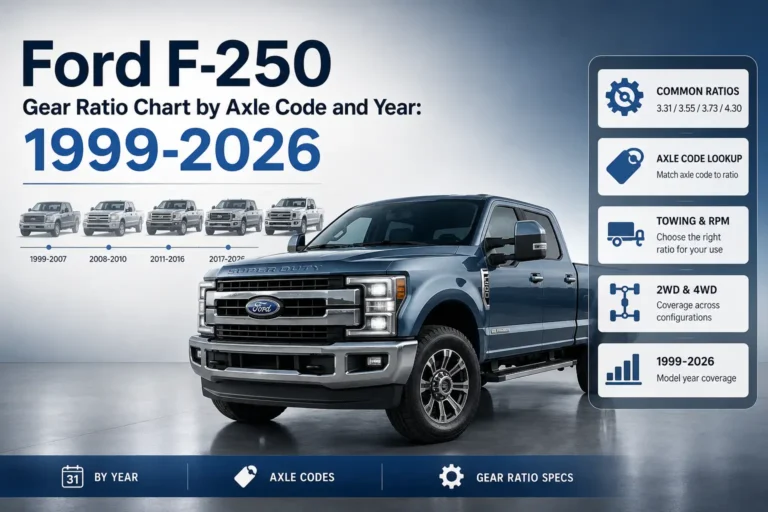
Use the chart below to narrow the ratio by model year, engine, and rear-wheel configuration. Then verify your specific truck using the AXLE code on the driver’s door certification label.
FORDMASTERX / SUPER DUTY REFERENCE
Ford F-350 Gear Ratios Explained
Compare common factory axle ratios, identify your engine configuration and locate your truck’s original axle code.
Five Common Modern Gear Ratios
The bars illustrate increasing mechanical torque multiplication, not measured towing capacity.
2026 F-350 Factory Ratio Examples
Ratios offered on selected configurations. Availability depends on the exact truck.
*Selected diesel DRW configurations may also offer 4.30.
Common Axle Codes
Selected examples from modern Super Duty documentation. Codes are year-dependent.
Find Your Truck’s Actual Ratio
Locate the Safety Compliance Certification Label on the door edge or door-latch pillar.
Record the factory axle code printed on the label.
Match the code to your model year. Check the axle physically if the truck was modified.
FordMasterX.com
Ford F350 Gear Ratio Chart by Year and Engine
Recommended Best Deal Products


The table below focuses on verified F-350 pickup configurations from key Ford model years. Ford changed combinations based on cab, drivetrain, tires, GVWR package, and towing equipment, so the ratio shown for an engine was not necessarily available on every truck with that engine.
| Model Year | Engine | Configuration | Verified Factory Axle Ratios |
|---|---|---|---|
| 2011 | 6.2L Gas V8 | F-350 Pickup | 3.73, 4.30 |
| 2011 | 6.7L Power Stroke Diesel | F-350 Pickup | 3.31, 3.55, 3.73, 4.30 |
| 2015 | 6.2L Gas V8 | F-350 SRW and DRW | 3.73, 4.30 |
| 2015 | 6.7L Power Stroke Diesel | F-350 SRW | 3.31, 3.55 |
| 2015 | 6.7L Power Stroke Diesel | F-350 DRW | 3.73, 4.30 |
| 2017 | 6.2L Gas V8 | F-350 SRW | 3.73, 4.30 |
| 2017 | 6.7L Power Stroke Diesel | F-350 SRW | 3.31, 3.55 |
| 2017 | 6.2L Gas V8 | F-350 DRW | 3.73, 4.30 |
| 2017 | 6.7L Power Stroke Diesel | F-350 DRW | 3.55, 4.10 |
| 2020 | 6.2L Gas V8 | F-350 SRW | 3.73, 4.30 |
| 2020 | 6.7L Power Stroke Diesel | F-350 SRW | 3.31, 3.55 |
| 2020 | 7.3L Gas V8 | F-350 SRW | 3.73, 4.30 |
| 2020 | 6.2L Gas V8 | F-350 DRW | 3.73, 4.30 |
| 2020 | 6.7L Power Stroke Diesel | F-350 DRW | 3.55, 4.10 |
| 2020 | 7.3L Gas V8 | F-350 DRW | 3.73, 4.30 |
| 2023 | 6.7L Power Stroke Diesel | F-350 SRW | 3.31, 3.55 |
| 2023 | 6.7L High Output Diesel | F-350 SRW | 3.31, 3.55 |
| 2023 | 6.8L Gas V8 | F-350 SRW | 3.73, 4.30 |
| 2023 | 7.3L Gas V8 | F-350 SRW | 3.73, 4.30 |
| 2026 | 6.7L Power Stroke Diesel | F-350 SRW | 3.31, 3.55 |
| 2026 | 6.7L High Output Diesel | F-350 SRW | 3.31, 3.55 |
| 2026 | 6.8L Gas V8 | F-350 SRW | 3.73, 4.30 |
| 2026 | 7.3L Gas V8 | F-350 SRW | 3.73, 4.30 |
| 2026 | 6.7L Power Stroke Diesel | F-350 DRW | 3.55, 4.10, selected 4.30 configurations |
| 2026 | 6.7L High Output Diesel | F-350 DRW | 3.55, 4.10, selected 4.30 configurations |
| 2026 | 6.8L Gas V8 | F-350 DRW | 4.30 |
| 2026 | 7.3L Gas V8 | F-350 DRW | 3.73, 4.30 |
Ford’s 2011 towing guide shows 3.73 and 4.30 with the 6.2L gas engine and 3.31, 3.55, 3.73, and 4.30 entries with the 6.7L diesel depending on F-350 configuration.
The pattern became more configuration-specific in later years. The 2017 F-350 SRW chart pairs the 6.2L gas engine with 3.73 or 4.30, while the 6.7L diesel uses 3.31 or 3.55. DRW diesel trucks in Ford’s 2017 data use 3.55 and 4.10 in relevant configurations.
For 2020, Ford lists the F-350 SRW 6.2L with 3.73 or 4.30, the 6.7L diesel with 3.31 or 3.55, and the 7.3L gas engine with 3.73 or 4.30.
Ford’s 2023 chart keeps the same general split for SRW trucks. Diesel models use 3.31 and 3.55, while the 6.8L and 7.3L gas engines use 3.73 and 4.30.
The 2026 F-350 SRW chart follows that pattern again. Ford lists 3.31 and 3.55 for both versions of the 6.7L diesel, 3.73 and 4.30 for the 6.8L gas engine, and 3.73 and 4.30 for the 7.3L gas engine.
F-350 DRW trucks need separate attention. For 2026, Ford lists 3.55 and 4.10 for standard and High Output 6.7L diesel applications, with 4.30 appearing on selected configurations. The 6.8L gas DRW uses 4.30, while the 7.3L gas DRW lists 3.73 and 4.30.
That is why the door sticker matters. A general chart narrows your options, but the factory AXLE code identifies what Ford originally installed on your truck.

Audible — Listen Free for 30 Days
One free credit a month and thousands of titles included.
Listen Free for 30 Days As an Amazon Associate I earn from qualifying purchases.How Ford F350 Axle Codes Match Gear Ratios
The AXLE code is the fastest way to confirm your factory ratio. Ford prints the code on the Safety Compliance Certification Label near the driver’s door.
For modern Super Duty trucks, common codes include the following.
| Gear Ratio | Non Limited Slip | Limited Slip | Electronic Locking |
|---|---|---|---|
| 3.31 | 31 | Not available | 3H |
| 3.55 | 35 | 3K | 3J |
| 3.73 | 37 | 3L | 3E |
| 4.10 | Varies by year | 4N on recent pickups | Often not available |
| 4.30 | Often not available | 4L | 4M |
Ford’s 2026 documentation lists 31 for a 3.31 non-limited-slip axle, 3H for a 3.31 electronic locker, 35 for a 3.55 open axle, 3K for a 3.55 limited-slip axle, and 3J for a 3.55 electronic locker. It also lists 37, 3L, and 3E for 3.73 variants.
Codes change across generations, so do not apply a modern chart blindly to an older truck. Our full Ford axle code chart covers the identification process in more detail.
The ratio table above tells you what was available. The next step is confirming what your particular F-350 left the factory with.
How to Find Your F350 Gear Ratio on the Door Label
Recommended Best Deal Products
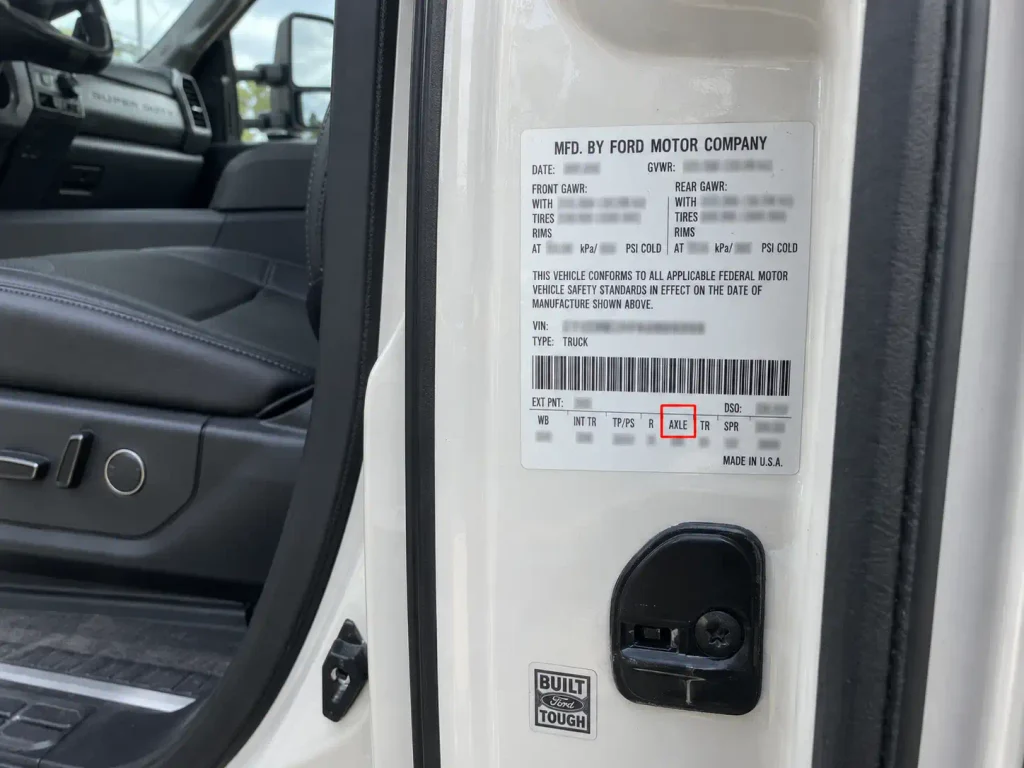
You normally do not need to open the differential to identify the original axle ratio. Ford provides the necessary code on the truck’s certification label.
- Open the driver’s door.
- Find the Safety Compliance Certification Label on the door edge or door-latch pillar.
- Look below the barcode for the field marked AXLE.
- Write down the two-character code.
- Match it with the correct Ford axle-code chart for your model year.
- If the axle has been replaced, verify the physical axle tag or differential before ordering gears or parts.
Ford gives essentially this procedure in its Super Duty towing documentation. The company directs owners to the Safety Compliance Certification Label and the AXLE code when the gear ratio is unknown.
A door label identifies the factory build. It cannot prove that a previous owner never swapped the differential or changed the ring and pinion.
Once you have confirmed the number, understanding what 3.31, 3.55, 3.73, 4.10, or 4.30 means becomes much easier.
What Each F350 Gear Ratio Changes on the Road
A numerically higher axle ratio gives the drivetrain more torque multiplication at the wheels. A numerically lower ratio turns the driveshaft fewer times for each wheel revolution.
Audible Premium Plus — Annual Membership
12 audiobook credits up front, plus the full Audible catalogue.
See Annual Plans As an Amazon Associate I earn from qualifying purchases.The practical difference depends heavily on the engine and transmission. A modern 10-speed F-350 behaves differently from an older four-speed or six-speed truck even when both have the same rear axle ratio.
3.31 Gears
The 3.31 ratio appears primarily with modern F-350 SRW diesel configurations.
It is the tallest common ratio in recent F-350 pickup charts. The lower numerical ratio favors lower driveshaft and engine speed once the transmission reaches its cruising gears.
3.55 Gears
The 3.55 ratio is common on modern Power Stroke trucks and gives slightly more mechanical advantage than 3.31.
Ford also uses 3.55 on current F-350 DRW diesel configurations, so it should not be treated as an SRW-only ratio.
3.73 Gears
The 3.73 ratio appears frequently with gas-powered F-350s.
Both the 6.8L and 7.3L gas engines use 3.73 in current SRW applications, while Ford also lists 3.73 with certain current 7.3L DRW configurations.
4.10 Gears
The 4.10 ratio gives more torque multiplication than 3.55 or 3.73.
It is especially relevant to F-350 DRW diesel trucks. Ford’s 2026 towing guide lists 4.10 with both the standard 6.7L Power Stroke and the High Output 6.7L diesel on DRW configurations.
4.30 Gears
A 4.30 axle provides the most aggressive multiplication among the common ratios in modern F-350 pickup charts.
Ford pairs 4.30 with current 6.8L and 7.3L gas trucks, and the ratio also appears on selected diesel DRW configurations.
The ratio affects pulling characteristics, but it cannot be used by itself to determine how much your truck may legally or safely tow.
How F350 Gear Ratio Affects Towing Capacity
Gear ratio matters for towing, but it does not determine an F-350’s tow rating by itself.
Ford calculates towing limits around the full truck configuration. Engine, GCWR, cab, wheelbase, 4×2 or 4×4 drivetrain, SRW or DRW axle, GVWR, tires, packages, payload, passengers, hitch type, and other equipment can all change the final rating.
The 2026 F-350 SRW chart gives a clear example. A 6.8L gas truck with a 3.73 axle is listed with a 21,000-pound GCWR, while the same engine with 4.30 gearing is listed at 24,400 pounds GCWR.
The 7.3L gas example is similar. Ford lists a 25,200-pound GCWR with 3.73 gearing and up to 29,000 pounds with the 4.30 combination shown in the same chart.
That does not mean changing only the gears automatically gives your existing truck the higher factory rating. The higher-rated configuration may include different tires, axle hardware, GVWR packages, springs, cooling equipment, or other components.
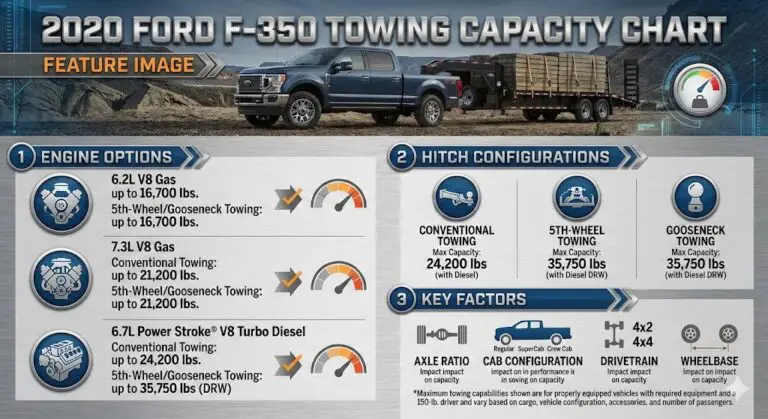
For exact limits after identifying your axle, use our Ford F350 towing capacity guide. Owners of that model year can also compare the configuration against the dedicated 2020 Ford F350 towing capacity chart.
The important distinction is simple. The axle ratio helps explain capability, while the truck’s certified configuration determines the rating.
Which F350 Gear Ratio Fits Towing and Highway Use
The useful ratio depends on what you ask the truck to do and which ratios Ford offered with your powertrain.
| Main Use | Ratio Direction | Why |
|---|---|---|
| Highway driving with lighter loads | Lower numerical ratio | Lower final-drive multiplication |
| Mixed highway and towing | Middle of the available range | Balances cruising and pulling characteristics |
| Frequent heavy towing | Higher numerical ratio | More torque multiplication |
| Oversized tires | Often benefits from deeper gearing | Larger tires make effective gearing taller |
A 3.31-equipped Power Stroke and a 4.30-equipped gas F-350 should not be compared as if axle ratio were the only variable. The diesel’s torque curve, transmission, tire size, vehicle weight, and factory GCWR all differ.
The best approach is to stay within Ford’s approved combinations when buying a truck for a specific trailer. If you already own the F-350, identify its ratio first and then check the towing chart for that exact configuration.
Modified tire size creates one more variable because the effective final-drive ratio changes even when the ring and pinion stay untouched.
How Larger Tires Change Your F350 Effective Gear Ratio
Larger tires make the truck behave as though it has a numerically lower axle ratio.
You can estimate the change with this formula:
Effective Ratio = Original Ratio × Original Tire Diameter ÷ New Tire Diameter
For example, changing from a 34-inch tire to a 37-inch tire with 3.73 gears gives an effective ratio of about 3.43.
3.73 × 34 ÷ 37 = 3.43
That means the truck now has less effective torque multiplication at the tire than it did with the original diameter.
This does not change the physical 3.73 gears inside the differential. It changes the overall relationship between driveshaft rotation and distance traveled per wheel revolution.
If you are changing wheels and tires at the same time, our Ford Super Duty wheel offset chart can help you check wheel fitment separately from the gearing calculation.
Before considering a regear, confirm your current axle code, actual tire diameter, transmission, and intended towing load.
How to Confirm Your F350 Gear Ratio in 4 Steps
Use these four checks before relying on a gear-ratio number from a listing, forum post, or previous owner.
- Identify the model year and engine. This narrows the factory combinations Ford offered.
- Confirm whether the truck is SRW or DRW. Dual rear wheel trucks often have different ratios from SRW versions.
- Read the AXLE code on the driver’s door label. Decode it using the correct model-year reference.
- Verify altered trucks physically. If the axle or ring and pinion may have been replaced, check the differential tag or measure the ratio directly.
This sequence prevents one of the most common mistakes with F-350 specifications, assuming that every truck with the same engine received the same rear axle.
Use the Exact Ratio for Your F350 Configuration
The Ford F350 gear ratio chart is most useful as a starting point. Modern SRW diesel trucks commonly use 3.31 or 3.55, gas SRW trucks commonly use 3.73 or 4.30, and DRW trucks add combinations such as 4.10 depending on engine and model year.
Do not select parts or calculate towing capability from a generic ratio list alone. Check the AXLE code, confirm whether your F-350 is SRW or DRW, and match that information with Ford’s towing data for the correct year.
That gives you the factory configuration you actually need instead of a ratio that merely existed somewhere in the Super Duty lineup.
5 Common Ford F350 Gear Ratio Questions
What Gear Ratio Does a Ford F350 Have
An F-350 does not have one universal gear ratio. Depending on year, engine, and SRW or DRW configuration, modern trucks commonly use 3.31, 3.55, 3.73, 4.10, or 4.30 gears. Check the driver’s door AXLE code to identify the factory ratio on your truck.
How Do I Find the Gear Ratio on My F350
Find the Safety Compliance Certification Label near the driver’s door and look for the field marked AXLE. Ford uses the two-character code in that field to identify the factory ratio and differential type.
Is 3.55 or 3.73 Better for an F350
Neither ratio is universally better. A 3.73 provides more mechanical multiplication than 3.55, while 3.55 is taller. Your engine, transmission, tire size, trailer weight, and the factory configurations Ford approved for that model year should determine which setup fits the job.
Is a 4.30 Gear Ratio Good for Towing
A 4.30 ratio provides more torque multiplication than 3.31, 3.55, 3.73, or 4.10. Ford uses 4.30 in several high-capability gas F-350 configurations, but the axle ratio alone does not establish towing capacity. Always use the complete Ford towing specification for the truck.
Can I Tell My F350 Gear Ratio From the VIN
The VIN itself does not present the axle ratio as an obvious gear-ratio digit. For most owners, Ford’s recommended quick check is the AXLE code on the driver’s Safety Compliance Certification Label. If the drivetrain has been modified, inspect the axle hardware or verify the ratio mechanically.