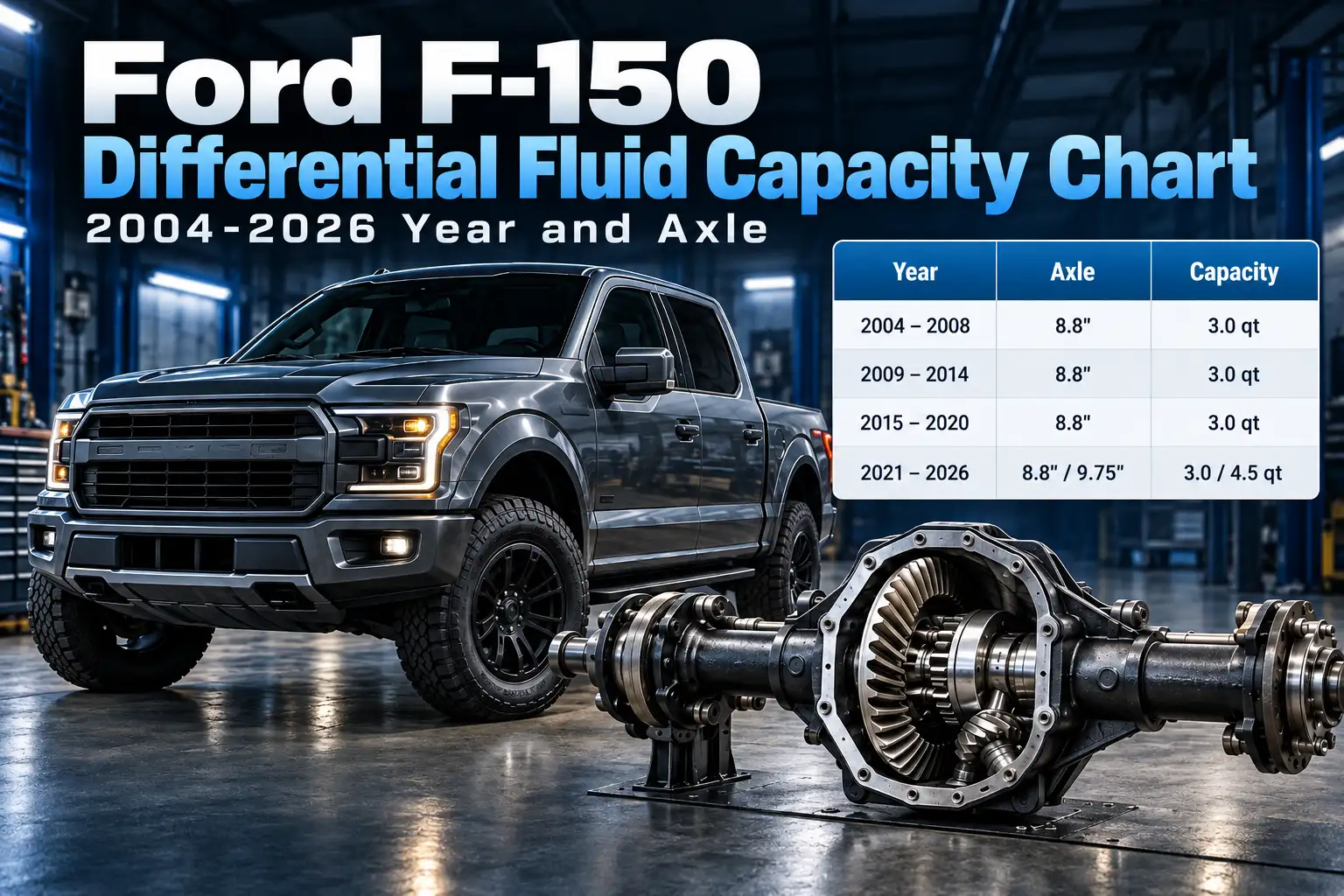
Ford F-150 Differential Fluid Capacity Chart: 2004-2026 Year and Axle

Your Ford F-150’s rear differential holds between 4.0 and 7.0 pints of gear oil. The exact number depends on which axle your truck came with and which generation it belongs to, not on the model year alone.
Ford put four different rear axle housings under the F-150 over the years: the 8.8 inch, the standard 9.75 inch, the heavy duty 10.25 inch, and a higher capacity 9.75 inch version used on the Raptor. Each one holds a different amount of fluid.

Prime for Young Adults — 6 Months Free
Students and 18–24s get six months of Prime free, then half price.
Start 6 Months Free As an Amazon Associate I earn from qualifying purchases.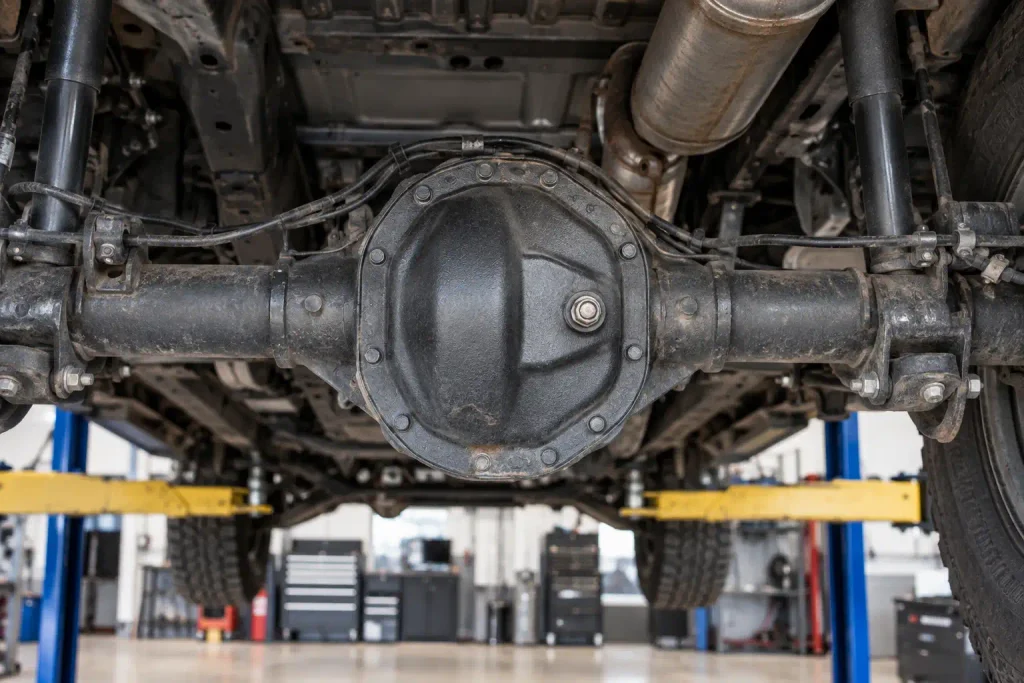
Before you trust any number on this page, confirm which axle your truck actually has. If you’re not sure, our F-150 rear end identification guide walks through every visual cue that separates one housing from another.
Ford F-150 Quick Reference
Differential Fluid Capacity by Axle and Year
Rear axle refill capacity varies by axle size and by generation. Confirm your axle code before filling.
Rear Axle Capacity
Correct Fluid by Generation
2016 to present
Motorcraft SAE 75W-85
XY-75W85-QL · WSS-M2C942-A
2004 to 2014

Audible — Listen Free for 30 Days
One free credit a month and thousands of titles included.
Listen Free for 30 Days As an Amazon Associate I earn from qualifying purchases.Motorcraft SAE 75W-140
XY-75W140-QL · WSL-M2C192-A
Traction-Lok limited slip axle? Add 4 fl oz of Motorcraft friction modifier XL-3 before filling. Skip it on an open differential or an electronic locker.
How to Find Your Ford F-150 Axle Code
Recommended Best Deal Products


Check your driver’s door jamb sticker before doing anything else. Every F-150 carries a safety compliance certification label there, and it includes an axle code field.
That code is the fastest way to identify your exact axle without crawling under the truck. Cross-reference it against the Ford axle code chart to see the axle size, gear ratio, and whether your truck has a limited slip differential from the factory.
If the door sticker is missing, faded, or was replaced during a repair, you have a backup option. The axle tag bolted to the differential cover carries the same code, though it can be harder to read once it picks up years of road grime and surface rust.
Knowing your axle size is the difference between filling to the correct level and guessing. With the axle identified, the actual capacity numbers below will apply directly to your truck.
Ford F-150 Rear Differential Fluid Capacity by Axle Type
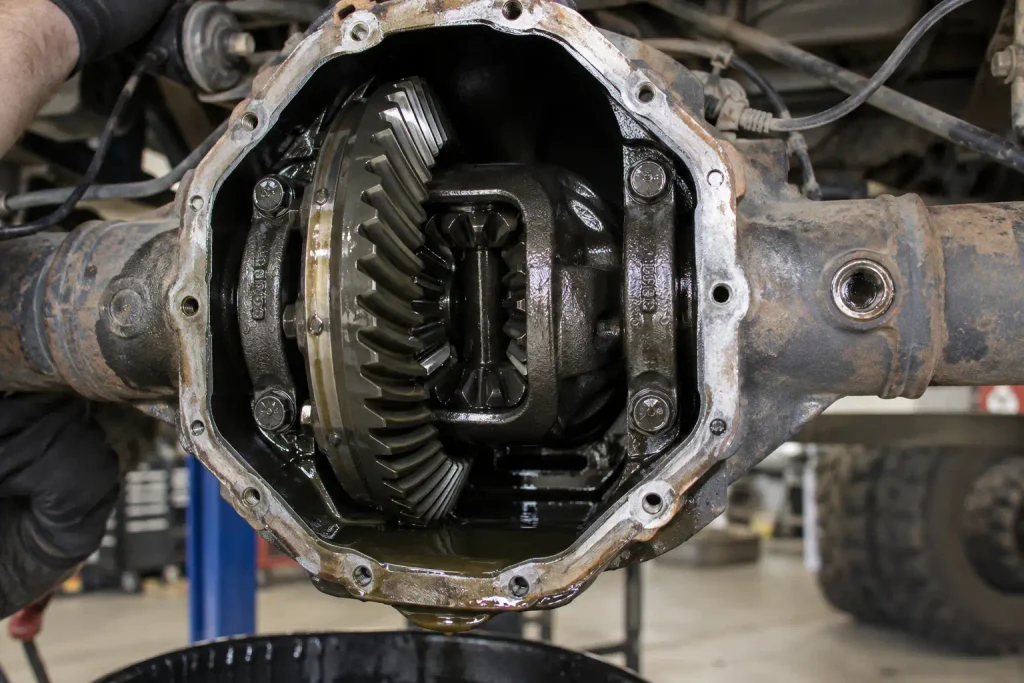
The F-150’s rear differential capacity actually changed between generations, not just between axle sizes. Ford’s own Motorcraft lubricant reference charts show two distinct capacity sets, one for 2004 through 2014 trucks and a lower set for 2016 and newer trucks built on the aluminum body platform.
| Generation | Axle Size and Type | Rear Diff Capacity | Friction Modifier |
|---|---|---|---|
| 2004 to 2014 | 8.8 or 9.75 inch, Conventional or Electronic locker | 5.5 pints (2.60 L) | Not required |
| 2004 to 2014 | 8.8 or 9.75 inch, Traction-Lok limited slip | 5.3 pints (2.51 L) | XL-3, 4 fl oz |
| 2004 to 2014 | 10.25 inch, Traction-Lok limited slip | 7.0 pints (3.31 L) | XL-3, 4 fl oz |
| 2010 to 2014 | 9.75 inch, Raptor Electronic locker | 6.0 pints (2.84 L) | Not required |
| 2016 to present | 9.75 inch, Conventional or Electronic locker | 4.6 pints (2.18 L) | Not required |
| 2016 to present | 8.8 inch, Conventional or Electronic locker | 4.0 pints (1.89 L) | Not required |
| 2016 to present | 9.75 inch, Raptor Conventional or Electronic locker | 5.6 pints (2.65 L) | Not required |
| 2016 to 2017 | 8.8 inch, Dual Rear Wheel | 6.0 pints (2.84 L) | Not required |
The safest fill method regardless of which row applies to your truck is to fill slowly through the fill hole on a level surface until fluid begins to run out, then let it settle and top off once more. That approach fills to the actual level line rather than relying on a printed number alone, and it protects you if your truck’s build sheet differs slightly from the chart above.
Audible Premium Plus — Annual Membership
12 audiobook credits up front, plus the full Audible catalogue.
See Annual Plans As an Amazon Associate I earn from qualifying purchases.The fill and check plug sits at the rear differential fill plug location on the driver’s side of the housing, just above axle centerline.
Front Differential Fluid Capacity for 4×4 F-150 Models
Recommended Best Deal Products


4×4 F-150s also carry a front differential, which most owners never touch since it rarely needs service outside of a leak. The front unit is an 8.8 inch IFS housing on every 4×4 F-150, though the capacity and fluid spec changed generations, just like the rear.
On 2004 through 2014 4×4 F-150s, the front differential holds 3.5 pints and takes Motorcraft SAE 80W-90 premium gear lubricant, part number XY-80W90-QL. The early Raptor’s front differential, built 2010 through 2014, holds 3.25 pints of the same 80W-90 fluid plus 4 fluid ounces of XL-3 friction modifier.
On 2016 and newer 4×4 F-150s, the front differential holds 3.6 pints and takes the same Motorcraft SAE 75W-85 synthetic fluid used in the rear, meeting Ford spec WSS-M2C942-A. The current Raptor’s Torsen front unit holds 3.2 pints of that 75W-85 fluid plus 4 fluid ounces of XL-3 friction modifier.
Fill level on the front differential is measured differently than the rear on some model years. Check your specific service manual for the exact fill line before topping off, since overfilling the front unit is a more common mistake than underfilling it.
Source: Motorcraft Axle Lubricants Quick Reference Lubricant Applications and Capacities Chart, front axle rows for F-150, Expedition, and Navigator, 2004 to 2014 and 2016 to 2025 editions.
Correct Differential Fluid Type and Friction Modifier for the F-150
Not every 75W-90 gear oil on the shelf is the right fluid for your F-150. Ford has used two different rear axle fluid specs, and the changeover lines up with the generation change rather than a mid-cycle update.
2004 through 2014 F-150s of every rear axle size and type call for Motorcraft SAE 75W-140 full synthetic gear oil, part number XY-75W140-QL, meeting Ford spec WSL-M2C192-A. 2016 and newer F-150s moved to Motorcraft SAE 75W-85 full synthetic hypoid gear lubricant, part number XY-75W85-QL, meeting Ford specification WSS-M2C942-A. The switch happened with the aluminum body redesign that launched for the 2015 model year.
If your F-150 has a Traction-Lok limited slip rear axle, it needs friction modifier added on a complete refill regardless of generation. Ford calls for 4 fluid ounces of Motorcraft friction modifier XL-3, part number EST-M2C118-A, added to the housing before the gear oil goes in. Trucks with an open differential or an electronic locking differential do not need the friction modifier, and Ford’s own documentation specifically warns against adding it to an electronic locker.
Skipping the friction modifier on a Traction-Lok axle is a common cause of chatter or clunking noise during low speed turns after a fluid change.
Source: Motorcraft Axle Lubricants Quick Reference Lubricant Applications and Capacities Chart, footnote 3 on friction modifier quantity and fluid legend, both editions.
When to Change F-150 Differential Fluid
Recommended Best Deal Products


Ford doesn’t put differential fluid changes on a fixed mileage schedule, with two exceptions. The factory position is that axle fluid does not need changing or checking unless a leak is suspected or the axle has been submerged in water.
The first exception is heavy use. If you regularly tow in outside temperatures above 70 degrees Fahrenheit, or run at wide open throttle above 45 mph for extended periods, Ford recommends changing the rear axle fluid every 30,000 miles when the axle is filled with non-synthetic fluid.
The second exception works in your favor. That 30,000 mile interval can be waived entirely, extending to a 150,000 mile service interval, if the axle is filled with 75W-85 synthetic fluid meeting spec WSS-M2C942-A.
Factory fill levels aren’t always perfect either. Owners on F-150 forums have reported finding their rear differential noticeably low on fluid at 57,000 to 60,000 miles with no visible leak, suggesting some trucks leave the factory under-filled. Checking your level at every oil change costs nothing and catches this early.
To check without a full fluid change, see our guide on how to check your differential fluid level on the F-150.
Best Differential Fluid and Tools for F-150 Owners
Getting the right fluid on the shelf before you start the job saves a second trip to the parts store. These items cover the fluid, the additive, and the tool most owners are missing.
Motorcraft SAE 75W-85 Rear Axle Oil, XY75W85QL. This is the current factory spec fluid for 2016 and newer F-150 rear and front differentials, meeting Ford’s WSS-M2C942-A specification. Trucks built 2004 through 2014 need the SAE 75W-140 version instead.
Motorcraft Friction Modifier XL-3. Required for any Traction-Lok limited slip axle on a complete refill, at 4 fluid ounces per axle. Skip this on an open differential or an electronic locker.
A basic gear oil transfer pump or a squeeze bottle with a hose extension makes filling through the small differential fill hole far less messy than pouring straight from the bottle. Any pump rated for 75W gear oil viscosity from AutoZone, RockAuto, or a hardware store works for this job.
F-150 Differential Fluid Capacity FAQ
Does the F-150 need scheduled differential fluid changes?
No. Ford does not put differential fluid on a fixed service interval unless a leak is suspected, the axle has been submerged, or the truck sees heavy towing with non-synthetic fluid.
How much fluid does a 9.75 inch rear end take?
It depends on the generation. 2004 through 2014 trucks take 5.5 pints, while 2016 and newer trucks take 4.6 pints. Fill slowly to the level of the fill hole rather than relying on a fixed number.
What happens if you overfill the differential?
Excess fluid typically works its way past the axle seals and shows up as oil on the inside of the wheels and brake components. It rarely damages the differential itself, but it creates a mess worth avoiding.
Can you use 75W-90 instead of 75W-85 in a newer F-150?
Stick to the specified 75W-85 synthetic fluid meeting WSS-M2C942-A on 2016 and newer trucks. Using a different viscosity than the factory spec on a Traction-Lok axle can affect how the friction modifier performs.