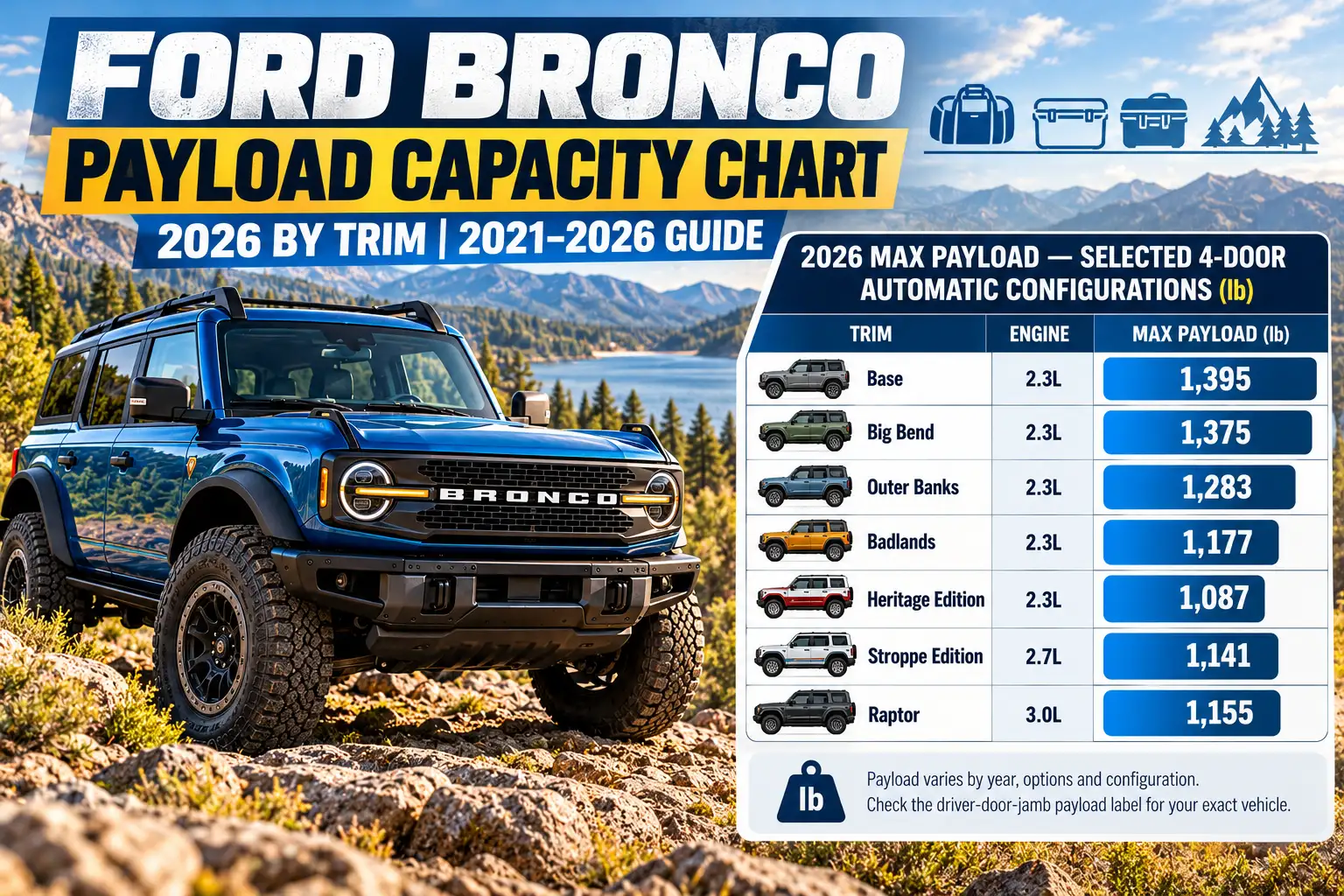
Ford Bronco Payload Capacity Chart By Year & Trim (2021–2026)

The Ford Bronco payload capacity chart varies by model year, trim, engine, transmission, doors, and optional equipment. In Ford’s published 2026 configurations, maximum payload ratings run from 1,067 to 1,417 pounds. A 2026 four-door Base with the 2.3L engine and seven-speed manual has the 1,417-pound published rating; a two-door Badlands with the 2.3L automatic is rated at 1,067 pounds.


Those figures describe particular configurations, not every Bronco with the same badge. For the weight your own SUV can carry, use the Tire and Loading label on its driver-side doorjamb. The charts below cover the full-size, body-on-frame Bronco for 2021 through 2026, not the separate Bronco Sport.
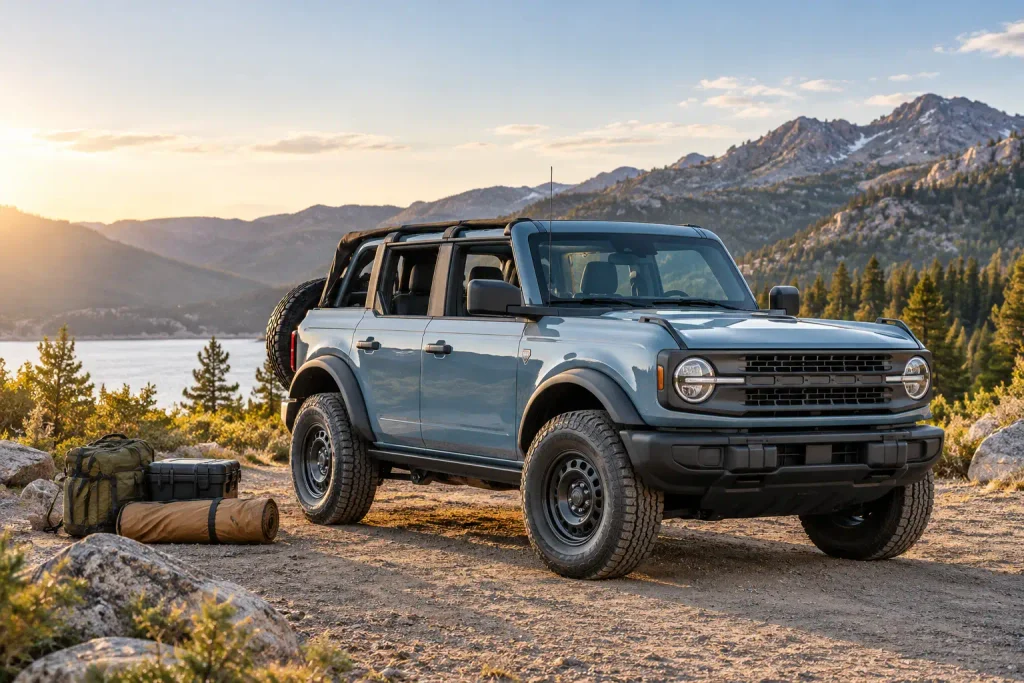
FordMasterX / Factory specification visual
2026 Ford Bronco Payload at a Glance
Maximum factory payload changes with body style and equipment. These are published ratings for specific configurations, not a substitute for your doorjamb label.
Base 4-door · 2.3L · manual
Badlands 2-door · 2.3L · automatic
2-Door vs 4-Door
Same Base trim, 2.3L engine, 7-speed manual
Effect of Sasquatch
Same 4-door Base, 2.3L engine, 7-speed manual
Check your own Bronco: The Tire and Loading label on the driver’s doorjamb gives the vehicle-specific occupants-and-cargo limit. Passengers and added gear consume that allowance.
Ford Bronco Payload Capacity Chart From 2021 to 2026
The table offers documented example configurations for each model year. It is not a list of the lowest and highest ratings sold in those years. A whole-year range would require every factory option combination to be verified, and several historical databases mix equipment or report inconsistent weights.
| Model year | Documented Bronco configuration | Published payload | Evidence |
|---|---|---|---|
| 2021 | Base, 2-door, 2.3L, 7-speed manual | 1,254 lbs | Cars.com vehicle specification |
| 2022 | Big Bend, 4-door, 2.3L, 7-speed manual | 1,454 lbs | Ford 2022 technical specification |
| 2023 | Base, 2-door, 2.3L, 7-speed manual | 1,254 lbs | Car and Driver specification |
| 2024 | Big Bend, 2-door, 2.3L, 7-speed manual | 1,243 lbs | Car and Driver specification |
| 2025 | Badlands, 2-door, 2.3L, 7-speed manual | 1,015 lbs | Car and Driver specification |
| 2026 | Base, 4-door, 2.3L, 7-speed manual | 1,417 lbs | Ford 2026 technical specification |
These examples are not directly comparable as a year-over-year trend: they represent different trims and, in some cases, different body styles. In particular, the 2025 Badlands example is not a statement that every 2025 Bronco carries only 1,015 pounds.
The original 2021 Bronco Base specifications published by Cars.com support the 1,254-pound example. A copy of Ford’s 2022 Bronco technical specifications lists the four-door Big Bend manual at 1,454 pounds without options. The 2023 and 2024 figures above match their individually identified Car and Driver specification listings.
The key is to match year, door count, trim, engine, transmission, and equipment before comparing payload. For shoppers considering a current-model Bronco, Ford provides a substantially more detailed 2026 matrix.
2026 Ford Bronco Payload Capacity by Trim and Configuration
Ford’s 2026 Bronco technical specifications, dated February 18, 2026, list curb weight, GVWR, payload, axle ratings, and towing by configuration. The payload values below are copied from the manufacturer’s two-door and four-door tables, rather than estimated from a generic curb weight.
2026 Two Door Bronco Payload Ratings
| Trim and equipment | Engine | Transmission | Maximum payload |
|---|---|---|---|
| Base | 2.3L I-4 | 7-speed manual | 1,147 lbs |
| Badlands | 2.3L I-4 | 7-speed manual | 1,087 lbs |
| Base with Sasquatch | 2.3L I-4 | 7-speed manual | 1,087 lbs |
| Base | 2.3L I-4 | 10-speed automatic | 1,188 lbs |
| Badlands | 2.3L I-4 | 10-speed automatic | 1,067 lbs |
| Base with Sasquatch | 2.3L I-4 | 10-speed automatic | 1,132 lbs |
The two-door automatic Base has a published payload of 1,188 pounds, while the automatic Badlands has 1,067 pounds. Even though both use the 2.3L engine, their equipment and weight ratings are not identical.
2026 Four Door Bronco Payload Ratings
| Trim and equipment | Engine | Transmission | Maximum payload |
|---|---|---|---|
| Base | 2.3L I-4 | 7-speed manual | 1,417 lbs |
| Base with Sasquatch | 2.3L I-4 | 7-speed manual | 1,248 lbs |
| Big Bend | 2.3L I-4 | 7-speed manual | 1,333 lbs |
| Big Bend with Black Diamond | 2.3L I-4 | 7-speed manual | 1,246 lbs |
| Badlands | 2.3L I-4 | 7-speed manual | 1,243 lbs |
| Heritage Edition | 2.3L I-4 | 7-speed manual | 1,109 lbs |
| Base | 2.3L I-4 | 10-speed automatic | 1,395 lbs |
| Base with Sasquatch | 2.3L I-4 | 10-speed automatic | 1,266 lbs |
| Big Bend | 2.3L I-4 | 10-speed automatic | 1,375 lbs |
| Big Bend with Black Diamond | 2.3L I-4 | 10-speed automatic | 1,239 lbs |
| Outer Banks | 2.3L I-4 | 10-speed automatic | 1,283 lbs |
| Outer Banks with Sasquatch | 2.3L I-4 | 10-speed automatic | 1,182 lbs |
| Badlands | 2.3L I-4 | 10-speed automatic | 1,177 lbs |
| Heritage Edition | 2.3L I-4 | 10-speed automatic | 1,087 lbs |
| Outer Banks | 2.7L V6 | 10-speed automatic | 1,296 lbs |
| Outer Banks with Sasquatch | 2.7L V6 | 10-speed automatic | 1,195 lbs |
| Badlands | 2.7L V6 | 10-speed automatic | 1,204 lbs |
| Heritage Edition | 2.7L V6 | 10-speed automatic | 1,180 lbs |
| Stroppe Edition | 2.7L V6 | 10-speed automatic | 1,141 lbs |
| Raptor | 3.0L V6 | 10-speed automatic | 1,155 lbs |
These are Ford’s maximum payload ratings for the listed configurations. The optional-equipment mix and accessories fitted to a particular SUV can change its carrying capacity. Ford instructs owners to check the doorjamb label rather than use the brochure table as the final limit.
The 2026 Raptor is rated at 1,155 pounds in Ford’s four-door table. Its 3.0L engine and specialized suspension do not make it the highest-payload Bronco. A more powerful engine is not a substitute for checking the weight rating.
How Two Door and Four Door Bronco Payload Ratings Compare
The four-door Bronco can have a higher published payload than a comparable two-door model, but four doors do not guarantee more capacity across every trim.
For a 2026 Base with the 2.3L engine and manual transmission, Ford lists 1,147 pounds for the two-door and 1,417 pounds for the four-door, a difference of 270 pounds. With the 2.3L automatic, the corresponding Base ratings are 1,188 and 1,395 pounds, a difference of 207 pounds.
Those comparisons keep the trim, engine, and transmission the same. If you compare a heavily equipped four-door Badlands with a lightly equipped two-door Base, the result can change.
Also consider seating: Ford lists four occupants for the two-door and five for the four-door. Carrying another passenger uses available payload, so a higher published rating does not automatically mean more space for camping gear after everyone is seated.
Which Bronco Packages Change Payload Capacity
Sasquatch and other equipment packages change the weight of the Bronco, and in some cases the manufacturer’s GVWR, too. The effect is configuration-specific, not a fixed number that can be subtracted from every trim.
For example, Ford lists the 2026 four-door Base with the 2.3L manual at 1,417 pounds of payload. Add the factory Sasquatch configuration shown in its chart, and the rating becomes 1,248 pounds. That is 169 pounds less carrying capacity for those two published setups.


For the 2026 four-door Outer Banks with the 2.3L automatic, Ford shows 1,283 pounds without Sasquatch and 1,182 pounds with it, a 101-pound difference. The change is different from the Base example because the configurations and ratings differ.
The Black Diamond Package also appears as a separate Big Bend configuration in Ford’s 2026 table. To understand how the Bronco’s hardware and equipment groups differ, see the Ford Bronco model comparison chart.
For aftermarket bumpers, winches, racks, skid plates, and other add-ons installed later, account for their actual weight when determining remaining carrying capacity. This matters particularly for a Bronco set up for off-road travel.
Where to Find Your Bronco Payload Rating
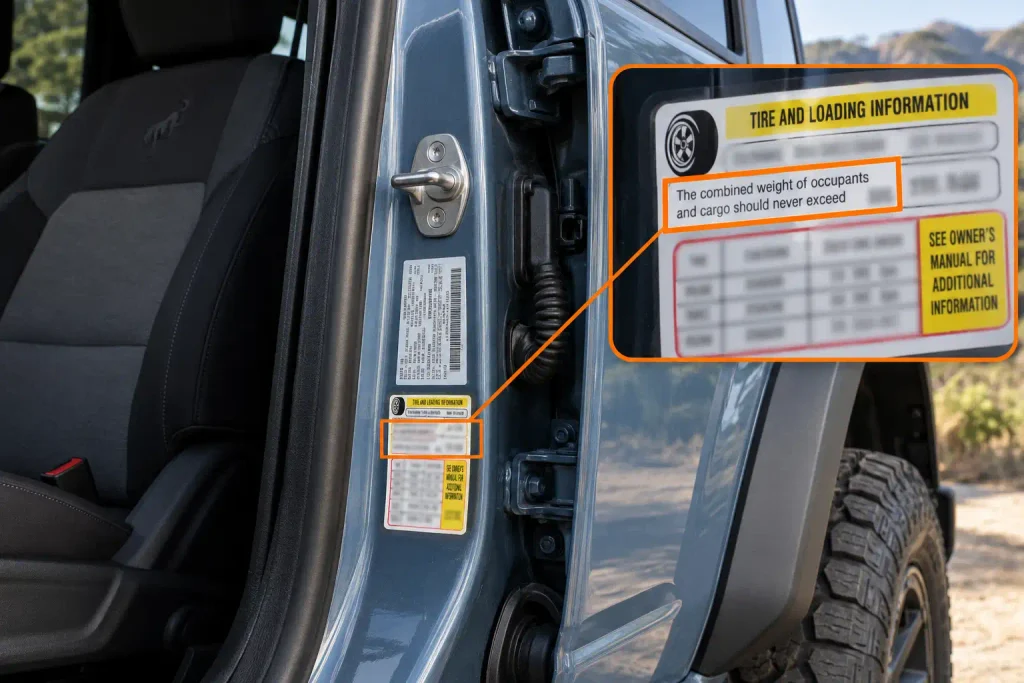
The Bronco’s Tire and Loading Information label gives a vehicle-specific combined occupants-and-cargo weight limit. It normally sits on the driver’s side B-pillar or door-edge area.
- Open the driver’s door and find the Tire and Loading Information label.
- Read the statement giving the combined weight of occupants and cargo, in pounds and kilograms.
- Record that figure as your vehicle’s starting payload allowance, before adding people and cargo.
- Check the nearby certification label for GVWR and front and rear gross axle weight ratings if you are planning a heavy or unusual load.
Do not mistake the tire-pressure numbers for the payload rating. Likewise, GVWR is not the amount of cargo you can put inside the SUV; it is the permitted maximum weight of the loaded vehicle.
If equipment was added after the vehicle left the factory, the added weight takes up part of the remaining payload. The doorjamb figure and the actual weight of the current vehicle are more useful than a trim name alone.
How to Calculate Remaining Bronco Payload With Gear
Start with the maximum combined occupant-and-cargo weight on your particular Bronco’s label. Subtract the people, cargo, and accessories you are adding, including trailer tongue weight when towing.
Remaining payload = labelled occupant-and-cargo allowance − occupants − cargo − added accessories − trailer tongue weight.
Here is a hypothetical weekend-trip calculation using a Bronco with a 1,200-pound vehicle-specific allowance. The weights below are examples, not Ford factory specifications.
| Load item | Example weight |
|---|---|
| Doorjamb occupant-and-cargo allowance | 1,200 lbs |
| Driver | 180 lbs |
| Passenger | 150 lbs |
| Camping supplies and luggage | 240 lbs |
| Aftermarket bumper added after manufacture | 65 lbs |
| Roof rack and cargo added after manufacture | 70 lbs |
| Trailer tongue weight | 180 lbs |
| Estimated remaining payload | 315 lbs |
The calculation is 1,200 − 180 − 150 − 240 − 65 − 70 − 180 = 315 pounds.
Count each item only once. If an accessory’s weight is already reflected in the vehicle-specific certified weight or a revised label, do not subtract it twice. People and loose cargo still need to be counted.
This is only a remaining-payload calculation. It does not prove that the front axle, rear axle, tires, hitch, roof, or trailer is within its separate rated limit. If the load is substantial or concentrated toward one end of the Bronco, obtain actual loaded axle weights at a scale.
Payload vs Towing Capacity and GVWR on a Bronco
Payload, towing capacity, and GVWR measure different things.
| Rating | What it means |
|---|---|
| Payload | Allowance for occupants and cargo carried by the Bronco |
| GVWR | Maximum permitted total weight of the loaded Bronco |
| Towing capacity | Maximum permitted trailer weight under the specified conditions |
| GAWR | Maximum permitted weight carried by an individual axle |
Trailer tongue weight presses down on the Bronco and uses some of its available carrying capacity. A trailer could be under the Bronco’s tow limit while the SUV itself exceeds its payload or rear-axle limit because of passengers and equipment.
Ford’s 2026 sheet lists 3,500 pounds of maximum conventional towing for many configurations, 3,460 pounds for the four-door Badlands with the 2.7L V6, and 4,500 pounds for the Raptor. These are tow ratings, not payload ratings.
For the year-by-year trailer figures and equipment requirements, use the separate Ford Bronco towing capacity chart. Keeping these topics separate avoids confusing the amount a Bronco can carry with the amount it can pull.
How Roof Cargo Affects Ford Bronco Payload
A rooftop tent or cargo box must satisfy both the vehicle’s roof-load limit and its available payload. Those are separate checks.
Ford’s 2026 specifications list the following roof-load values for applicable configurations:
| Roof type | Dynamic load while driving | Static load when parked |
|---|---|---|
| Two-door hardtop | 110 lbs | 450 lbs |
| Four-door hardtop | 110 lbs | 450 lbs with the stated tire restriction |
| Four-door soft top | No rating listed | No rating listed |
Ford states that the four-door hardtop static rating is not available with 35-inch 315/70R17 tires. Roof rack specifications, roof configuration, and accessory mounting instructions impose additional conditions. Do not assume that a tent is approved simply because it weighs less than 450 pounds.
The dynamic limit applies while driving. A static rating does not authorize carrying that same weight on the roof while moving. Count the rack and cargo against the SUV’s available payload as applicable, then check the roof and rack ratings separately.


What Bronco Owners Should Check Before Loading
The Ford Bronco payload capacity chart is most useful for comparing specific factory configurations, not assigning one number to every SUV bearing the Bronco badge. Door count, engine, transmission, packages, and installed accessories can all change the available carrying capacity. The 2026 tables demonstrate why a Base, Badlands, Heritage Edition, and Raptor should not be treated as interchangeable.
Before a trip, find the occupant-and-cargo weight limit on your Bronco’s own doorjamb label. Add up everyone riding in the SUV, cargo, added accessories, and any trailer tongue weight. Check the resulting load against payload, axle, tire, hitch, and roof limits where applicable. If those numbers do not work, remove weight rather than relying on the higher rating of another Bronco configuration.
Frequently Asked Questions About Ford Bronco Payload
How Much Payload Can a 2026 Ford Bronco Carry?
Ford’s published 2026 configurations range from 1,067 to 1,417 pounds of maximum payload. The 1,067-pound figure belongs to the two-door Badlands 2.3L automatic, while the 1,417-pound figure belongs to the four-door Base 2.3L manual. Check your own doorjamb label for the vehicle-specific limit.
Does a Four Door Bronco Carry More Than a Two Door?
It can, when you compare otherwise similar models. In Ford’s 2026 Base 2.3L manual listings, the four-door carries a 1,417-pound maximum rating versus 1,147 pounds for the two-door. But different trims and accessories can change that relationship, and more passengers leave less payload for gear.
Does the Sasquatch Package Reduce Bronco Payload?
In some of Ford’s 2026 matched configurations, yes. The four-door Base 2.3L manual is listed at 1,417 pounds without Sasquatch and 1,248 pounds with it. That is a 169-pound difference for that comparison, not a universal reduction for every Bronco year and trim.
Does Trailer Tongue Weight Count Toward Payload?
Yes. Tongue weight is part of the load supported by the Bronco and reduces the carrying capacity available for passengers and cargo. Even when the trailer itself is below the towing limit, the SUV can exceed its own payload or axle rating, so check both limits.
Is Bronco Sport Payload the Same as Bronco Payload?
No. The Bronco Sport is a separate, smaller unibody model with different vehicle weight ratings and specifications. Do not apply a regular Bronco payload chart to a Bronco Sport; the Ford Bronco vs Bronco Sport comparison explains the model differences, and your Sport’s doorjamb label provides its actual carrying limit.