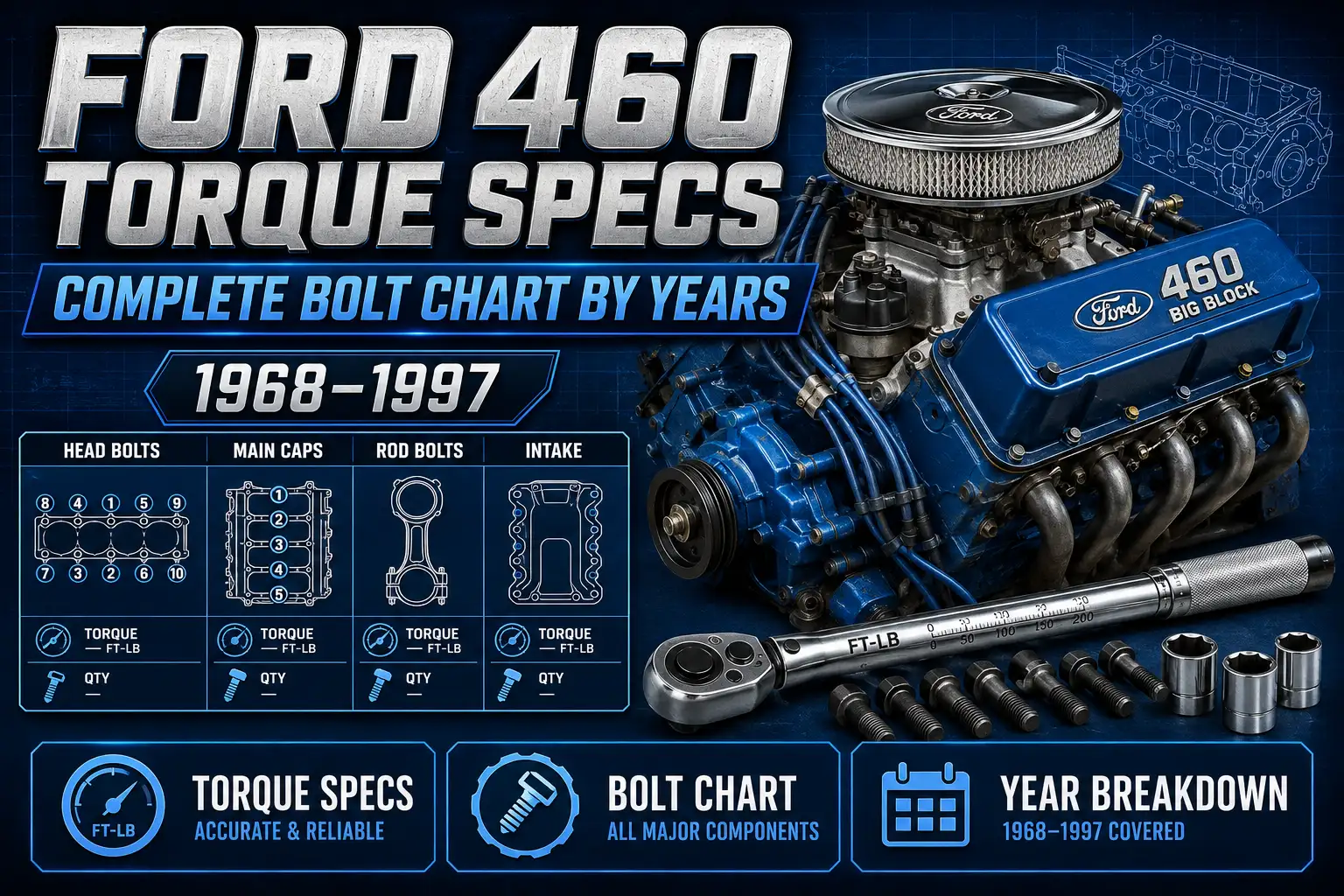
Ford 460 Torque Specs: Complete Bolt Chart by Years 2026

Ford 460 torque specs vary by fastener, model year, cylinder head, and installed hardware. For a stock 429 or 460 using factory-style bolts, the main caps normally tighten to 95–105 ft-lb, connecting rods to 40–45 ft-lb, and cylinder-head bolts to approximately 130–140 ft-lb.
Those numbers should not be applied blindly to every build. A 1990s fuel-injected truck engine, an early carbureted 460, and a performance engine with aluminum heads or ARP studs may require different procedures.

Prime for Young Adults — 6 Months Free
Students and 18–24s get six months of Prime free, then half price.
Start 6 Months Free As an Amazon Associate I earn from qualifying purchases.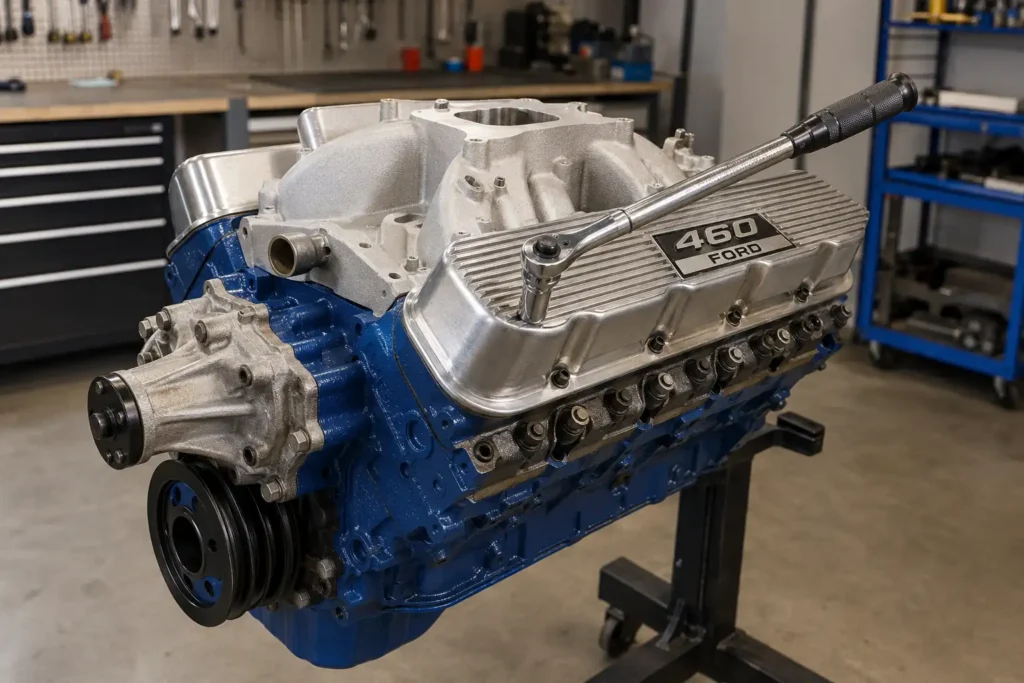
The tables below organize the specifications by engine section and explain when you need to follow a component manufacturer instead of a general Ford value.
Critical warning: These specifications apply primarily to stock-type Ford 385-series hardware. Follow the instructions supplied with aftermarket bolts, studs, connecting rods, cylinder heads, gaskets, and intake manifolds whenever they differ.
Ford 460 Torque Specs
Recommended Best Deal Products

Common factory-style torque values for stock Ford 429 and 460 big-block engine assembly.
Main Bearing Cap Bolts
95–105 ft-lb
Stock two-bolt main caps
Connecting Rod Bolts
41–45 ft-lb
Stock rods and factory-style bolts
Cylinder Head Bolts

Audible — Listen Free for 30 Days
One free credit a month and thousands of titles included.
Listen Free for 30 Days As an Amazon Associate I earn from qualifying purchases.130–140 ft-lb
Stock iron heads and factory hardware
Intake Manifold Bolts
25–30 ft-lb
Stock-style intake manifold
Rocker Arm Bolts
18–25 ft-lb
Non-adjustable or pedestal valvetrain
Harmonic Damper Bolt
70–90 ft-lb
Audible Premium Plus — Annual Membership
12 audiobook credits up front, plus the full Audible catalogue.
See Annual Plans As an Amazon Associate I earn from qualifying purchases.Crankshaft damper retaining bolt
Camshaft Sprocket Bolt
40–50 ft-lb
Factory cam sprocket hardware
Flywheel or Flexplate Bolts
75–85 ft-lb
Stock crankshaft fasteners
Front Cover Bolts
12–18 ft-lb
Avoid overtightening the aluminum cover
Cylinder Head Tightening Stages
Tighten from the center of the head outward while alternating between bolt rows.
Cam Thrust Plate Bolts
48–96 in-lb
Use an inch-pound torque wrench
Aftermarket heads, studs, rods, intake manifolds, gaskets, and lubricants may require different values. Follow the exact component manufacturer instructions whenever they differ from this stock reference.
Complete Ford 460 Torque Specs Quick Chart
The following chart covers the most commonly requested factory-style Ford 429 and 460 fasteners. Summit Racing publishes these general values for stock-type bolts with light engine oil applied to the threads and bolt-head contact surfaces.
| Component | Torque Specification | Application Notes |
|---|---|---|
| Main Bearing Cap Bolts | 95–105 ft-lb | Stock two-bolt main caps |
| Connecting Rod Bolts | 40–45 ft-lb | Stock rods and bolts |
| Cylinder Head Bolts | 130–140 ft-lb | Stock iron heads and factory-style bolts |
| Non-Adjustable Rocker Bolts | 18–25 ft-lb | Positive-stop or pedestal valvetrain |
| Intake Manifold Bolts | 25–30 ft-lb | Stock cast-iron head applications |
| Exhaust Manifold Bolts | 22–45 ft-lb | Varies by model year and bolt position |
| Oil Pump Retaining Bolt | 25 ft-lb | Stock oil pump |
| Camshaft Sprocket Bolt | 40–50 ft-lb | Factory cam sprocket hardware |
| Camshaft Thrust Plate Bolts | 48–96 in-lb | Use an inch-pound torque wrench |
| Harmonic Damper Bolt | 70–90 ft-lb | Damper-to-crankshaft bolt |
| Flywheel or Flexplate Bolts | 75–85 ft-lb | Stock crankshaft fasteners |
| Pressure Plate Bolts | About 35 ft-lb | Verify clutch manufacturer instructions |
| Engine-to-Transmission Bolts | 40–50 ft-lb | Late truck service specification |
| Front Cover Bolts | 12–18 ft-lb | Do not overtighten the aluminum cover |
| Distributor Hold-Down | 17–25 ft-lb | Late 7.5L truck specification |
| Spark Plugs | 5–10 ft-lb | Late production iron-head application |
| Oil Pan Quarter-Inch Bolts | 7–9 ft-lb | Late EFI 7.5L engine |
| Oil Pan Five-Sixteenth Bolts | 8–11 ft-lb | Late EFI 7.5L engine |
The 1995 Ford F-250 and F-350 7.5L service listings confirm values including 41–45 ft-lb for rod caps, 95–105 ft-lb for main caps, 40–50 ft-lb for the cam sprocket bolt, 70–90 ft-lb for the crankshaft damper, and 12–18 ft-lb for the front cover.
Ford 460 Main Cap Torque in 3 Steps
Recommended Best Deal Products

Stock Ford 460 main bearing cap bolts tighten to 95–105 ft-lb. A three-step approach provides more even clamping than taking each bolt directly to its final value.
A practical tightening process is:
- Tighten all main-cap bolts to 35 ft-lb.
- Increase all bolts to 70 ft-lb.
- Finish each bolt at 95–105 ft-lb.
Start with the center main cap. Work toward the front and rear of the block while alternating sides of each cap.
The final torque must match the value used when the block was line-honed or line-bored. Changing bolts, studs, lubricant, or final torque after machining can alter the main-bearing bore.
If an engine shop machined the block with ARP studs, use the same studs, lubricant, and torque value documented by that shop. Do not substitute the stock 95–105 ft-lb specification.
Ford 460 Connecting Rod Bolt Torque
Factory Ford 460 connecting-rod bolts normally tighten to 40–45 ft-lb. The 1995 7.5L service specification narrows this slightly to 41–45 ft-lb.
For stock rods:
- Apply the lubricant specified for the bolt.
- Seat the rod cap correctly against the matching rod.
- Tighten both nuts gradually and evenly.
- Finish each fastener at 41–45 ft-lb.
- Confirm that the crankshaft still rotates freely.
The rod and cap must remain a matched pair. Installing a cap backward or on another rod can distort the big-end bore even when the torque reading is correct.
Aftermarket connecting-rod bolts should be tightened according to bolt stretch whenever the manufacturer provides a stretch specification. A torque wrench alone cannot account for friction differences as accurately as direct bolt-stretch measurement.
Ford 460 Head Bolt Torque and Tightening Stages
Recommended Best Deal Products

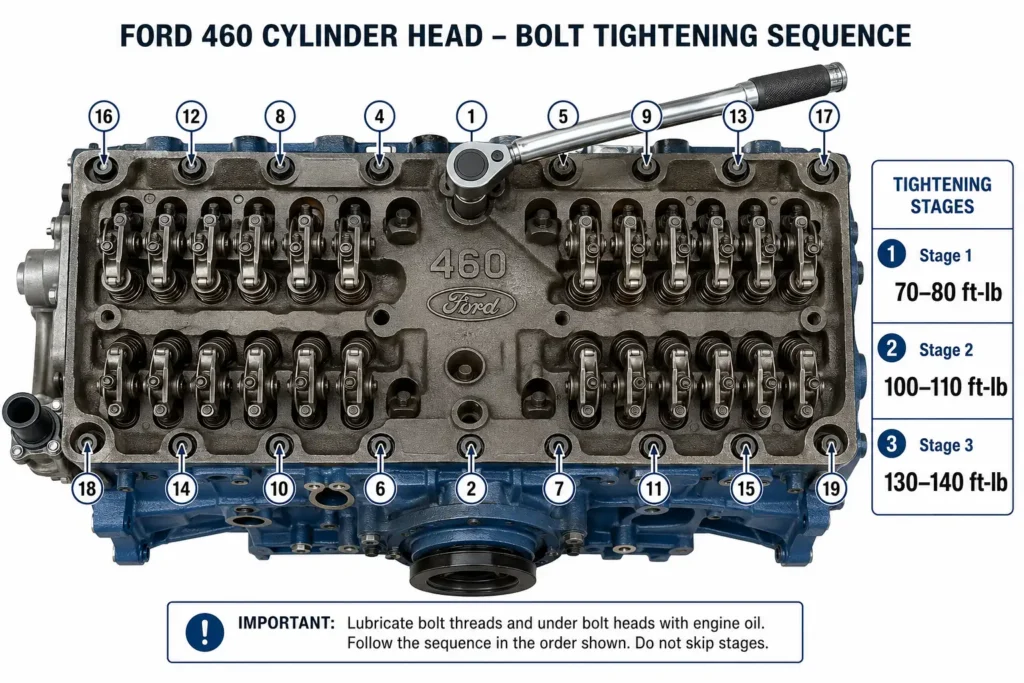
Stock Ford 460 cylinder-head bolts are commonly listed at a final torque of 140 ft-lb. Late 7.5L truck procedures are also published as a three-stage process ending between 130 and 140 ft-lb.
Use these stages for stock iron heads and factory-style bolts:
| Tightening Stage | Torque |
|---|---|
| First Pass | 70–80 ft-lb |
| Second Pass | 100–110 ft-lb |
| Final Pass | 130–140 ft-lb |
Tighten the head bolts from the center of the cylinder head toward both ends. Alternate between the upper and lower bolt rows so the clamping load spreads evenly across the gasket.
Do not tighten all bolts along one row from front to rear. That approach can load one section of the head before the rest of the gasket is compressed.
When 140 Ft-Lb Is Not Correct
Do not use the general 140 ft-lb value without checking the installed parts when the engine has:
- Aluminum cylinder heads
- ARP bolts or studs
- Aftermarket main or head studs
- Non-stock thread lubricant
- A performance head gasket with its own procedure
- Thread inserts or repaired block threads
- Modified or high-compression cylinder heads
Ford Performance states that its Super Cobra Jet aluminum heads fit 429 and 460 engines, but it also warns builders to check piston-to-valve clearance and review component-specific instructions because these heads differ from stock production heads.
The Ford 460 also used different valvetrain designs across production. Ford Performance notes that 1968–1972 hydraulic-cam engines used a screw-in positive-stop stud, while 1973 and later production 429 and 460 engines used a slotted pedestal arrangement.
Ford 460 Rocker Arm Torque by Valvetrain Type
Late stock Ford 460 pedestal or positive-stop rocker fasteners normally tighten to 18–25 ft-lb. Some general 385-series charts list 18–22 ft-lb, while late truck service information permits up to 25 ft-lb.
| Valvetrain Type | Typical Specification |
|---|---|
| Stock Non-Adjustable Rocker | 18–22 ft-lb |
| Late Pedestal Rocker Bolt | 18–25 ft-lb |
| Adjustable Stud-Mount Rocker | Set by lash or preload, not a universal bolt torque |
| Aftermarket Roller Rocker | Follow rocker manufacturer instructions |
A stock positive-stop valvetrain does not use the rocker nut to make a conventional lash adjustment. The fastener seats against its stop, and the final torque secures the assembly.
An adjustable performance valvetrain works differently. Hydraulic lifter preload or mechanical valve lash must be set according to the camshaft and rocker instructions.
Ford 460 Intake Manifold Torque
A stock-style Ford 460 intake manifold normally uses 25–30 ft-lb as the final bolt torque. Tighten the bolts from the center of the intake toward the front and rear in several passes.
Use this general process:
- Install all bolts finger-tight.
- Tighten the center bolts first.
- Alternate between the left and right banks.
- Work outward toward both ends.
- Make a second pass at an intermediate torque.
- Finish at 25–30 ft-lb unless the manifold instructions specify another value.
Aftermarket intake manifolds frequently use different values. Edelbrock specifies 25 ft-lb for many 429 and 460 manifolds, while its Victor 460 instructions reduce several 5/16-inch bolts to 15–18 ft-lb.
Trick Flow instructs installers to tighten one of its 429 and 460 intake manifolds in three stages of 16, 22, and 30 ft-lb.
These differences show why the manifold manufacturer’s instructions must override a general stock torque chart.
Ford 460 Exhaust Manifold Torque
Late 7.5L service information lists a broad exhaust-manifold range of 22–45 ft-lb. Other application-specific references list approximately 20–25 ft-lb for early installation passes.
The wide range exists because bolt size, model year, heat shields, spacers, and manifold design can differ.
For a factory cast-iron manifold:
- Start all bolts by hand.
- Tighten the center fasteners first.
- Work outward toward both ends.
- Use multiple passes.
- Recheck accessible fasteners after the first complete heat cycle if the gasket manufacturer allows it.
Do not apply a high final value to an aftermarket header flange unless its manufacturer specifies that torque. Thin header flanges can distort before a factory manifold torque is reached.
Ford 460 Oil Pan and Front Cover Torque
Late fuel-injected 7.5L engines use different values according to oil-pan bolt diameter:
| Fastener | Torque |
|---|---|
| Quarter-Inch Oil Pan Bolt | 7–9 ft-lb |
| Five-Sixteenth Oil Pan Bolt | 8–11 ft-lb |
| Front Cover Bolt | 12–18 ft-lb |
These figures come from 1995 F-250 and F-350 7.5L service listings.
Oil-pan bolts require much less torque than main-cap or cylinder-head bolts. Excess torque can crush a cork or rubber gasket, distort the pan rail, and create the leak the installer was trying to prevent.
Start the pan bolts at the center of each side. Work toward the corners in an alternating pattern.
The timing cover and water pump share several fastener locations on many 460 installations. A general factory timing-cover specification is 12–18 ft-lb, but bolt length and thread location must be confirmed before assembly.
Ford 460 Harmonic Balancer and Cam Bolt Torque
The Ford 460 harmonic damper bolt tightens to 70–90 ft-lb on late factory applications. The camshaft sprocket retaining bolt tightens to 40–50 ft-lb.
The camshaft thrust-plate bolts use only 48–96 in-lb. That is equal to 4–8 ft-lb, but an inch-pound wrench provides better control at such a low value.
Do not confuse inch-pounds with foot-pounds. Applying 48–96 ft-lb to the thrust-plate bolts would likely strip or break the small fasteners.
The harmonic balancer must be installed with a proper damper installation tool. Using the crank bolt to pull the damper onto the crankshaft can damage the first crankshaft threads before the bolt reaches its final torque.
Ford 460 Flywheel and Transmission Torque
General stock-type 385-series data lists the flywheel or flexplate bolts at 75–85 ft-lb. Pressure-plate bolts are commonly listed at approximately 35 ft-lb, while late engine-to-transmission bolts tighten to 40–50 ft-lb.
A 1994 F-250 460 service reference lists the torque-converter fasteners at 22–30 ft-lb.
| Component | Torque |
|---|---|
| Flywheel or Flexplate to Crankshaft | 75–85 ft-lb |
| Pressure Plate to Flywheel | About 35 ft-lb |
| Engine to Transmission | 40–50 ft-lb |
| Torque Converter Fasteners | 22–30 ft-lb |
Inspect flywheel and flexplate bolts before reuse. Replace fasteners with damaged threads, rounded heads, necking, corrosion, or an uncertain history.
For additional year-by-year engine output information, the Ford 460 horsepower and torque chart covers the engine’s production history from 1968 through 1997.
5 Rules That Change a Torque Reading
A torque wrench measures resistance to rotation. It does not directly measure bolt clamping force.
Five factors can change the clamping load produced by the same torque setting.
1. Thread Lubricant
Oil, ARP lubricant, thread sealer, and dry threads create different friction levels. A lubricated fastener usually reaches more clamping force than a dry fastener at the same indicated torque.
Summit specifies that its general 429 and 460 values assume stock-type bolts with light engine oil on the threads and under the bolt head.
2. Fastener Material
Aftermarket bolts and studs may have different strength, thread engagement, and tightening instructions. Never assume an ARP fastener uses the stock Ford value.
3. Cylinder Head Material
Aluminum heads expand differently from cast-iron heads. They may also use hardened washers and different torque steps.
4. Thread Condition
Rust, old sealer, damaged threads, coolant, or oil trapped in a blind hole can produce a false torque reading. Liquid trapped beneath a bolt can also create hydraulic pressure and damage the block.
5. Torque Wrench Accuracy
A wrench used outside its ideal operating range may be less accurate. Use an inch-pound wrench for small fasteners and a suitable foot-pound wrench for main caps, rods, and head bolts.
How to Torque Ford 460 Bolts Correctly
Follow the same basic preparation process before tightening any critical Ford 460 fastener.
- Confirm the exact engine year and installed components.
- Clean the bolt and block threads.
- Chase dirty threads with the correct thread chaser.
- Remove debris and liquid from blind holes.
- Inspect the bolt for stretching or thread damage.
- Apply only the specified lubricant or sealer.
- Start every bolt by hand.
- Tighten in the required sequence.
- Use two or three gradual torque passes.
- Mark each completed bolt when working through a large pattern.
If vacuum hoses or emissions connections were removed during intake-manifold work, use the Ford 460 vacuum line routing diagram to restore each connection to its correct port.
Which Ford 460 Torque Value Should You Use
Use the specification supplied by the most application-specific authority.
Follow this priority order:
- Aftermarket fastener manufacturer instructions
- Aftermarket cylinder head, rod, or manifold instructions
- Exact Ford service manual for the truck and model year
- Gasket manufacturer instructions
- General stock Ford 429 and 460 torque chart
For example, an Edelbrock intake value is more applicable to an Edelbrock manifold than a general stock Ford chart. An ARP stud instruction is more applicable to an ARP stud kit than the factory head-bolt value.
The general chart is most useful when the engine retains factory cast-iron components and stock-style replacement fasteners.
Ford 460 Torque Specs FAQ
What Is the Ford 460 Main Cap Torque?
Stock Ford 460 main-cap bolts tighten to 95–105 ft-lb. Tighten the center cap first, work outward, and use the same final value used during block machining.
What Is the Ford 460 Connecting Rod Torque?
Stock connecting-rod bolts normally tighten to 40–45 ft-lb. The late 7.5L service specification is 41–45 ft-lb.
What Is the Ford 460 Head Bolt Torque?
Stock iron-head installations commonly finish at 130–140 ft-lb. Use three stages and tighten from the center outward, but follow the head, gasket, or fastener instructions when aftermarket parts are installed.
What Is the Ford 460 Intake Manifold Torque?
A stock-style intake manifold usually tightens to 25–30 ft-lb. Some aftermarket manifolds use lower values for specific bolt sizes, so check the supplied installation sheet.
What Is the Ford 460 Rocker Arm Torque?
Stock non-adjustable or pedestal rocker fasteners normally tighten to 18–25 ft-lb. Adjustable roller-rocker systems require a lash or hydraulic-preload procedure rather than one universal torque value.
What Is the Ford 460 Harmonic Balancer Bolt Torque?
The factory-style harmonic damper bolt tightens to 70–90 ft-lb. Use a damper installation tool before applying the final bolt torque.
Are Ford 460 Head Bolts Torque to Yield?
Most traditional stock 429 and 460 rebuild procedures use a final torque specification rather than a modern torque-plus-angle procedure. Bolt reuse still depends on the exact year, bolt condition, and replacement-fastener instructions.
Use the Correct Specification for Your Build
Ford 460 torque specs are reliable only when they match the engine year, installed parts, fastener type, and lubricant. For a stock-style build, use 95–105 ft-lb for the main caps, 41–45 ft-lb for the rod caps, and 130–140 ft-lb for factory-style head bolts.
Do not transfer these values to aluminum heads, aftermarket rods, studs, or performance intake manifolds. Check the component instructions first, clean every thread, and tighten critical fasteners gradually in the correct sequence.
A careful torque procedure protects the block, keeps gaskets evenly clamped, and prevents small assembly errors from becoming expensive engine failures.