
Ford 1.5 3 Cylinder Engine Problems and 7 Fixes for 2026

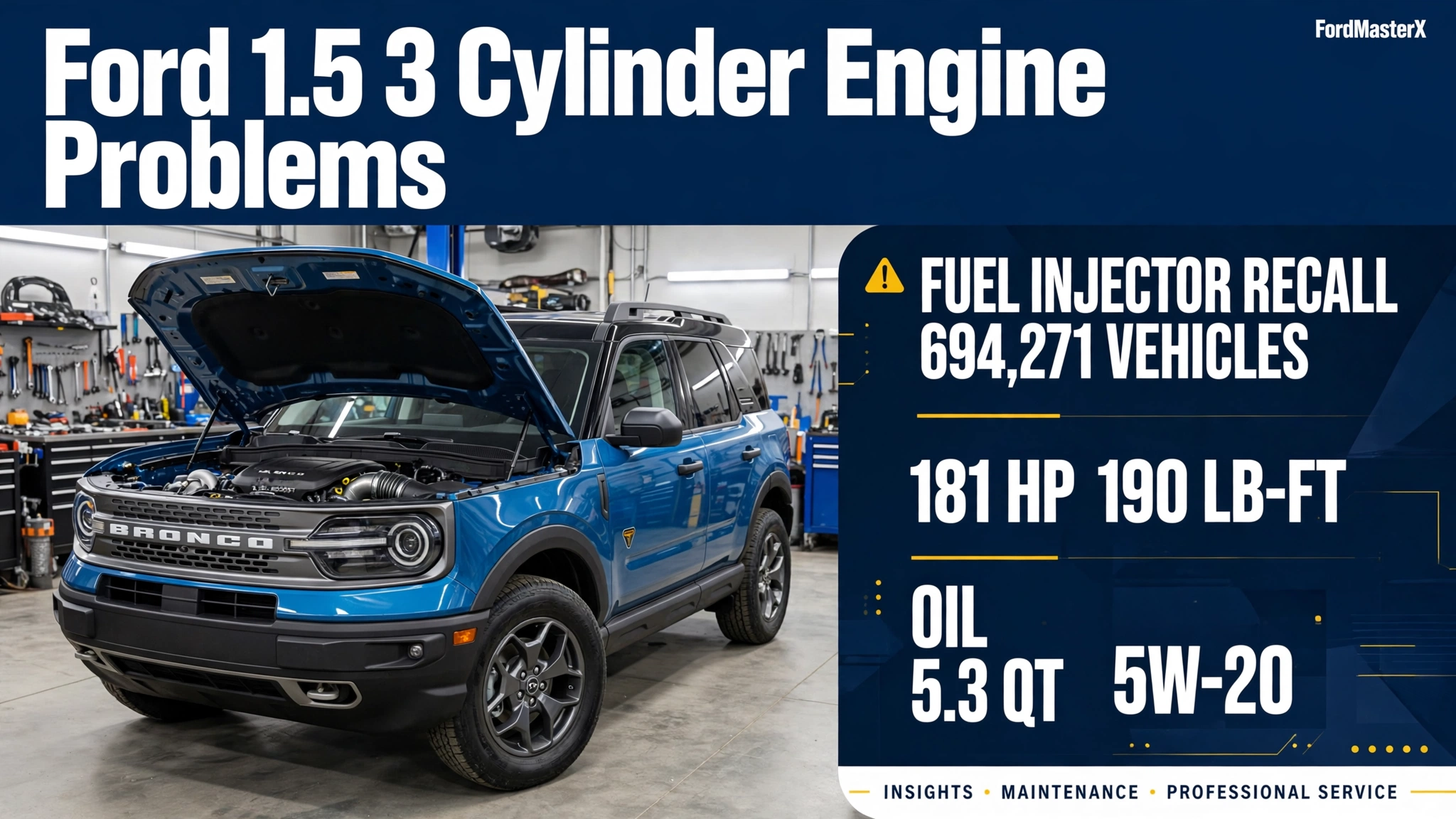
Ford 1.5 3 cylinder engine problems start with one recall every owner must act on. A cracked high-pressure fuel injector can leak gasoline onto a hot engine, and Ford recalled 694,271 Escape and Bronco Sport SUVs for it.
This guide covers the Dragon 3-cylinder EcoBoost in the Escape from 2020 and the Bronco Sport from 2021, not the older 1.5L 4-cylinder, which has a different and worse coolant problem.
We separate verified recalls from owner reports in every section. A problem with a recall number and a Ford remedy is a fact.
A problem with only forum posts behind it is labeled as an owner report.
7 Problems in One Table
Here is the whole answer in one table. The infographic after it gives you the same list to save or share.
| Problem | Severity | Who it hits | Fix |
|---|---|---|---|
| Cracked fuel injector | High, fire risk | 694,271 vehicles | Free recall 25S76 |
| Wet oil pump belt wear | High if ignored | High-mileage engines | Replace by 100,000 miles |
| Coolant loss, cold misfire | Medium | Some early engines | Pressure test, then borescope |
| Carbon on intake valves | Medium | Past 60,000 miles | Walnut blasting, $300-$600 |
| Water pump leak | Medium | Owner reports near 25,000 miles | Inspect, replace pump |
| Ball plug oil leak | High, fire risk | 404 recalled SUVs | Free recall 25S61 |
| Oil separator crack | Low to medium | 2020-2022 models | Free recall 22S21 |
1.5L 3 Cylinder Problems At a Glance
Escape 2020 and newer, Bronco Sport 2021 and newer. Check your VIN first: recalls are free.
| Problem | Who it hits | Fix |
|---|---|---|
| Cracked fuel injector | 694,271 vehicles | Free recall 25S76 |
| Wet oil pump belt wear | High-mileage engines | Replace by 100,000 miles |
| Coolant loss, cold misfire | Some early engines | Pressure test, then borescope |
| Carbon on intake valves | Past 60,000 miles | Walnut blasting, $300-$600 |
| Water pump leak | Owner reports near 25,000 miles | Inspect, replace pump |
| Ball plug oil leak | 404 recalled SUVs | Free recall 25S61 |
| Oil separator crack | 2020-2022 models | Free recall 22S21 |
Direct answer: the cracked fuel injector recall is the one problem every owner must act on, because it can cause an underhood fire. The rest are maintenance or limited-scope issues.
Sources: NHTSA recall 25V467 and Ford recall 25S76; NHTSA recall 25V372 and Ford 25S61; NHTSA recall 22V191 and Ford 22S21; Ford 2021 Bronco Sport technical specifications; Autoblog wet belt feature, 2026.
Three of the seven problems are free to fix at a dealer. Three more are maintenance items you can plan for. The injector, ball plug, and oil separator recalls all carry a fire risk, and all three have free remedies.
Start with the recall check, then the belt, then the symptoms you can see and smell. Do not start with a parts guess.
Which Fords Use the 1.5 3 Cylinder Dragon Engine
The 1.5L EcoBoost 3-cylinder is Ford’s Dragon engine, a small turbocharged three-cylinder built for compact SUVs. In the United States it powers the Escape from the 2020 model year and the Bronco Sport from the 2021 model year.
Ford rates the engine at 181 horsepower at 6,000 rpm and 190 lb-ft of torque at 3,000 rpm on premium fuel. Those figures come from Ford’s 2021 Bronco Sport technical specifications, measured to the SAE J1349 standard.
The block and head are aluminum, the compression ratio is 11 to 1, and the displacement is 1,497 cc.
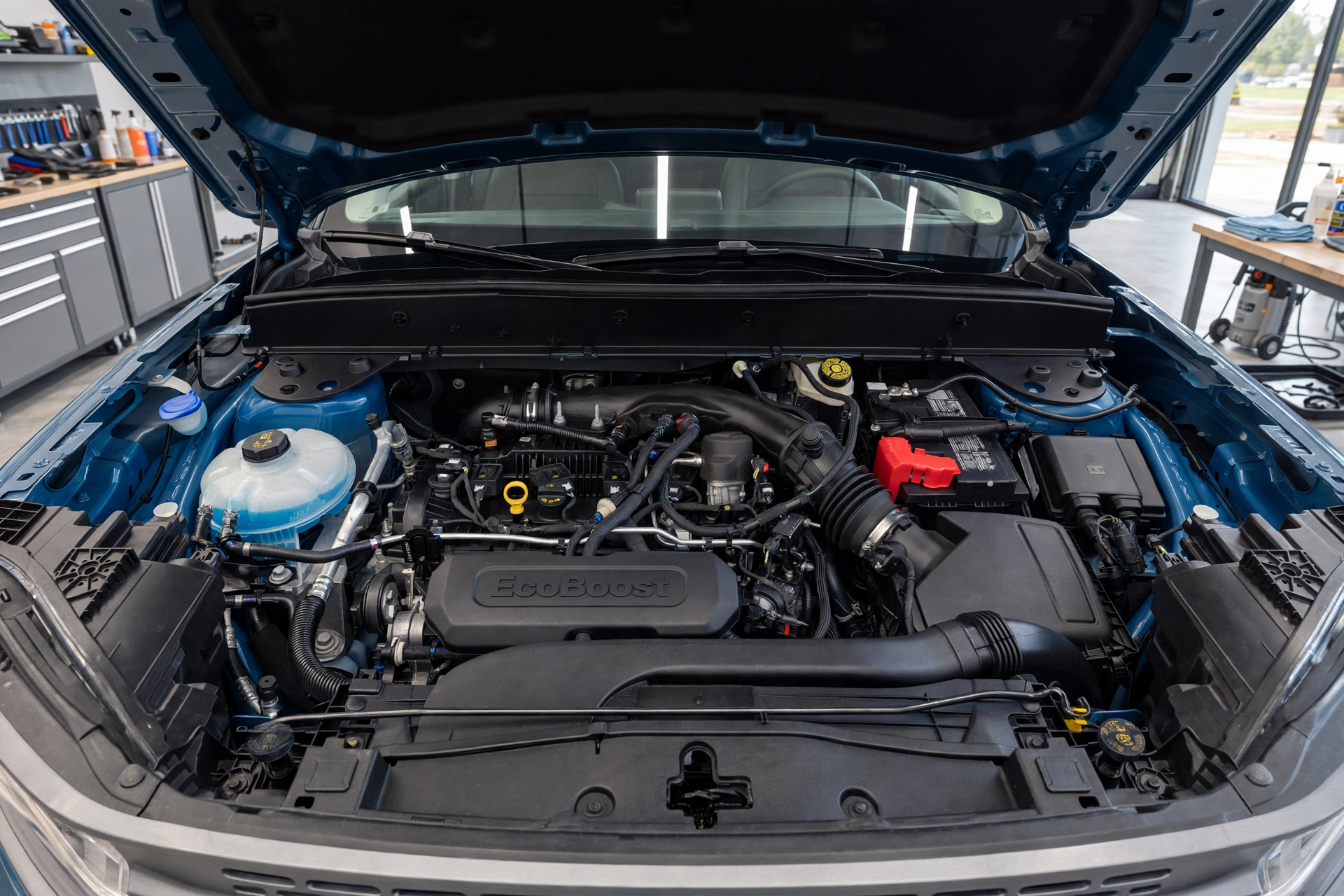
AI-generated illustration: the 1.5L 3-cylinder Dragon engine bay in a Bronco Sport.
| Model | Years with the 1.5L 3-cylinder | Trims |
|---|---|---|
| Escape | 2020 and newer | Base engine on most trims |
| Bronco Sport | 2021 and newer | Base, Big Bend, Outer Banks |
| Focus, Europe only | 2018 and newer | Small EcoBoost models |
| Fiesta, Europe only | 2018 and newer | Small EcoBoost models |
The Bronco Sport Badlands uses a different engine, the 2.0L 4-cylinder EcoBoost with 250 horsepower, which is not part of the injector recall in this guide.
Every Dragon engine pairs with an 8-speed automatic transmission, with standard four-wheel drive on the Bronco Sport and front- or all-wheel drive on the Escape.
You can confirm which engine your Ford has from the VIN or the underhood label, which also shows the build details.
Oil and Coolant Specs
The 2021 Bronco Sport with the 1.5L engine holds 5.3 quarts of oil with a filter, and Ford specifies Motorcraft SAE 5W-20 synthetic blend meeting spec WSS-M2C960-A1. Some owners report that later builds hold more oil, so check your own manual before you buy oil.
Coolant capacity on the same 2021 Bronco Sport is 7.7 quarts. Use only the coolant type your manual lists, and never mix coolant colors.
Our Ford engine oil recommendation chart lists the spec for this engine next to every other Ford engine, so you can check the grade in one place.
Dragon 3 Cylinder Versus the Older 4 Cylinder
The most common mistake is mixing up two different engines: the older 1.5L EcoBoost is a 4-cylinder built from 2014 to 2019 for the Escape and Fusion.
The Dragon is a 3-cylinder built from 2020 for the Escape and from 2021 for the Bronco Sport. They share a displacement number and nothing else.
The 4-cylinder has an open-deck block, where the coolant jacket wraps the cylinders with a thin bridge of metal between the bores. Heat cycles fatigue that bridge until cracks open and coolant leaks into the cylinders.
Ford fixed it with a redesigned short block under TSB 19-2346 and Customer Satisfaction Program 21N12.
The Dragon 3-cylinder uses a different block, with no Ford TSB or customer program for coolant intrusion and no short block campaign. The two engines fail in different ways, and the fixes do not transfer.
Our Kuga 1.5 EcoBoost problems guide covers the older 4-cylinder in full, including the coolant intrusion test path, LSPI piston damage, and turbo oil contamination. Read it if your Ford is a 2014 to 2019 model.
The 2018 Escape 1.5L 4-cylinder specs and reliability page gives the older engine’s numbers for comparison: the 4-cylinder made 179 horsepower and used a timing belt.
The Dragon makes 181 horsepower and uses a timing chain with a separate wet oil pump belt, which is covered later in this guide.
Cracked Fuel Injectors Cause 694,271 Vehicle Recall
This is the problem that defines the Dragon engine. A high-pressure fuel injector can crack, and fuel can leak into the engine compartment.
Fuel vapor near a hot surface can ignite, and Ford has linked eight underhood fires to this defect, which is why the recall exists and why it is free.
The current recall is Ford 25S76, NHTSA campaign 25V467. It covers 2021 to 2024 Bronco Sport and 2020 to 2022 Escape SUVs with the 1.5L engine, a total of 694,271 vehicles.
The population is 339,044 Bronco Sport and 355,227 Escape SUVs, as the NHTSA Part 573 report for recall 25V467 lists in full.
This recall replaces three earlier campaigns for the same defect: 22S73, 24S16, and 25S21. If your Ford already had one of those repairs, you still need the new remedy when it is ready.
Ford has said the current remedy is an interim PCM software update, and the final hardware remedy was under development with second owner letters anticipated in July 2026.
What the Recall Covers
The recall covers the fuel injector cracking defect only. The software update watches fuel rail pressure, and if it drops, it shuts down the high-pressure fuel pump and cuts engine power, which lowers the fire risk while the permanent fix is prepared.
The software does not replace a cracked injector. It detects the leak and limits the damage. Ford’s own recall notice calls this an interim repair, and owners should expect a second visit for the final remedy.
What the Software Fix Does
When the system sees a pressure drop that points to a cracked injector, it derates the engine and cools the hot surfaces. The final remedy replaces the high-pressure fuel rail assembly and the fuel injectors.
You may notice a loss of power and a warning message if the system trips.
Do not ignore that warning. A power cut with a fuel smell means the system found a leak.
Park away from buildings, switch the engine off, and call your dealer. Ford’s recall page for 25S76 lists the affected years and the free repair, and it is the page to check before you call.
What to Do Now
Check your VIN at nhtsa.gov/recalls or on the Ford owner site before you spend anything, because recalls are tied to build dates and VIN ranges.
If your VIN shows an open recall, book the dealer visit. The repair is free.
Our powertrain warranty guide explains what Ford covers and what it does not. Recall work sits outside warranty entirely, so Ford pays for a safety fix even on an old truck with no warranty left.
Oil Pump Wet Belt Wear After 100,000 Miles
The Dragon engine uses a timing chain, not a timing belt. The worry is the separate oil pump belt, which runs inside the engine in oil.
That wet belt drives the oil pump, so if it fails, oil pressure drops to zero and the engine can destroy itself in seconds.
Autoblog reports that Ford revised the Dragon belt interval from 150,000 miles to 100,000 miles after premature belt degradation, and specialists recommend replacement between 80,000 and 100,000 miles.
The belt sheds rubber as it wears, and the debris can block the oil pickup and starve the engine.
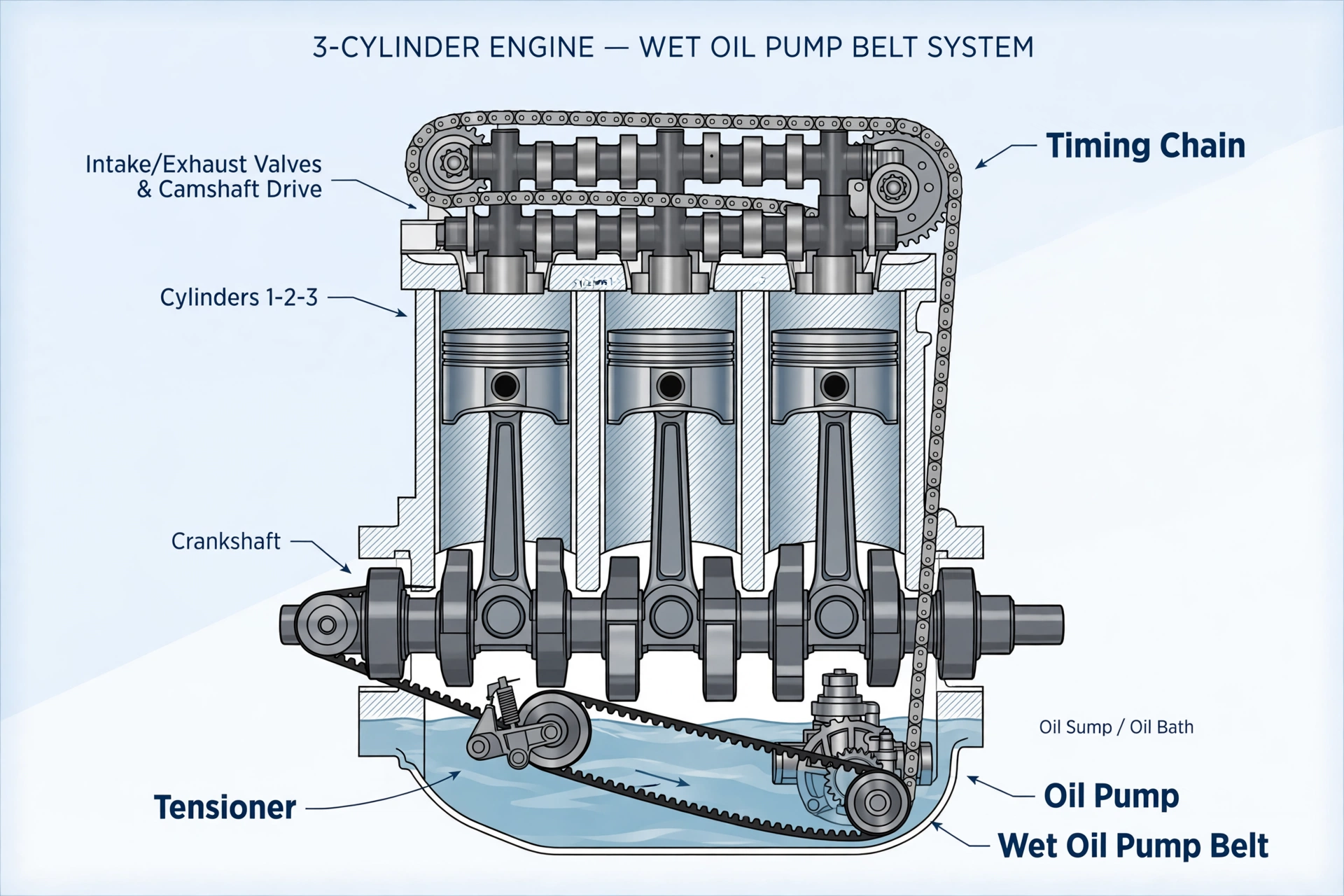
AI-generated illustration: the wet oil pump belt, tensioner, oil pump, and timing chain in the Dragon engine.
Wrong oil speeds up the damage, because the oil chemistry protects the belt material, so use oil that meets the Ford specification for the engine.
There is no dashboard warning for a worn wet belt. The first sign is often a low oil pressure warning, and by then the damage may be done.
Treat the belt as a scheduled part, not a lifetime part, even though Ford lists it as a lifetime item. Our wet belt replacement cost guide covers the same belt-in-oil design, and the access and labor lessons carry over.
Coolant Loss and Cold Start Misfires After 60,000 Miles
Coolant loss with no visible leak scares Dragon owners most, because it is the signature of the 4-cylinder coolant intrusion failure. On the Dragon, the story is different and weaker.
Some owners report coolant loss and rough cold starts, but no Ford TSB, recall, or customer program ties those reports to a Dragon block defect.
What-breaks.com, which tracks Bronco Sport weaknesses, notes coolant intrusion reports on some 3-cylinder engines from about 60,000 miles, with the root cause on the Dragon less documented.
The reports exist, and the mechanism is not proven.
On the 4-cylinder, coolant pools in a cylinder overnight, the engine misfires on a cold start, and the codes are P0300 through P0304 with P0316 for a startup misfire. A borescope shows a steam-cleaned piston top in the affected cylinder.
If your Dragon loses coolant, do not assume the block is cracked. Check the water pump, hoses, degas bottle, and cap first, because those are the common external leaks.
Then run a cooling system pressure test. Only if the pressure drops with no external leak should a shop move to a block test and a borescope.
Carbon Buildup on Intake Valves After 60,000 Miles
The Dragon is direct injection only, so fuel sprays straight into the cylinder and never washes the back of the intake valves. Oil vapor from the PCV system bakes onto the hot valves instead, and carbon builds up over time.
This is true of every direct-injection EcoBoost, not just the Dragon.
The symptoms arrive slowly. A rough idle, a cold-start stumble that clears as the engine warms, and a small loss of power and fuel economy are the usual signs.
A borescope through the intake shows the deposits, and a shop can measure how much airflow is lost.
The fix is walnut shell blasting, which strips the deposits without damaging the metal. Owner guides quote $300 to $600 for the service.
Chemical induction cleaning can help early, but it will not clear heavy deposits, and Ford treats carbon cleaning as maintenance, not a defect, so do not expect warranty coverage.
Short trips make it worse, because the engine never gets hot enough to burn off deposits, while longer highway runs and on-time oil changes slow it down.
Our 3.5 EcoBoost cam phaser replacement guide is a different engine, but it shows the same habits pay off: clean oil, correct spec, and no skipped services.
Water Pump Leaks Reported Near 25,000 Miles
Water pump failure is the most repeated owner complaint about the Dragon that has no recall behind it. Owner reports describe pumps leaking coolant from the housing, sometimes more than once on the same vehicle, with first failures near 25,000 miles and some drivers on a fourth or fifth pump.
Those numbers come from owner reports, not from Ford. No Ford recall or TSB for the Dragon water pump was found in this research.
That does not mean the reports are false. It means the failure rate is not documented in a Ford publication, so no verified rate or repair cost is given here.
The symptom is simple to check. Look for coolant loss with no puddle under the truck, a sweet smell after a hot drive, and a coolant level that keeps dropping between checks.
A pump can weep slowly for weeks before it fails outright, and catching it at the weep stage is the difference between a planned repair and an overheating event.
If the pump fails while you drive, the temperature gauge will climb fast. Pull over and switch off.
Driving an overheated Dragon risks the head gasket and the head itself, a repair far more expensive than a pump, so keep a jug of the correct coolant in the truck if you are chasing a slow leak.
Cylinder Head Ball Plug Oil Leaks in 404 Recalled SUVs
This recall is small and specific, which is why it is easy to miss. Ford recall 25S61, NHTSA campaign 25V372, covers certain 2023 to 2025 Escape and 2025 Bronco Sport SUVs with the 1.5L engine.
The total population is 404 vehicles. The cylinder head may have been improperly manufactured, and the ball plugs in the head can fail.
A failed ball plug can cause a rapid oil leak. Oil on a hot engine or exhaust can catch fire, and losing oil can also cut engine power.
Ford’s recall notice says dealers will replace the cylinder head assembly as necessary, free of charge. Owner notification letters were mailed August 8, 2025.
Only 404 vehicles are covered, so most Dragon owners will never see this recall, but check your VIN anyway, because a single missed letter matters.
Oil Separator Housing Cracks in 2020 to 2022 Models
The engine oil separator housing sits on the Dragon engine and can crack. When it cracks, oil leaks out, and the leak can reach hot parts. NHTSA lists the risk as an oil leak near hot parts that can increase the risk of a fire.
Ford recall 22S21, NHTSA campaign 22V191, covers certain 2020 to 2022 Escape and 2021 to 2022 Bronco Sport SUVs with the 1.5L engine, a total of 345,451 vehicles.
The symptom is an oil leak with no clear source and a faint burning oil smell, which a shop can trace to the separator housing with a visual check. The recall repair is free at a dealer, and it applies to the early Dragon builds only.
Oil leaks deserve a fast check even when they are small. Our guide to common oil leaks on the 3.5 EcoBoost shows the same habit: find the highest wet point, clean it, and watch where the oil returns.
A leak that looks like a valve cover gasket can turn out to be the separator housing.
5 Diagnostic Tests That Find the Real Cause
Guessing parts is the most expensive way to fix a Dragon engine. These five tests cost little and separate the seven problems from each other, so run them in order and stop when a test gives you an answer.
Pressure Test the Cooling System
A shop pressurizes the cold cooling system to about 20 PSI and watches it for 30 minutes. If pressure drops with no external leak, coolant is going inside the engine, and if pressure holds, the cooling system is sound.
Block Test for Exhaust Gas
A chemical block test checks the coolant for exhaust gas, and the test fluid changes color if combustion gas is present.
A positive result points to a head gasket or block problem, and it is the test that confirms the worst case.
Borescope the Cylinders
A borescope goes through the spark plug hole and shows the piston tops. A piston that looks steam-cleaned, shiny and free of carbon while the others are dark, is burning coolant, which is stronger evidence than any code.
Scan for Misfire Codes
A scan tool reads the stored codes. P0300 through P0304 mean misfires by cylinder, and P0316 means a misfire in the first 1,000 revolutions after startup.
P0299 means underboost, which points to the turbo or a boost leak. Codes name the symptom, not the part, so use them with the tests above. Our Escape O2 sensor location guide shows where one common sensor sits on the exhaust side.
Check Oil and Coolant Weekly
Check the oil level and the coolant level once a week, cold, on level ground. Write the levels down.
A slow drop you can measure over 1,000 miles is evidence a shop can use. A level you never checked is a guess.
What Each Repair Costs in 2026
The recalls in this table are free, which is a firm fact. The rest are ranges to plan with, and the table says which is which.
| Repair | Cost in 2026 | Source of the figure |
|---|---|---|
| Fuel injector recall 25S76 | Free | Ford recall, NHTSA 25V467 |
| Ball plug recall 25S61 | Free | Ford recall, NHTSA 25V372 |
| Oil separator recall 22S21 | Free | Ford recall, NHTSA 22V191 |
| Walnut blasting, carbon buildup | $300-$600 | Owner guide range |
| Head gasket repair, if ever needed | $1,500-$3,000 | Owner guide estimate, not a Ford figure |
| Water pump replacement | Get a written quote | No verified published range found |
| Wet oil pump belt replacement | Get a written quote | No verified published range found |
| Short block, 4-cylinder only | $5,000 and up | Kuga post, not a Dragon repair |
The short block line is in the table so you can see the contrast: a 4-cylinder coolant intrusion repair can pass $5,000, while a Dragon has no equivalent repair in the record.
For the water pump and the wet belt, labor is most of the bill, because access is tight and the belt sits behind the timing chain.
Ask for an itemized quote that splits parts and labor, and compare it with one other shop before you approve the work.
7 Maintenance Habits That Prevent Most Failures
None of these habits fixes a cracked injector or substitutes for a recall. They keep the rest of the engine alive, and they are cheap.
- Use the right oil. Use SAE 5W-20 that meets WSS-M2C960-A1, and change it on time. The wet belt and the turbo both depend on the oil chemistry.
- Check coolant weekly. A falling level is the earliest warning of a leak. Catch it while it is a weep, not after it is an overheat.
- Change oil by the monitor and the calendar. Our guide to how often a car needs an oil change explains the Ford interval rules, including the one-year ceiling on low miles.
- Let the turbo cool. After a hard highway run, idle for 60 to 90 seconds before you switch off, because hot oil left in the turbo bearings turns to sludge.
- Do not lug the engine. Avoid hard acceleration at low rpm in a high gear, and downshift to keep the revs up when you need power, which also helps avoid low-speed pre-ignition.
- Book the belt before 100,000 miles. Plan the wet oil pump belt with the timing chain service, because a belt changed on your schedule is a maintenance bill, and a belt that fails is an engine bill.
- Run the VIN every year. New recalls appear after you buy the truck, so check nhtsa.gov/recalls once a year, and again before any long trip.
Should You Buy a Used Escape or Bronco Sport
The answer depends on the year, the trim, and the recall status. A 2021 or newer Bronco Sport with the injector software update done and no open recalls is a reasonable buy, while a 2020 Escape with an open recall and no service records is not, until the recall is closed.
The 2.0L Badlands is the safer pick if you want to avoid the injector recall entirely. It costs more and uses more fuel, but it has no injector fire recall and no Dragon wet belt.
The Weekly Driver analysis of NHTSA complaints gives the 1.5L a 3.8 out of 10 reliability score, against 8.1 for the 2.0L, which matches the recall record.
Before you pay, check three things, starting with the VIN for open recalls.
Second, check the coolant level cold and look for a sweet smell or white smoke on a cold start. Third, ask for oil change records showing the right 5W-20 grade.
A truck that passes all three is a fair buy, and a truck that fails any one of them is a reason to walk away or to cut the price.
Avoid the earliest 2020 Escape builds with no recall work and no records. They carry the injector recall, the oil separator recall, and the highest chance of a tired water pump, while later builds with full records are a different truck.
Questions Ford Owners Ask About 1.5 3 Cylinder Problems
Is the Ford 1.5 3 Cylinder EcoBoost Reliable?
It is reliable enough after the recalls are done, and risky before they are done. The injector recall is the main risk, and it is free to fix. Once the software update is in and the belt is on a schedule, most owners report normal service.
What Years of the 1.5 EcoBoost Should You Avoid?
Avoid a 2020 Escape or a 2021 Bronco Sport with open recalls and no service history. The engine itself is the same across the years, so the year matters less than the recall status and the maintenance record.
A 2023 or newer model with clean records is the safest used buy.
Does the 1.5 3 Cylinder Have Coolant Intrusion?
Not as a verified defect. The famous coolant intrusion failure belongs to the older 1.5L 4-cylinder, which Ford fixed with a revised short block.
Some Dragon owners report coolant loss, but no Ford TSB or recall ties it to the 3-cylinder block, so test first and do not assume the worst.
How Long Does the 1.5 EcoBoost Wet Belt Last?
Ford revised the Dragon belt interval from 150,000 miles to 100,000 miles, and specialists recommend replacement between 80,000 and 100,000 miles. Treat it as a scheduled part, not a lifetime part.
A failed belt stops the oil pump, so the cost of waiting can be an engine.
Is There a Recall for the 1.5 EcoBoost Fuel Injector?
Yes. Ford recall 25S76 covers 694,271 Escape and Bronco Sport SUVs, and it replaces earlier recalls 22S73, 24S16, and 25S21.
The current remedy is a free software update, with a final hardware remedy under development, so check your VIN to see if your truck is covered.
Can You Drive With a Cracked Fuel Injector?
No, not once you know about it. A cracked injector can leak fuel onto a hot engine, and Ford has linked eight underhood fires to the defect.
If you smell fuel or see a warning, park away from buildings, switch off, and call your dealer for the free recall repair.
Check Your VIN Before You Spend One Dollar
Ford 1.5 3 cylinder engine problems are a short list, and the top item is free to fix. Run your VIN, close any open recall, and put the wet oil pump belt on a schedule before 100,000 miles. Those two moves remove the fire risk and the biggest engine risk.
Then watch the simple things: coolant level, oil level, and cold-start behavior. A Dragon that holds its fluids and starts clean is a sound small turbo engine, and a Dragon that loses coolant or smells of fuel needs a shop, not a guess.
Check the VIN first, and let the tests decide the rest.