

Camshaft Position Sensor Location on a Ford F-150: Where It Is and How to Replace It

The sensor tells the powertrain control module (PCM) where each camshaft is, so it can control fuel injection, ignition and variable cam timing. A fault usually sets codes P0340 to P0394, but Ford’s own bulletins show these codes are often caused by low oil or the cam timing (VCT) system, not the sensor.
📦 In This Article We Recommend
Picked for relevance and reader value — affiliate links below.

⭐ Editor’s Pick
Genuine Ford OEM Motorcraft Camshaft Position Sensor
★★★★☆ (1,652 reviews)
“Genuine Motorcraft — the same part Ford installs at the factory.”
Get the OEM Sensor for Your F150 →As an Amazon Associate, we earn from qualifying purchases at no extra cost to you.
Why You Need To Find The Camshaft Position Sensor Location


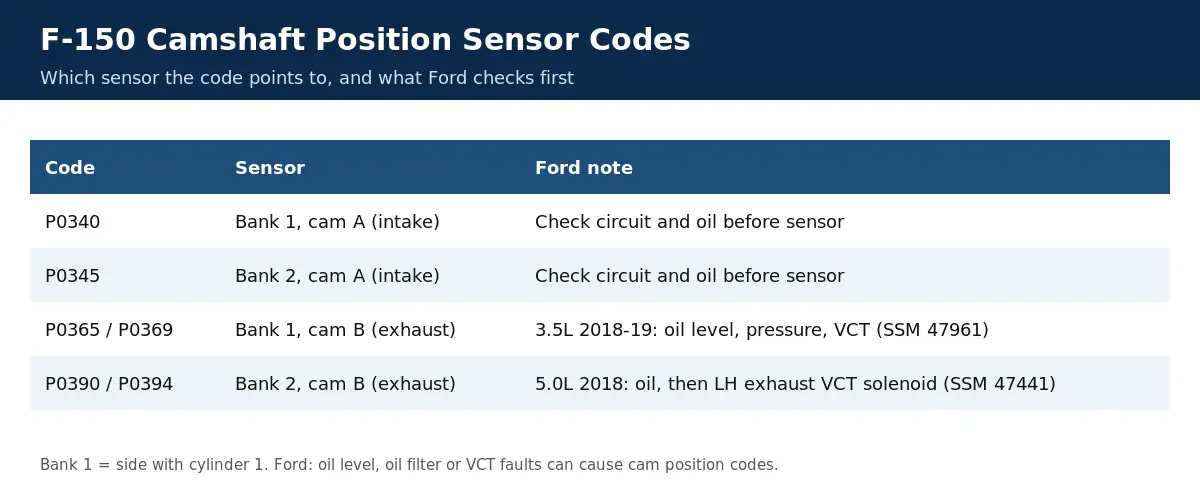
Before you hunt for the sensor, read the code. The standard OBD-II codes point to a specific sensor: P0340 and P0345 are “A” (usually intake) sensors on banks 1 and 2, and P0365 and P0390 are “B” (usually exhaust) sensors on banks 1 and 2. Bank 1 is the side with cylinder 1.


Symptoms of a CMP fault can include a check engine light, hard starting or a long crank, rough running and stalling. Ford’s diagnostic procedure also notes that engine oil level, the oil filter, oil contamination or the VCT system can cause camshaft position errors.
If testing confirms a failed sensor, a Motorcraft replacement is the OEM part. Check oil level and the VCT solenoids first, as Ford’s bulletins advise.
Amazon Pick
Genuine Ford OEM Motorcraft Camshaft Position Sensor
★★★★☆ (1,652 reviews)
Get the OEM Sensor for Your F150 →When the cam position sensor is confirmed faulty, a genuine Motorcraft replacement is the clearest path to a reliable fix — it’s the same part Ford uses at the factory.
Amazon Pick
Genuine Ford OEM Motorcraft Camshaft Position Sensor
★★★★☆ (1,652 reviews)
Get the OEM Sensor for Your F150 →For example, Ford’s SSM 47441 for 2018 F-150 5.0L trucks with P0390 or P0394 says to check the oil level, then replace the bank 2 exhaust VCT solenoid, and not to replace the camshaft position sensors. TSB 18-2360 gives the same fix. For 2018–2019 3.5L EcoBoost trucks with P0365 or P0369, SSM 47961 says to check the oil level, oil pressure and the VCT units first.
Identifying The Camshaft Position Sensor Location


With the engine cool, open the hood and remove the engine cover if your truck has one. On DOHC engines like the 5.0L V8 and the 3.5L and 2.7L EcoBoost V6, look at the front of each cylinder head, near where the valve cover meets the front cover. Each sensor is a small plastic sensor held by one bolt, with a 3-pin connector.


Older 4.6L and 5.4L Triton engines use a different layout, so match the sensor to the code and your manual before removing anything. For the 2016 5.0L, see our 2016 F-150 5.0 camshaft sensor guide.
How To Access The Camshaft Position Sensor


Access depends on the engine. On some trucks the front sensors are easy to reach; on others you may need to move the air intake tube, the engine cover or wiring brackets first.
Disconnect the battery, then press the tab and unplug the connector. Note the sensor’s orientation, and check your repair manual for your year and engine.


Inspect the connector and wiring for oil, corrosion or damage while you are there.
Read Also: 2016 Ford F 150 5.0 Camshaft Position Sensor Location
Removing And Replacing The Camshaft Position Sensor
- Disconnect the negative battery cable.
- Unplug the sensor’s electrical connector.
- Remove the mounting bolt and twist the sensor out of the head.
- Lightly oil the new O-ring, then install the new sensor and bolt, tightened to the spec in your manual.
- Reconnect the connector and the battery.
Don’t pry on the connector or the sensor body, because the plastic is brittle.
Testing The New Camshaft Position Sensor
Clear the codes with a scan tool, start the engine and drive the truck, then check again for pending codes. Ford’s pinpoint test has the technician raise engine speed above 1,500 rpm for 10 seconds, repeated, and then run the PCM self-test.
If the same code returns with a new sensor, check the wiring, the connector, the oil level and the VCT system, as Ford’s procedures direct.
Frequently Asked Questions: Camshaft Position Sensor Location on a Ford F-150
Where Is the Camshaft Position Sensor on a Ford F-150 5.4 Engine?
On the 5.4L Triton, the sensor position differs from the newer DOHC engines, and it changed between the 2-valve and 3-valve versions. Check the workshop manual or a parts diagram for your exact year before removing parts.


How Do I Identify the Camshaft Position Sensor on My F-150?


Look for a small plastic sensor held by one bolt at the front of a cylinder head, with a 3-pin connector. Ford’s part base number for the CMP sensor is 6B288.
Can a Faulty Camshaft Position Sensor Cause Problems on an F-150?


Yes. It can cause a check engine light, hard starts, rough running or stalling. But on F-150s, cam position codes are often caused by low oil or a VCT fault, so diagnose before replacing the sensor.
How Do I Replace the Camshaft Position Sensor on a Ford F-150?


Disconnect the battery, unplug the sensor, remove its single bolt, and twist it out. Install the new sensor with a lightly oiled O-ring, tighten the bolt to spec, then reconnect everything and clear the codes.
Can I Replace the Camshaft Position Sensor on My F-150 Myself?


Often, yes. It is usually a one-bolt job with basic tools. Confirm with a scan tool which sensor the code points to, and check that the cause isn’t oil level or the VCT system first.
Conclusion
F-150 camshaft position sensors sit at the front of the cylinder heads, and modern V6 and V8 engines have one per camshaft.
Use the code to find the right sensor, check the oil level and VCT system first, and follow Ford’s bulletins before replacing parts.
When in doubt, check the workshop manual for your year and engine, or have a shop run Ford’s pinpoint test.
Motorcraft Cam Position Sensor
OEM Motorcraft part — no adaptation needed, clears codes reliably.
★★★★☆ (1,652)
Check Price on Amazon →Amazon Affiliate Link