2014 Ford Edge Fuse Box Diagram: Every Fuse by Engine

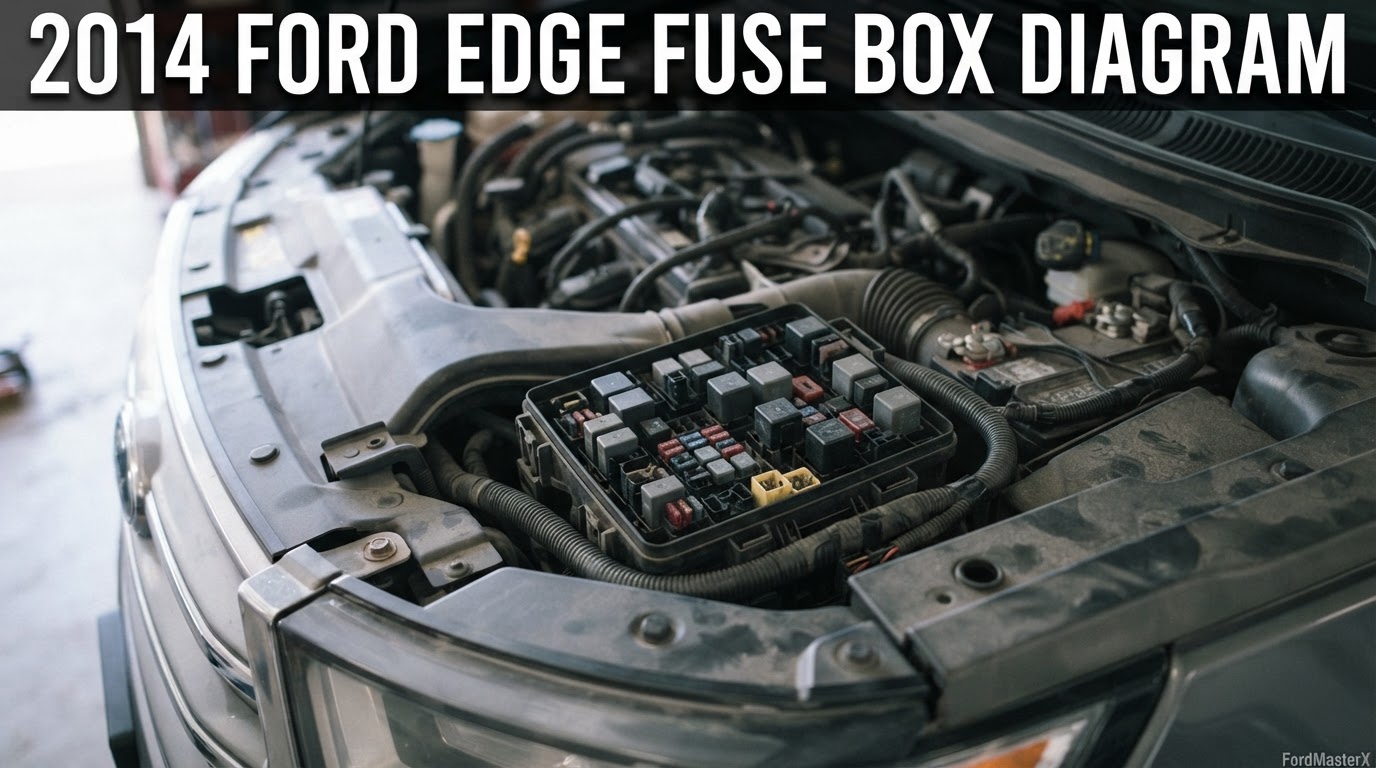
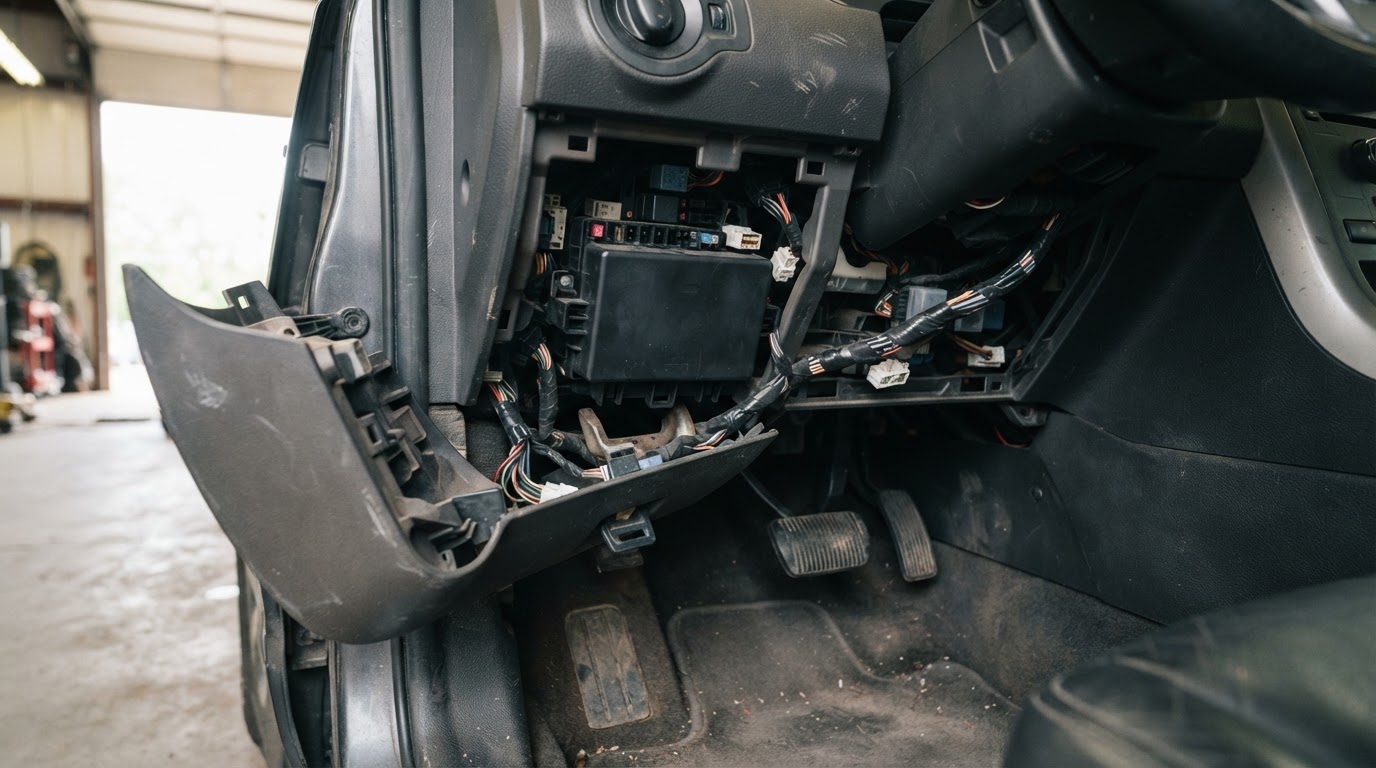
Your 2014 Ford Edge has two fuse boxes. The Power Distribution Box is under the hood by the battery. The Body Control Module panel is behind a trim piece in the driver footwell.
The front cigarette lighter is fuse 27, rated 20A. If your Edge has the 2.0L EcoBoost engine, check fuse 69 for 20A, not 15A.
That last point is the one most charts miss. Skip to what changes by engine if that is why you are here.
Where are the fuse boxes on a 2014 Ford Edge?


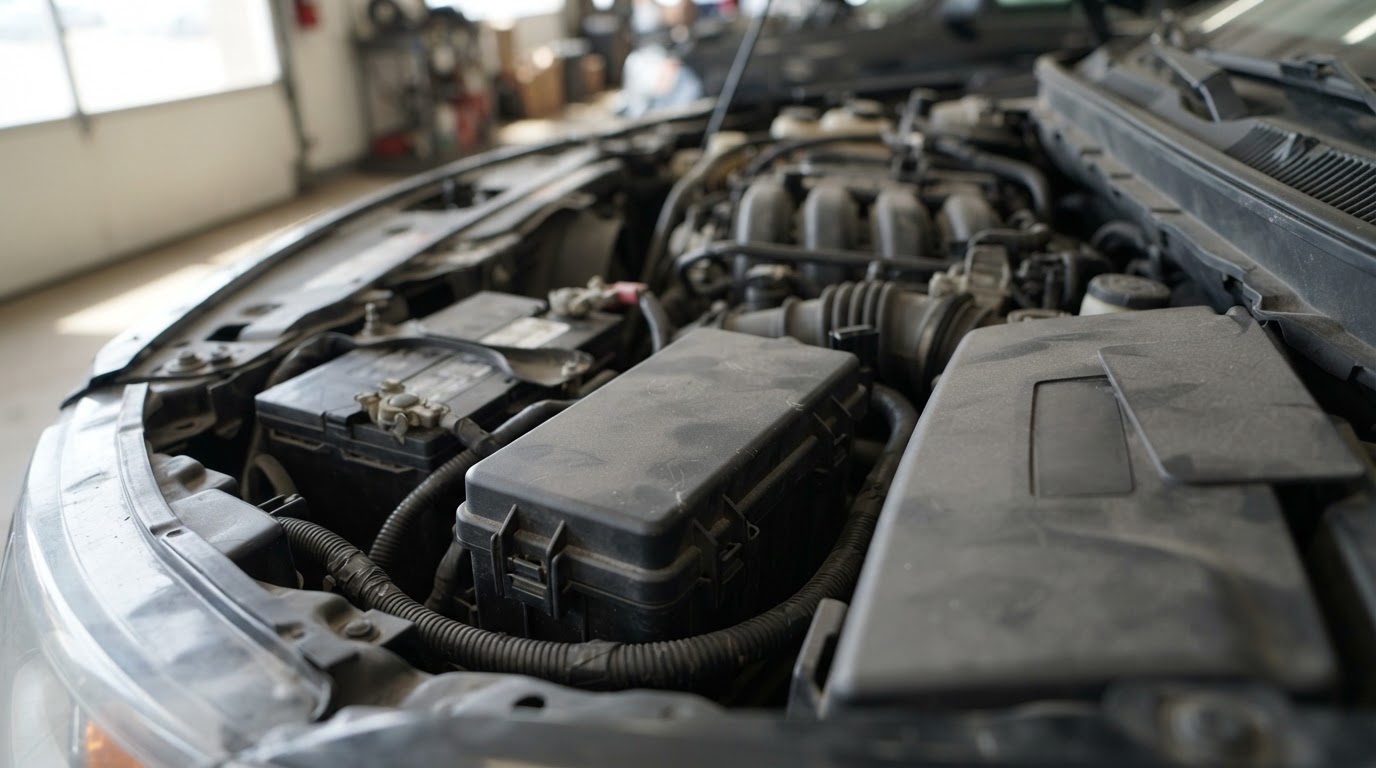
Power Distribution Box. Engine compartment, under the hood, driver side, next to the battery, under a protective cover. It carries the high current fuses: the starter motor, both cooling fans, the fuel pump and the blower motor.
Body Control Module fuse panel. Passenger compartment, behind a trim panel in the driver footwell, near the parking brake. Slide the release lever, pull the trim panel away, then use the puller tool built into the cover.
Worth knowing: the box cover on your specific Edge has a label printed on the underside. Trim level, engine and options move individual fuses around in ways a generic chart cannot account for. That label is the final authority.
Does the 2.0L EcoBoost Edge use different fuses than the V6?


Yes, on several positions. Ford sold the 2014 Edge with three engines. Base trucks got the 3.5L V6, Sport got the 3.7L V6, and EcoBoost models got the 2.0L four cylinder.
Most fuse charts list one amperage per slot and never say which engine it covers. On this box, that gap can put the wrong fuse in the wrong truck.
| Fuse (box) | Circuit | 3.5L / 3.7L V6 | 2.0L EcoBoost |
|---|---|---|---|
| 69 (PDB) | Vehicle power #1 | 15A | 20A |
| 70 (PDB) | A/C relay, vehicle power #3, AWD module / active grille shutter | 10A | 10A |
| 75 (PDB) | A/C clutch diode | Fitted | Not used |
| 86 (PDB) | PCM relay, PCM keep-alive | 7.5A | Not used here |
| 90 (PDB) | PCM, Transmission Control Module | Not used this way | 10A |
| 91 (PDB) | Adaptive cruise control / automatic transmission warm-up | 10A | 5A |
| 96 (PDB) | Canister purge solenoid diode | Not used | Fitted |
| 37 (BCM) | Climate control | 10A | Not used this way |
| 42 (BCM) | Grade assist control switch (hill start) | Not used this way | 5A |
| 56 (PDB) | Transmission control module | Not used | 15A |
Fuse 69 matters most. It feeds vehicle power circuit 1 at 15A on the V6 and 20A on the 2.0L EcoBoost, same slot.
Put a 15A fuse in a 2.0L Edge and it can blow under ordinary load. Put a 20A fuse in a V6 and the circuit loses the protection the wiring was sized for.
Check your engine before you buy a replacement fuse, not after it blows a second time.
I cross-checked this split against bolidenforum.de’s dedicated 2011-2014 Edge thread and fuseandrelay.com’s own table. Both list the same two values for fuse 69. Neither says which engine gets which, in the chart itself.
This generation also carries an older trap from before the 2011 facelift. The 2007-2010 Edge numbered these same four power point fuses differently. It used 17, 64, 65 and 66 instead of 9, 20, 21 and 27.
Our 2013 Ford Edge fuse box diagram covers that generation split in full, since 2013 and 2014 share one layout.
Power Distribution Box fuse chart: fuses 1 to 98

The complete Power Distribution Box, fuse by fuse. Rows marked with a red number are the ones covered in the engine comparison above.
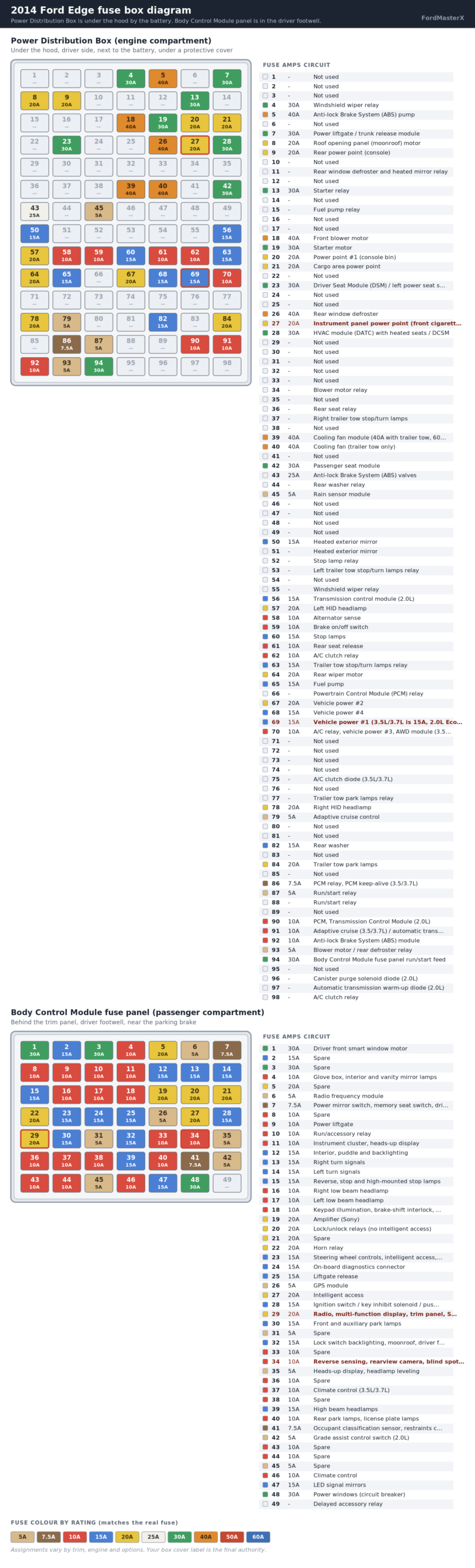
| Fuse | Amps | Circuit |
|---|---|---|
| 1 | – | Not used |
| 2 | – | Not used |
| 3 | – | Not used |
| 4 | 30A | Windshield wiper relay |
| 5 | 40A | Anti-lock Brake System (ABS) pump |
| 6 | – | Not used |
| 7 | 30A | Power liftgate / trunk release module |
| 8 | 20A | Roof opening panel (moonroof) motor |
| 9 | 20A | Rear power point (console) |
| 10 | – | Not used |
| 11 | – | Rear window defroster and heated mirror relay |
| 12 | – | Not used |
| 13 | 30A | Starter relay |
| 14 | – | Not used |
| 15 | – | Fuel pump relay |
| 16 | – | Not used |
| 17 | – | Not used |
| 18 | 40A | Front blower motor |
| 19 | 30A | Starter motor |
| 20 | 20A | Power point #1 (console bin) |
| 21 | 20A | Cargo area power point |
| 22 | – | Not used |
| 23 | 30A | Driver Seat Module (DSM) / left power seat switch |
| 24 | – | Not used |
| 25 | – | Not used |
| 26 | 40A | Rear window defroster |
| 27 | 20A | Instrument panel power point (front cigarette lighter) |
| 28 | 30A | HVAC module (DATC) with heated seats / DCSM |
| 29 | – | Not used |
| 30 | – | Not used |
| 31 | – | Not used |
| 32 | – | Not used |
| 33 | – | Not used |
| 34 | – | Blower motor relay |
| 35 | – | Not used |
| 36 | – | Rear seat relay |
| 37 | – | Right trailer tow stop/turn lamps |
| 38 | – | Not used |
| 39 | 40A | Cooling fan module (40A with trailer tow, 60A without) |
| 40 | 40A | Cooling fan (trailer tow only) |
| 41 | – | Not used |
| 42 | 30A | Passenger seat module |
| 43 | 25A | Anti-lock Brake System (ABS) valves |
| 44 | – | Rear washer relay |
| 45 | 5A | Rain sensor module |
| 46 | – | Not used |
| 47 | – | Not used |
| 48 | – | Not used |
| 49 | – | Not used |
| 50 | 15A | Heated exterior mirror |
| 51 | – | Heated exterior mirror |
| 52 | – | Stop lamp relay |
| 53 | – | Left trailer tow stop/turn lamps relay |
| 54 | – | Not used |
| 55 | – | Windshield wiper relay |
| 56 | 15A | Transmission control module (2.0L) |
| 57 | 20A | Left HID headlamp |
| 58 | 10A | Alternator sense |
| 59 | 10A | Brake on/off switch |
| 60 | 15A | Stop lamps |
| 61 | 10A | Rear seat release |
| 62 | 10A | A/C clutch relay |
| 63 | 15A | Trailer tow stop/turn lamps relay |
| 64 | 20A | Rear wiper motor |
| 65 | 15A | Fuel pump |
| 66 | – | Powertrain Control Module (PCM) relay |
| 67 | 20A | Vehicle power #2 |
| 68 | 15A | Vehicle power #4 |
| 69 | 15A | Vehicle power #1 (3.5L/3.7L is 15A, 2.0L EcoBoost is 20A) |
| 70 | 10A | A/C relay, vehicle power #3, AWD module (3.5/3.7L) or active grille shutter (2.0L) |
| 71 | – | Not used |
| 72 | – | Not used |
| 73 | – | Not used |
| 74 | – | Not used |
| 75 | – | A/C clutch diode (3.5L/3.7L) |
| 76 | – | Not used |
| 77 | – | Trailer tow park lamps relay |
| 78 | 20A | Right HID headlamp |
| 79 | 5A | Adaptive cruise control |
| 80 | – | Not used |
| 81 | – | Not used |
| 82 | 15A | Rear washer |
| 83 | – | Not used |
| 84 | 20A | Trailer tow park lamps |
| 85 | – | Not used |
| 86 | 7.5A | PCM relay, PCM keep-alive (3.5/3.7L) |
| 87 | 5A | Run/start relay |
| 88 | – | Run/start relay |
| 89 | – | Not used |
| 90 | 10A | PCM, Transmission Control Module (2.0L) |
| 91 | 10A | Adaptive cruise (3.5/3.7L) / automatic transmission warm-up (2.0L) |
| 92 | 10A | Anti-lock Brake System (ABS) module |
| 93 | 5A | Blower motor / rear defroster relay |
| 94 | 30A | Body Control Module fuse panel run/start feed |
| 95 | – | Not used |
| 96 | – | Canister purge solenoid diode (2.0L) |
| 97 | – | Automatic transmission warm-up diode (2.0L) |
| 98 | – | A/C clutch relay |
A cheap fuse assortment kit covers both the mini and standard blade sizes in these two boxes. It costs less than a single dealer fuse and saves a second trip. Any brand meeting the ATO/ATC standard fits.
Body Control Module fuse panel chart: fuses 1 to 49
The complete Body Control Module panel, in the driver footwell.
| Fuse | Amps | Circuit |
|---|---|---|
| 1 | 30A | Driver front smart window motor |
| 2 | 15A | Spare |
| 3 | 30A | Spare |
| 4 | 10A | Glove box, interior and vanity mirror lamps |
| 5 | 20A | Spare |
| 6 | 5A | Radio frequency module |
| 7 | 7.5A | Power mirror switch, memory seat switch, driver seat module |
| 8 | 10A | Spare |
| 9 | 10A | Power liftgate |
| 10 | 10A | Run/accessory relay |
| 11 | 10A | Instrument cluster, heads-up display |
| 12 | 15A | Interior, puddle and backlighting |
| 13 | 15A | Right turn signals |
| 14 | 15A | Left turn signals |
| 15 | 15A | Reverse, stop and high-mounted stop lamps |
| 16 | 10A | Right low beam headlamp |
| 17 | 10A | Left low beam headlamp |
| 18 | 10A | Keypad illumination, brake-shift interlock, start button LED, anti-theft, PCM wake-up |
| 19 | 20A | Amplifier (Sony) |
| 20 | 20A | Lock/unlock relays (no intelligent access) |
| 21 | 20A | Spare |
| 22 | 20A | Horn relay |
| 23 | 15A | Steering wheel controls, intelligent access, headlamp switch |
| 24 | 15A | On-board diagnostics connector |
| 25 | 15A | Liftgate release |
| 26 | 5A | GPS module |
| 27 | 20A | Intelligent access |
| 28 | 15A | Ignition switch / key inhibit solenoid / push-button start |
| 29 | 20A | Radio, multi-function display, trim panel, SYNC module |
| 30 | 15A | Front and auxiliary park lamps |
| 31 | 5A | Spare |
| 32 | 15A | Lock switch backlighting, moonroof, driver front window, auto-dim mirror |
| 33 | 10A | Spare |
| 34 | 10A | Reverse sensing, rearview camera, blind spot monitor |
| 35 | 5A | Heads-up display, headlamp leveling |
| 36 | 10A | Spare |
| 37 | 10A | Climate control (3.5L/3.7L) |
| 38 | 10A | Spare |
| 39 | 15A | High beam headlamps |
| 40 | 10A | Rear park lamps, license plate lamps |
| 41 | 7.5A | Occupant classification sensor, restraints control module |
| 42 | 5A | Grade assist control switch (2.0L) |
| 43 | 10A | Spare |
| 44 | 10A | Spare |
| 45 | 5A | Spare |
| 46 | 10A | Climate control |
| 47 | 15A | LED signal mirrors |
| 48 | 30A | Power windows (circuit breaker) |
| 49 | – | Delayed accessory relay |
Which fuse controls the radio, SYNC and amplifier?
Fuse 29 in the Body Control Module panel, 20A. It feeds the radio, the multi-function display, the trim panel electronics and the SYNC module together.
The Sony amplifier runs on its own circuit, fuse 19, also 20A. If the subwoofer and door speakers go silent but the radio screen still lights up, check fuse 19 first.
If the whole system is dark, including the screen, check fuse 29 first.
2014 Ford Edge symptom to fuse guide
Readers arrive with a symptom, not a fuse number. Start here, then confirm the position in the full chart above.
| Symptom | Check this fuse | Box |
|---|---|---|
| Front cigarette lighter or power outlet is dead | 27, 20A | Power Distribution Box |
| Console bin power outlet is dead | 20, 20A | Power Distribution Box |
| Rear console power outlet is dead | 9, 20A | Power Distribution Box |
| Cargo area power outlet is dead | 21, 20A | Power Distribution Box |
| Radio, SYNC or multi-function display is dark | 29, 20A | Body Control Module |
| Amplifier or subwoofer silent, speakers still play | 19, 20A | Body Control Module |
| Blower motor will not blow air on any setting | 18, 40A | Power Distribution Box |
| Rear window defroster will not clear | 26, 40A | Power Distribution Box |
| Backup camera or blind spot monitor is dead | 34, 10A | Body Control Module |
| Power liftgate will not open or close | 7 (30A) and 9 (10A) | Both boxes |
| Horn stays silent | 22 relay, 20A | Body Control Module |
| No start, fuel pump suspected | 65, 15A | Power Distribution Box |
| One low beam headlamp out, bulb tests good | 16 or 17, 10A | Body Control Module |
| Both high beam headlamps out | 39, 15A | Body Control Module |
| OBDII port dead, scan tool will not power on | 24, 15A | Body Control Module |
How do you tell if a fuse is actually blown?
A blown fuse shows a broken metal strip inside the clear plastic body. Pull the fuse and hold it up to a light to check.
A hairline break is easy to miss. Test continuity with a multimeter set to ohms if the strip looks intact. Near zero resistance means the fuse is good.
Never guess the replacement rating. Match the number on the old fuse against your box cover label, especially near fuse 69. A higher rated fuse lets the wiring become the fuse instead, and that failure costs far more to fix.
Why does the same fuse keep blowing?
A fuse that blows once is usually a one-off surge. One that blows again within days is telling you something is wrong upstream, not asking for a bigger fuse.
Unplug whatever you most recently added. A phone charger left in a power point is a common repeat offender. So is an aftermarket amplifier wired into the audio fuses, or a dash cam on a delayed accessory feed.
Check for chafed insulation where the harness flexes, especially near the liftgate hinge and the driver door jamb.
If a fuse blows the instant you push it in, that circuit has a hard short. Stop replacing fuses and trace the wiring with a proper diagnostic tool instead of guessing. A plastic fuse puller keeps you from cracking the panel housing while you work through the circuit.
A battery that keeps going flat overnight points at a parasitic draw, not a blown fuse. Rule out a weak battery first, since it looks identical to a real draw.
This generation shares its battery tray and group size with the 2013 Edge. Our battery guide for the 2013 Ford Edge covers picks that fit the 2014 too.
Is the 2014 Ford Edge fuse box different from the 2013?
No, not in any way that changes which slot you check. The dedicated 2011-2014 source I cross-checked reports the 2014 Edge as identical to 2013. Every fuse number and amperage matches.
The only documented differences between the two years are in label wording, not in the fuses themselves. One circuit description adds a mention of the rearview camera.
Another drops a parenthetical note. Neither changes a number.
If you own a 2013 Edge instead, see our 2013 Ford Edge fuse box diagram for your exact year.
This also holds for 2011 and 2012. Ford did not touch the fuse layout again until 2015. That year brought a redesigned second generation Edge with its own separate box.
2014 Ford Edge fuse quick reference
The fuses owners look up most, in one place.
| What you want | Fuse | Amps | Box |
|---|---|---|---|
| Cigarette lighter, front power point | 27 | 20A | Power Distribution Box |
| Vehicle power #1 (engine-specific) | 69 | 15A V6 / 20A 2.0L | Power Distribution Box |
| Starter motor | 19 | 30A | Power Distribution Box |
| Fuel pump | 65 | 15A | Power Distribution Box |
| Front blower motor | 18 | 40A | Power Distribution Box |
| Cooling fan module | 39 | 40A/60A | Power Distribution Box |
| Rear window defroster | 26 | 40A | Power Distribution Box |
| HID headlamps, left / right | 57 / 78 | 20A each | Power Distribution Box |
| Horn | 22 | 20A | Body Control Module panel |
| Radio, SYNC, amplifier | 29 / 19 | 20A each | Body Control Module panel |
Not sure your Edge matches this exactly? Your box cover label is the final authority, especially on fuse 69.
Options like all-wheel drive, trailer tow and heated seats add fuses this guide covers. Your specific build may not use all of them.