
1996 Ford Ranger Fuse Box Diagram: Every Fuse and Relay Chart

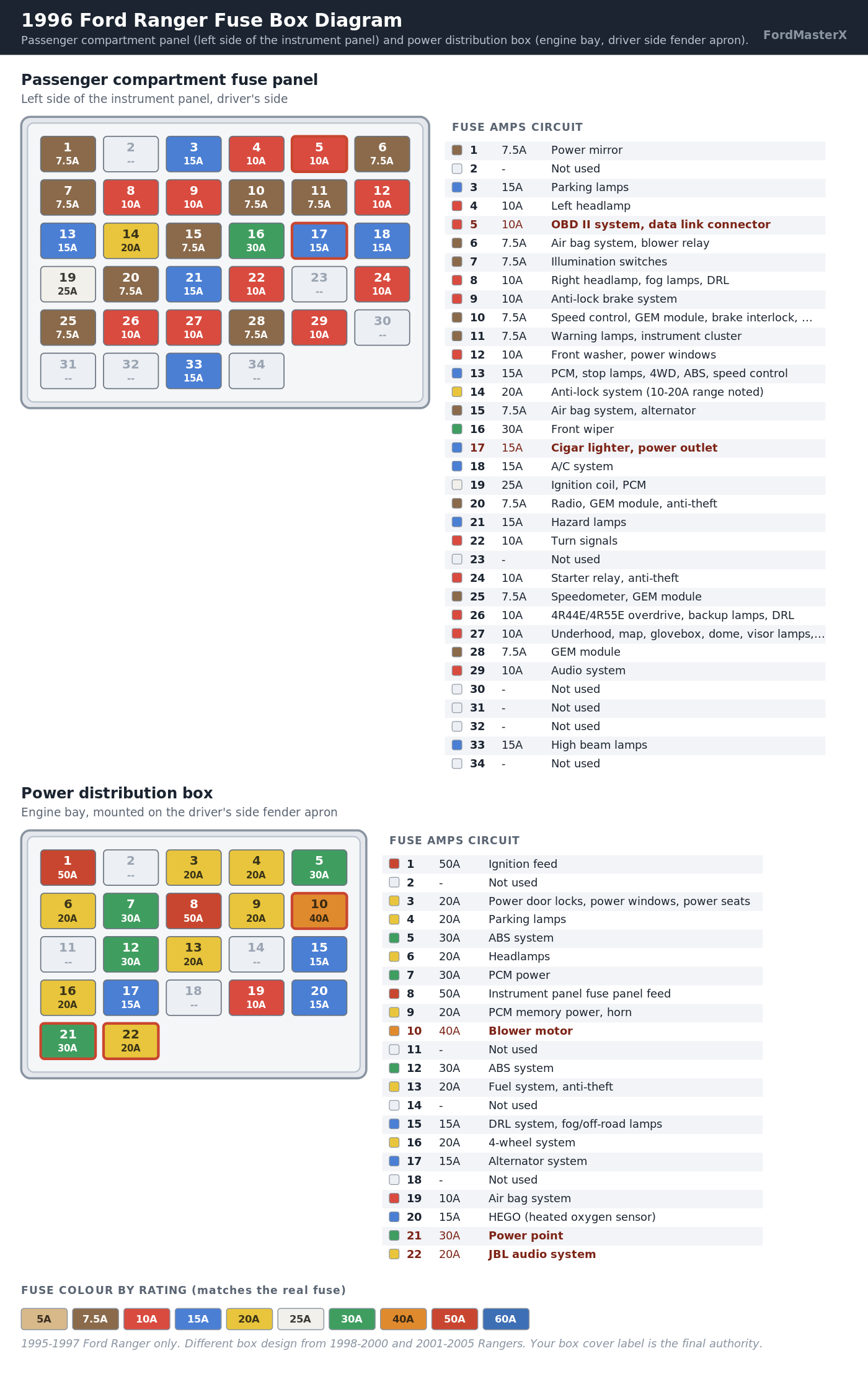
Your 1996 Ford Ranger has two fuse sources. The passenger compartment fuse panel is at the left end of the instrument panel, driver’s side. The power distribution box is in the engine bay, mounted on the driver’s side fender apron. The cigar lighter and power outlet run on fuse 17, rated 15A, in the interior panel.
Where are the fuse boxes on a 1996 Ford Ranger?
Recommended Best Deal Products


Passenger compartment fuse panel. Left side of the instrument panel, driver’s side, behind a removable cover. Pull the cover by its finger divot. Four spare fuses and the fuse-pulling tool sit on the underside of that cover.
Power distribution box. Engine compartment, mounted on a bracket on the driver’s side fender apron. This box also carries two of the three relay modules on your truck, covered further down this page.
This is a different box design from the Rangers Ford built just a few years later. The 1998-2000 Ranger and the 2001-2005 Ranger each use their own fuse numbering, already covered on FordMasterX. None of those numbers apply here.
Most sites get this wrong: the cigar lighter fuse amperage
Three sources that are specific to the 1996 model, or that treat 1995 to 1997 as one shared table, all agree: fuse 17, the cigar lighter and power outlet, is rated 15A. Auto Genius’s 1996-specific chart and StartMyCar’s 1996-specific page both list 15A, and a fuse-box.info-derived reference thread covering the full 1995-1997 range states 15A with no year split at all.
Two other pages disagree, and both are auto-generated single-year “portal” pages built from that same underlying 1995-1997 data. One labeled 1995 lists fuse 17 at 30A. One labeled 1997 lists it at 25A. Neither cites a reason for a mid-range change, and nothing in any owner-facing source backs a renumbering of fuse 17 between 1995 and 1997.
Read this as a data-generation error on the per-year pages, not a real Ford spec change. The source those pages were built from gives one number, 15A, for the whole 1995 to 1997 Ranger. Your fuse panel cover legend is the final authority for your specific truck.
1996 Ford Ranger passenger compartment fuse chart
Recommended Best Deal Products


Left side of the instrument panel, driver’s side. 34 numbered positions, all mini (ATO/ATC) blade fuses. Eight positions are not used.
| Fuse | Amps | Circuit protected |
|---|---|---|
| 1 | 7.5A | Power mirror |
| 2 | – | Not used |
| 3 | 15A | Parking lamps |
| 4 | 10A | Left headlamp |
| 5 | 10A | OBD II system, data link connector |
| 6 | 7.5A | Air bag system, blower relay |
| 7 | 7.5A | Illumination switches |
| 8 | 10A | Right headlamp, fog lamp system, DRL |
| 9 | 10A | Anti-lock brake system |
| 10 | 7.5A | Speed control, GEM module, brake interlock, A/C |
| 11 | 7.5A | Warning lamps, instrument cluster |
| 12 | 10A | Front washer, power windows |
| 13 | 15A | PCM, stop lamps, 4WD, anti-lock brakes, speed control |
| 14 | 20A | Anti-lock system (sources note a 10-20A range) |
| 15 | 7.5A | Air bag system, alternator |
| 16 | 30A | Front wiper |
| 17 | 15A | Cigar lighter, power outlet |
| 18 | 15A | A/C system |
| 19 | 25A | Ignition coil, PCM |
| 20 | 7.5A | Radio, GEM module, anti-theft |
| 21 | 15A | Hazard lamps |
| 22 | 10A | Turn signals |
| 23 | – | Not used |
| 24 | 10A | Starter relay, anti-theft |
| 25 | 7.5A | Speedometer, GEM module |
| 26 | 10A | 4R44E/4R55E overdrive, backup lamps, DRL |
| 27 | 10A | Underhood, map, glovebox and dome lamps, visor lamps, 4×4 system |
| 28 | 7.5A | GEM module |
| 29 | 10A | Audio system |
| 30 | – | Not used |
| 31 | – | Not used |
| 32 | – | Not used |
| 33 | 15A | High beam lamps |
| 34 | – | Not used |
None of the three sources split this panel by engine. If your box is missing a position listed here, that usually means an option your truck does not have, not a different panel for a different engine.
1996 Ford Ranger power distribution box fuse chart
Engine bay, driver’s side fender apron. 22 numbered fuse positions plus two diodes and a resistor, shared across the three sources with no engine split.
| Fuse | Amps | Circuit protected |
|---|---|---|
| F1 | 50A | Ignition feed |
| F2 | – | Not used |
| F3 | 20A | Power door locks, power windows, power seats |
| F4 | 20A | Parking lamps |
| F5 | 30A | ABS system |
| F6 | 20A | Headlamps |
| F7 | 30A | PCM power |
| F8 | 50A | Instrument panel fuse panel feed |
| F9 | 20A | PCM memory power, horn |
| F10 | 40A | Blower motor |
| F11 | – | Not used |
| F12 | 30A | ABS system |
| F13 | 20A | Fuel system, anti-theft |
| F14 | – | Not used |
| F15 | 15A | DRL system, fog/off-road lamps |
| F16 | 20A | 4-wheel system |
| F17 | 15A | Alternator system |
| F18 | – | Not used |
| F19 | 10A | Air bag system |
| F20 | 15A | HEGO (heated exhaust gas oxygen sensor) |
| F21 | 30A | Power point |
| F22 | 20A | JBL audio system, if equipped |
Two diodes (PCM and ABS) and an RABS resistor sit in this box with no amp rating of their own. Eight relays live here too: starter, fuel pump, PCM power, wide-open-throttle A/C, fog lamp, wiper hi-lo, horn, and wiper run.
Where are the other relay modules, and what do they do?
Recommended Best Deal Products


Most fuse charts for this truck stop at the two main boxes. Your 1996 Ranger actually carries three separate relay modules, and knowing where they are saves a wasted diagnosis.
| Module | Location | Relays inside |
|---|---|---|
| Engine compartment relay module 1 | Engine bay | Blower motor, front washer pump |
| Engine compartment relay module 2 | Engine bay | ABS pump relay, ABS main relay |
| Instrument panel relay module 3 | Interior, behind the instrument panel | Anti-theft, interior lamps, battery saver, 4×4 clutch, all-door unlock, all-door lock, one-touch down, park lamp delay |
If a fuse checks good with a multimeter set to continuity but the circuit still does not work, the next thing to check is the matching relay in one of these three modules, not a second look at the fuse you already tested.
Symptom to fuse: which one to check first
| What’s happening | Check first |
|---|---|
| Cigar lighter or power outlet dead | Fuse 17 (15A), interior panel. If that is good, check F21 (30A) in the power distribution box. |
| Radio or audio system dead | Fuse 29 (10A) and fuse 20 (7.5A), interior panel. JBL-equipped trucks also run F22 (20A) in the power distribution box. |
| Blower motor does not blow air at all | F10 (40A), power distribution box. If the blower works on some speeds but not others, check fuse 6 (7.5A) and relay module 1 instead. |
| ABS warning light stays on | Fuse 9 (10A), interior panel, plus F5 and F12 (30A each), power distribution box. Also check relay module 2. |
| Turn signals or hazards do not work | Fuse 22 (10A) for turn signals, fuse 21 (15A) for hazards, interior panel. |
| One headlamp out, other side fine | Fuse 4 (10A) left or fuse 8 (10A) right, interior panel. F6 (20A), power distribution box, feeds both. |
| Power windows or locks dead | Fuse 12 (10A), interior panel, and F3 (20A), power distribution box. |
| Truck will not crank | Fuse 24 (10A), interior panel, and F1 (50A), power distribution box. Also check the starter relay in the power distribution box. |
| 4×4 will not engage | Fuse 27 (10A), interior panel, F16 (20A), power distribution box, and the 4×4 clutch relay in module 3. |
Why does 1996 matter specifically, and not just “1995 to 1997”?
1996 was the model year the US completed its phase-in of mandatory OBD II. Fuse 5 in your interior panel, rated 10A, exists for exactly that: the OBD II system and the data link connector under your dash. That is the 16-pin connector a code reader plugs into.
Every other position in both boxes matches across the three sources checked for 1995, 1996 and 1997 as one shared layout, aside from the cigar lighter fuse discrepancy covered above. Treat this as one generation for diagnostic purposes, and confirm against your own box cover for anything specific to your build.
Quick reference: the fuses people search for most
| Circuit | Fuse | Amps | Box |
|---|---|---|---|
| Cigar lighter / power outlet | 17 | 15A | Interior panel |
| Radio | 29, 20 | 10A, 7.5A | Interior panel |
| Blower motor | F10 | 40A | Power distribution box |
| Headlamps (main feed) | F6 | 20A | Power distribution box |
| ABS | 9, F5, F12 | 10A, 30A, 30A | Both |
| Turn signals | 22 | 10A | Interior panel |
| Starter relay feed | 24, F1 | 10A, 50A | Both |
If the same fuse blows again within a week of replacing it, the fault is upstream of the fuse, not in the fuse itself. A fresh fuse does not fix a chafed wire or a shorted component, and reading live data is what actually isolates that. Our Ford diagnostic tool comparison covers what works on trucks this age.
A cheap ATO/ATC fuse assortment kit costs less than one dealer fuse and saves the second trip for whichever position actually blew. Fuse assortment kits on Amazon. For checking continuity on a fuse you already pulled, or voltage at a connector, any multimeter that reads ohms and volts works. Multimeters on Amazon.
Ford redesigned this fuse box twice more in the years after your truck. If you are working on a 2001 Ford Ranger, a 2002 Ranger, or a 2004 Ranger instead, none of the fuse numbers on this page carry over. Those model years use a different box entirely, with their own numbered charts.