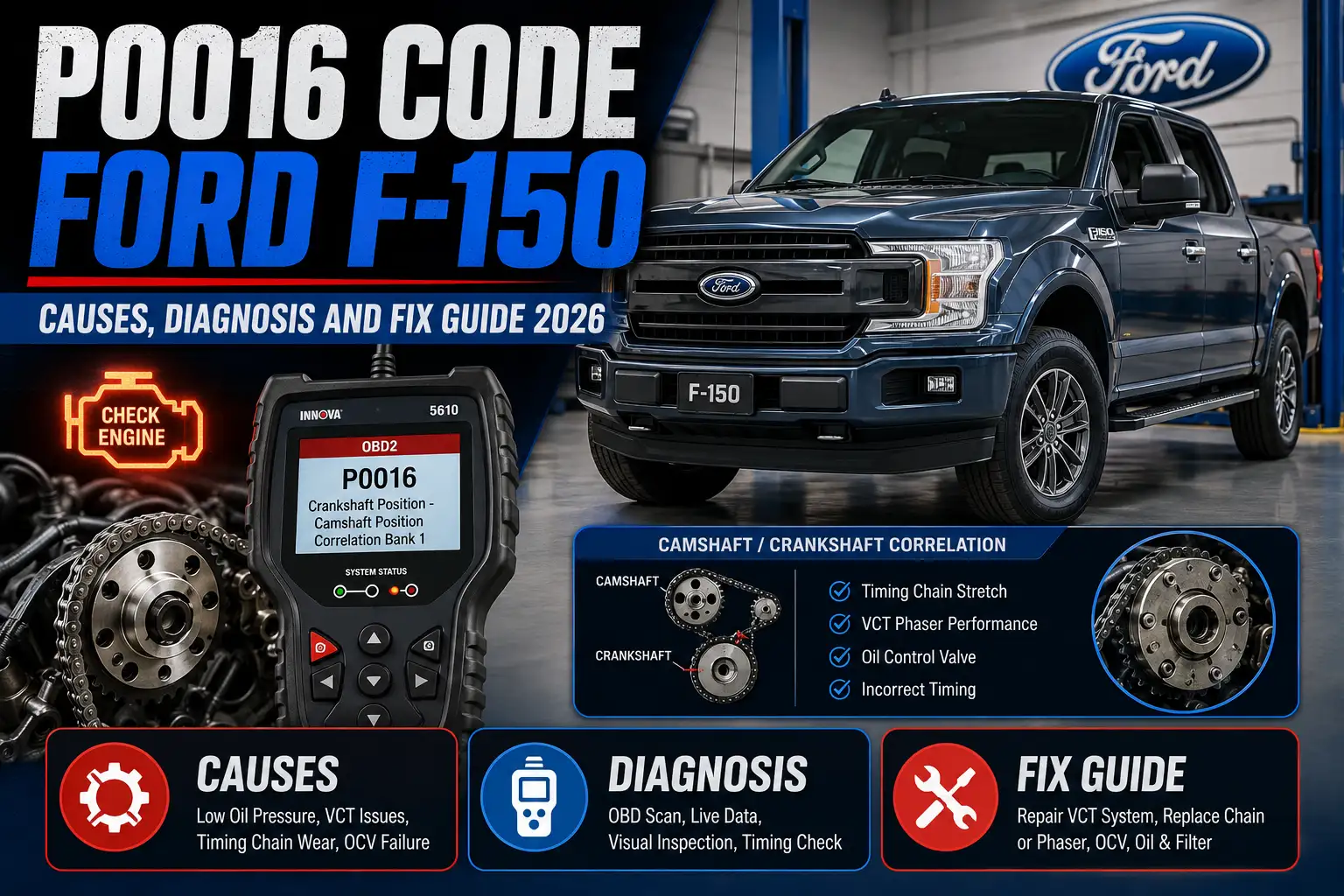
P0016 Code Ford F150 Causes: Diagnosis and Fix Guide 2026

The P0016 code on a Ford F150 means the powertrain control module, or PCM, detects an incorrect relationship between the crankshaft position and the Bank 1 camshaft position. Ford defines P0016 as a crank and cam position correlation fault for Bank 1.
Do not assume the camshaft position sensor itself has failed. On an F-150, P0016 can point to VCT control, a sticking VCT solenoid, mechanical timing wear, a cam phaser problem, incorrect timing after engine work, or a sensor circuit issue.

Prime for Young Adults — 6 Months Free
Students and 18–24s get six months of Prime free, then half price.
Start 6 Months Free As an Amazon Associate I earn from qualifying purchases.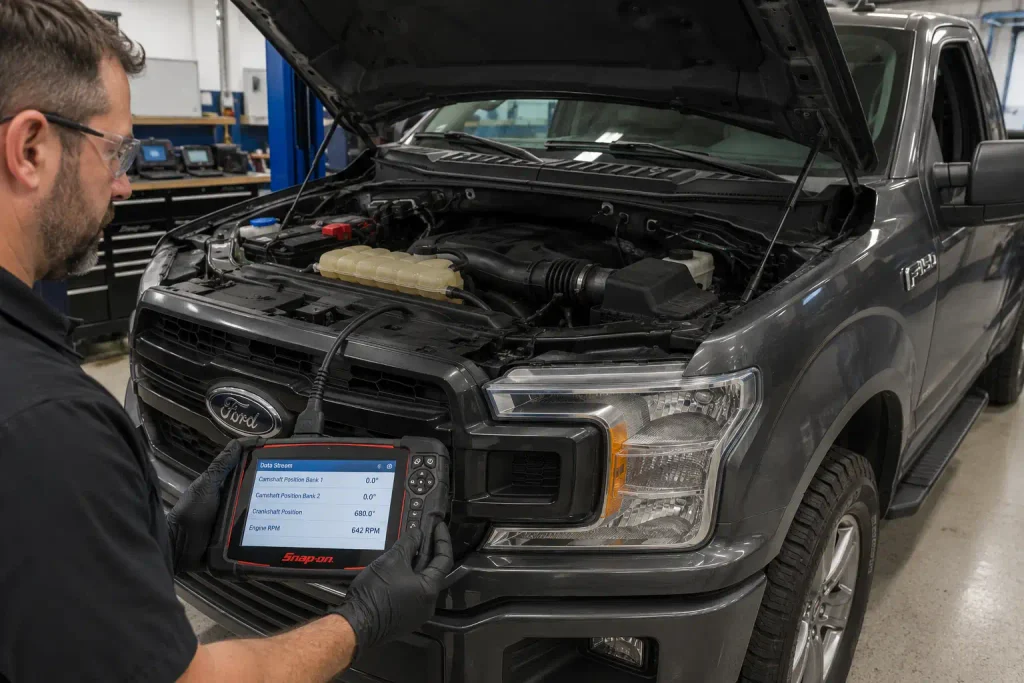
The correct diagnostic path depends heavily on the engine, model year, build date, accompanying codes, and scan-tool data.
Ford F-150 P0016 Diagnostic Path
Use the code, engine details, oil condition, VCT data, noise, and related DTCs to choose the correct repair path.
Scan Every Stored Code
Save P0016, related VCT codes, sensor codes, misfire codes, and freeze-frame data before clearing the PCM.
Start HereIdentify Engine and Build Date
Ford service procedures differ between early 3.5L EcoBoost, certain 5.0L trucks, and other F-150 applications.
TSB CheckCheck Engine Oil
Verify oil level, condition, viscosity, and the correct Ford specification because VCT operation depends on proper oil control.
Low Cost CheckEvaluate VCT Response
Compare commanded and actual cam timing where scan-tool data is available. Poor response can point toward VCT control.
Scan DataListen for Timing Noise
Cold-start rattle from the timing-cover area raises suspicion for phaser or mechanical timing problems.
Mechanical ClueChoose the Correct Test Path
Test wiring when signal faults exist. Inspect VCT or mechanical timing when correlation evidence points there.
Confirm Before RepairWhat the Evidence Usually Points Toward
Strong timing-cover rattle, repeated stalling, severe misfires, oil-pressure warnings, or evidence of jumped timing call for prompt mechanical diagnosis.

Audible — Listen Free for 30 Days
One free credit a month and thousands of titles included.
Listen Free for 30 Days As an Amazon Associate I earn from qualifying purchases.What P0016 Means on Your Ford F150 Engine
Recommended Best Deal Products

P0016 is a correlation code, not a direct component-failure code. The PCM monitors crankshaft and camshaft signals and checks whether the cam remains where the PCM expects it to be relative to crankshaft rotation.
Ford’s newer gasoline OBD documentation lists P0016 as Crank/Cam Position Correlation Bank 1. The monitor uses crankshaft position and camshaft position inputs while the engine operates.
Crankshaft Position Signal
The crankshaft position sensor tells the PCM where the crankshaft is in its rotation. The PCM needs that information for ignition timing, fuel injection, misfire monitoring, and cam timing calculations.
A crankshaft circuit failure normally has its own codes, such as P0335 or P0336. That is one reason P0016 should not automatically be treated as a failed crank sensor.
Intake Camshaft Position
The camshaft position sensor allows the PCM to determine actual cam position.
P0016 concerns Bank 1 cam-to-crank correlation. Exact sensor location changes with engine configuration, so confirm the engine before removing parts.
Correlation Outside Expected Range
The PCM knows where the camshaft should be in relation to the crankshaft.
If the actual relationship moves outside the programmed tolerance, P0016 can set. The sensor may be reporting the problem correctly even when the real fault is mechanical timing or VCT control.
That distinction is what makes engine-specific diagnosis critical.
Which F150 Engines Have Different P0016 Patterns
The fastest way to misdiagnose P0016 is to apply the same repair to every Ford F-150.
Audible Premium Plus — Annual Membership
12 audiobook credits up front, plus the full Audible catalogue.
See Annual Plans As an Amazon Associate I earn from qualifying purchases.Ford has issued different service information for specific engines and production periods.
| F-150 Application | Documented P0016 Pattern | First Diagnostic Priority |
|---|---|---|
| 2011 to 2014 3.5L GTDI built on or before Oct. 10, 2014 | Primary timing-chain wear may cause P0016 | Check VCT_INT_ACT1 data |
| 2016 3.5L GTDI under 2,000 miles | Certain paired VCT DTCs may identify a VCT solenoid issue | Check paired DTCs |
| Applicable 2015 to 2020 Ford models | Debris may cause a VCT solenoid to stick | Follow VCT pinpoint testing |
| 2018 5.0L built on or before Jan. 3, 2018 | Multiple DTCs including P0016 may occur with no drivability concern | Check PCM calibration and TSB |
| Other F-150 years and engines | No universal repair applies | Follow normal Ford diagnostics |
Ford TSB 17-0026 specifically covers 2011 to 2014 F-150 trucks with the 3.5L GTDI engine built on or before October 10, 2014. Ford states that P0016 on those trucks may result from a worn primary timing chain.
Ford also issued TSB 16-0038 for certain 2016 F-150 3.5L GTDI trucks with fewer than 2,000 miles. That bulletin uses paired DTCs to identify specific VCT solenoid faults.
The lesson is simple. Identify your engine, year, build date, and all stored codes before choosing a repair.
Check These 5 Basics Before Replacing Parts
Before buying a cam sensor or opening the timing cover, collect enough information to select the correct diagnostic branch.
1. Verify Engine Oil Level
Check the dipstick on level ground according to your F-150 owner’s manual.
The VCT system changes cam timing hydraulically, so oil condition and proper lubrication belong near the beginning of the diagnostic process. Do not assume an oil issue is the cause just because the level is low.
2. Verify the Correct Oil Specification
Confirm that the oil in the truck matches the recommendation for your exact engine and model year.
Ford has changed viscosity and specification requirements across F-150 engines. Use the Ford engine oil recommendation chart to identify the relevant specification, then confirm it against your owner’s manual.
3. Record Every Stored Code
Do not clear P0016 immediately.
Record all stored, pending, and permanent codes plus freeze-frame information. Related codes can completely change the diagnosis.
Pay special attention to codes such as:
- P0011
- P0012
- P0017
- P0018
- P0021
- P0022
- P0300 series misfire codes
- Camshaft or crankshaft sensor circuit codes
For example, Ford TSB 16-0038 directs technicians working on qualifying 2016 3.5L GTDI trucks to look for specific code pairs rather than P0016 alone.
4. Listen During Cold Start
Start the engine after it has been sitting long enough to become cold.
Listen for abnormal rattling or tapping from the front timing-cover area. Noise does not prove that the timing chain or cam phaser is bad, but it raises the priority of mechanical timing inspection.
5. Check Recent Engine Work
Ask whether the code appeared after timing-chain, cam-phaser, cylinder-head, VCT, sensor, or front-cover work.
If P0016 appeared immediately after timing components were disturbed, verifying mechanical timing becomes a high priority.
Once these basic checks are complete, separate a VCT control fault from a mechanical timing fault.
If P0016 Points to a VCT Solenoid Problem
A sticking VCT solenoid can prevent the PCM from controlling cam timing as commanded.
Ford SSM 48423 covers certain 2015 to 2020 Ford and Lincoln models with P0016 and other VCT codes. Ford states that small debris can make a VCT solenoid stick.
Ford’s service message instructs technicians to use PC/ED Pinpoint Test HK11 to cycle the affected VCT solenoid 10 times before attempting component diagnosis or replacement. The purpose is to attempt to clear debris from the solenoid.
Related VCT Codes Are Present
If P0016 appears with P0011 or P0012, the VCT system deserves close attention.
An over-advanced or over-retarded cam timing code provides more information than P0016 by itself.
A particularly specific example exists for low-mileage 2016 3.5L GTDI trucks. TSB 16-0038 states that a qualifying truck with P0011 and P0016 together should follow Ford’s procedure for the Bank 1 intake VCT solenoid.
Commanded and Actual Timing Disagree
A capable scan tool can help determine whether cam timing follows PCM commands.
If the PCM commands a cam change but the actual position does not respond correctly, VCT control becomes more suspicious. Ford’s diagnostic documentation specifically monitors VCT operation as part of cam and crank correlation testing.
For 3.5L EcoBoost owners who need to identify the component physically, see the 3.5 EcoBoost VCT solenoid location guide.
If VCT testing is normal but the cam remains out of correlation, mechanical timing moves higher on the list.
If a 3.5 EcoBoost Has Timing Chain Evidence
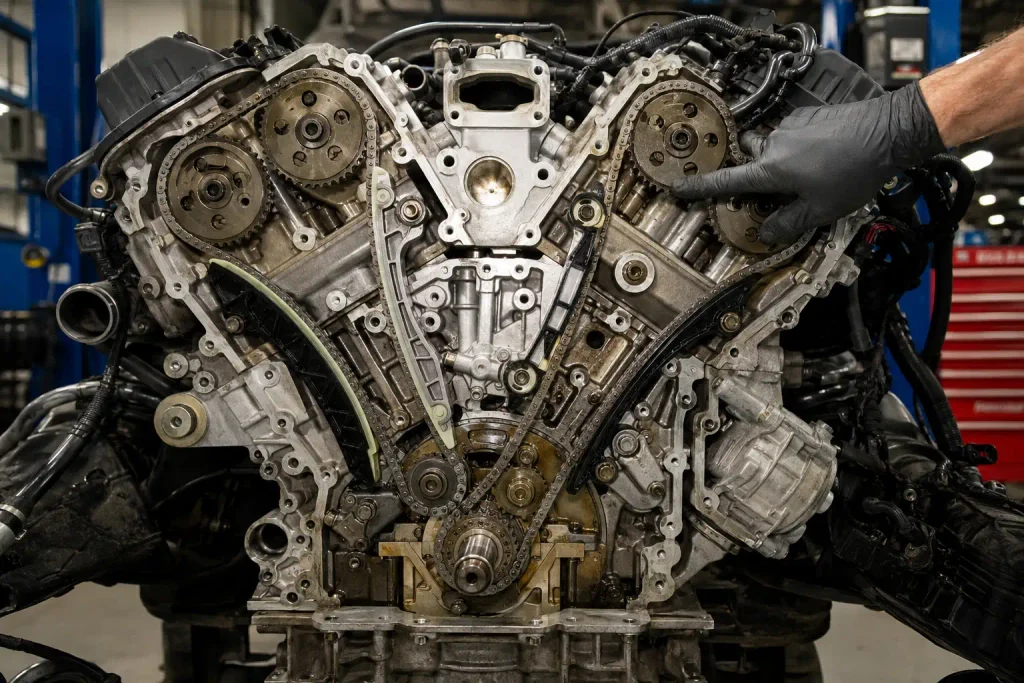
Certain first-generation 3.5L EcoBoost F-150 trucks have one of the clearest Ford-documented P0016 diagnostic paths.
Ford TSB 17-0026 applies to 2011 to 2014 F-150 trucks equipped with the 3.5L GTDI engine and built on or before October 10, 2014. Ford states that a worn primary timing chain may cause P0016.
Confirm the Build Date
The bulletin’s production cutoff matters.
If the truck was built after October 10, 2014, Ford states that this specific procedure does not apply. Normal PC/ED diagnosis should be used instead.
Check VCT Scan Data
Ford’s procedure calls for checking the VCT_INT_ACT1 PID with the key on and engine running.
For trucks that meet the bulletin conditions, Ford specifies:
- +6 degrees or greater: proceed with the bulletin’s timing-chain repair path.
- Less than +6 degrees: the bulletin does not apply and normal diagnosis is required.
This +6-degree figure belongs to this specific Ford bulletin. It should not be applied as a universal P0016 threshold to every F-150 engine.
Confirm Mechanical Timing Repair
When all conditions in TSB 17-0026 are met, Ford directs technicians to replace the primary timing chain using the Workshop Manual procedure.
Timing-chain replacement is not a basic sensor job. It requires correct engine timing, specialized procedures, and careful reassembly.
If diagnosis also points toward phaser wear, the 3.5 EcoBoost cam phaser replacement guide covers the related timing-system repair in greater detail.
If Startup Rattle Suggests Cam Phaser Trouble
A cold-start rattle changes the diagnostic priority, but it does not prove that a cam phaser alone has failed.
Ford has separately documented VCT-unit rattle on certain 2017 to 2020 F-150 trucks with the 3.5L EcoBoost engine built on or before November 30, 2019. Ford TSB 23-2143 addresses ticking, tapping, or rattle from the front-cover area following a cold start and identifies worn VCT units as the condition addressed by that bulletin.
That bulletin is useful symptom evidence, but it should not be used to declare every P0016 a cam-phaser failure.
Rattle Appears at Startup
Record how long the noise lasts and where it appears to originate.
A repeatable rattle from the timing-cover area deserves more attention than an unrelated exhaust, accessory-drive, or heat-shield noise.
P0016 Returns After Clearing
A code that returns after proper testing provides stronger evidence of an active fault than an old history code.
Do not repeatedly clear the PCM just to turn off the warning light. Capture the scan data needed for diagnosis first.
Mechanical Timing Needs Inspection
When startup noise, VCT data, and correlation faults point in the same direction, the timing system may require professional inspection.
Phasers, chains, guides, tensioners, VCT solenoids, and oil control all interact. Replacing one expensive component without confirming the fault can leave P0016 unchanged.
If Sensors or Wiring Cause P0016
Sensor replacement belongs later in the diagnostic sequence unless testing points directly to an electrical problem.
Ford’s OBD documentation distinguishes P0016 from camshaft and crankshaft sensor circuit codes. For example, P0340 and P0341 concern camshaft sensor circuit or performance faults, while P0335 and P0336 concern crankshaft sensor faults.
Inspect the Cam Sensor Circuit
Inspect the connector for damage, corrosion, oil contamination, loose terminals, or harness damage.
If you need to identify the sensor before testing it, use the Ford F150 camshaft position sensor location guide.
Do not replace the sensor simply because P0016 mentions camshaft position.
Inspect the Crank Sensor Circuit
The PCM also needs an accurate crankshaft reference.
If crankshaft-specific circuit codes are present, diagnose those faults using the correct Ford wiring diagram and engine-specific PC/ED testing.
Compare Signal Integrity
Advanced diagnosis may require viewing camshaft and crankshaft signals with a scope or using manufacturer-level scan data.
A good sensor can accurately report that the engine is mechanically out of time. This is why blind sensor replacement is a poor P0016 strategy.
Use This 6 Step P0016 Diagnostic Order
Use the evidence in this order rather than starting with the cheapest sensor.
- Scan all modules and save data. Record P0016, accompanying DTCs, pending codes, and freeze-frame information.
- Identify engine and build date. Ford TSB applicability can depend on both.
- Check engine oil. Confirm level, condition, viscosity, and specification for the exact engine.
- Evaluate VCT operation. Check related VCT codes and compare commanded versus actual timing where scan data is available.
- Check applicable Ford service information. Use engine-specific TSBs and SSMs before replacing parts.
- Test electrical or mechanical timing based on evidence. Inspect wiring when signal faults exist and inspect mechanical timing when correlation data supports it.
This quick matrix narrows the path further:
| What You Find | Diagnostic Priority |
|---|---|
| P0016 with P0011 or P0012 | Test Bank 1 intake VCT operation |
| Qualifying 2011 to 2014 3.5L GTDI with VCT_INT_ACT1 +6° or greater | Follow Ford timing-chain procedure |
| 2016 3.5L GTDI under 2,000 miles with P0011 plus P0016 | Check TSB 16-0038 VCT-solenoid procedure |
| Startup timing-cover rattle with abnormal cam timing | Inspect VCT units and mechanical timing |
| P0016 immediately after timing-system repair | Verify mechanical timing |
| Cam or crank circuit DTCs present | Diagnose sensor circuit and wiring |
| Early 2018 5.0L with multiple listed DTCs but no drivability concern | Check TSB 18-2058 and PCM calibration |
The last condition can save substantial unnecessary parts replacement.
Ford TSB 18-2058 covers certain 2018 F-150 5.0L trucks built on or before January 3, 2018 that can store P0016 and several other DTCs while showing no drivability concern. Ford’s repair procedure calls for PCM reprogramming rather than timing-system parts replacement when the bulletin’s conditions are met.
When Should You Stop Driving With P0016
Whether you should drive with P0016 depends on the symptoms behind the correlation fault.
If the truck has only a steady Check Engine Light, runs normally, maintains normal oil pressure, and has no abnormal mechanical noise, arrange diagnosis promptly rather than assuming immediate engine failure. Ford’s 2018 5.0L bulletin even documents a specific P0016-related condition with no drivability concerns.
Stop driving and investigate the problem before continuing if you have:
- Severe timing-cover rattling or knocking
- Rough running that becomes significantly worse
- Repeated stalling
- An oil-pressure warning
- Serious misfires with timing-related codes
- Evidence that the engine has jumped mechanical timing
Do not use a fixed mileage such as “safe for another 500 miles.” P0016 describes a condition, and the severity of the underlying failure can vary greatly.
What Usually Fixes Ford F150 P0016
There is no single repair that fixes every P0016 code Ford F150 case.
The correct repair follows the confirmed fault. Depending on the engine and test results, that can mean servicing a VCT issue, replacing a failed VCT solenoid, correcting damaged wiring, updating PCM calibration, correcting mechanical timing, replacing a worn primary timing chain, or repairing worn VCT components.
Ford’s own bulletins demonstrate why diagnosis matters. One P0016 application directs technicians toward a timing chain. Another identifies a VCT solenoid. A specific 2018 5.0L condition calls for PCM reprogramming.
Diagnose first and replace parts second.
5 Common P0016 Ford F150 Questions
Can Low Oil Cause P0016 on a Ford F150?
Low or unsuitable oil can interfere with proper operation of oil-controlled cam timing systems, so oil level and specification should be checked early. However, low oil does not prove that it caused P0016. Continue diagnosis before replacing VCT or timing parts.
Does P0016 Mean the Camshaft Sensor Is Bad?
No. P0016 means the PCM detects incorrect cam-to-crank correlation. Ford uses separate DTCs for camshaft sensor circuit faults, so a working sensor can set P0016 by accurately reporting incorrect mechanical cam timing.
Can a Bad Cam Phaser Cause P0016?
A VCT-unit or cam-phaser problem can affect actual cam timing and contribute to a correlation fault. However, VCT solenoids, timing-chain wear, mechanical timing, wiring, and calibration problems can produce similar evidence, so the phaser should be confirmed before replacement.
Can a Stretched Timing Chain Cause P0016?
Yes, on specific F-150 applications. Ford TSB 17-0026 states that P0016 on certain 2011 to 2014 3.5L GTDI F-150 trucks built on or before October 10, 2014 may be caused by a worn primary timing chain.
Can I Drive My F150 With P0016?
A short trip may be possible when the truck runs normally and has no serious mechanical noise or oil-pressure warning, but P0016 should be diagnosed promptly. Stop driving if strong timing noise, severe misfires, stalling, or other signs of a mechanical timing problem appear.
Fix P0016 by Diagnosing the Correct F150 System
The P0016 code Ford F150 does not tell you to replace one specific sensor. It tells you that Bank 1 cam timing and crankshaft position no longer agree as expected.
Start with the engine, year, build date, complete DTC list, oil condition, and VCT scan data. Then use the applicable Ford service information to determine whether you are dealing with a VCT solenoid, timing chain, cam phaser, PCM calibration, wiring problem, or another mechanical timing fault.