
Gerald J. Ford Stadium Seating Chart 2026 Ultimate Guide

The Gerald J. Ford Stadium seating chart is a simple three-part code. Your ticket lists a section, a row, and a seat, and those three numbers place you in one exact chair at 5800 Ownby Drive in Dallas, Texas, on the Southern Methodist University campus.
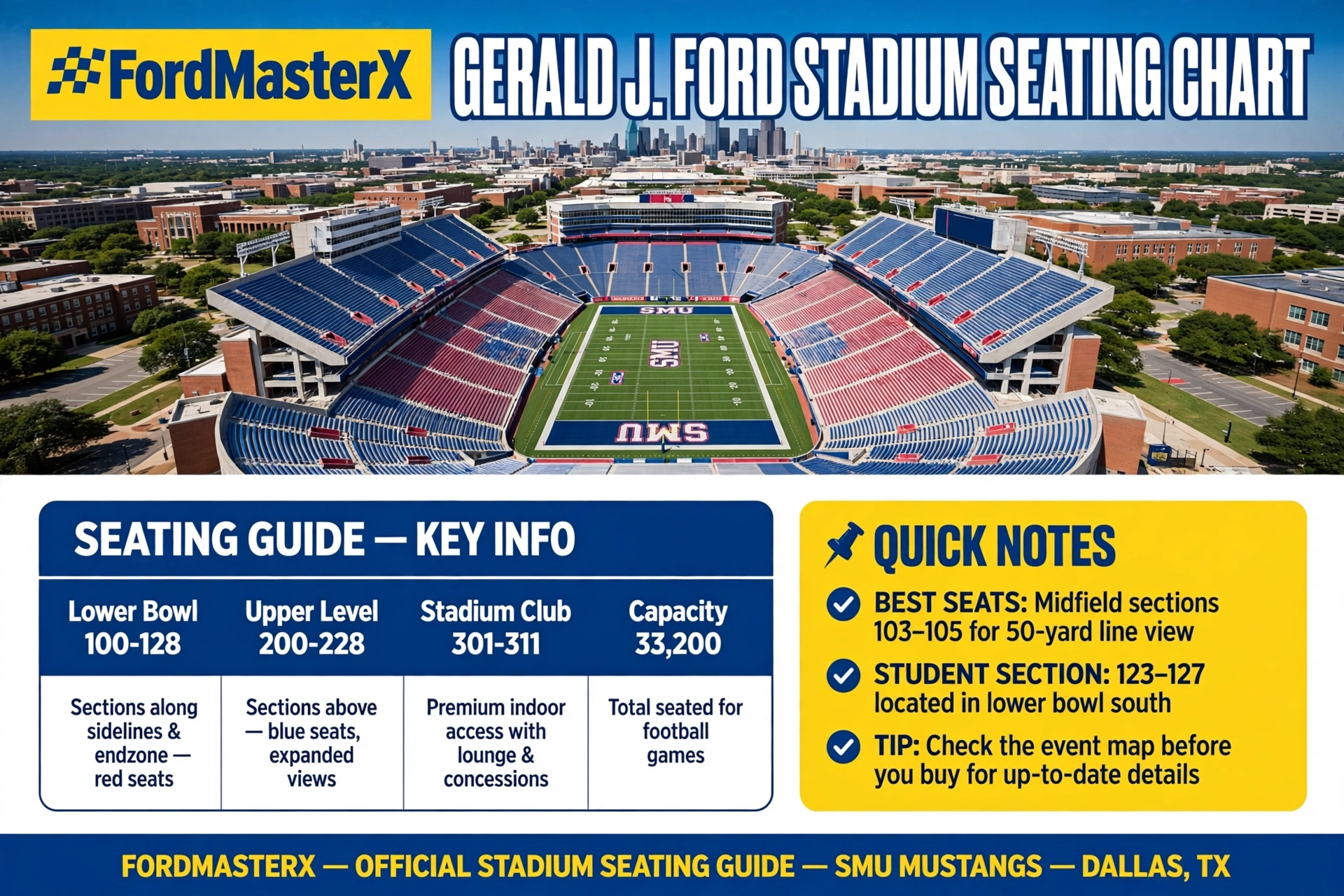
The stadium is a horseshoe bowl with stands on three sides and an open south end. It holds 33,200 for SMU Mustangs football, according to the current SMU Athletics listing.


This guide explains how to read that code and which sections give the best view for each kind of fan. Use it before you buy.
What Are the Seating Levels at Gerald J. Ford Stadium
Gerald J. Ford Stadium stacks its seats in four groups. The lower bowl sits closest to the field, the 200 level sits above it, the Stadium Club sits higher still on the west side, and suites and premium areas sit in the tower, the loge boxes, and the south end zone complex.
The lower bowl runs from section 100 to section 128. It wraps both sidelines and curves around the north end zone.
The 200 level runs from section 200 to section 228. It sits above the lower bowl on the sidelines and around the north end.
The Stadium Club runs from section 301 to section 311. It is an enclosed premium level with indoor access, lounges, and concessions.
Suites sit in the three-level tower and press box, in loge boxes, and in the Garry Weber End Zone Complex at the south end. SMU lists nearly 2,100 club-level seats and nearly 2,000 seats in 41 luxury suites across those premium areas.
Capacity by Level
| Level | Sections | What You Get |
|---|---|---|
| Lower bowl | 100-128 | Closest to the field, rows near the action |
| Upper level | 200-228 | Raised view, full-field picture, lower prices |
| Stadium Club | 301-311 | Enclosed premium level, indoor lounge access |
| Suites and premium | Tower, loge, Weber Complex | Private seating, service, best amenities |
| Total capacity | All levels | 33,200 for football |
The current 33,200 figure comes from the SMU Athletics facilities page for Gerald J. Ford Stadium. Older SMU listings and many guides still say 32,000, which was the capacity when the stadium opened in 2000.
The change follows the Garry Weber End Zone Complex, a $100 million project that opened in August 2024. Treat 33,200 as the current figure and 32,000 as the original figure.
Gerald J. Ford Stadium Seating at a Glance


A horseshoe bowl with an open south end, four seating groups, and one three-part ticket code: section, row, and seat.
| Level | Sections | What You Get |
|---|---|---|
| Lower bowl | 100-128 | Closest to the field, best views near midfield |
| Upper level | 200-228 | Raised full-field view, lower prices |
| Stadium Club | 301-311 | Enclosed premium level, indoor lounge access |
| Suites and premium | Tower, loge, Weber Complex | Private seating and service, best amenities |
| Total capacity | All levels | 33,200 for football (32,000 when it opened in 2000) |
How to Read Your Ticket
- SECTION Your wedge of the bowl, such as 104.
- ROW Your height inside that wedge. Lower-bowl rows vary by section: one guide puts most at rows 1 to 25 and another near 1 to 35.
- SEAT Your chair along that row. Seat numbers run in order along the row. Confirm the direction on your event map.
Best Seats by Fan Type
- Best view: midfield sections 103 to 105 and 123 to 125, a few rows up.
- Families on a budget: north end zone in the lower bowl.
- First visit: 200 level sideline near midfield, sections 203 to 205 or 223 to 225.
- Students: the Stampede, sections 123 to 127, entering through Gate 5.
Before You Go
- Address: 5800 Ownby Drive, Dallas, TX 75205, on the SMU campus in University Park.
- Bags: clear bags up to 12 by 6 by 12 inches, plus a small clutch. Check the current SMU policy.
- Getting there: DART Mockingbird Station is about one mile away; East Campus shuttles run on game day.
The venue has not published a seat-number direction rule, and premium section numbers vary by event, so check the seat map for your specific game before you buy. Sources: SMU Athletics facilities page; Wikipedia, Gerald J. Ford Stadium; ReservedSeat SMU guide.


How Do Seat Numbers Work in Each Row


A Gerald J. Ford Stadium ticket gives you three facts in one line. The section is your wedge of the bowl, the row is your height in that wedge, and the seat is your chair along that row.
Read the three facts in that order. Section first, because it puts you on the right side of the building. Row second, because it sets your height and distance, and seat last, because it fixes your exact chair.
Seat numbers run in order along a row. The lowest number sits at one aisle end of the row, and the numbers rise step by step toward the other aisle. That standard stadium convention is a useful buying aid when you compare two listings in the same row.


Treat that convention as a guide, not a venue guarantee. No published SMU source states the seat-number direction for this stadium. The event map for your game is the final authority on both direction and exact seat positions.
Row counts vary by section, and published guides disagree on the highest row. One guide puts most lower-bowl sections at rows 1 to 25, while another puts typical lower-bowl rows at 1 to 35. Check the row on your ticket against the event map, and do not assume two sections share the same top row.
Club and premium areas use shorter row ranges, and some use lettered rows such as A to D. That is normal for premium seating, where rows are short and chairs are wider. The SeatingChartHub guide to Gerald Ford Stadium reports the same row pattern and the same entry layout.
Which 100 Level Sections Give the Best View
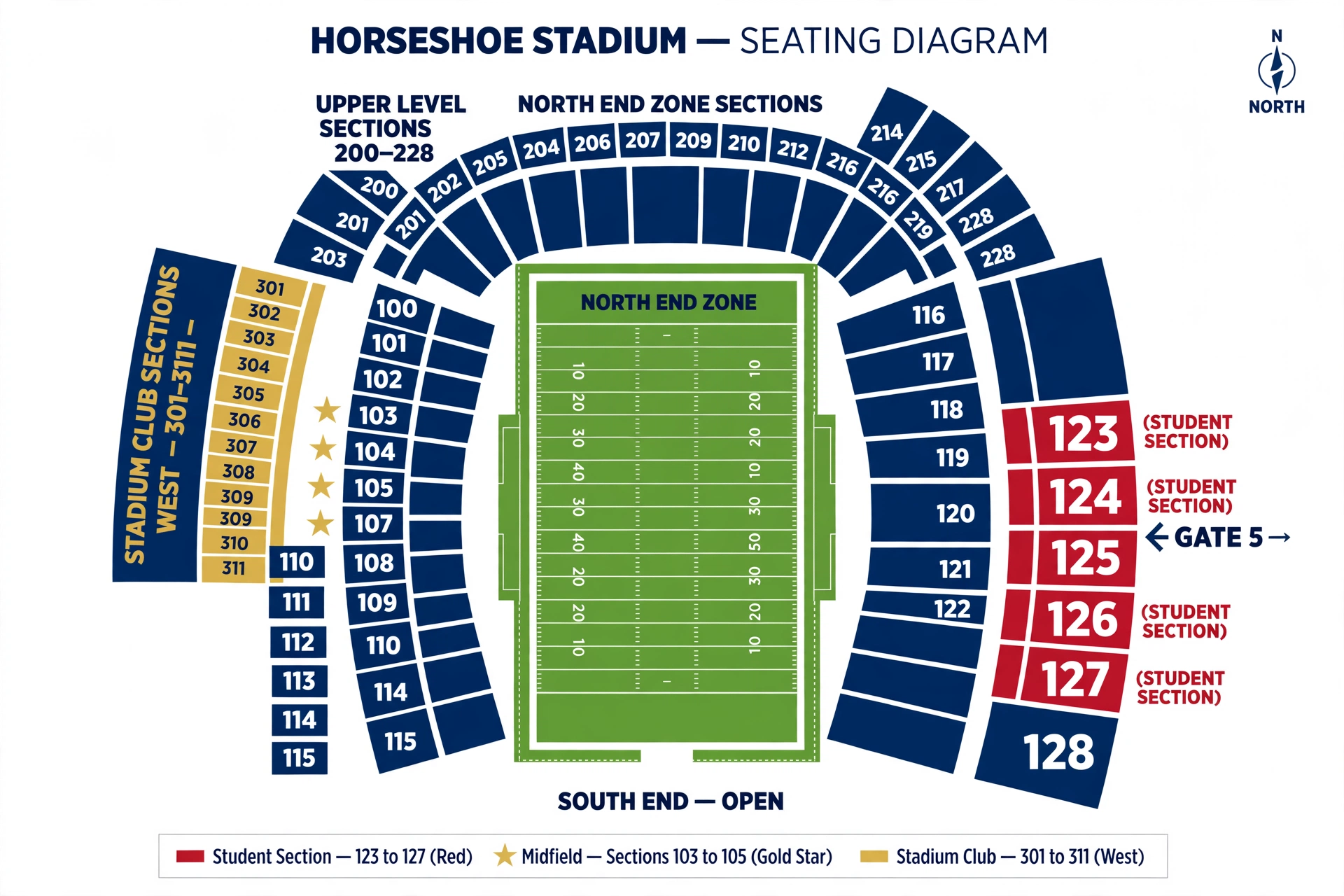
The 100 level runs from section 100 to section 128 around the bowl. Midfield sections give the best all-around view, and the guides agree on which ones they are.
Sections 103 to 105 sit near midfield behind the SMU bench. Sections 123 to 125 sit near midfield on the opposite sideline, behind the visiting bench. Those two groups are the best seats in the lower bowl.
Sections 104 to 106 are also named as a midfield pick by some guides. The overlap tells you the same thing: buy between the 40-yard lines if you can.
A seat a few rows up usually beats the very front row. The front row puts you at field level, but the benches and the players standing on the sideline can block part of the far side.
The bowl is compact for a college stadium. Even the top rows of the lower bowl sit closer to the field than the upper deck of a 90,000-seat stadium. A high row on the 40-yard line often beats a low row in a corner.
Seats in the north end zone cost less and still give you a close view at your end. The trade is depth: plays at the far south end get hard to judge from behind one goal line.
For a larger-stadium comparison, see our Ford Field seating chart with rows. The same midfield-first rule applies there, at a much bigger scale.
How Does the 200 Level Compare

The 200 level is the budget option with a real upside. You sit higher and farther from the field than the lower bowl, but you gain a full view of the whole field.
Midfield sections 203 to 205 and 223 to 225 are the strongest choice up here. They keep the action in front of you, and the price gap to the lower bowl is widest on the sidelines.
The seats to think twice about are the very top rows at the 200 level ends. Those are the longest looks in the building, and the angle flattens the action at the far end.
For a first visit, the 200 level is a smart buy. The stadium is compact, so even the upper rows keep you close to the field.
One more warning applies to the south end. There are no stands at the south end, so plays near that goal line are watched from the sidelines at a flat angle. That is the cost of the open horseshoe, and it affects every level.
Club Seats, Suites, and the Weber End Zone Complex
Club seats sit between the open bowl and a suite in comfort and price. They are wider and padded, with indoor lounge access, and they sit in prime sideline spots between the 20-yard lines.
The Stadium Club, sections 301 to 311, is the enclosed club level. It gives an elevated midfield view with shelter from sun and rain, plus lounge and concession access inside.
Suites are the top tier. SMU lists nearly 2,000 suite seats in 41 luxury suites, split between the loge boxes, the three-level tower and press box, and the Weber End Zone Complex.
The Garry Weber End Zone Complex opened in August 2024 at the south end. It added about 1,200 new club seats in that end zone, plus football facilities, hospitality space, and recruiting areas.
Premium section numbers vary by event, and the south end zone premium areas do not follow the same numbering as the bowl. Check the event map for your game before you pay a premium price.
Our Ford Center seating chart with seat numbers explains the same club-versus-bowl trade at a smaller indoor arena.
Best Seats for 3 Kinds of Fans
The picks below come from SMU sources and fan guides. They cover the three fans who ask this question most.
Families on a Budget
Pick the north end zone in the lower bowl. It is the value pick for families, with lower prices and a close view of scoring plays at your end.
Arrive early so kids can settle in before kickoff. The north end zone is also the calmest part of the bowl, away from the student section.
Students and the Stampede


The Stampede is the SMU student section. It fills sections 123 to 127, and seats go to whoever arrives first.
Students enter through Gate 5, according to SMU Athletics. Student tickets are free and are claimed online starting the Sunday of game week.
Expect standing and noise for the whole game. If you want a quiet seat, do not buy near sections 123 to 127.
First-Time Visitors to Ford Stadium
Pick a 200 level sideline section a few rows up, near midfield. You get the full field in front of you, a fair price, and a clear sense of the whole stadium.
For a marquee game, the sideline seats between the 30-yard lines sell first. Book early, and treat a high midfield row as a better seat than a low corner row.
Our Ford Idaho Center seating chart covers the same first-timer logic at another Ford-named venue.
How to Find Your Exact Seat in 5 Steps
Step 1: Open the event map on the ticket seller. Each game carries its own seat map, and that map is the only chart that matches your night.
Step 2: Read your ticket in section, row, seat order. Find the section wedge first, then the row, then the seat number along that row. Do not guess from the seat number alone, because the same seat number exists in every section.
Step 3: Match the section to the bowl shape. Lower bowl 100 to 128, upper level 200 to 228, club 301 to 311. The student block 123 to 127 and the midfield pair 103 to 105 and 123 to 125 tell you which sideline you are on.
Step 4: Check the row height against the sun and the benches. For an afternoon kickoff, the west side is the shady side, and a few rows up clears the benches. The front row is closest, but it is also the row most likely to lose part of the view.
Step 5: Plan your entrance before you arrive. Students use Gate 5. Player will call is reported at Gate 1 and visiting team will call at Gate 7, so check your ticket or the SMU gameday page for your gate.
The ReservedSeat guide to SMU football at Ford Stadium gives the same advice: sideline seats between the 30s, west side shade for afternoon games, and the north end zone for families.
What to Know About Accessible Seating and Entry
Accessible seating sits at the top row of the lower level. Companion seats are available with accessible seats, based on availability.
Accessible drop-off is on Binkley Avenue, between the Binkley Parking Center and Armstrong Fieldhouse. Accessible parking is available in the reserved lots with a valid disabled parking permit.
Contact the SMU ticket office before you buy if you need a specific accessible location. The ticket office number is 214-SMU-GAME.
Strollers are not allowed in the stands. They may be left at the gate or checked with Guest Services, and Gate 5 is reported as the stroller check point.
Parking, Bags and Entry Rules in 6 Points
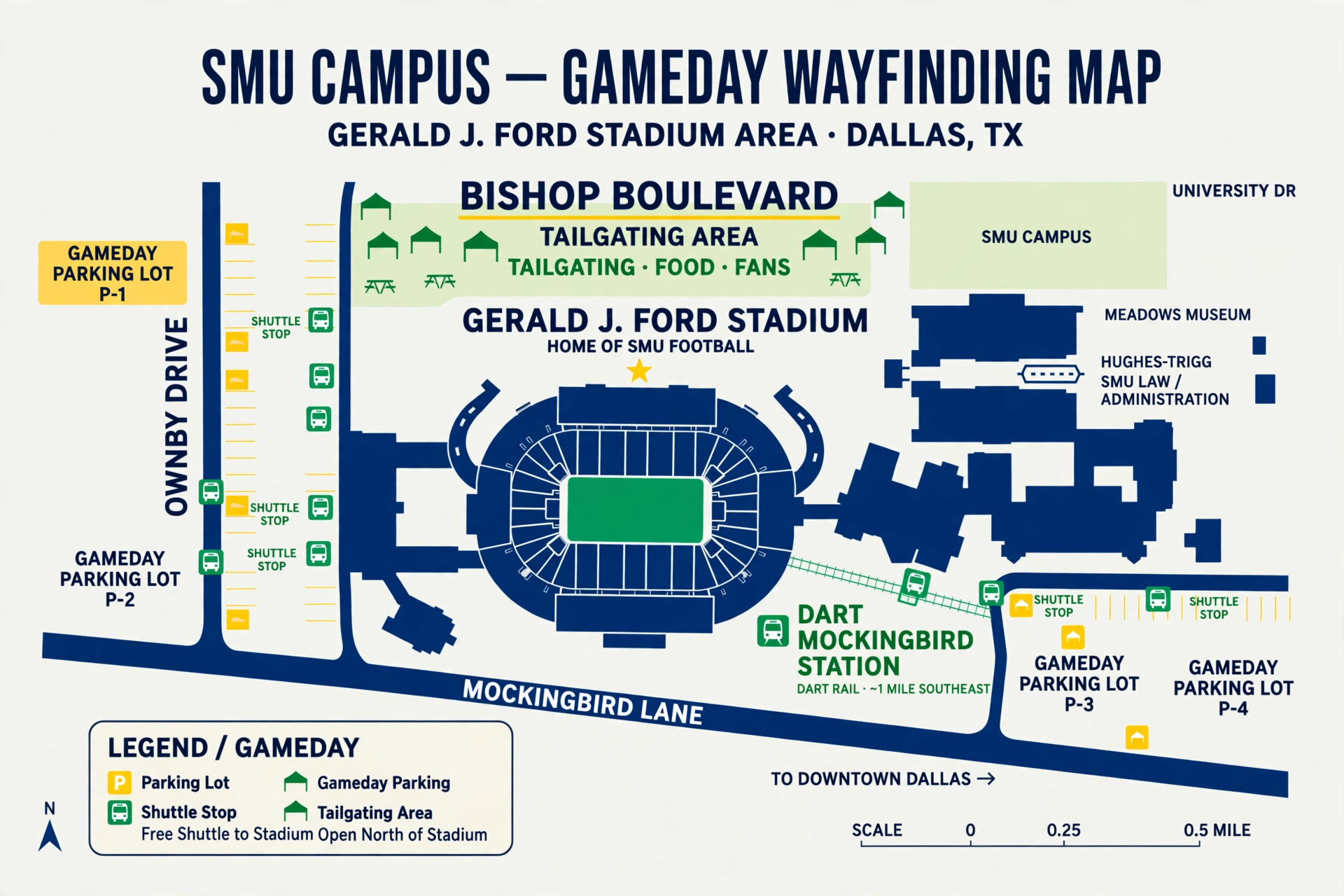
Point 1: Use official gameday parking, not neighborhood streets. University Park and Highland Park restrict street parking and write tickets. SMU directs fans to its official gameday lots.
Point 2: Reserved lots were listed at $72 to $150 per season in 2024-25 summaries. General parking runs about $10 to $20 per vehicle. Cash lots are available on game day, and lots open four hours before kickoff.
Point 3: Take the train or a shuttle if you can. DART Mockingbird Station is about one mile from the stadium. East Campus shuttles pick up at the Energy Square Garage, at SMU Boulevard by the North Central Expressway frontage road, and at Binkley Avenue and Airline Drive.
Point 4: Bags have a strict size limit. The most recent published policy allows clear plastic, vinyl, or PVC bags up to 12 by 6 by 12 inches, one-gallon clear freezer bags, and a small clutch about the size of a hand. Backpacks and outside food and drink are not allowed.
Point 5: Arrive early for the Boulevard. Tailgating at SMU is called Boulevarding, and it happens on Bishop Boulevard under the trees near Dallas Hall. It is one of the best-known pregame scenes in college football.
Point 6: Check the current policy before you go. Bag rules, lot prices, and gate assignments change by season. The SMU gameday page is the final word for your game.
Our Ford Field concert seating chart covers the same parking-first planning at a downtown NFL stadium.
7 Questions About Gerald J. Ford Stadium Seats Answered
How Do I Read My Ticket?


Read it as section, row, then seat. The section is your wedge of the bowl, the row is your height inside that wedge, and the seat is your chair along that row.
Which Way Do Seat Numbers Run?
Seat numbers run in order along the row, with the lowest number at one aisle end. Treat that standard convention as a buying aid and confirm the direction on your event map.
What Sections Are on the 100 Level?
The lower bowl runs from section 100 to section 128. Midfield sits at sections 103 to 105 on one side and 123 to 125 on the other.
How Many People Does It Hold?
It holds 33,200 for football, according to the current SMU Athletics listing. The original capacity was 32,000 when it opened in 2000.
Where Is the Student Section?
The Stampede fills sections 123 to 127. Students enter through Gate 5, and seats go to whoever arrives first.
Is There an Open End?
Yes. The south end is open, next to Mockingbird Lane. The Garry Weber End Zone Complex now stands there, and the bowl is expandable to about 45,000 by enclosing that end.
Is This the Gerald Ford Amphitheater?
No. The Gerald Ford Amphitheater is a different venue in Vail, Colorado, with its own seating layout. Do not use its map for an SMU game.
Your 3-Step Check Before You Buy
The Gerald J. Ford Stadium seating chart is easy to read once you know the code. Section, row, and seat place you in one exact chair, and the event map shows you that chair before you pay.
Start with the section and match it to the bowl shape. Lower bowl 100 to 128, upper level 200 to 228, club 301 to 311.
Then check the row height, because a few rows up usually beats the front row. Then confirm the seat direction on the event map.
Buy the seat that fits your night, not the closest seat. A midfield seat a few rows up is the best pick for most fans, the north end zone is the best pick for families, and the 200 level is the best pick for a first visit.
Where These Gerald J. Ford Stadium Facts Come From
Capacity, history, premium seating, and address figures are from the SMU Athletics facilities page and the Wikipedia entry for Gerald J. Ford Stadium. Section ranges, best-seat picks, and the student section are cross-checked across ReservedSeat, SeatingChartHub, GameTime, and TicketPurchase guides.
Gate, parking, shuttle, and bag figures are from SMU gameday summaries and 2024-25 policy reports. Other sources: Stadium Journey, GoodSeats, and the SMU Daily Campus. Where sources disagreed (the 32,000 versus 33,200 capacity and the highest lower-bowl row), this guide states both figures and names the current one.