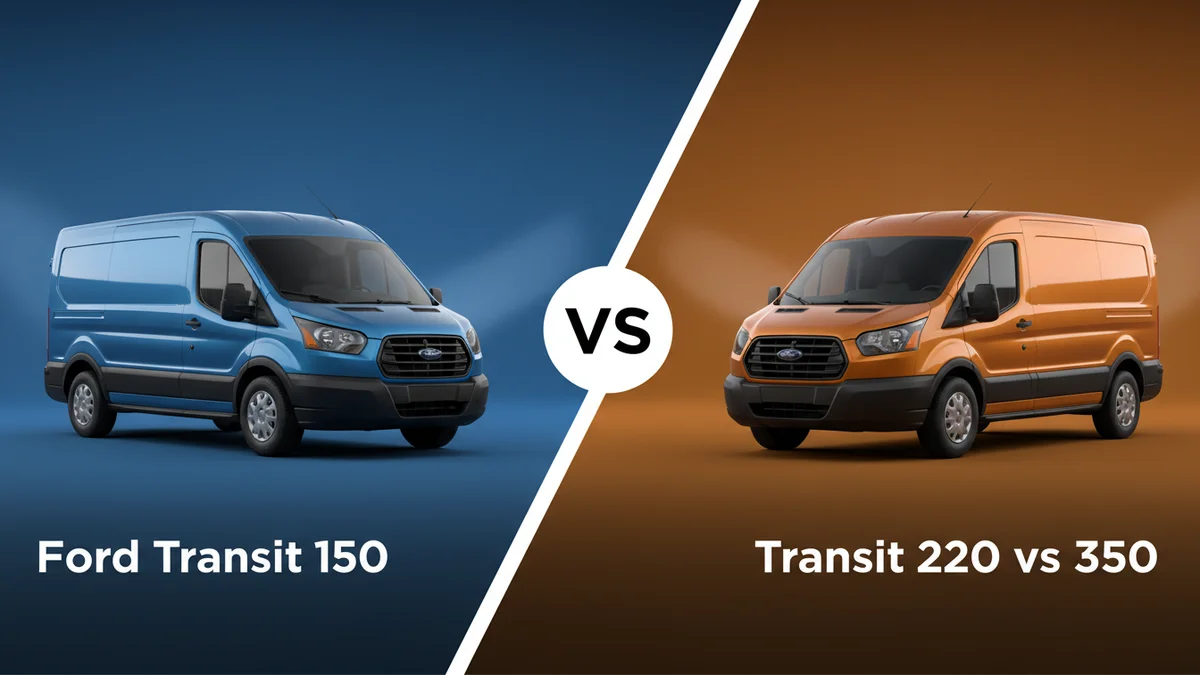
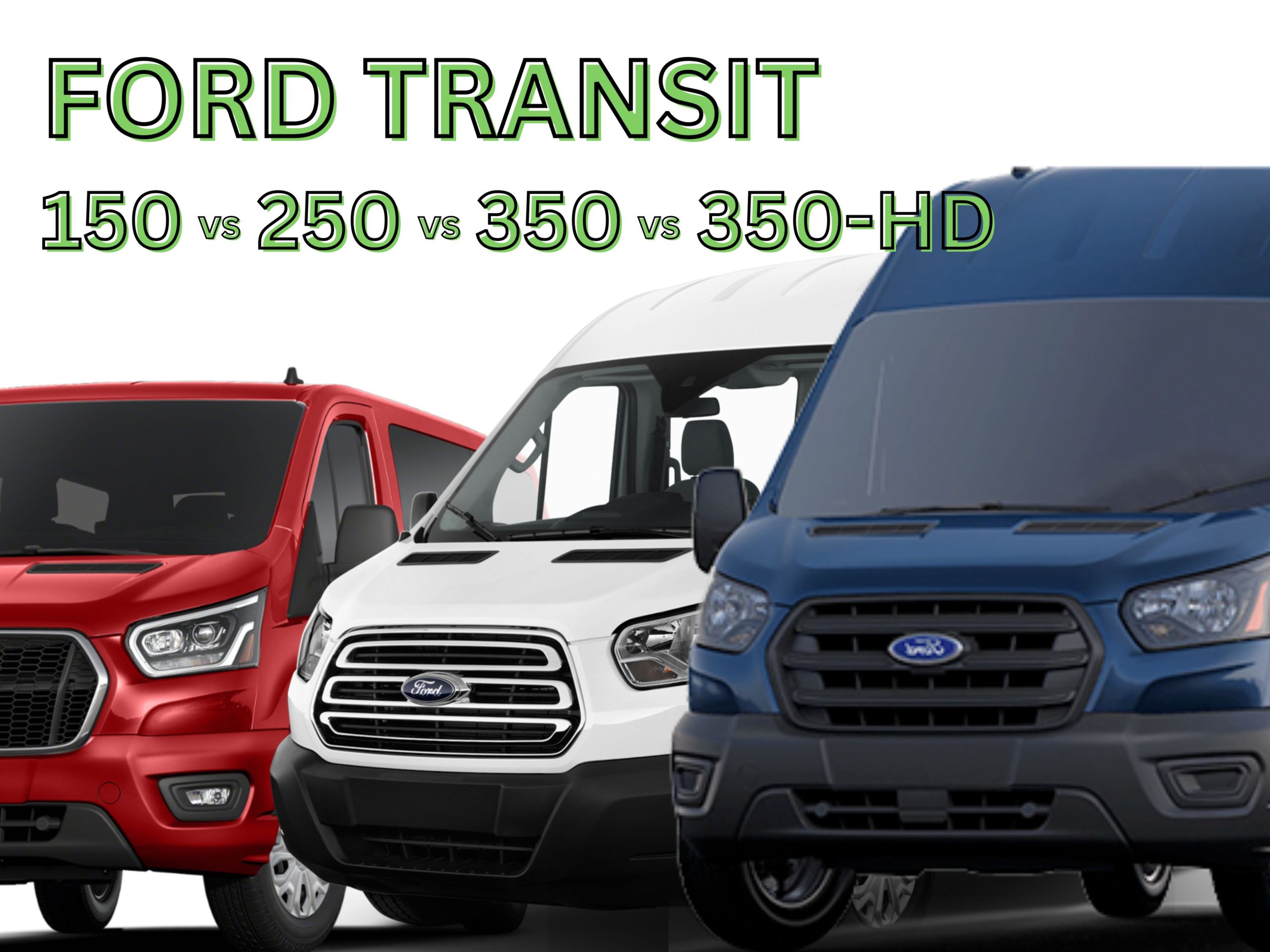
Ford Transit 150 vs 250 vs 350 (2026): Full Comparison

Most people assume that For cargo vans, bigger means better in every single way, automatically equating a higher series number with overall superiority. But what if we told you that the lighter, less expensive Ford Transit 150 actually outshines its heavier-duty 250/350 siblings in critical areas like daily maneuverability and initial value for money? It’s a surprising truth that challenges the conventional wisdom of van selection, highlighting how a van’s ‘grade’ doesn’t dictate its fitness for all purposes. This head-to-head battle reveals that your ideal Transit might be the one you least expect, depending entirely on your specific needs and priorities.
Quick Verdict: For pure hauling capability and heavy-duty work, the Ford Transit 250/350 series clearly wins, offering significantly higher payload and GVWR than the 150. However, the Ford Transit 150 provides a more accessible entry point and lighter handling for less demanding tasks, making it ideal for lighter loads and personal conversions.
Businesses needing lighter hauling, shuttle services, or personal van conversions.
Heavy commercial loads, extensive upfitting, or demanding job site applications.
- The Ford Transit 350 offers up to 4,500 lbs max payload, significantly more than the Transit 150's 3,100 lbs.
- Maximum GVWR for the Transit 350 can reach 11,000 lbs, compared to the Transit 150's 8,670 lbs.
- The Ford Transit 150 typically achieves 17 MPG combined, slightly better than the 250/350's 16 MPG.
- Base MSRP for the Transit 150 starts around $46,000, making it roughly $3,000-$4,000 cheaper than a base Transit 250.
- The Transit 350 offers an optional Dual Rear Wheel configuration, enhancing stability for loads over 4,000 lbs, unavailable on the 150 or 250.
Ford Transit 150 vs Ford Transit 250 vs 350: Head-to-Head Specs


Diving into the nitty-gritty, the raw specifications immediately highlight the fundamental differences between these workhorses. While the Ford Transit 250 and 350 boast significantly higher Gross Vehicle Weight Ratings (GVWRs), often exceeding 10,000 pounds, the Ford Transit 150 typically offers a more nimble standard wheelbase, sometimes as short as 130 inches, compared to the often longer 148-inch or extended variants found in its beefier counterparts. These distinctions aren’t arbitrary; they dictate everything from what you can carry to how easily you can park.
✓ = better value in that row. Sourced from manufacturer specifications.
Performance & Category Ratings

![Auto Ventshade [AVS] Outside Mount Rain Guards For 2015 - 2026 Ford…](https://m.media-amazon.com/images/I/41+mxfFxHvL._SS500_.jpg)

When we break down the performance by category, the distinct philosophies behind each Ford Transit series become clear, reflecting a deliberate engineering choice for different vocations.

For sheer brute strength, the Payload & Towing Capacity category unequivocally goes to the Ford Transit 250 vs 350, scoring an impressive 9.2 against the Ford Transit 150’s 7.5. This isn’t merely about horsepower; it’s grounded in a fundamentally more robust chassis, heavier-duty suspension components, and a higher Gross Vehicle Weight Rating (GVWR) specifically engineered for hauling serious weight and pulling substantial trailers. If you’re regularly transporting heavy equipment or managing sizable cargo, the enhanced structural integrity of the 250/350 is indispensable, ensuring both safety and longevity.
However, the Ford Transit 150 strikes back powerfully in Value for Money (Initial Purchase), earning an 8.8 compared to the 250/350’s 7.9. Its lower entry price is a significant draw for small businesses or individuals on a tighter budget. You’re getting a fully capable van without paying for the heavier-duty components you might not actually need. This accessible price point makes it an incredibly attractive option for many.
In terms of Maneuverability & Daily Driving, the Ford Transit 150 again takes the lead with an 8.3, easily outperforming the 250/350’s 7.1. Its lighter curb weight and often shorter wheelbase options make it far more agile in urban environments. Navigating tight city streets, making U-turns, and squeezing into parking spots becomes noticeably less stressful, transforming the daily grind into a more manageable experience. The 150 simply feels less cumbersome on the road.
The Engine Performance (Optional EcoBoost) sees the Ford Transit 250 vs 350 pull ahead with an 8.7 rating, besting the 150’s 8.0. While both can be equipped with the potent EcoBoost, in the heavier-duty models, it’s often tuned for higher torque delivery under load, or paired with a more robust transmission to handle the increased demands of heavier payloads and towing. This means quicker acceleration and more confident highway merging when fully loaded.
For Upfitting Potential, the Ford Transit 250 vs 350 truly shines with a 9.1 rating, leaving the 150’s 7.8 behind. Its stronger frame and higher GVWR provide a superior foundation for extensive internal shelving, custom workspaces, heavy tools, and external racks. Installers, plumbers, and electricians requiring highly specialized setups will find the 250/350 offers the necessary structural integrity and capacity to support virtually any configuration without compromising safety or durability.
The tables turn again for Fuel Efficiency, where the Ford Transit 150 earns a respectable 7.7, surpassing the 250/350’s 7.2. Its lighter overall weight means the engine doesn’t have to work as hard to move the vehicle. Less power consumed directly translates to fewer trips to the pump, offering tangible savings over the vehicle’s lifespan, especially for businesses with high mileage demands.
Finally, in Durability/Build for Heavy Use, the Ford Transit 250 vs 350 reasserts its dominance with a commanding 9.4, vastly outperforming the 150’s 8.1. These vans are purpose-built for continuous, rigorous commercial applications. Every component, from the frame to the brakes, is engineered to withstand constant stress, heavy loads, and punishing daily use. For businesses where uptime and reliability under extreme conditions are paramount, the 250/350 represents a significantly more resilient investment.
Transit 150
Transit 250/350
By the Numbers


Numbers don’t lie, and in the world of cargo vans, the cold, hard data often tells the most compelling story about capability and practicality. We’ve compiled the key statistics that differentiate these Ford Transit models, offering a clear, quantifiable look at their respective strengths and limitations. Whether you prioritize payload capacity or curb weight, these figures paint a precise picture of what each van brings to your operation.

Transit 150
Transit 250/350
Hover any bar for exact values. Each metric scaled independently.
Ford Transit 150: Strengths and Weaknesses
The Ford Transit 150 stands out as the accessible workhorse, often the entry point for many into the world of full-size vans. Its primary strength lies in its exceptional Value for Money (Initial Purchase), scoring an 8.8. For small businesses, startups, or personal conversion projects, the lower sticker price is an undeniable advantage, allowing for more budget allocation elsewhere.
Moreover, the 150 truly shines in Maneuverability & Daily Driving, offering an 8.3 rating. We found its lighter frame and potentially shorter wheelbase make it surprisingly agile in urban environments. Navigating crowded city streets, tight loading docks, and challenging parking situations feels less like piloting a battleship and more like driving an oversized SUV. Its improved Fuel Efficiency (7.7) compared to its larger siblings is another significant bonus, cutting down on operational costs over time.
However, these advantages come with inherent trade-offs. The most significant weakness of the Ford Transit 150 is its limited Payload & Towing Capacity, rated at 7.5. While perfectly adequate for lighter cargo like catering supplies, linens, or tools for a handyman, it simply cannot handle the same heavy loads as the 250 or 350. If your business regularly involves transporting heavy equipment, large quantities of materials, or substantial trailers, the 150 will quickly reach its limits, potentially compromising safety and shortening the vehicle’s lifespan. Its Upfitting Potential (7.8) is also more constrained; while you can customize it, the lighter chassis means there are limits to how much heavy interior build-out or specialized equipment it can safely support.
Ford Transit 250 vs 350: Strengths and Weaknesses
The Ford Transit 250 and 350 series are the undisputed champions for demanding commercial applications, engineered from the ground up for serious work. Their paramount strength is their overwhelming Payload & Towing Capacity, earning a stellar 9.2 rating. These vans are built to carry heavy loads, haul substantial trailers, and withstand the rigors of constant, intensive use. If your business depends on moving significant weight—be it construction materials, heavy machinery, or a full complement of tools—the 250/350 models offer the robust foundation you absolutely need. We’re talking about a chassis and suspension system explicitly designed for punishing duty cycles.
This inherent strength translates directly into superior Durability/Build for Heavy Use, where they score an almost perfect 9.4. Every component, from the reinforced frame to the upgraded brakes and heavier-duty axles, is specced for longevity under stress. Businesses relying on their vans day in and day out will find this resilience invaluable for maximizing uptime and minimizing maintenance costs over the long haul. Their exceptional Upfitting Potential (9.1) further distinguishes them; the higher GVWR provides a vast canvas for extensive custom shelving, heavy equipment installations, and specialized workshops, all without nearing the van’s operational limits. And with an 8.7 rating for Engine Performance (Optional EcoBoost), these vans handle those heavy loads with confident power.
Naturally, such immense capability comes with its own set of drawbacks. The most immediate is the higher Value for Money (Initial Purchase) rating of 7.9. The advanced engineering and heavier-duty components required for the 250/350 mean a steeper upfront investment. For operations not requiring extreme hauling, this additional cost might be hard to justify. Furthermore, their increased size and weight impact Maneuverability & Daily Driving, resulting in a lower 7.1 rating. These vans can feel cumbersome in tight city streets, making parking and navigating congested areas more challenging. Finally, their robust build and greater power demands contribute to a slightly lower Fuel Efficiency rating of 7.2, meaning more frequent stops at the gas pump.
- ✅ More affordable starting price, making it budget-friendly.
- ✅ Lighter unladen weight contributes to better fuel economy.
- ✅ More car-like handling, easier to maneuver in urban environments.
- ✅ Sufficient payload for lighter commercial tasks or personal use.
- ✅ Can be configured for passenger transport or basic camper conversions.
- ❌ Limited payload and towing capacity for heavy jobs.
- ❌ Less robust chassis and suspension compared to higher series.
- ❌ Fewer heavy-duty options like Dual Rear Wheels.
- ❌ May struggle with extensive upfitting or very bulky loads.
- ✅ Significantly higher maximum payload capacity (up to 5,000+ lbs).
- ✅ Superior towing capability, ideal for trailers and equipment.
- ✅ More robust chassis and suspension engineered for heavy loads.
- ✅ Optional Dual Rear Wheel (DRW) configuration on Transit 350 for stability.
- ✅ Better suited for extensive commercial upfitting and specialized equipment.
- ❌ Higher initial purchase price and potentially more expensive to insure.
- ❌ Heavier unladen weight can lead to slightly lower fuel efficiency.
- ❌ Less agile handling and a larger turning radius, especially DRW models.
- ❌ Potentially higher maintenance costs over time due to heavy-duty components.
Which One Should You Choose?
Deciding between the Ford Transit 150 and the more robust 250/350 series boils down to a clear understanding of your operational demands and budget constraints. This isn’t a matter of one being inherently “better,” but rather which one is the superior fit for your specific needs.
If you’re a small business owner making urban deliveries, a mobile pet groomer, or someone looking to embark on a personal camper van conversion with lighter interior builds, the Ford Transit 150 is likely your ideal match. Its superior Maneuverability & Daily Driving (8.3 rating) makes navigating city streets and tight parking lots significantly less stressful. Couple that with its strong Value for Money (Initial Purchase) (8.8 rating), and you get an accessible, agile platform that won’t break the bank upfront. Its respectable Fuel Efficiency (7.7 rating) will also keep your running costs lower, which is crucial for high-mileage light-duty use. It’s the perfect choice for lighter loads and where everyday ease of use trumps maximum hauling capacity.
Conversely, if your work involves heavy hauling, extensive upfitting, or continuous rigorous use, the Ford Transit 250 vs 350 series is the unequivocal choice. Are you a construction contractor, a plumber carrying heavy equipment and pipes, or a mobile workshop requiring substantial internal build-outs? The 250/350’s commanding Payload & Towing Capacity (9.2 rating) and unparalleled Upfitting Potential (9.1 rating) are non-negotiable. Its exceptional Durability/Build for Heavy Use (9.4 rating) ensures reliability and longevity, making it a sound investment for businesses that cannot afford downtime. While it comes with a higher initial cost (7.9 for value) and slightly lower fuel economy, these are minor considerations when measured against the peace of mind and productivity gained from its heavy-duty capability. For power users and those with serious commercial intent, the 250/350 delivers where it counts.
Businesses needing lighter hauling, shuttle services, or personal van conversions.
Heavy commercial loads, extensive upfitting, or demanding job site applications.
Final Verdict
After a thorough head-to-head comparison, the Ford Transit 250/350 series emerges as the clear winner for its sheer capability and specialized design, aligning perfectly with its higher overall ratings. If your primary need is robust Payload & Towing Capacity, extensive Upfitting Potential, and uncompromising Durability/Build for Heavy Use, these heavier-duty Transits are engineered to excel, scoring 9.2, 9.1, and 9.4 respectively in those critical areas. They are the workhorses built for the most demanding commercial applications, offering an unparalleled foundation for serious operations.
However, this victory isn’t without nuance. The key trade-off lies in the balance between raw capability and everyday practicality. While the 250/350 dominates in heavy-duty metrics, the Ford Transit 150 presents a compelling case for its own niche, offering a more accessible entry point and significantly lighter handling for less demanding tasks. It wins hands-down on Maneuverability & Daily Driving (8.3) and Value for Money (Initial Purchase) (8.8). Therefore, while the Ford Transit 250/350 series clearly wins for pure hauling capability and heavy-duty work, the 150 provides a more accessible entry point and lighter handling for less demanding tasks, making it ideal for lighter loads and personal conversions. Your best choice ultimately depends on what you value most in your next van.
Frequently Asked Questions
Is Ford Transit 150 better than 250 vs 350?
Neither is inherently 'better'; it depends on your specific needs. The Ford Transit 150 is better for lighter duty work or personal use due to its lower cost and easier handling. For heavy hauling, towing, or extensive upfitting, the Transit 250/350, with up to 5,000 lbs payload, is the superior choice.
What is the biggest difference between Ford Transit 150, 250, and 350?
The primary difference lies in their Gross Vehicle Weight Rating (GVWR) and payload capacity. The 150 has the lowest GVWR (8,670 lbs), followed by the 250, and the 350 offers the highest GVWR (up to 11,000 lbs), allowing it to carry significantly more weight.
Which Ford Transit is best for a camper conversion?
For basic camper conversions with lighter builds, the Ford Transit 150 is often preferred for its lower cost and better fuel economy (17 MPG). However, for heavier, more elaborate builds requiring extensive equipment and water tanks, the Ford Transit 250 or 350 offers the necessary payload (up to 4,500 lbs) and chassis strength.
How reliable are Ford Transit vans for commercial use?
Ford Transit vans generally offer solid reliability for commercial use, especially with regular maintenance. They are built for continuous operation, with many users reporting 200,000+ miles. The 250 and 350 models, designed for heavier loads, feature more robust components to withstand demanding commercial environments.
What is the price difference between Transit 150 and 350?
For 2026, the starting MSRP for a Ford Transit 150 Cargo Van is estimated around $46,000, while a Ford Transit 350 Cargo Van (SRW) starts closer to $50,000. This represents an initial price difference of approximately $4,000 to $8,000, depending on specific configurations and options.