
Ford Ranger Spark Plug Gap Chart for 2.3L, 2.7L and 3.0L EcoBoost

The Ford Ranger spark plug gap is 0.028–0.031 in (0.7–0.8 mm) in the U.S. Ford owner-manual specifications for the modern gasoline EcoBoost engines covered here. The range applies to the stock 2.3L, 2.7L and 3.0L Ranger Raptor configurations in the chart. Match your truck’s model year, engine and replacement part before checking any plug.
The same gap range does not make the plugs interchangeable. Start with the correct Ford or Motorcraft part lookup for your VIN. Then verify the actual plugs you received and follow the plug manufacturer’s instructions for measuring, adjustment and installation.
Ford Ranger factory spark plug gap
- 2019–2023 2.3L EcoBoost
- 0.028–0.031 in (0.7–0.8 mm)
- 2024–2026 2.3L and 2.7L EcoBoost
- 0.028–0.031 in (0.7–0.8 mm)
- 2024–2026 3.0L Ranger Raptor
- 0.028–0.031 in (0.7–0.8 mm)
Factory U.S. gasoline pickups. Confirm the correct part by engine and VIN.
| U.S. Ranger model years | Stock gasoline engine | Gap, inches | Gap, millimeters |
|---|---|---|---|
| 2019–2023 | 2.3L EcoBoost | 0.028–0.031 | 0.7–0.8 |
| 2024–2026 | 2.3L EcoBoost | 0.028–0.031 | 0.7–0.8 |
| 2024–2026 | 2.7L EcoBoost | 0.028–0.031 | 0.7–0.8 |
| 2024–2026 | 3.0L EcoBoost Ranger Raptor | 0.028–0.031 | 0.7–0.8 |
These are the Ford-published range and units for the listed factory configurations. The scope excludes older North American Ranger engines, vehicles with a different market specification and vehicles that have been modified. Use the vehicle-specific instructions for those applications.
Where Ford publishes the Ranger plug gap
Look in the manual’s engine specification table for the exact engine. Ford places the specification alongside other engine facts such as displacement, compression ratio and firing order. The line you need is Spark plug gap. Avoid taking a firing-order number or a value from the neighboring engine section and treating it as the gap.
For the earlier U.S. Ranger generation, Ford’s 2019 2.3L table makes the application clear. The same value appears in Ford’s subsequent U.S. engine specification material through 2023. The gap is a range. Its two endpoints are not separate specifications for street driving and towing. 2019 Ranger 2.3L engine specifications
From 2024, the U.S. truck lineup added different engine options. Compare the individual engine sections in Ford’s North American manuals. The 2.7L and the 3.0L may each be described as an EcoBoost V6, so the displacement identifies which set of service instructions applies. Ford lists the 3.0L under its Raptor application. 2024 Ranger North American Owner’s Manual · 2026 Ranger North American Owner’s Manual
Ford pairs 0.028–0.031 in with 0.7–0.8 mm. Those are the numbers as published. The metric and inch versions are rounded to the stated precision. Use one consistent scale on the gauge rather than calculating extra decimal places and creating a new service limit. For example, 0.030 in sits inside the Ford inch range. That does not make it the only acceptable setting or a reason to adjust a correct plug.
How to confirm that you have the right plugs
Start with the model year, engine displacement and VIN. A trim badge can help identify the truck, but similar trims and options can be paired with different engines. Check the build information, or ask a Ford parts department to look up the plug for the VIN. Ask if the part number has been superseded since the manual was printed.
When the parts arrive, compare the part number on the box and plug against the order. If the supplier substituted another manufacturer, verify that manufacturer’s listing for the exact vehicle. A catalog picture may show the same general shape for several components. The actual part and its documented application are more useful than the picture.
Keep the package until you have inspected the parts. A mixed order can leave you with several plugs that look alike but use different numbers. A label that identifies the correct model family without the correct engine does not settle fitment. Confirm the application before measuring, and stop if the marking on an individual plug disagrees with its packaging.
Plug fitment includes details beyond the electrode opening. The ground strap shape, shell reach, seat design, insulator, terminal and heat range can matter. If the plug is cracked, bent or visibly damaged, set it aside for replacement even if a gauge suggests that the gap is in range. A correct-looking measurement cannot resolve physical damage or the wrong design.
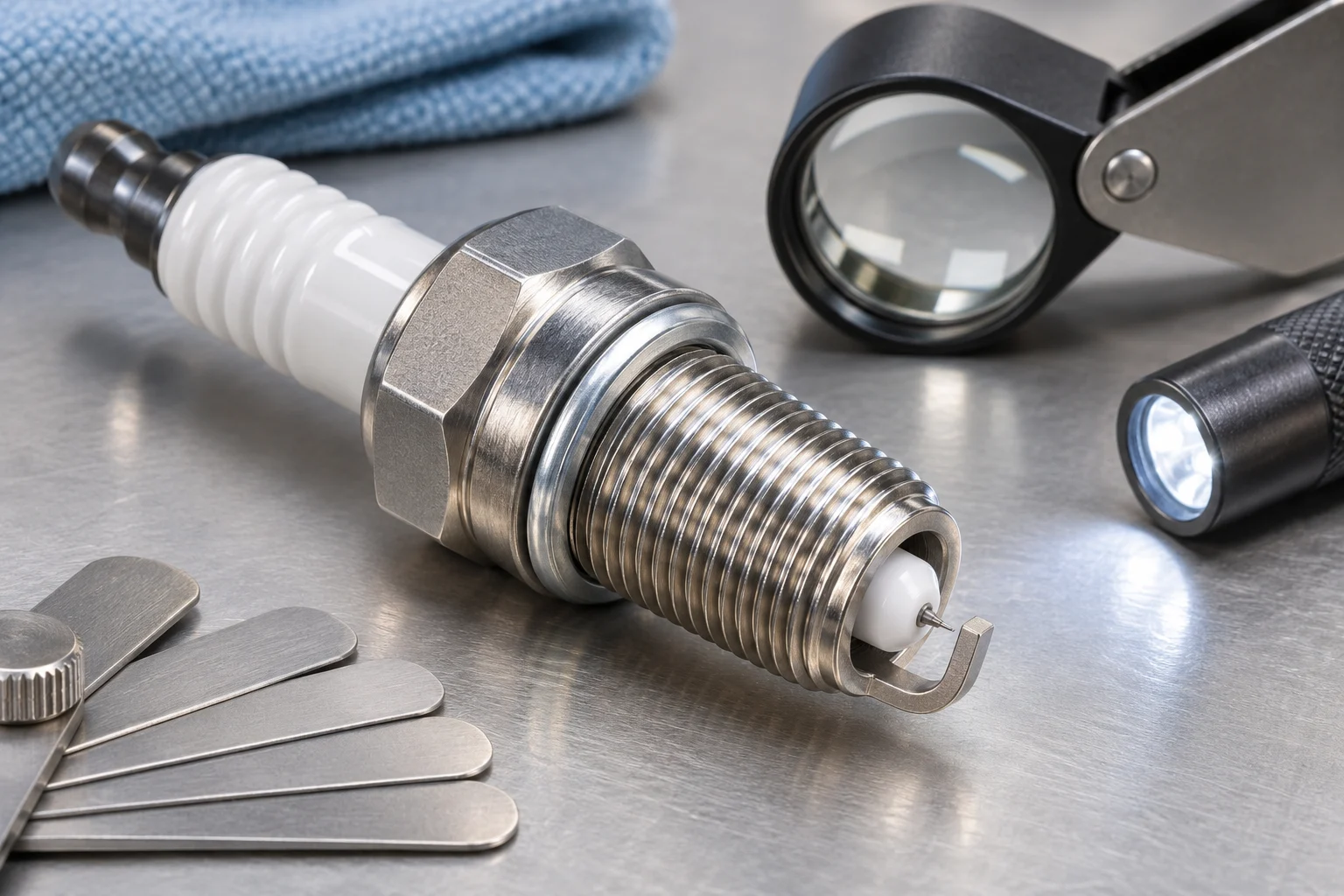
Checking a factory-style plug without damaging it
Work on a clean bench with good lighting. Look at the electrode end and identify the ground strap that sits over the center electrode. That opening is the space you are checking. The shell threads and the distance from the shell to the ground strap are different dimensions.
Choose the gauge style the plug manufacturer recommends for that specific electrode design. NGK recommends a round-wire or pin gauge for fine-wire plugs. Keep force away from the center electrode and its ceramic insulation. A tool that wedges between the parts can damage them or change the opening while you are trying to measure it. NGK guidance on checking new plug gaps
Use the gauge gently and mark any plug that appears outside the published range. Repeat the measurement from a clear view before ruling it out. An angled check can make it harder to tell whether you are reading the actual gap or touching the side of the ground strap. If you are unsure which part of the gauge corresponds to your measurement units, resolve that before touching the electrodes again.
A new plug advertised as pre-gapped is supplied with a preset opening. Verify it as directed by the manufacturer or installer, especially if there is any sign of shipping damage. Do not adjust it merely to make each reading identical when the plugs meet the correct fitment and gap requirements.
If a new plug is outside the range, verify the stock-engine specification and part number first. Then check whether the plug manufacturer permits adjustment. If adjustment is prohibited, if the ground strap is damaged, or if the mismatch is large enough to suggest a wrong part, replace the plug. If permitted and within the manufacturer’s instructions, a technician can use a suitable tool that acts on the ground strap without levering against the center.
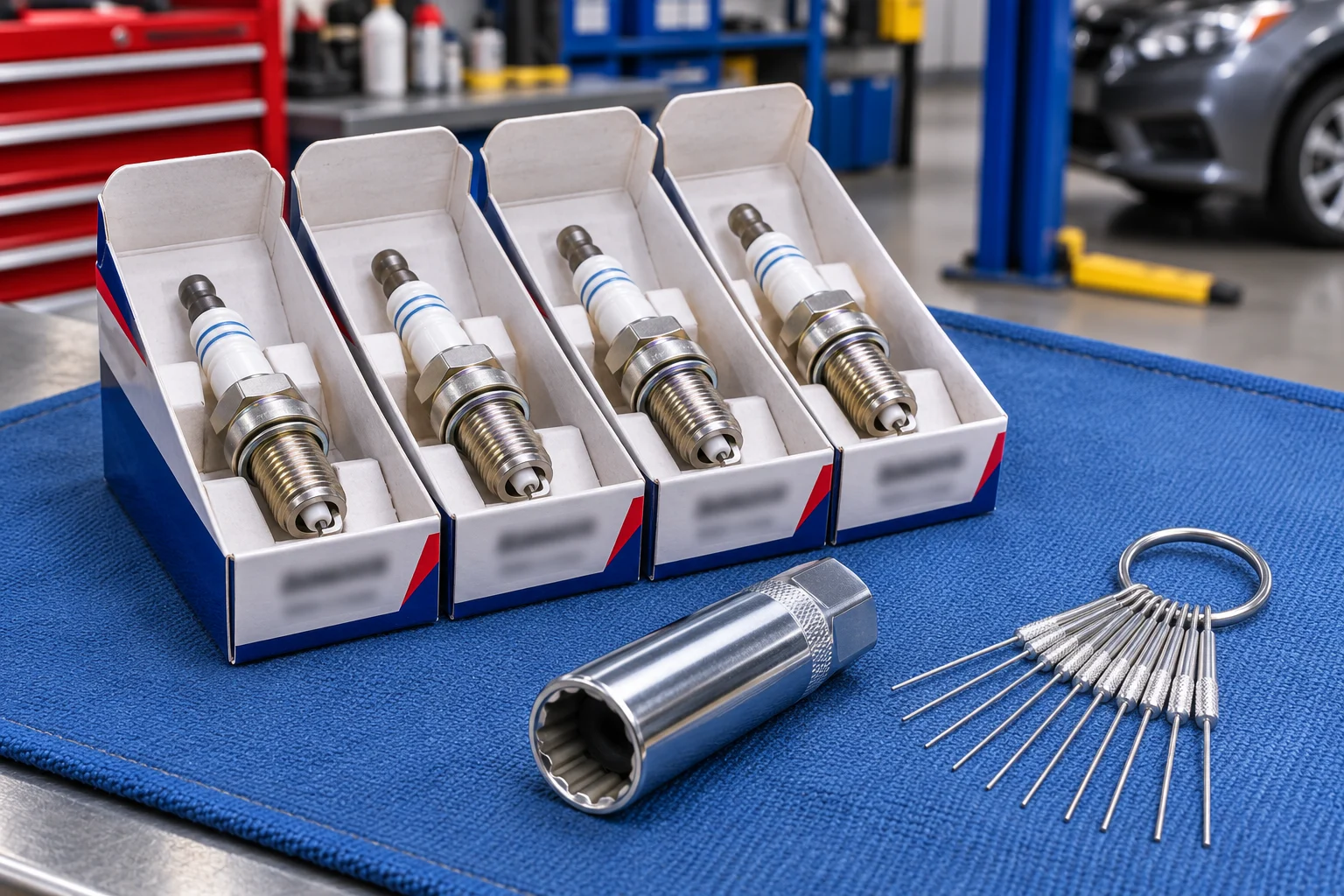
The gap is separate from installation torque
The chart states a dimension, with units of inches and millimeters. It gives no instruction for tightening the spark plug. Torque comes from the applicable Ford service procedure for the engine and the replacement part. Keep the correct torque specification, thread condition and required tools ready before removing the old plugs.
Start with a safe, cool working environment as directed by the service procedure. Identify which covers, connectors or coils the specific engine requires you to move. Make sure dirt does not fall into the plug well. If access is difficult, avoid improvising a tool path that puts side load on the plug or causes the socket to bind. Model-specific access can differ across the engines in the chart. The 2.3L EcoBoost engine diagram helps orient owners who have confirmed that engine.
Check what the plug maker says about thread lubrication. The effect of lubricant on tightening can matter, and some plugs are designed to be installed dry. Use the documented procedure for the exact plug and engine. A torque approach copied from a different Ranger or a product review may use a different assumption about the threads or seat.
Plan how to identify and record the cylinder positions if you are diagnosing a fault. Keep each removed plug associated with its cylinder and take a clear photo before cleaning or discarding it. That record can help distinguish one cylinder with a recurring problem from a pattern affecting the whole set. A photo is only a clue. Use it with diagnostic information and vehicle history.
When the gap measurement is only one clue
A worn or mis-gapped plug can contribute to ignition problems, but the same symptoms can come from other causes. A rough idle, stumble under load or cylinder-specific diagnostic code does not prove the spark plug is at fault. Collect the relevant codes and conditions, then follow the appropriate engine diagnostic procedure.
If the symptom started after a plug replacement, begin with what changed. Confirm the exact plugs and their application, inspect the related connectors, and verify that the installation followed the applicable procedure. Ask whether the symptom is tied to cold start, acceleration or an individual cylinder. Those observations make it easier to check useful leads in order.
If the opening on a removed plug is beyond the factory range, record the measurement and condition of the tip. Wear can change the appearance of the electrodes and the gap over time. Use Ford’s maintenance schedule and the applicable service assessment to decide whether to replace the set. Avoid using an old, worn plug as a template for checking a new one.
A gap that checks out does not rule out a damaged insulator, wrong part, coil issue or wiring fault. If the truck has a flashing check-engine light, significant power loss or a warning requiring a stop, follow the owner’s manual response. Avoid trying to reproduce a severe misfire by accelerating hard. Seek diagnosis when a symptom persists or the vehicle cannot be operated safely.
Stock engines versus modified Rangers
The Ford manual specifications in the chart are for stock applications. A tuned engine can have different requirements set by the tuner or engine builder. A gap posted for one modification is meaningful only with its supporting setup and instructions. Do not apply it simply because another truck carries the same EcoBoost badge.
For a used truck of uncertain history, look for documentation of the tune, engine hardware and plug part number. Confirm the service setup with the supplier who is responsible for that configuration. If you cannot establish the configuration, have it evaluated rather than guessing a modified-vehicle specification. When the engine is confirmed to be stock, use the correct Ford documentation and part lookup.
Write the specification on the work order
Before taking the old plugs out, record the VIN, confirmed engine, number of replacement plugs and plug part number. Match the number of plugs to the replacement procedure and check that every package contains the expected part. Note the Ford gap range in the same units as the gauge you are using. If a plug manufacturer’s instructions specify a particular technique for checking a pre-gapped plug, keep those instructions with the part.
When a shop is doing the work, ask it to confirm whether the quote includes all of the service items required by the procedure and whether it will record a measurement if something does not match. If the job is diagnostic rather than routine maintenance, ask the technician to record the cylinder location and the condition of the old parts. The work order should make clear which parts were installed and why. That record is especially important if a replacement plug later needs to be matched to the parts already installed.
A written specification also helps when the replacement was ordered remotely. You can send the supplier the actual part marking, the label and a description of the mismatch without sharing unrelated vehicle identifiers in public. Ask for confirmation of fitment before opening or modifying the rest of the set.
Frequently asked questions
Is 0.030 inch within the Ford Ranger plug gap range?
Yes. For the factory engines listed here, 0.030 in lies between Ford’s 0.028 in and 0.031 in endpoints. Check the specific plug manufacturer’s directions and verify part fitment in addition to the measurement.
Do the 2.7L Ranger and 3.0L Ranger Raptor use the same plug?
They have the same published gap range in the cited U.S. documentation. The gap alone cannot establish that one part fits both engines. Use the part lookup that matches the engine and VIN.
Do I need to regap every new Ranger spark plug?
Check a plug’s fitment, physical condition and gap as directed. When a correct new plug falls within the applicable range and its instructions call for no change, leave it as supplied. If there is a mismatch, determine whether the manufacturer allows adjustment or calls for replacement.
Can I use this chart on a 4.0L or an overseas diesel Ranger?
The chart covers 2019–2026 U.S. gasoline EcoBoost Ranger applications listed above. An older 4.0L has its own gas-engine specification. An overseas diesel uses a different ignition system and may have glow plugs, which are separate from the gasoline spark plugs described here. Verify the market and engine before using a service specification.