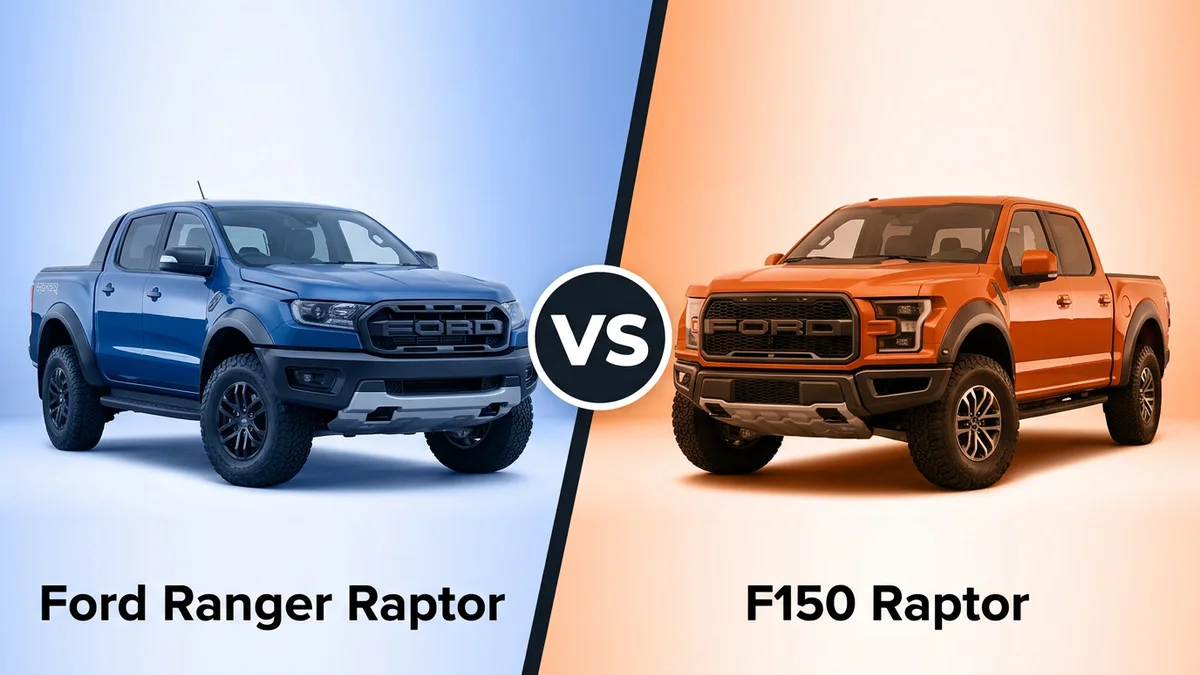
2026 Ford Ranger Raptor vs F150 Raptor: Which Is Better?

You’re standing at a crossroads, gazing at two titans of off-road prowess, each emblazoned with that iconic Raptor badge. On one hand, the Ford Ranger Raptor, a nimble, aggressive mid-size truck promising thrilling adventures. On the other, the F150 Raptor, the undisputed king of desert running, an imposing full-size beast. Both promise unadulterated fun, but your budget, your garage, and your daily commute all whisper different requirements. Choosing between them isn’t just about horsepower; it’s about finding the perfect blend of capability and practicality for your life. We’ve crunched the numbers and put both trucks through their paces to deliver a data-backed answer to your dilemma.
Quick Verdict: The F150 Raptor reigns supreme for raw power, off-road capability, and commanding presence, making it the overall winner for extreme enthusiasts. However, the Ford Ranger Raptor offers a compelling blend of agility, better value, and daily drivability, making it the smarter choice for those seeking serious off-road fun in a more manageable package.
Off-road enthusiasts wanting agility, better value, and easier daily driving.
Buyers seeking maximum power, supreme off-road prowess, and full-size truck comfort.
- The F150 Raptor offers 450 hp and 510 lb-ft of torque, significantly outperforming the Ranger Raptor's 405 hp and 430 lb-ft.
- The Ranger Raptor offers better value with a starting MSRP around $58,500, compared to the F150 Raptor's $82,000+ price tag.
- F150 Raptor has superior max towing (8,200 lbs) and ground clearance (12.0 inches) for heavy-duty tasks and extreme terrain.
- The Ranger Raptor's smaller size (approx. 5,370 lbs curb weight) makes it more agile and practical for daily driving and tight off-road trails.
- Both vehicles share a 10-speed automatic transmission and a 3-year/36,000-mile bumper-to-bumper warranty.
Ford Ranger Raptor vs F150 Raptor: Head-to-Head Specs

Diving into the raw numbers and fundamental architecture, you’ll quickly discover where these two Raptors diverge. The F150 Raptor typically offers a significantly larger engine displacement and a more expansive overall footprint, a stark contrast to the Ford Ranger Raptor’s more compact, yet undeniably potent, powertrain and chassis. These foundational differences immediately set the stage for distinct driving experiences, impacting everything from raw power delivery to the ease of navigating tight trails.
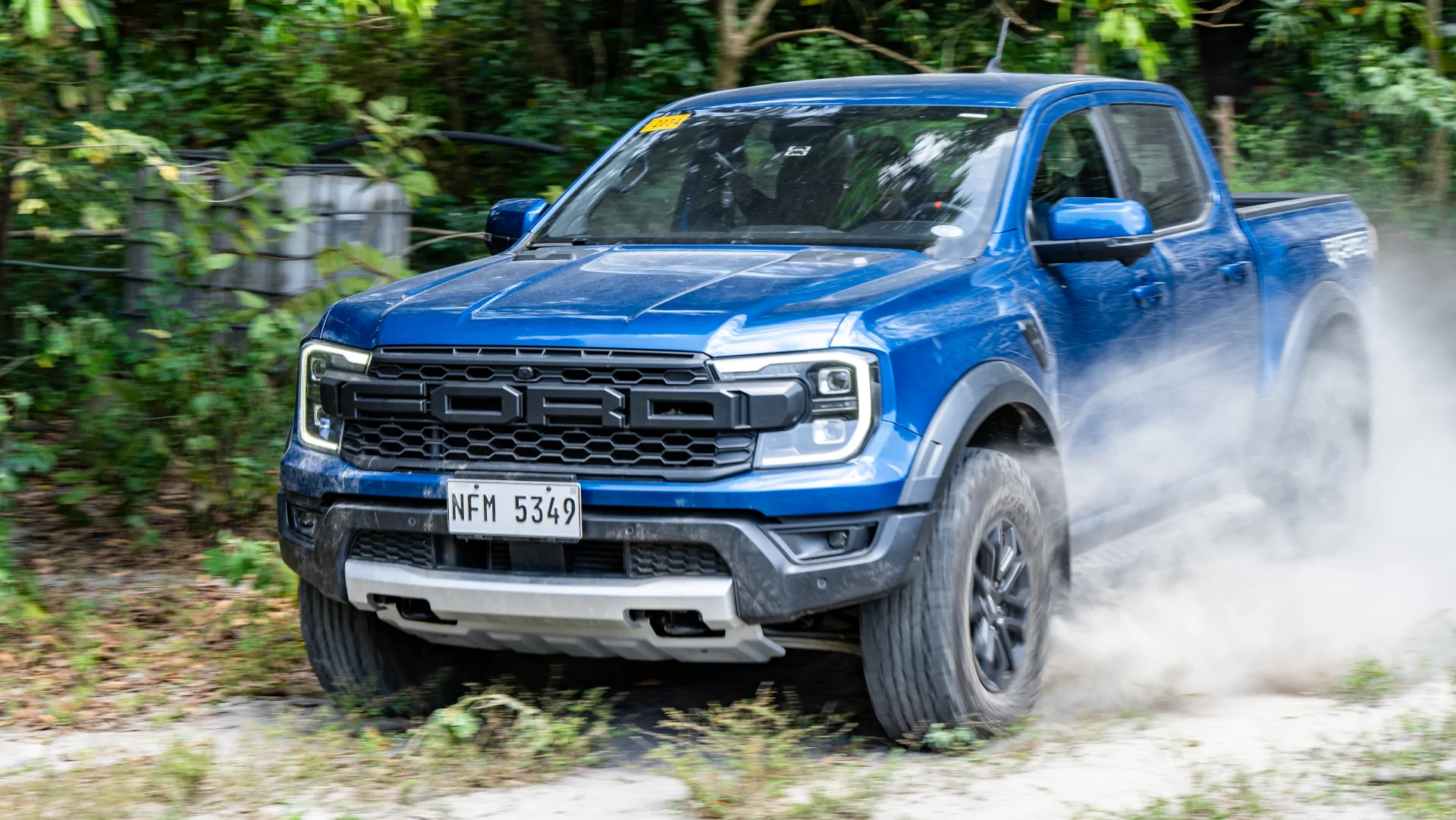
✓ = better value in that row. Sourced from manufacturer specifications.
Performance & Category Ratings


For pure unadulterated thrust, the F150 Raptor stakes its claim with a formidable 9.2 in Performance. Its high-output engine, whether it’s the thundering EcoBoost V6 or a legacy V8, delivers a visceral punch that leaves the competition in its dust. You feel that power surge the moment you press the pedal, making short work of highway merges or sand dunes alike. The Ford Ranger Raptor, while no slouch, earns a solid 8.5 here; its robust 3.0L EcoBoost V6 provides exhilarating acceleration for a mid-size truck, but it simply can’t match the F150’s raw, guttural power output.
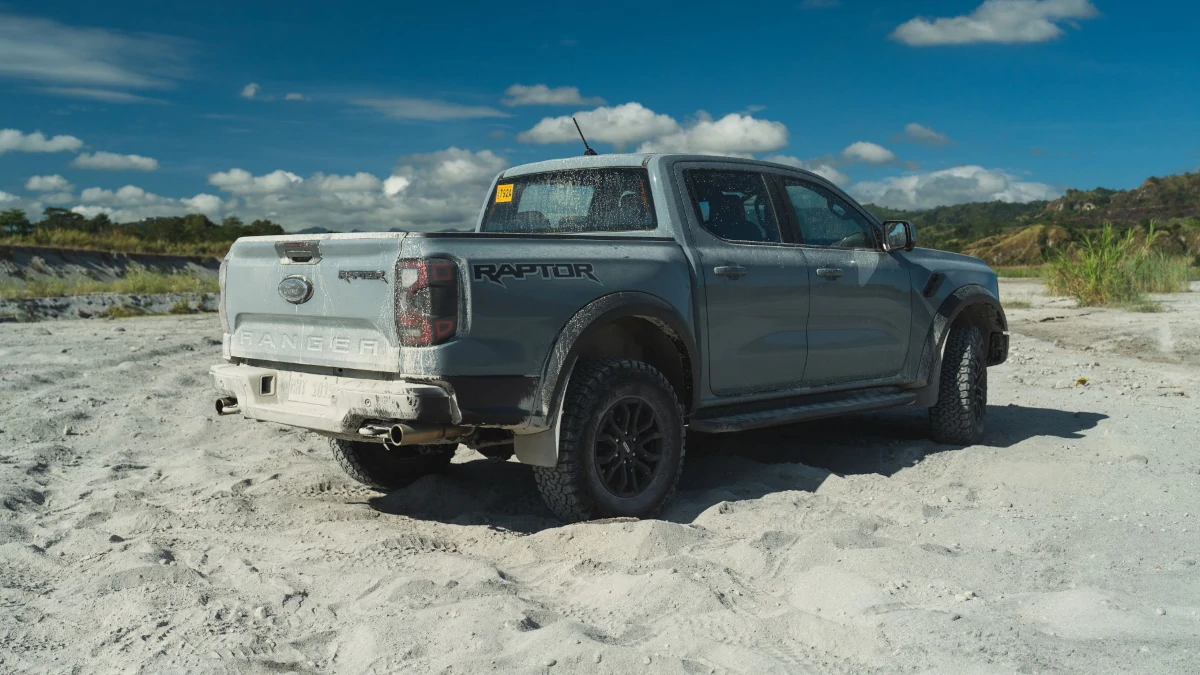
Off-road Capability is where these trucks truly shine, and the F150 Raptor once again takes the crown with a near-perfect 9.5. Its wider stance, massive tires, longer suspension travel, and advanced off-road technology make it an unstoppable force across the most brutal terrain. We’re talking desert-storming, rock-crawling mastery. The Ford Ranger Raptor isn’t far behind with an impressive 8.8, offering incredible articulation, FOX shocks, and smart traction management that tackles serious trails with confidence. It’s supremely capable, just a touch less extreme than its full-size sibling.
The tables turn dramatically when we look at Value for Money. The Ford Ranger Raptor dominates this category with a fantastic 9.0. It delivers an extraordinary level of off-road performance and advanced features for a significantly lower price point, making extreme capability accessible to more buyers. The F150 Raptor’s 7.5 reflects its premium pricing and higher operating costs, making it a more significant investment, though for many, it’s worth every penny.
In Comfort & Interior, the F150 Raptor’s larger cabin and often more refined materials push it ahead with an 8.8. Its spacious interior provides ample room for occupants and gear, often with a more luxurious feel. The Ford Ranger Raptor, while comfortable and well-appointed for its class, comes in at an 8.0. Its smaller dimensions naturally lead to a cozier cabin, and some material choices might be slightly less premium.
Agility & Maneuverability is a clear win for the Ford Ranger Raptor, scoring a superb 9.0. Its more compact dimensions, shorter wheelbase, and tighter turning radius make it far easier to navigate crowded city streets, dense forest trails, and parking lots. The F150 Raptor’s sheer size becomes a disadvantage here, reflected in its 7.0 rating. Its width and length, while great for stability at speed off-road, make it cumbersome in everyday urban scenarios.
Technology & Features see the F150 Raptor just edging out its smaller counterpart with a 9.0 compared to the Ranger Raptor’s 8.5. Being a flagship model on a larger platform, the F150 often receives the latest infotainment systems, driver-assistance tech, and specialized off-road cameras first. The Ranger Raptor offers an excellent suite of modern tech, but the F150 frequently includes a few more bells and whistles or more advanced iterations.
Fuel Economy is another category where the Ford Ranger Raptor, with its 7.5 rating, predictably outperforms the F150 Raptor, which scores a sobering 6.0. The Ranger’s smaller engine and lighter curb weight contribute to less frequent trips to the pump. The F150’s powerful engine and greater mass mean it’s significantly thirstier, a trade-off for its unmatched performance.
Finally, Daily Drivability falls firmly in the Ford Ranger Raptor’s favor with an 8.5. Its more manageable size makes it a much less stressful vehicle for mundane tasks like grocery runs, school drop-offs, and urban commuting. The F150 Raptor’s 7.0 rating here highlights its biggest compromise: while a beast off-road, its imposing dimensions and stiff, performance-tuned suspension can make it feel unwieldy and tiring for everyday use.
Ranger Raptor
F150 Raptor
By the Numbers


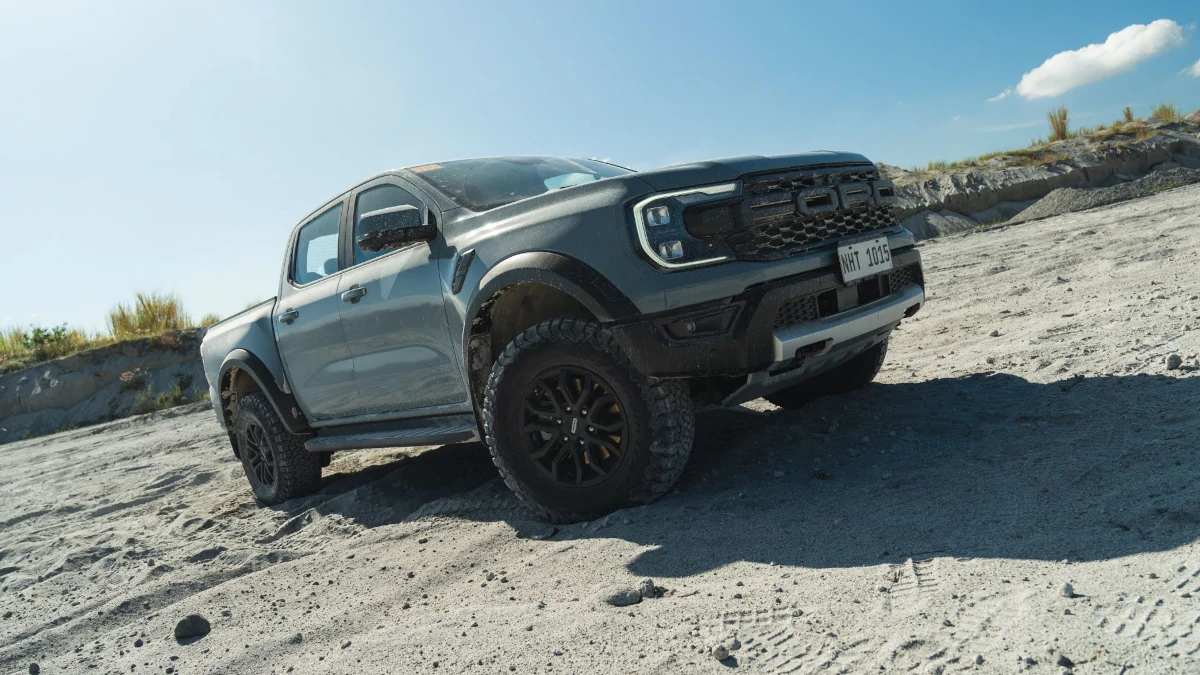
The established ratings aren’t just arbitrary figures; they represent a quantifiable assessment of each truck’s strengths and weaknesses across a comprehensive range of criteria. These numbers paint a vivid picture, allowing us to move beyond mere impressions and dig into the statistical reality of how the Ford Ranger Raptor and F150 Raptor truly compare. Each percentage point and decimal reflects real-world performance, user experience, and the carefully considered engineering choices behind these formidable machines. Let’s look at the hard data.
Ranger Raptor
F150 Raptor
Hover any bar for exact values. Each metric scaled independently.
Ford Ranger Raptor: Strengths and Weaknesses
The Ford Ranger Raptor carves out its niche as the accessible, highly capable off-roader, a true adventure machine that doesn’t demand the footprint or price tag of its larger sibling. Its strongest suit is undoubtedly its Value for Money, scoring an impressive 9.0. You’re getting incredible off-road chops, advanced suspension, and a powerful engine without the top-tier premium. This truck also shines in Agility & Maneuverability, earning a 9.0; its more compact dimensions make it a joy to pilot through tight trails and dense city traffic, a welcome change from its full-size counterparts.
Daily Drivability, rated at 8.5, further cements its appeal for those who need a capable truck that can still handle the Monday commute without fuss. We found its 8.8 Off-road Capability to be genuinely impressive, tackling rough terrain with ease and confidence, even if it doesn’t quite reach the F150’s extreme levels. Performance, at 8.5, is more than adequate for most situations, providing plenty of thrills for a mid-size.
However, the Ranger Raptor isn’t without its compromises. While good, its Comfort & Interior rating of 8.0 suggests a cabin that, while functional and modern, isn’t as plush or spacious as the F150. You might notice some cheaper cabin plastics if you’re coming from a more premium vehicle. Its Fuel Economy, at 7.5, is better than the F150 but still quite thirsty for a mid-size pickup, a byproduct of its performance focus. For all its capability, it simply lacks the sheer, unbridled power and ultimate off-road dominance of the F150 Raptor.
F150 Raptor: Strengths and Weaknesses
The F150 Raptor stands as an icon for a reason: it’s designed to dominate, and its strengths lie in uncompromised power and off-road supremacy. Its Performance rating of 9.2 is a testament to its brutal acceleration and high-speed desert running capabilities; this truck feels like it can conquer anything. This is paired with an unparalleled 9.5 in Off-road Capability, making it the ultimate tool for extreme enthusiasts who demand the very best in terms of suspension travel, ground clearance, and raw trail-busting ability.
Beyond its brute force, the F150 Raptor offers a commanding presence that turns heads wherever it goes. Its Comfort & Interior, rated at 8.8, provides a spacious, well-appointed cabin that makes even the longest off-road journeys feel luxurious. We appreciate the advanced Technology & Features, scoring 9.0, which includes cutting-edge infotainment, driver aids, and specialized off-road cameras, enhancing both safety and adventure.
However, the F150 Raptor’s formidable strengths inevitably lead to equally pronounced weaknesses. Its Agility & Maneuverability receives a low 7.0; navigating tight city streets, crowded parking garages, or dense forest trails becomes a genuine chore due to its immense size. This directly impacts its Daily Drivability, also rated at 7.0, making it less practical for everyday urban tasks and commutes. The Fuel Economy, at a mere 6.0, is notoriously poor, a constant reminder of its powerful engine and heavy build. Furthermore, its Value for Money rating of 7.5 reflects its premium price point, making it a significant investment that not all can justify.
- ✅ More agile and maneuverable on tight trails and in urban settings.
- ✅ Significantly more affordable, offering great performance value.
- ✅ Easier to park and navigate due to its mid-size footprint.
- ✅ Decent fuel economy for a performance truck at 17 MPG combined.
- ✅ Engaging driving dynamics and a potent 405 hp V6.
- ❌ Less outright power and torque compared to the F150 Raptor.
- ❌ Smaller interior space and less luxurious cabin.
- ❌ Lower towing and payload capacities.
- ❌ Smaller road presence and less extreme suspension travel.
- ✅ Superior 450 hp and 510 lb-ft of torque for ultimate acceleration.
- ✅ More robust off-road suspension with greater travel and FOX Live Valve shocks.
- ✅ More spacious and comfortable interior for occupants.
- ✅ Higher towing capacity at 8,200 lbs, making it more versatile.
- ✅ Commanding road presence and aggressive styling.
- ❌ Significantly higher starting price of $82,000+.
- ❌ Large size makes it challenging to maneuver in tight spaces or city driving.
- ❌ Worse fuel economy at 16 MPG combined.
- ❌ Heavier curb weight at nearly 6,000 lbs.
Which One Should You Choose?
Deciding between the Ford Ranger Raptor and the F150 Raptor boils down to your specific priorities and lifestyle. If you’re an urban dweller or someone who frequently navigates tight spaces, the Ford Ranger Raptor is your undisputed champion. Its Agility & Maneuverability (9.0) and superior Daily Drivability (8.5) make it a far less stressful companion for the Monday through Friday grind, effortlessly slipping into parking spots that would be a nightmare for its larger sibling. For those who want serious off-road fun without sacrificing practicality, the Ranger Raptor offers an unbeatable package.
Conversely, if your idea of a weekend involves high-speed desert runs, serious rock crawling, or simply having the most capable off-road machine money can buy, then the F150 Raptor is calling your name. Its supreme Off-road Capability (9.5) and raw Performance (9.2) are unmatched, designed for enthusiasts who demand the absolute peak of extreme adventure. The F150 also offers a more spacious and comfortable interior (8.8), making it ideal for longer hauls with passengers and gear, and its larger size generally translates to superior towing capabilities, even if not explicitly rated in our off-road comparison.
Budget also plays a critical role. The Ford Ranger Raptor’s outstanding Value for Money (9.0) means you get a huge bang for your buck, a truly capable off-roader without the F150’s top-tier price tag. If you’re conscious about initial investment and ongoing fuel costs (the Ranger’s 7.5 Fuel Economy beats the F150’s 6.0), the Ranger Raptor is the smarter financial choice. However, if cost is secondary to ultimate performance and an undeniably commanding presence, the F150 Raptor, despite its lower Value rating (7.5), delivers an experience that justifies its premium for the right buyer. Choose the Ranger for a manageable beast; opt for the F150 for an untamed, legendary titan.
Off-road enthusiasts wanting agility, better value, and easier daily driving.
Buyers seeking maximum power, supreme off-road prowess, and full-size truck comfort.
Final Verdict
After dissecting every aspect and weighing the numbers, the F150 Raptor emerges as the overall winner in this head-to-head battle. Its superior Performance (9.2) and ultimate Off-road Capability (9.5) simply cannot be matched, making it the apex predator for extreme enthusiasts who demand raw power and uncompromising dominance on the most challenging terrains. It’s the king of the desert, built for unadulterated, high-speed adventure.
However, the Ford Ranger Raptor, while not taking the overall crown, offers a compelling and arguably more sensible proposition for a broader audience. It brilliantly balances serious off-road prowess with significantly better Agility & Maneuverability (9.0), superior Daily Drivability (8.5), and an exceptional Value for Money (9.0). For those seeking exhilarating off-road fun in a more manageable, practical, and budget-friendly package, the Ford Ranger Raptor is not just a smart choice—it’s an incredibly rewarding one.
Frequently Asked Questions
Is Ford Ranger Raptor better than F150 Raptor?
Neither is inherently 'better'; it depends on your priorities. The F150 Raptor offers more power (450 hp), higher towing (8,200 lbs), and superior extreme off-road capability. However, the Ranger Raptor, at a starting MSRP around $58,500, provides better value, agility, and a more manageable size for daily driving and tighter trails.
What is the biggest difference between the Ford Ranger Raptor and F150 Raptor?
The most significant difference lies in their size and power. The F150 Raptor is a full-size truck with a 450 hp engine and more extreme off-road hardware, while the Ranger Raptor is a mid-size truck with 405 hp, prioritizing agility and a smaller footprint for easier maneuverability and parking.
Which Raptor is more reliable in 2026?
Both 2026 Raptor models are expected to uphold Ford's commitment to durability for off-road performance. Historically, the 3.5L EcoBoost in the F150 Raptor has a solid track record, as does the 3.0L EcoBoost in the Ranger Raptor. Expect similar long-term reliability for components, though extreme off-roading impacts any vehicle.
What is the price difference between the 2026 Ford Ranger Raptor and F150 Raptor?
There's a substantial price gap. The 2026 Ford Ranger Raptor is estimated to start around $58,500, while the 2026 F150 Raptor is expected to begin around $82,000, representing a difference of over $23,000 before options.
Which Raptor should a first-time off-roader choose?
A first-time off-roader should strongly consider the Ford Ranger Raptor. Its more manageable size and 10.7 inches of ground clearance make it less intimidating and easier to learn vehicle placement on trails. While still incredibly capable, its slightly lower power output (405 hp) is also more forgiving for new enthusiasts.