Ford P0193 Code 6.7 Powerstroke: Causes Diagnosis and Fix Guide 2026

The Ford P0193 code on a 6.7 Powerstroke means the PCM is detecting an abnormally high electrical signal from the fuel rail pressure sensor circuit. It does not automatically mean the engine has dangerously high fuel pressure or that the high-pressure fuel pump has failed.
Ford identifies P0193 as Fuel Rail Pressure Sensor A Circuit High Input. On Ford’s 6.7L diesel diagnostic strategy, the code can set when fuel rail pressure sensor voltage rises above the calibrated circuit threshold.

Prime for Young Adults — 6 Months Free
Students and 18–24s get six months of Prime free, then half price.
Start 6 Months Free As an Amazon Associate I earn from qualifying purchases.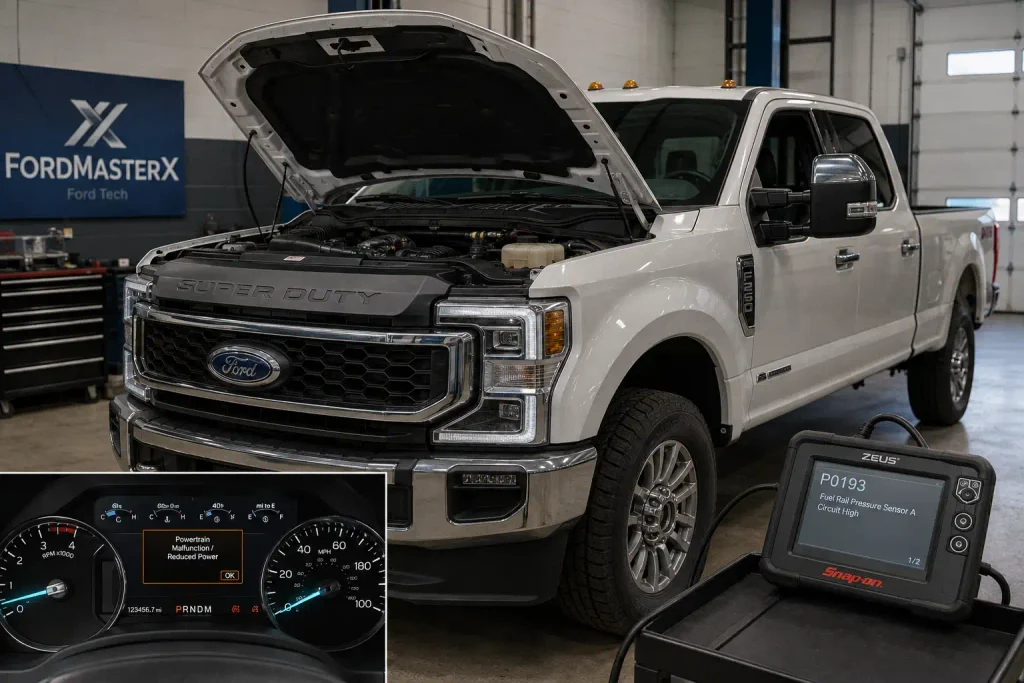
Start with the code combination, FRP live data, connector, and wiring before buying a sensor or touching the high-pressure fuel system.
Ford P0193 Code 6.7 Powerstroke Diagnostic Flow
Separate an FRP sensor fault from wiring or a true fuel-pressure control problem before replacing parts.
Follow These 6 Diagnostic Steps
Read Every Stored Code
Save stored, pending, and history codes plus freeze-frame data before clearing the PCM.
Watch FRP Live Data
Monitor fuel rail pressure sensor voltage and reported pressure with a Ford-capable scan tool.
Inspect the FRP Connector
Check the connector and harness for loose terminals, corrosion, pulled wires, damaged locks, or chafing.
Verify Reference and Return
Use the correct Ford wiring information for your model year to test sensor reference and return circuits.
Test the FRP Signal Circuit
Check whether the FRP signal remains abnormally high after the other sensor circuits test correctly.
Compare Desired and Actual Pressure
If electrical checks pass but pressure-control codes remain, compare commanded and measured rail pressure.
FRP Sensor Branch
Reference, return, connector, and signal wiring test correctly but FRP output remains abnormally high.

Audible — Listen Free for 30 Days
One free credit a month and thousands of titles included.
Listen Free for 30 Days As an Amazon Associate I earn from qualifying purchases.Wiring Branch
P0193 returns after sensor replacement or electrical testing reveals a bad reference, return, connector, or signal circuit.
Pressure Control Branch
P0193 appears with pressure-control codes and desired rail pressure does not track actual rail pressure.
What Ford P0193 Means on a 6.7 Powerstroke
Recommended Best Deal Products


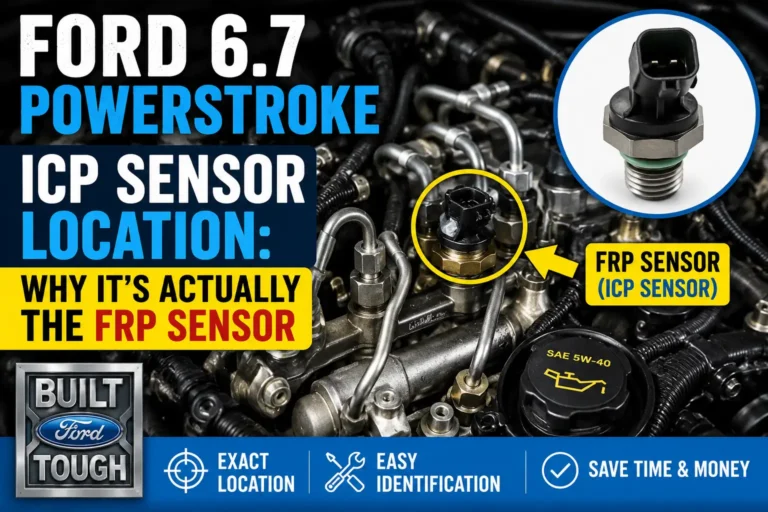
The 6.7L Power Stroke uses a fuel rail pressure sensor, commonly shortened to FRP sensor, to tell the PCM how much pressure exists in the high-pressure common rail.
Ford’s 2023 diesel OBD documentation lists these two electrical FRP faults:
| Code | Ford Definition | Typical Monitor Threshold |
|---|---|---|
| P0192 | Fuel Rail Pressure Sensor A Circuit Low Input | Below 0.13 V |
| P0193 | Fuel Rail Pressure Sensor A Circuit High Input | Above 3.17 V |
Ford lists a typical monitor duration of about 0.5 second for these circuit checks.
The same 0.13 V and 3.17 V thresholds appear in Ford’s older 6.7L diesel OBD documentation, including early engines and the 2015 model-year material.
That distinction matters. P0193 is primarily an electrical circuit code. P0088 is Ford’s separate code for fuel rail or system pressure being too high.
Ford’s 2023 training material shows the FRP sensor as part of the high-pressure common-rail system and identifies it as an input the PCM uses to control fuel pressure.
4 Conditions That Can Trigger Ford P0193
Four diagnostic paths deserve attention before expensive fuel-system parts are replaced.
Failed FRP Sensor
An internally failed FRP sensor can send an abnormally high signal even when actual rail pressure is normal.
Audible Premium Plus — Annual Membership
12 audiobook credits up front, plus the full Audible catalogue.
See Annual Plans As an Amazon Associate I earn from qualifying purchases.This becomes more likely when the sensor’s reference supply and ground are correct, the harness tests normally, but FRP voltage remains implausibly high.
Damaged FRP Wiring
P0193 can also result from an electrical fault between the sensor and PCM.
Look for:
- Loose or spread connector terminals
- Broken conductors near the connector
- Chafed insulation
- Corrosion or moisture
- A signal wire shorted to voltage
- Poor sensor return or ground
A real 6.7L diagnostic case published by diesel technicians involved several sensors reading approximately 4.98 to 4.99 volts together with multiple circuit-high codes, including P0193. That pattern pointed beyond a single FRP sensor and toward a shared electrical problem.
Sensor Supply Circuit Fault
Ford’s P0193 monitor lists the Sensor Supply 1 circuit as a prerequisite and references P06A6. If P0193 appears together with P06A6 or several unrelated sensor circuit-high codes, do not focus only on the FRP sensor.
A shared 5-volt reference or sensor-supply problem can affect several sensors at once.
Fuel Pressure Control Problem
Actual fuel-pressure regulation should move higher on the list when P0193 appears with codes such as P0088, P228E, or P228F.
Ford treats these as separate monitors. P228E means the fuel pressure regulator exceeded its learning limits too low, while P228F means it exceeded its learning limits too high.
For a clearer view of how the rails, FRP sensor, pressure control valve, pump, filters, and injectors connect, see the 6.7 Powerstroke fuel system diagram.
How to Diagnose P0193 in 6 Steps
Recommended Best Deal Products


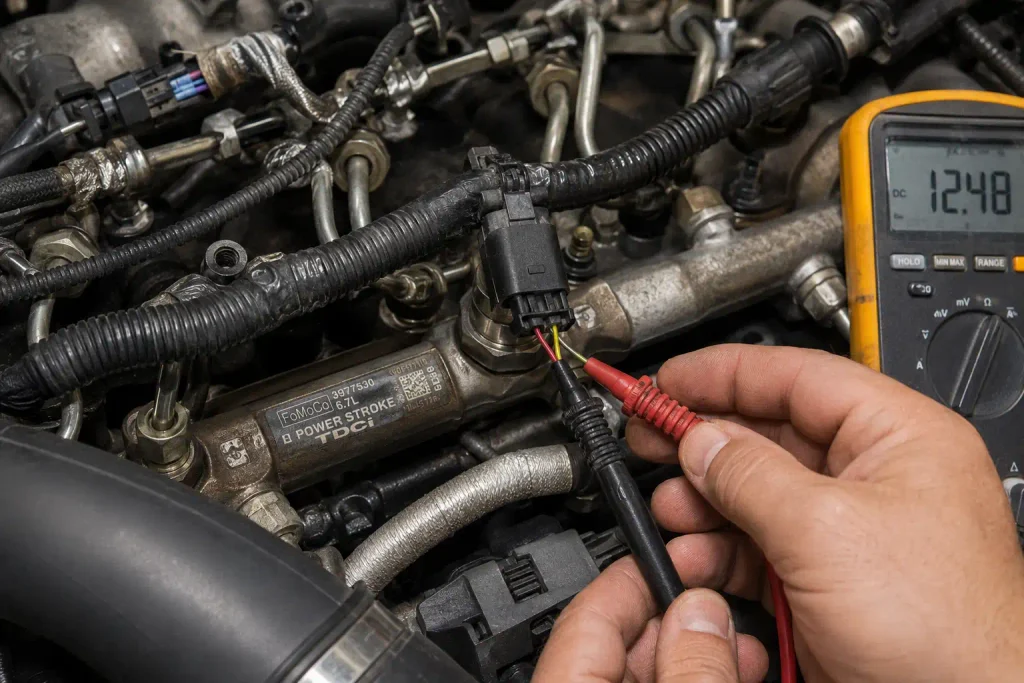
The fastest P0193 diagnosis starts with scan data and electrical testing rather than replacing parts.
Step 1 Read Every Trouble Code
Scan the PCM and record stored, pending, and history codes before clearing anything.
Pay particular attention to:
- P0191
- P0192
- P06A6
- P0087
- P0088
- P228E
- P228F
- Other sensor circuit-high codes
Save freeze-frame information if your scanner supports it.
If your basic scanner cannot display Ford diesel PIDs, an enhanced OBD2 scanner for Ford 6.7 diesel diagnostics is more useful because live FRP information is central to this test.
Step 2 Watch FRP Live Data
Turn the ignition on and monitor the fuel rail pressure and FRP sensor data available through your scan tool.
Do not diagnose the pump merely because the displayed pressure looks extremely high. P0193 can make the PCM receive an electrically false high signal.
Ford’s diagnostic strategy separates FRP circuit faults from actual pressure control. The PCM only runs some fuel-pressure monitors after it determines the FRP sensor circuit itself is valid.
Step 3 Inspect the FRP Connector
Switch the ignition off before handling the connector.
The FRP sensor is located on the fuel rail. On the earlier 6.7L arrangement, the sensor is associated with the left-side rail, and Ford’s current training diagrams continue to show the sensor within the common-rail pressure-control system.
Inspect the connector for damaged locks, pushed-back terminals, corrosion, contamination, stretched wires, or insulation damage.
Step 4 Verify the Reference Supply
The FRP sensor uses a three-wire circuit consisting of a reference supply, signal, and return.
Motorcraft’s wiring-pigtail catalog confirms a three-lead WPT-1066 fuel rail pressure sensor connector for 6.7L Super Duty applications through the 2011 to 2019 range.
With the correct wiring diagram for your exact model year, verify the reference supply and sensor return before condemning the sensor.
Do not guess terminal positions by wire color. Ford changed harnesses and fuel-system hardware across 6.7L generations.
Step 5 Test the Signal Circuit
If reference supply and return are correct, inspect the FRP signal circuit between the connector and PCM.
A signal that remains pulled high with the sensor disconnected points toward a circuit problem rather than an internally failed sensor. A wiring fault can hide inside insulation even when the harness looks normal externally.
Gently manipulating the harness while observing FRP live data can also expose an intermittent connection, but avoid pulling, piercing, or damaging terminals.
Step 6 Compare Desired and Actual Pressure
If the FRP circuit passes electrical checks but pressure-control DTCs remain, compare desired rail pressure with actual rail pressure.
Ford’s 2023 system description explains that during cranking, the PCM closes the pressure control valve and waits for about 34,470 kPa or 5,000 psi before beginning injection.
That figure is a system-operation reference, not a universal P0193 pass or fail specification.
A large difference between commanded and measured pressure sends the diagnosis toward the pressure control valve, volume control valve, high-pressure pump, fuel supply, or other hydraulic components.
If FRP Voltage Stays High Test the Sensor
If the reference circuit, return, connector, and signal wiring all pass inspection but the FRP signal remains outside Ford’s expected electrical range, the sensor becomes a much stronger suspect.
The correct OEM sensor also changes with model year.
| 6.7 Powerstroke Model Years | Ford Fuel Rail Pressure Sensor |
|---|---|
| 2011 to 2019 | BC3Z-9F838-A |
| 2020 to 2022 | LC3Z-9F838-A |
| 2023 to 2025 | PC3Z-9F838-A |
Ford parts listings identify BC3Z-9F838-A for 2011 to 2019 applications.
For a 2022 F-350 6.7L, Ford catalog data lists LC3Z-9F838-A specifically at the fuel rail.
Ford parts data for 2023 Super Duty models lists PC3Z-9F838-A, and the same part is cataloged for 2023 to 2025 F-250 and F-350 applications.
For a 2026 truck, verify the part using the VIN and current Ford parts catalog before ordering because the public catalog sources reviewed did not provide reliable 2026 fitment for 9F838.
Do not install an earlier sensor simply because the connector looks similar.
If P0193 Returns Check Wiring Next
Recommended Best Deal Products


If P0193 returns after installing a verified correct sensor, stop replacing sensors.
Test the connector and circuit.
Motorcraft identifies WPT-1066 as the three-lead FRP connector for many 2011 to 2019 6.7L Super Duty applications.
An especially useful clue is multiple circuit-high DTCs at the same time. If FRP, coolant temperature, fuel temperature, charge-air temperature, or other sensors all report abnormally high voltage, investigate the shared reference and PCM circuits instead of replacing each sensor.
The technician case involving a 2013 F-350 showed several sensors pinned near reference voltage together with P0193 and other circuit-high codes.
If only the FRP circuit is affected, concentrate on connector terminal tension, signal-wire continuity, short-to-voltage testing, and sensor return integrity.
When P0088 or P228F Changes the Diagnosis
P0193 and P0088 do not mean the same thing.
| Code | Ford Meaning | Main Diagnostic Focus |
|---|---|---|
| P0191 | FRP sensor range or performance | Sensor rationality |
| P0193 | FRP sensor circuit high input | Sensor and electrical circuit |
| P0088 | Fuel rail or system pressure too high | Actual versus commanded pressure |
| P228E | Regulator learning limit too low | Pressure regulation |
| P228F | Regulator learning limit too high | Pressure regulation |
Ford sets P0088 when measured rail pressure exceeds commanded pressure by a calibrated amount. In the 2023 OBD strategy, one threshold is a 250-bar difference for 1.4 seconds.
P228E and P228F monitor the rail-pressure controller’s learned correction. Ford describes the threshold as roughly a 20% deviation in rail pressure sensor slope adaptation under the monitor’s operating conditions.
If those codes accompany P0193, use the 6.7 Powerstroke fuel pressure regulator guide to understand the regulator side of the system.
Do not jump directly to a CP4 diagnosis. If you find metal contamination, rail-pressure build problems, or other evidence of high-pressure pump damage, compare those findings with documented 6.7 Powerstroke CP4 failure symptoms.
Quick P0193 Decision Guide for 6.7 Powerstroke
Use this table as a diagnostic starting point.
| What You Find | Most Likely Diagnostic Branch | What to Check Next |
|---|---|---|
| P0193 only | FRP sensor or circuit | FRP live data and connector |
| P0193 after sensor replacement | Wiring or connector | Reference, return, and signal |
| P0193 plus P06A6 | Sensor supply circuit | Shared reference circuit |
| P0193 plus several circuit-high codes | Shared electrical fault | Reference supply and PCM circuits |
| P0193 plus P0191 | FRP rationality issue | Sensor data and wiring |
| P0193 plus P0088 | Pressure reading or control issue | Desired vs actual FRP |
| P0193 plus P228F | Pressure regulation issue | Regulator and pressure control |
| Visible harness damage | Electrical fault | Repair circuit correctly |
| Electrical circuit tests correctly | FRP sensor or hydraulic branch | Continue model-year Ford pinpoint diagnosis |
The key is to let the test result choose the repair.
When P0193 Needs Professional Fuel System Testing
Basic scanning, connector inspection, and circuit diagnosis can be handled by experienced DIY owners. Opening the high-pressure common-rail system is different.
Ford’s 6.7L design uses extremely high pressure to feed the injectors, and the PCM requires about 5,000 psi just to begin injection during cranking.
Professional diagnosis is the better choice when:
- The truck repeatedly stalls or will not start
- P0087, P0088, P0093, P228E, or P228F remain active
- Actual and desired rail pressure do not track
- Metal or contaminated fuel is found
- Several PCM reference circuits test incorrectly
- The repair requires opening high-pressure fuel lines
- Correct PCM terminal testing requires factory breakout equipment
Ford contamination guidance warns that contaminated fuel can damage the high-pressure pump, injectors, fuel rails, and high-pressure lines.
Never loosen a high-pressure fuel connection on a running 6.7L Power Stroke to “see if fuel comes out.”
What Fixes Ford P0193 Most Reliably
The correct Ford P0193 code 6.7 Powerstroke fix depends on what makes the FRP signal invalid.
If reference voltage, sensor return, connector, and signal wiring are correct but FRP output remains high, replace the sensor with the correct model-year part.
If the signal remains abnormal after sensor replacement, repair the circuit rather than installing another sensor. If P0088 or regulator codes are also stored, move into desired-versus-actual pressure diagnosis.
The most useful first move is simple. Save every DTC and FRP PID before clearing the codes, then follow the electrical evidence.
5 Common Questions About 6.7 Powerstroke P0193
Can I Drive a 6.7 Powerstroke With P0193
Avoid depending on the truck until the fault is diagnosed, especially if it has reduced power, stalling, hard starting, or additional fuel-pressure codes. P0193 can make the PCM work with an unreliable rail-pressure signal, which can affect how the engine controls fuel delivery.
Where Is the 6.7 Powerstroke Fuel Rail Pressure Sensor
The FRP sensor is mounted in the high-pressure fuel rail system. On 2011 to 2019 engines, parts and service references place the high-pressure FRP sensor on the left or driver-side fuel rail, while later generations use updated fuel-system hardware.
Does P0193 Mean My CP4 Pump Is Bad
No. P0193 is specifically an FRP sensor circuit-high code, not a CP4 failure code. Test the FRP sensor circuit first and only investigate the high-pressure pump when other pressure, contamination, or pump-performance evidence supports that diagnosis.
Can Bad Wiring Cause P0193 on a 6.7 Powerstroke
Yes. A shorted signal circuit, damaged connector, poor sensor return, or shared supply problem can produce an abnormally high FRP signal. Multiple circuit-high codes appearing together make a shared electrical problem particularly important to investigate.
What Is the Difference Between P0191 and P0193
P0191 is a fuel rail pressure sensor range or performance fault. P0193 means the FRP sensor circuit signal is electrically too high. Ford monitors these faults separately, so the diagnostic path for P0191 should not automatically be used for P0193.