
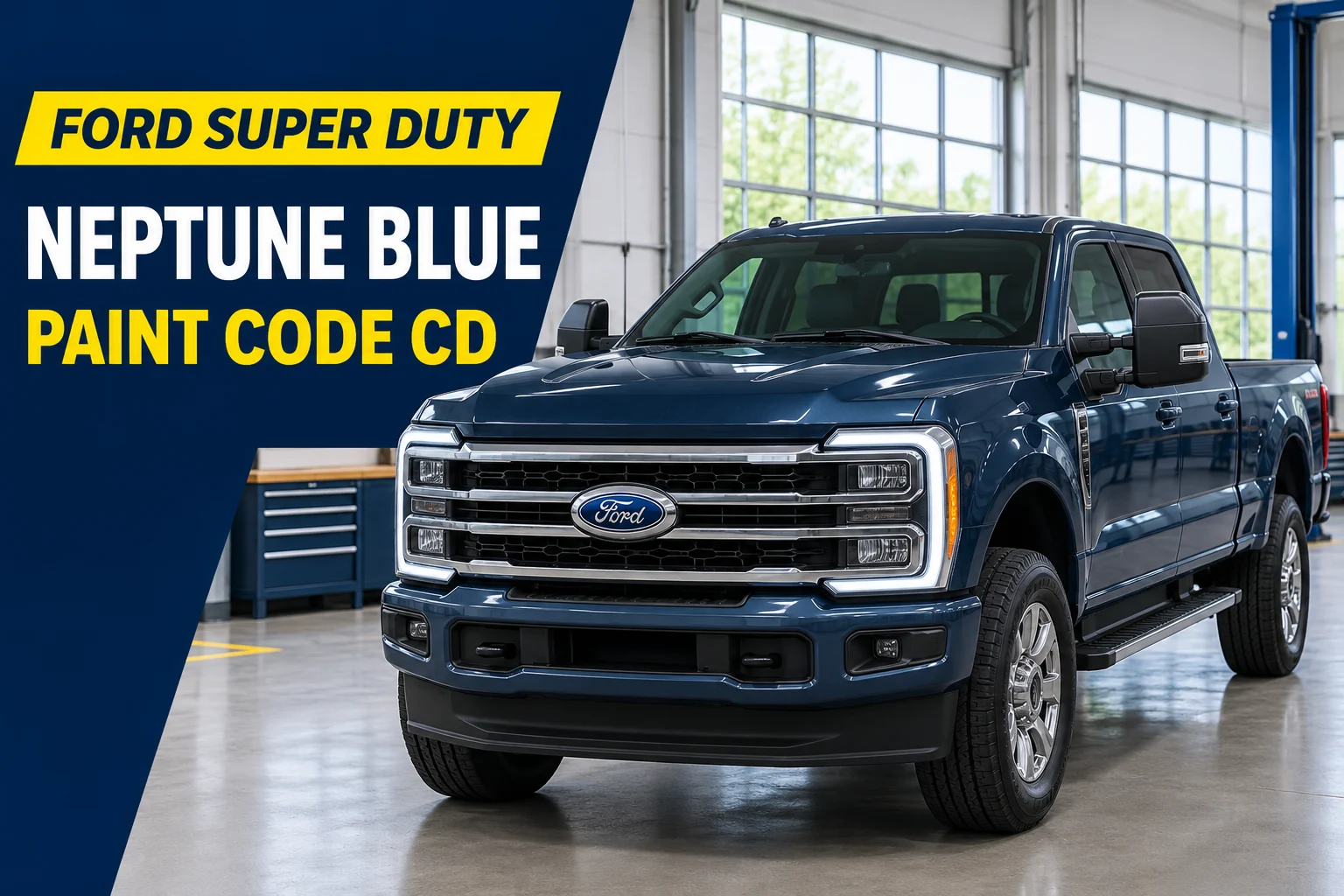
Ford Neptune Blue Paint Code CD for the 2027 Super Duty

The Ford Neptune Blue paint code is CD on the 2027 Super Duty pickup. Ford lists Neptune Blue as an extra-cost exterior color for the U.S. pickup range. If you already own the truck, open the driver’s door and look for CD next to EXT PNT on the vehicle certification label. For touch-up paint, give the supplier the code, the 2027 model year, and the exact truck model.
The order-guide code identifies the factory color. Matching a repaired panel involves one more step. A body shop needs to compare a paint sample with the panel currently on the truck, especially if it has been refinished or if the damage extends onto a neighboring panel.
Neptune Blue identification
- Ford paint code
- CD
- Factory application
- 2027 U.S. Super Duty pickups
- Ford pickup lines
- F-250, F-350 and F-450
- Verify on the truck
- EXT PNT on the driver-side certification label
Confirm the exact vehicle and panel before ordering paint.
| Detail | What to use |
|---|---|
| Ford color name | Neptune Blue |
| Ford exterior code | CD |
| Verified application | 2027 U.S. Super Duty pickups |
| Pickup line | F-250, F-350 and F-450 |
| On-truck check | EXT PNT field on the driver-side certification label |
| Repair check | Confirm the supplier’s formula with the code, model year and vehicle |
Which Ford trucks use the Neptune Blue CD code?
Ford’s May 2026 pickup order guide for the 2027 model year identifies Neptune Blue with exterior code CD. The guide covers the F-250, F-350 and F-450 Super Duty pickup line. This is the relevant model-year document when you are comparing a dealer listing or trying to interpret a build sheet. 2027 Ford Division Super Duty pickup order guide
Ford’s U.S. retail site also shows Neptune Blue as an extra-cost option on selected published configurations. At the time of review, the 360 viewer displayed it for examples including the F-250 XL STX, F-250 XLT Carhartt and F-350 King Ranch. Those examples demonstrate availability in the lineup. For a truck you intend to order, confirm your exact cab, trim and package in the live configurator or get a written build summary from the dealer. Ford Super Duty model page and 360 viewer
Availability at a dealership depends on what has actually been ordered or delivered. A dealer may use a shared stock photo before photographing a new arrival. A new-truck page can also show an available factory color that is different from the color on the lot. Confirm the particular VIN, the color on the window sticker and the actual truck when the decision depends on the finish.
It matters that the source is a pickup order guide. The F-450 pickup and a commercial F-450 chassis cab are different ordering applications. Treat the chassis cab as its own case and check the commercial build documentation for that VIN. Apply the same care to fleet units, repainted trucks and vehicles sold outside the United States. A country-specific order book may have a different set of available combinations.
An article or listing may use a calendar date of 2026 because Ford released information about the 2027 lineup during 2026. The model year is what you need for matching a paint listing. If you are looking up an earlier Super Duty, start with the F-350 paint code chart by model year or the Ford paint code index, then confirm the label on the vehicle.
How to find CD on the driver’s door label
Open the driver’s door and look along the door opening near the latch pillar. You are looking for the certification label that identifies the vehicle. Nearby tire and loading stickers can be useful for other jobs, but the field for this lookup is EXT PNT, the exterior-paint entry. Ford’s published certification-label diagrams identify that field separately from the interior trim and other codes. Ford certification label and code-field example
- Find the certification label. Look along the driver-side door opening and latch pillar. Use enough light to see the small print without glare.
- Locate EXT PNT. Read the characters beside the field label. Avoid copying a neighboring interior, axle, transmission or equipment code.
- Record the exact characters. For a factory Neptune Blue 2027 pickup, the expected code is CD. Keep a photo or written note for your own records.
- Confirm the model year and model. Give the paint counter the model year and whether the truck is an F-250, F-350 or F-450. If the code is unclear, ask for a VIN-specific factory build lookup.
- Identify the panel you are repairing. Say whether it is the hood, a door, the bedside or another part. If the truck is two-tone, specify whether the damage is on the main body color or the accent.
The small print can be hard to read on a dark truck in a garage. Use a flashlight from the side to cut reflections, or take a close photo and enlarge the text. Clean surface dust gently. Aggressive scraping or a solvent can damage the label. If a picture will be posted to an open forum, crop out the VIN, barcodes and other unrelated identification fields.
The paint entry and the VIN serve different purposes. The VIN lets the dealer find build information for the individual truck. Use the dealer’s lookup when the door sticker is damaged or missing, then ask for the factory color name and exterior code together. Comparing both makes it easier to catch a transcription error or a lookup of the wrong vehicle.
What if the label, listing and paint counter disagree?
Start by writing down exactly what each source says. A listing might call a truck Neptune Blue, the paper build summary might describe an exterior package, and the paint counter might ask for a proprietary mixing reference. Each source may be describing a different part of the job.
For the original factory specification, favor the label and VIN-specific build record. If a seller lists Neptune Blue and the label shows a different exterior code, ask the seller for a photo of the truck’s label or its factory window sticker. A copy of a label from another unit can look convincing, so compare the identifying information privately with the truck in front of you.
For the paint on a particular panel, inspect the actual panel and its finish history. A replacement tailgate might have arrived in a different finish before it was repainted. A used door from a donor truck can carry an older paint finish underneath the current one. A vinyl wrap can hide the original paint entirely. A bumper, flare or molding can also be a different material or finish from the main body.
If a supplier’s ordering system is still being updated for a new model year, request a manual lookup with Ford, CD, Neptune Blue, 2027 Super Duty. Some catalogs index factory code and color name separately. Ask the supplier to read back the combination on the quote. If the vendor comes back with a different color name or a formula listed for an unrelated vehicle, have it cross-check the application before mixing.
A vehicle with documented factory paint and a legible label is the simplest identification case. If the paint history is uncertain, bring the truck to a shop for comparison. The code narrows the search. The condition of the actual panel determines how much matching work is necessary.
How to order Neptune Blue touch-up paint
Write down the model year, make, exact pickup model, color name and CD. Ask the seller which paint system their product uses and what application it is intended for. A pen or small brush kit is aimed at chips. A larger scuff or a panel-sized repair may need different preparation and paint equipment. A bottle advertised for the right color can still be the wrong format for your damage.
If a vendor lists a mix identifier in addition to the factory code, ask it to explain which one is the Ford code and which one belongs to its paint system. Keep both on the invoice. Matching a catalog reference from one paint manufacturer to the product label of a different paint line can cause confusion even when both products use the same Ford code to describe the target color.
Before applying a product, read the supplier’s directions for surface prep, application, coat sequence and cure time. Ask whether the system calls for a separate clear layer and whether its instructions cover the underlying surface. Have a body shop assess an exposed substrate, spreading rust, a crease or deep damage rather than assuming a touch-up pen addresses the whole repair.
For a small chip, the practical goal is to cover the damaged spot and reduce how visible it is. For a large repair on a door or bedside, the goal is a consistent appearance across a much wider area. A shop can compare color, gloss and how the finish changes as the viewing angle changes. Ask for a sample comparison before approving work if the repair is on a panel you see prominently in daylight.
What a spray-out card tells you
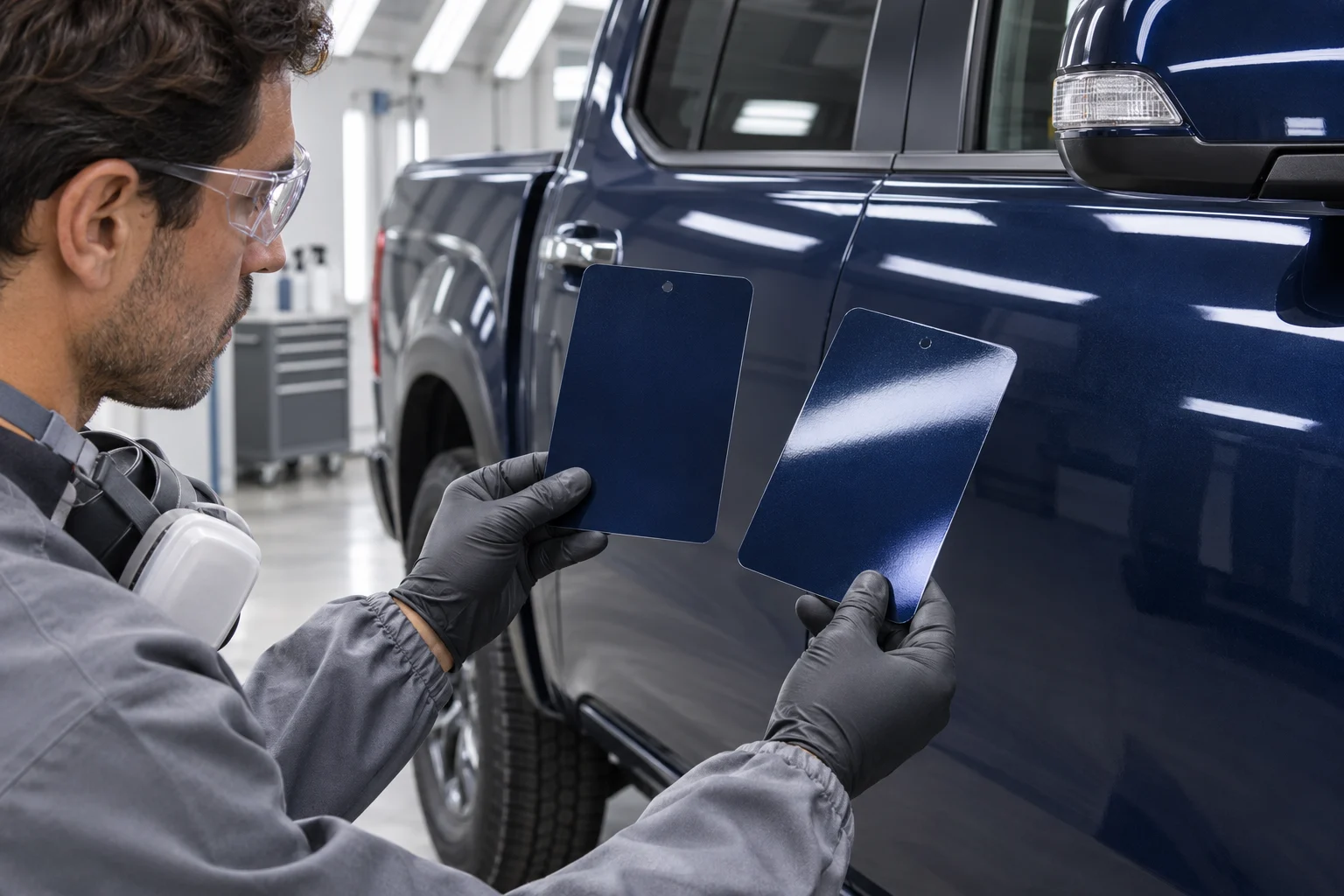
A spray-out card is a sample prepared in the paint system the shop expects to use. Once it is ready for evaluation, the shop compares it to the panel in several lighting conditions and from more than one angle. A sample that looks close under shop lighting may look different outside. Comparing the reflection and the color together can also reveal a mismatch in finish even if the dry color itself looks close.
Ask the shop to compare against a clean part of the adjacent panel. Dust, residue and an old coating can make a sample look different from the real finish beneath them. If the truck has already been repaired, compare the candidate sample against the neighboring area that will remain visible. This reduces the chance of matching an isolated section that has aged or been refinished differently.
If the damaged part is removed from the vehicle, share photos of how it sits next to the other panels and discuss whether the shop needs the truck present for final comparison. Photos help explain the location and extent of the damage. A physical comparison remains more reliable for selecting the mix.
What a dealer can confirm before you order a truck
For a new build, ask for a written summary with the model year, model, trim, exterior name and paint code. Have the salesperson confirm the exact configuration can be ordered with Neptune Blue. Use the same check if you are comparing a truck ordered by the dealer with a truck you can configure yourself. Availability on the model page can change across ordering cycles, and the dealer can tell you what the system accepts at the time of your order.
If there is a separate paint charge, ask for it on the quote for your exact build. Factory option amounts can vary by market or change before a purchase is completed. The line on your quote should identify the color clearly enough to compare it to the build sheet. It is also worth checking whether a package specifies a different exterior accent, grille treatment or lower body finish that will affect how the color looks.
On a stock unit, the window sticker and the certification label help separate a factory Neptune Blue truck from a similarly colored one. If you are buying from a distance, ask for photos taken outside in ordinary daylight with the camera’s color filters off. Ask for one wide view and a close view of a flat painted area. A darker or brighter screen image can change your impression of the color even if the underlying truck is correct.
Ford Authority’s coverage independently reports CD and describes Neptune Blue as one of the added colors for the 2027 Super Duty lineup. For an exact configuration or live pricing, use Ford’s current ordering tools and the vehicle-specific documents. Ford Authority’s 2027 Neptune Blue first look
Frequently asked questions
Is CD the paint code for every Ford called Neptune Blue?
The verified match here is CD on the 2027 U.S. Ford Super Duty pickup. Color names may be reused across product lines or markets. For another Ford model, identify the exact model year and check its certification label before reusing this code.
Can I match Neptune Blue from a screenshot?
Use screenshots to decide whether you want to see a truck in person. For paint repair, use the factory code and a physical sample. The camera, display and ambient light affect how a blue finish looks, so a digital color value is unsuitable as a paint formula.
What should I do if my truck has no readable EXT PNT code?
Ask a Ford dealer to look up the original build using the VIN and confirm the code and color name. If the panel may have been painted again, ask a body shop to compare the current finish. The build record can identify what Ford supplied and a sample comparison can identify what you need to match today.
Do two-tone trucks need two paint codes?
A two-tone truck may use one color on the main body and a separate finish on an accent area. Point out the actual damaged part and give the supplier the vehicle’s full exterior configuration. Verify the accent separately before ordering paint for it. Ford’s 2027 pickup order guide shows a King Ranch two-tone example with Neptune Blue CD on the primary body and Marsh Gray T9 on the lower accent. Confirm the actual configuration before using either code on a repair.