

Ford F-250 Dashboard Symbols That Need Immediate Attention

An oil-can light that comes on while your Ford F-250 is running calls for a different response than the ABS light by itself or the glow plug indicator before starting a diesel. If the oil pressure lamp comes on with the engine running, pull over safely and switch off the engine. If the brake warning stays on after you release the parking brake, treat it as a brake-system warning and get the truck checked. Look up the symbol after you’ve stopped somewhere safe.
This guide uses Ford’s 2026 U.S. Super Duty owner’s manual as the reference. Use the symbol, the accompanying message, and the moment it appeared together. The instrument cluster in an older F-250 or a truck with different equipment can look different, even when the underlying system has the same name.


Ford F-250 warning lights and the first action to take
What the warning calls for
Ford F-250 Super Duty · 2026 U.S. manual reference
- Oil pressure lamp with engine running
- Pull over safely and shut off the engine. Follow the Ford oil-level check and seek service for an unresolved warning.
- High engine temperature Stop safely
- Stop safely, switch off the engine and let it cool. Ford calls for service if the problem persists.
- Brake warning after releasing the parking brake
- Stop safely and get the brake system checked. Ford warns of reduced braking performance.
- ABS light by itself while driving
- Have the system checked. Ford describes normal braking without anti-lock assistance when only the ABS function is affected.
- Check-engine and powertrain lamps together with engine running
- Stop as soon as it is safe and follow the manual instructions. Have the truck checked promptly.
- Tire Pressure Low
- Check actual pressures against the truck’s tire label when safely parked. Address damage or air loss before driving.
- Glow plug indicator before a diesel start
- Follow the starting instructions for your configuration. The indicator is part of the normal diesel start procedure.
Start with the message if there is one. “Brake Fluid Level Low” tells you more about the immediate concern than a quick glimpse of a red lamp. A tire warning paired with “Tire Pressure Sensor Fault” points you toward a different check than “Tire Pressure Low.” When the truck gives several warnings at once, act on the one that carries the most immediate safety consequence. A brake warning or unstable handling takes priority over documenting a separate service message.
Oil can while the engine is running
Ford calls this the oil pressure warning lamp. The lamp can come on when you switch on the ignition. The condition that calls for action is illumination with the engine running. Stop as soon as you can safely leave traffic and shut the engine off. Once you can check the oil safely using the method in your manual, see where the level falls. Ford directs owners to have the system checked when the lamp is illuminated and the oil level is sufficient.
Oil level and oil pressure answer different questions. The dipstick tells you how much oil is present under the conditions prescribed for checking it. The warning concerns the lubrication system while the engine is operating. A normal dipstick reading therefore cannot clear the warning. If you find a low level, use the specified oil and follow your manual or seek service guidance. If you cannot establish that the truck is safe to restart, arrange assistance.
Make a note of when the lamp appeared. Did it appear at idle after a highway pull, just after a service, or when you were climbing a grade with a trailer? Those details give a technician a starting point. A short appearance can still matter. Leave the investigation for a safe location and avoid running the engine just to see whether you can recreate the warning.
High engine temperature message


If the display says “High engine temperature Stop safely,” Ford directs you to pull over safely, shut the engine off, and let it cool. Have the truck checked if the problem persists. The 2026 manual describes the coolant-temperature gauge moving toward its red zone as the engine starts to overheat. Read the message as well as the gauge because the cluster can show both.
Keep the coolant reservoir closed while the system is hot. Check the manual before looking at the coolant level. After you’re safely parked, note whether the warning occurred under a heavy load, after a long idle, or shortly after a coolant service. That information documents the circumstances for service.
Brake warning after releasing the parking brake
The brake lamp can light briefly at startup. It can also light with the parking brake applied and the ignition on. Once you are safely stopped, verify that the parking brake is released. If the brake warning remains on, the 2026 manual identifies low brake fluid or a brake-system fault as possibilities. Ford warns that braking performance can decrease significantly when driving with a brake warning illuminated.


A truck that feels slow to stop, has an abnormal pedal, or displays “Brake Fluid Level Low” needs immediate attention. If you are towing, the need to stop safely applies to the entire combination. Look for a pull-off with space for both vehicles. Keep your attention on steering and braking while you get out of traffic. Have the brake system checked before continuing when braking feels abnormal or you cannot establish that the truck can be driven safely.


A brake fluid check can help document a low level. A visible leak, a new warning after brake work, or fluid below the specified level are details to share with the shop. Follow the truck manual for checking fluid and leave repairs that affect brake-system integrity to appropriately equipped service personnel.
ABS light by itself

Ford’s 2026 manual says that an illuminated ABS indicator while driving means the anti-lock system has a malfunction. The manual describes conventional braking as still available when the loss is limited to the anti-lock function. It directs the driver to have the system checked. If both the brake and ABS warnings are present, or if the pedal or stopping behavior changes, follow the more urgent brake warning.
This distinction matters when the road is slick or you are towing. The truck may respond normally to an ordinary press of the pedal, while anti-lock assistance is unavailable in a hard stop. The absence of an obvious change in everyday braking cannot confirm that ABS works. A photo of which lamps appeared together is useful once the truck is parked. A technician can test the sensor, wiring and module to identify the cause.


Check-engine light and powertrain warning


The engine-shaped malfunction indicator lamp is associated with the onboard diagnostics system. If it comes on with the engine running, Ford says the system has detected an emission-control malfunction. A steady light calls for a check. When it flashes, a misfire could be occurring and the high exhaust temperature can damage components. Ford directs drivers to avoid hard acceleration and deceleration and have the truck checked promptly.
The powertrain warning, shown as a wrench in Ford’s instrument-cluster symbol reference, can indicate a powertrain or four-wheel-drive fault when illuminated with the engine running. If it flashes while driving, Ford directs you to slow down immediately, avoid hard acceleration or deceleration, and get the truck checked promptly. If the malfunction indicator and powertrain warning are both on with the engine running, Ford directs you to stop as soon as it is safe. Use the exact manual instructions for your truck once stopped, and arrange service promptly.
Think through what changed before the warning. If the truck displayed a shift or drive-mode message, capture its exact wording. Note whether you had just selected four-wheel drive, were under load on a grade, or noticed hesitation before the warning. Also record whether the truck was idling, driving steadily, or had just restarted.
A fault code provides another clue. A code describes what the system detected or how a test failed. Save the code and any available freeze-frame data before anyone clears the memory. For an example of how a diesel code can have several causes and different messages, see the Ford P20EE code guide.
Low tire pressure, sensor faults, and trailer warnings


A steady tire-pressure warning can mean one or more tires are significantly underinflated. Park somewhere safe and inspect the tires before continuing. Use a tire gauge. The 2026 manual directs you to the pressures specified on the tire label on the driver’s door edge or B-pillar. Read the front and rear values separately. On trucks with different recommended pressures at each axle, a single number entered for all four positions can be wrong.
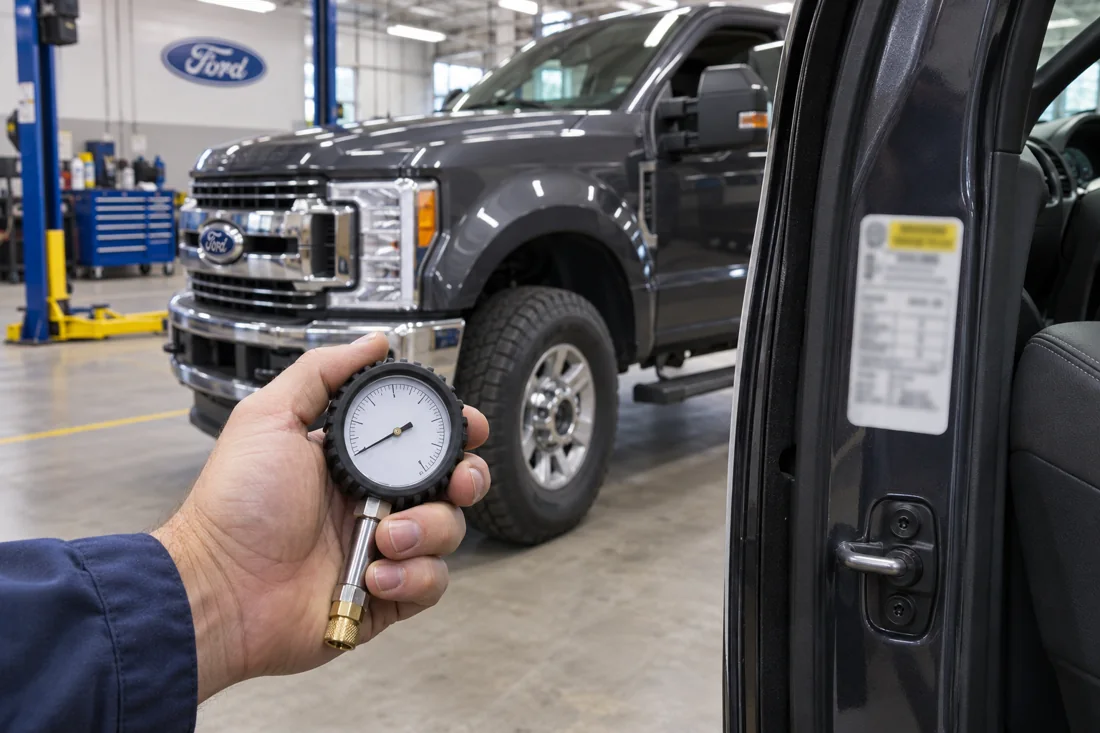
If you see a low tire after it has been parked in cold weather, verify its actual pressure and look for obvious damage or a leak. If a tire is visibly flat, damaged, or losing pressure, arrange for it to be addressed without driving on it. The pressure molded into the sidewall is tire information. The door-area label describes the manufacturer’s recommended pressures for the truck’s specified fitment. If the fitment or load setup has changed, confirm what applies with a qualified tire professional.
When the display says “Tire Pressure Monitor Fault” or “Tire Pressure Sensor Fault,” verify the pressures manually. The 2026 manual lists a temporary spare and system faults among the circumstances that can keep the lamp on or make it flash. Ford also calls for sensor retraining after each rotation on trucks with different recommended pressures at the front and rear. Distinguish a specific low reading from a display that cannot obtain a reading. A driver who treats those alerts as identical can overlook either a low tire or a monitoring fault.
A trailer alert is a separate check. On a truck equipped with trailer tire pressure monitoring, Ford lists messages that identify low trailer pressure, high trailer tire temperature, or a trailer sensor fault. Read the full message before you turn your attention to the truck tires. Check the correct trailer tire and confirm the recommended pressure for that trailer and tire setup.
Diesel glow plug and exhaust fluid messages
On a diesel F-250, the glow plug indicator is associated with starting. Ford tells drivers to wait for it to go out before starting in the procedures that call for waiting. In a push-button truck, check the starting procedure for that configuration. The relevant dashboard cues can differ from those of a truck with a key.
The diesel exhaust fluid display can tell you the tank level. The cluster can also show warnings about the selective catalytic reduction system. Read the message carefully before adding fluid. A low-level message concerns the available DEF. A system malfunction message calls for diagnosis. Ford describes possible speed limitations associated with DEF and selective catalytic reduction warnings. Give any countdown or operating restriction your attention before planning a long trip or towing leg.
If the alert appeared after a refill, record the message and what was added. Read the diesel exhaust fluid and troubleshooting sections of the manual matched to your truck. Save any diagnostic codes for service and avoid erasing them just to hide the display. FordMasterX’s F-250 DEF counter guide explains how to distinguish the level warning from a fault. Use the current Ford manual for the procedure and limits that apply to your vehicle.
How to tell a status indicator from a fault
The instrument cluster shows which features are in use as well as showing warnings. Record when the symbol appeared, whether you had just operated that feature, whether the light flashed, and whether the display gave any instructions. A mark visible at ignition-on that goes out during the normal start sequence is different evidence from a lamp that stays on or reappears after the truck is moving.
Ford shows separate menus and controls for 4.2-inch and 12-inch 2026 instrument cluster displays. Screen organization and choices change with the equipment. If the photo you found online looks different from your dash, open the manual for your model year, then look up the symbol in the instrument cluster section and read the troubleshooting section for its system. Use the manual supplied with your truck for its supported features and exact operating instructions.
Record the warning after you park

First write down the exact message and which lamps came on together. Then add the model year, the engine, whether it was a cold start or the engine was already warm, and whether you were towing. Note a shaky idle, an unusual brake pedal, slow cranking, or another physical change you felt. If you can photograph the display while parked, include the entire instrument cluster so the shop can see what else was shown. Avoid posting the VIN or other identifying details in a public photo.
“ABS light on at 35 mph after moving off, brake lamp off, pedal felt normal” is more specific than “brake light.” Likewise, “exhaust fluid system fault at startup after fueling, no low-level message” tells the service adviser which diagnostic questions to ask. Record a warning even if it clears after a restart. One normal start cannot tell you why the light originally came on.
If you cannot match the warning to the manual, decide based on the conditions. Abnormal braking, loss of power in hazardous traffic, smoke, a damaged tire, or an oil pressure warning while the engine runs warrants immediate attention. Calls and photos can wait until the truck is safely stopped. If safe operation is in doubt, use roadside assistance or service guidance before driving again.
References and coverage
The reference is the 2026 Ford Super Duty Owner’s Manual, U.S. and Canada edition dated June 2025. See Symbols Glossary (pp. 24–27), Starting and Stopping the Engine (pp. 203–204), Brakes (pp. 263–265), Selective Catalytic Reduction (pp. 229–230), Coolant (pp. 467 and 471–472), and Tire Pressure Monitoring System (pp. 532–534). The 2024 Ford Super Duty Owner’s Manual has its own cluster and system chapters. This guide summarizes Ford documentation. Use the manual and placards supplied with your F-250 to match its equipment and warning behavior.


