Ford P20EE Code Causes, Symptoms, and Fixes by Model Year 2026

The Ford P20EE code means the selective catalytic reduction (SCR) system is not meeting its monitored nitrogen oxide (NOx) conversion-efficiency threshold. On a 6.7L Powerstroke, that does not automatically mean the SCR catalyst needs replacement. DEF delivery, sensor readings, operating conditions, and certain PCM calibrations can change the diagnosis.
Start by recording your Ford’s model year, all stored codes, and the exact dashboard warning. Then follow the matching diagnostic branch below. The goal is to identify the failed system before spending money on a NOx sensor, DEF component, or exhaust aftertreatment assembly.
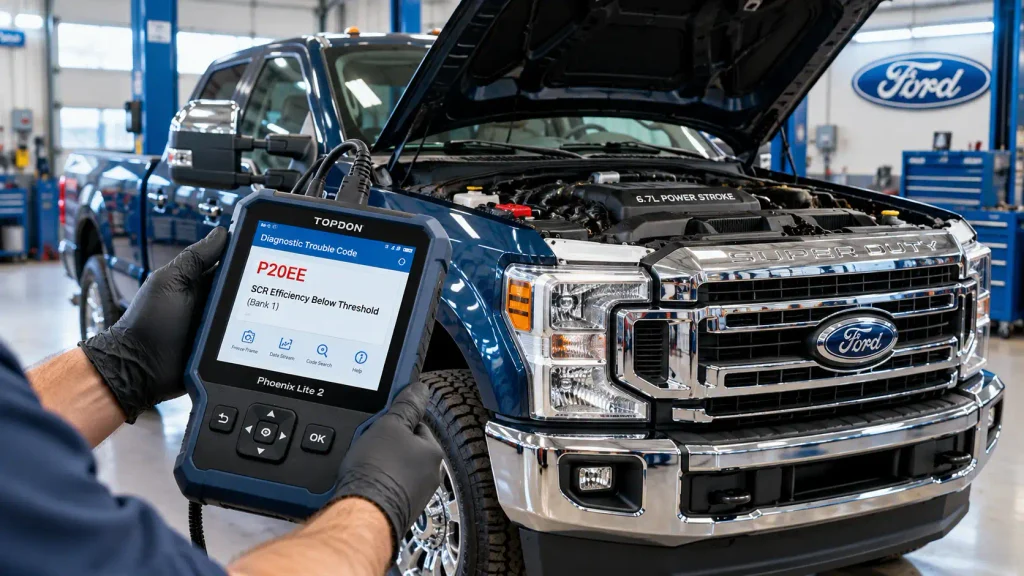
Ford diesel diagnostics | Quick decision guide
Ford P20EE Code: What Should You Check First?
P20EE signals low monitored SCR NOx conversion efficiency. It does not prove the SCR catalyst has failed. Follow the evidence before replacing parts.
Record model year, VIN, all stored and pending codes, available freeze-frame data, and the exact dashboard warning.
Speed restriction or DEF countdown showing? Follow the owner manual and arrange prompt professional diagnosis. Do not use code clearing to evade a restriction.
Which fault pattern do you see?
DEF or reductant system fault
Check the specific DEF delivery, quality, heater, pressure, or dosing code using Ford’s procedure.
NOx sensor or circuit fault
Use the exact sensor fault, wiring checks, and Ford-directed scan data. P20EE alone does not identify a bad sensor.
Isolated or recurring P20EE
Check related engine and exhaust conditions, DEF dosing, sensor plausibility, and the applicable SCR pinpoint test.
Relevant examples include certain 2015 Super Duty trucks (TSB 18-2109), 2017–2020 trucks (SSM 49202), and qualifying 2024–2025 F-250 trucks (TSB 25-2420). These are not universal fixes.
Perform the specified repair or programming, complete any required relearn or reset, and confirm the applicable emissions monitor runs without P20EE returning.
Diagnostic note: If multiple companion codes are present, follow Ford’s relevant test sequence. Pinpoint tests, manual DPF regenerations, and SCR parameter resets may require qualified technicians and Ford-capable equipment.
What Does Ford P20EE Code Mean on Powerstroke
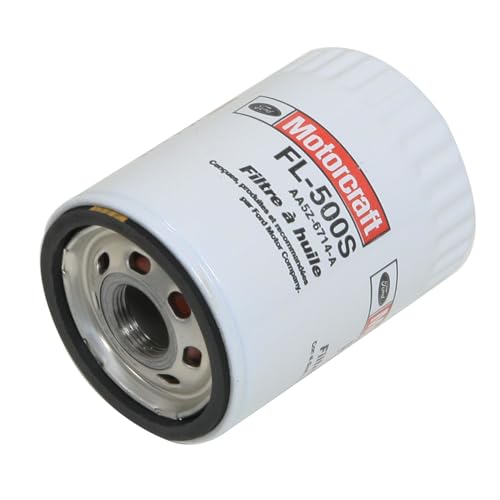


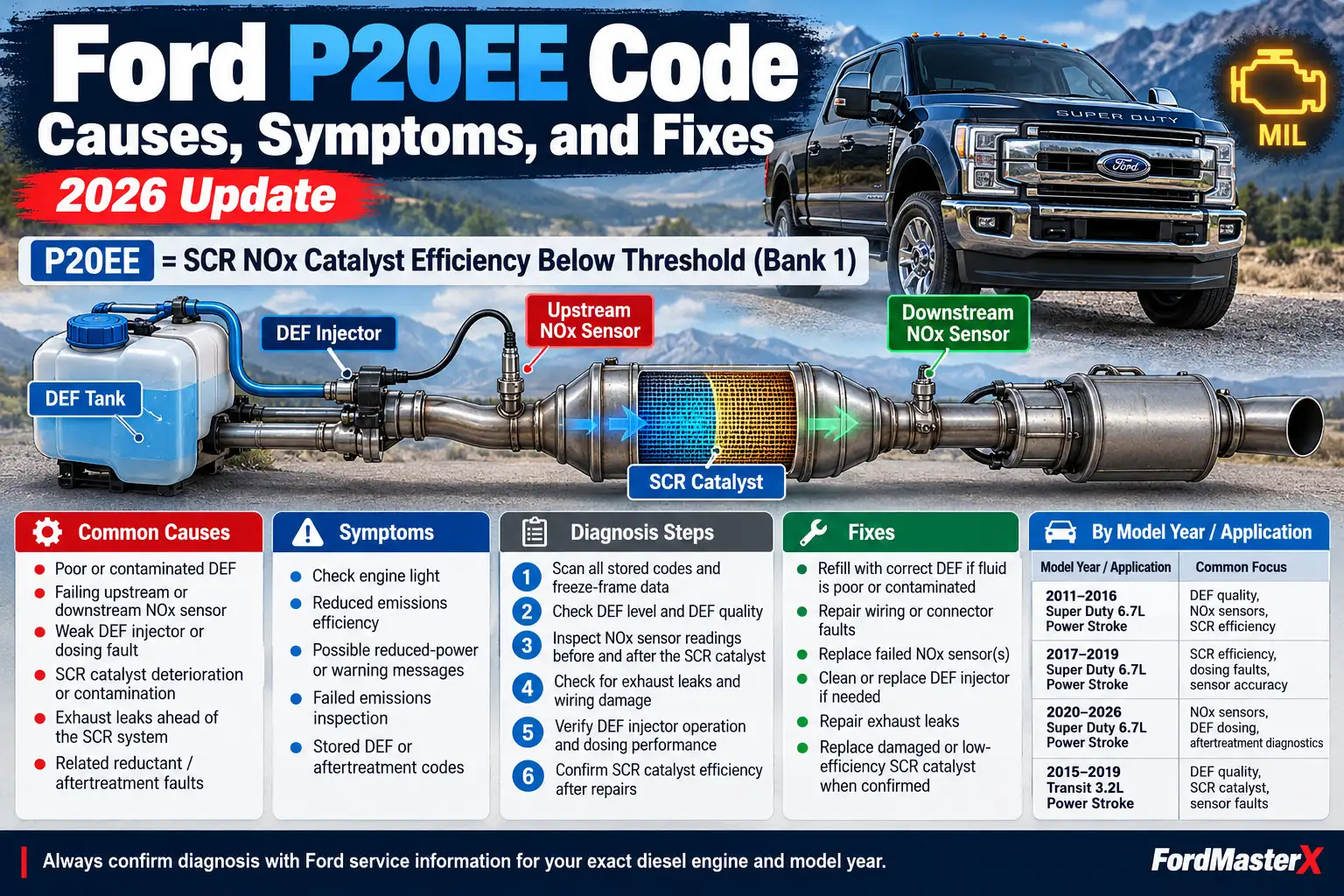
P20EE stands for SCR NOx Catalyst Efficiency Below Threshold. The SCR system injects diesel exhaust fluid (DEF) into the exhaust stream so the catalyst can reduce nitrogen oxides. The powertrain control module (PCM) evaluates whether that conversion is working as expected.
Ford’s 2023–2024 diesel OBD system summary lists NOx sensors, exhaust-temperature sensors, the DEF injection system, airflow, and other engine inputs among the conditions checked by the 6.7L catalyst-efficiency monitor.
That document specifies a 55% cumulative SCR efficiency malfunction threshold for its 2023–2024 calibration description. This is a monitoring specification, not a universal DIY pass/fail reading or a threshold to apply to older trucks. Ford calibrations and diagnostic procedures vary by year.
A failed monitor tells you that the observed system performance fell below the applicable threshold. It does not identify which part caused it. The first useful step is to collect the clues that separate those possibilities.
Which 4 Clues Determine the Correct Diagnosis


Four details determine which P20EE diagnostic path fits your truck. Do not clear the codes until you have recorded them and any available freeze-frame information.
Model Year and Engine Configuration
Write down the exact year, model, engine, and VIN. A 2015 F-350 and a 2025 F-250 may need different checks even if both display P20EE. A dealer can check bulletins by VIN.
Stored and Companion Diagnostic Codes
Read all PCM codes, including pending and stored faults, not only P20EE. A companion code involving reductant delivery, NOx sensor performance, or DPF operation may give you a more specific starting point. Record its status.
Dashboard Warnings and Power Restrictions
A check-engine light alone is not the same as a DEF fault countdown or a speed-limiting message. Record the dashboard wording and whether the truck has reduced power. That sets urgency.
Recent DEF and Repair History
Note any recent DEF refill, suspected contamination, exhaust repair, sensor replacement, or PCM update. Timing can guide testing but does not prove causation.
If your scan shows an additional DEF-system fault, investigate that system before assuming the SCR catalyst has failed.
What to Check When DEF Faults Accompany P20EE
When P20EE appears with a reductant or DEF-system code, use the companion code’s diagnostic procedure first. An SCR catalyst cannot deliver its expected NOx reduction if the fluid delivery system is not functioning as designed.
Begin with checks that do not require opening a hot or pressurized exhaust system:
- Check DEF level and recent refills. Confirm the correct fluid went into the DEF tank, not the diesel fuel tank. Use owner-manual-approved fluid from a clean container.
- Look for visible contamination or leakage. White residue around an accessible DEF fitting can suggest a leak, but residue alone does not establish which component failed.
- Read the other fault codes. A reductant pressure, heater, injector, or quality-related fault needs its own Ford diagnostic path. Do not replace the DEF pump merely because P20EE is present.
- Request a controlled dosing test when indicated. A qualified diesel technician can evaluate commanded injection, actual delivery, and related operating data using the correct Ford service procedure.
Topping off the DEF tank is appropriate when the level is low. It is not a confirmed repair for a faulty injector, pressure problem, contaminated fluid, or failed SCR efficiency monitor.
If DEF-system tests pass and P20EE remains active, move to NOx sensor evidence rather than replacing parts at random.
How to Check NOx Sensor Faults Before Replacement
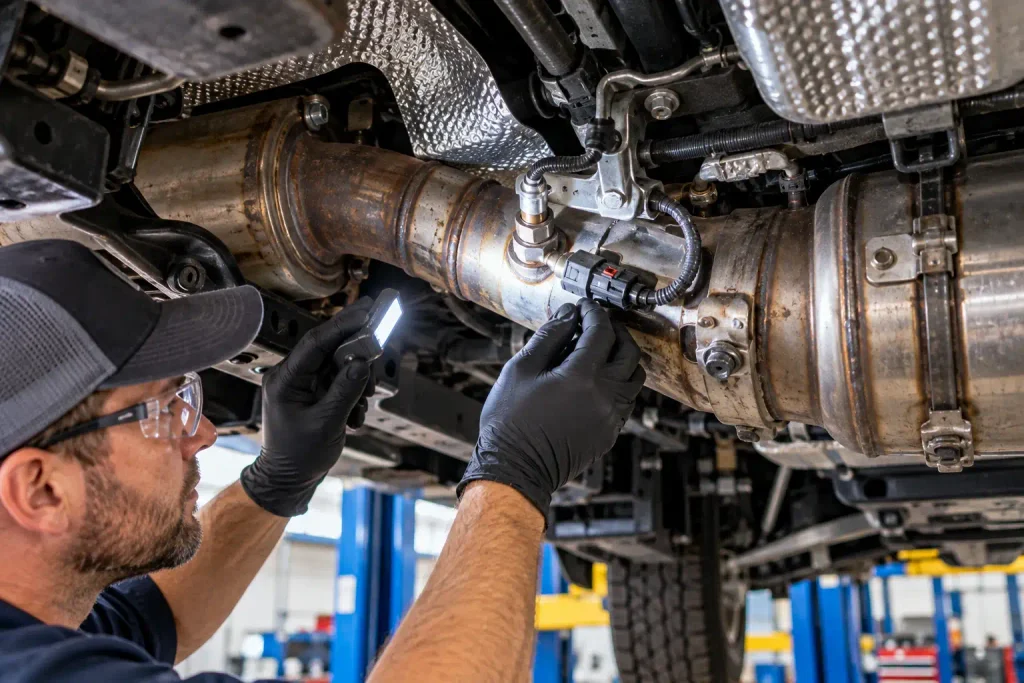
NOx sensors measure exhaust nitrogen oxides so the PCM can evaluate aftertreatment performance. On applicable 6.7L Powerstroke systems, readings before and after the SCR catalyst help assess conversion efficiency.
Use a 6.7 Powerstroke exhaust system diagram to understand the relative positions of the DPF, SCR catalyst, temperature sensors, and NOx sensors. Actual component locations depend on the truck’s model year and exhaust configuration.
If a NOx Sensor Code Is Present
Record the exact code and sensor description from a Ford-capable scan tool. An electrical, communication, or performance fault should be diagnosed using its specific Ford pinpoint test. Check accessible wiring and connectors for damage only when the exhaust is cool and the truck is safely parked.
A sensor code does not justify replacing both NOx sensors.
If No NOx Sensor Code Is Present
A technician can compare sensor plausibility and commanded DEF operation under the conditions required by Ford’s diagnostic routine. One NOx reading observed at idle is not enough to condemn an expensive sensor or catalyst.
Do not apply an arbitrary parts-store NOx ppm value as a universal Ford specification. The right test conditions, expected readings, and conclusions depend on the vehicle’s calibration.
If sensor and DEF tests do not explain the code, the next branch evaluates SCR performance itself.
What to Test When P20EE Appears Alone
An isolated P20EE code calls for verification of SCR efficiency, not immediate replacement of the catalyst assembly. First, confirm whether the fault is current or repeatable and whether the monitor completed under appropriate conditions.
A sensible technician-led sequence is:
- Confirm code status. Save all DTCs and freeze-frame data. An old stored code after a completed repair requires a different response from an active, recurring fault.
- Check for upstream problems. Investigate relevant engine, EGR, boost, exhaust-temperature, and DPF faults that could affect monitor operation.
- Verify DEF delivery. Use the appropriate Ford test to assess dosing operation and fluid-system integrity.
- Evaluate sensor plausibility. Compare the required NOx and temperature inputs at Ford-specified conditions, rather than relying on a single idle snapshot.
- Perform the applicable SCR pinpoint test. Only condemn the catalyst when the diagnostic results support that determination.
The exact service steps are not interchangeable across years. Some Ford test routines require a professional scan tool, specific exhaust temperatures, or controlled regeneration. These are shop procedures, not instructions to force a regeneration on the roadside.
Before approving an SCR replacement quote, check whether Ford issued a service bulletin for your specific model year and build.
Which Ford P20EE Bulletins Apply by Model Year
Ford has published several different service instructions involving P20EE. A bulletin is not a recall, does not automatically cover every truck in its year range, and may have been revised. Ask a Ford service department to verify current applicability by VIN.
| Model Year | Document or Diagnostic Path | What Changes |
|---|---|---|
| 2011–2014 | Model-year PC/ED diagnostics | Follow the applicable Ford pinpoint tests; do not assume a later software fix applies. |
| 2015 | TSB 18-2109 | Certain 6.7L Super Duty trucks with P20EE or listed companion codes have a PCM reprogramming procedure. |
| 2016 | VIN-specific PC/ED diagnostics | Verify current programming and test instructions; do not extend the 2015 bulletin without confirmation. |
| 2017–2020 | SSM 49202 | Updated RD15 test includes two technician-performed DPF manual regenerations and an SCR parameter reset. |
| 2021–2023 | VIN-specific PC/ED diagnostics | Confirm the current Ford service path; no universal P20EE repair should be assumed. |
| 2024–2025 F-250 | TSB 25-2420, if eligible | Qualifying trucks may have an incorrectly illuminated MIL due to PCM calibration. |
| 2026 | Current VIN-specific documentation | Check the latest Ford instructions rather than applying an older bulletin automatically. |
What Ford Says for 2015 Super Duty
TSB 18-2109, dated April 4, 2018, addresses certain 2015 F-Super Duty 6.7L trucks with P012F, P207F, P2002, and/or P20EE. Ford’s action was PCM reprogramming using the specified service software. This is a professional programming procedure, not evidence that every 2015 truck needs a new catalyst.
What Ford Says for 2017 Through 2020
Ford SSM 49202 updates PC/ED pinpoint test RD15 for some 2017–2020 Super Duty 6.7L trucks with P20EE. It calls for two DPF manual regenerations and the specified SCR parameter reset with an appropriate Ford diagnostic scan tool as part of that test procedure.
These actions require suitable equipment and trained personnel. They are not a generic owner reset or an instruction to perform two highway drives.
What Ford Says for Certain 2024 and 2025 F-250 Trucks
Ford TSB 25-2420, dated September 9, 2025, applies to qualifying 2024–2025 F-250 6.7L diesel trucks in North America with minor feature code AAZNQ or AAZNS and a GVWR of 9,900 or 10,000 pounds.
Ford states that an incorrectly illuminated malfunction indicator lamp with P20EE may result from PCM calibration and does not affect drivability or durability in that specified condition. The published repair is PCM and TCM reprogramming. The bulletin lists 0.6 labor hour for its defined programming operation; that is not a retail repair-price estimate.
The dealer must check the truck’s VIN and build features before applying this bulletin. Do not extend this repair to other trucks.
Next, match the finding to the repair.
How to Choose the Right P20EE Repair
Repair the confirmed cause, not the most expensive component associated with the code. Use this decision matrix after the fault codes and applicable Ford service instructions have been checked.
| Confirmed Finding | Correct Next Action |
|---|---|
| Separate DEF delivery or quality fault | Diagnose and repair that fault; then reassess P20EE. |
| NOx sensor or wiring fault confirmed | Repair the identified circuit or sensor; verify readings afterward. |
| Eligible PCM calibration bulletin | Have the specified dealer-level programming performed. |
| SCR efficiency failure verified after related checks | Follow the applicable Ford repair procedure for the affected assembly. |
| No cause established | Continue qualified testing rather than buying speculative parts. |
If a shop recommends an SCR or DPF assembly, ask which Ford pinpoint-test result supports replacement. Also ask the dealer to review Ford emissions warranty coverage for your VIN, mileage, registration state, and the specific failed component. A technical service bulletin does not itself extend warranty coverage.
The remaining decision is whether the truck can be operated safely while repair is arranged.
When Is It Unsafe to Keep Driving
P20EE does not produce the same dashboard warning on every Ford truck. Warnings range from a check-engine light to a DEF fault, reduced power, or a speed-limiting countdown.
If the engine runs normally and there is no active restriction, record the fault and arrange diagnosis promptly. Avoid assuming that a truck which feels normal has passed its emissions monitor.
If the dashboard announces a speed limit, a countdown, or an idle-only condition, follow your model-year owner manual and arrange service before the restriction makes travel impractical. Reduced power can be especially consequential while towing or entering fast-moving traffic.
For owners whose DEF warning remains after a confirmed repair, the separate guide on how to reset a Ford F-250 DEF counter explains the warning context. It should not be used as a substitute for diagnosing an active P20EE fault.
Do not bypass the emissions system or repeatedly erase codes to evade warnings. After the underlying issue is fixed, verify the monitor completed successfully.
How to Confirm the P20EE Repair Worked
A cleared code is not proof of a successful repair. The better test is whether the fault remains absent after the required Ford diagnostic procedure and monitor conditions are satisfied.
Save the original code report and repair record. After the confirmed fix, complete any scan-tool reset, relearn, or regeneration specified for that model year. Then recheck pending and stored codes, dashboard messages, and relevant live data.
The monitor requires applicable operating conditions. A generic five-minute idle or a fixed highway distance cannot guarantee verification on every 6.7L Powerstroke.
Our separate Ford 6.7 diesel exhaust fluid system fault reset guide covers broader DEF-warning scenarios. For recurring P20EE, return to the failed pinpoint-test branch rather than repeating resets.
What Ford Owners Should Do Next
The ford p20ee code identifies an SCR efficiency problem, but it does not name a failed part. The right starting point is your truck’s year, all companion codes, freeze-frame data, and exact warning message. Those details determine whether DEF delivery, NOx sensor inputs, SCR performance, or a qualifying software bulletin should be investigated first.
Do not purchase an SCR catalyst or NOx sensor based on P20EE alone. If basic checks reveal no clear fault, ask a qualified Ford diesel technician for the applicable PC/ED pinpoint-test results and a VIN-specific bulletin check.
A documented diagnosis gives you a stronger repair decision and a practical way to confirm that the problem is actually fixed.
Ford P20EE Code Frequently Asked Questions
What Does P20EE Mean on a Ford 6.7 Powerstroke
P20EE means the selective catalytic reduction system is not meeting its monitored NOx conversion-efficiency threshold. The fault may involve DEF delivery, sensor inputs, SCR operation, or a qualifying calibration issue. It does not prove that the catalyst itself has failed, so record all codes before replacing parts.
Can Bad DEF Fluid Cause Ford P20EE Code
Contaminated or unsuitable DEF can interfere with the SCR system and may contribute to a poor-efficiency result. But P20EE alone cannot establish fluid contamination. Check the DEF history and related codes, then use an appropriate test before draining the tank or replacing any components.
Does P20EE Mean the NOx Sensor Is Bad
No. The PCM uses NOx sensor readings to evaluate SCR performance, but P20EE is an efficiency code rather than proof of a failed sensor. A separate sensor fault, wiring test, or Ford-directed live-data assessment is needed to support a sensor replacement.
Can I Drive My Ford Truck With P20EE
Whether you can continue driving depends on the truck’s behavior and dashboard warnings. A check-engine light without operating restrictions requires prompt diagnosis, while a speed-limiting countdown or reduced-power warning calls for more urgent attention. Follow the model-year owner manual and avoid towing when power is restricted.
Will Clearing the P20EE Code Fix the Problem
No. Clearing P20EE removes diagnostic information but does not correct a DEF delivery fault, sensor failure, SCR performance issue, or unsuitable calibration. Complete the applicable repair and any required Ford reset or relearn procedure, then confirm the emissions monitor runs without returning the code.